
The market is projected to grow from USD 820.00 million in 2025 to USD 2,050.78 million by 2035 because Gulf governments are investing in local biologics and vaccine manufacturing to improve health security. The market growth is being supported by government funding, vaccine security, biosimilars, research expansion, and global partnerships. The market is expected to reach USD 1,296.78 million by 2030 and sustain a CAGR of 9.60% during the forecast period. Plants use cell culture media and support cell therapy and cell-based vaccine programs.
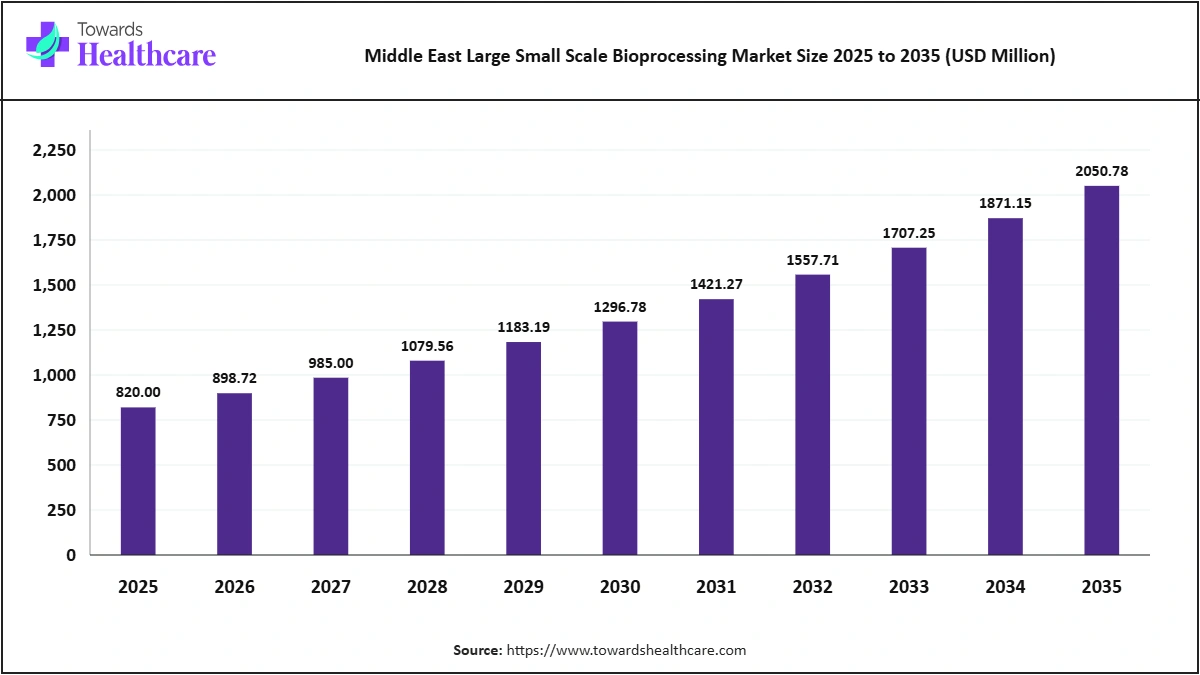
Analyst View: We built the estimate from bioprocessing equipment and consumable imports and installed capacity by country, cross-checked against regional estimates for the Middle East and Africa of about USD 1.47 billion by 2030 and supplier sales.
Driver: Government funding and investment initiatives are driving the expansion of domestic biomanufacturing capabilities. Vaccine security is being increasingly focused on, which promotes local vaccine production and investment in bioprocessing infrastructure. Biosimilar manufacturing expansion is driving the demand for bioprocessing equipment and technologies. Research expands. Technology transfer and the development of regional manufacturing capabilities is being facilitated by strategic partnerships with global biotechnology companies.
Restraint: There is a significant shortage of skilled bioprocessing professionals, which limits the pace of development and operation of advanced manufacturing facilities. There is a significant reliance on imported bioprocessing equipment and technologies, which drives up procurement costs and leaves regional manufacturers exposed to supply chain disruptions. The relatively small size of individual national markets can limit the scale of production and reduce the commercial viability of large bioprocessing investments. Regulatory frameworks are still in the developmental stage, and regulatory capacity is also limited, which can make the approval of biologics manufacturing facilities a time-consuming process.
Opportunity: The establishment and expansion of regional CDMOs is creating growth opportunities for regional bioprocessing equipment suppliers. Biosimilar manufacturing capacity expansion is fueling the demand for scalable bioprocessing technologies. Significant investments in single-use bioprocessing are prompting suppliers to adopt disposable equipment and integrated manufacturing solutions. Training programs and workforce development initiatives help to strengthen regional bioprocessing capabilities. Regional biopharmaceutical export hubs are rapidly developing, which boosts investment in large-scale manufacturing capabilities.
Market Drivers - Impact & CAGR Contribution (2026-2035)
| Driver | Impact | ≈ CAGR Contribution | Time Horizon | Key Regions |
| Governments fund biomanufacturing | High | +3.75 pp | Short to long term | Middle East-wide, strongest in Saudi Arabia |
| Vaccine security matters | Medium | +3.16 pp | Medium to long term | Middle East-wide, fastest uptake in Saudi Arabia |
| Biosimilars grow | Medium | +2.69 pp | Short to medium term | Middle East-wide |
| Research expands | Low | +2.11 pp | Long term | Saudi Arabia |
Note: Contributions are indicative estimates of each factor's effect on annual growth.
Sources: Expert interviews, secondary sources, Towards Healthcare database and Towards Healthcare analysts.
Taken together, these drivers add about 11.71 percentage points to the annual growth of the Middle East large small scale bioprocessing market, with governments fund biomanufacturing having the largest effect. Their influence is strongest in Saudi Arabia, while uptake grows fastest in Saudi Arabia.
Market Restraints - Impact & Negative CAGR Contribution (2026-2035)
| Restraint | Impact | ≈ Negative CAGR Contribution | Time Horizon | Key Regions |
| Skilled staff are scarce | High | -0.95 pp | Short to medium term | Middle East-wide |
| Imports dominate | High | -0.70 pp | Medium term | Smaller and price-sensitive markets |
| Small markets | Medium | -0.46 pp | Short term | Saudi Arabia and other mature markets |
Note: Contributions are indicative estimates of each factor's effect on annual growth.
Sources: Expert interviews, secondary sources, Towards Healthcare database and Towards Healthcare analysts.
These restraints are expected to reduce annual growth of the Middle East large small scale bioprocessing market by about 2.11 percentage points, led by skilled staff are scarce. Their effect eases over the forecast period as suppliers, buyers and regulators adapt, leaving a net CAGR of 9.60% from 2026 to 2035.
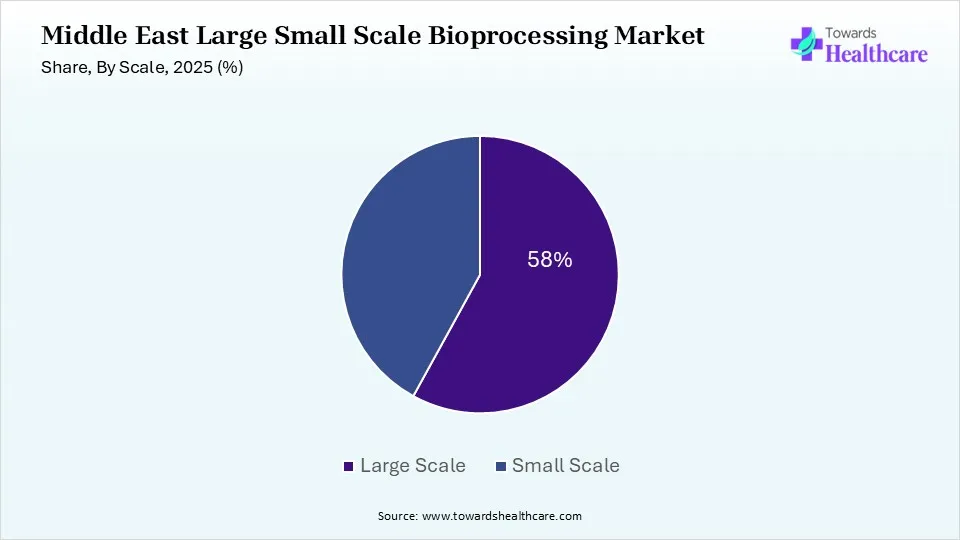
Note: 2025 is the base year; 2035 shares and CAGRs are forecasts.
Sources: Expert interviews, secondary sources, Towards Healthcare database and Towards Healthcare analysts.
Large Scale held a market share of 58.00% in 2025 and is projected to expand at a CAGR of 8.90% during the forecast period. The leadership of this segment can be attributed to the fact that new national biologics and vaccine plants need commercial capacity. The large scale segment is expected to grow slower than the overall market over the forecast period.
Small Scale captured a 42.00% share in 2025 and is projected to expand at a CAGR of 10.50% during the forecast period. This segment is growing at the fastest rate owing to the expansion of research centers and the pilot plant ecosystem. The small scale segment is expected to grow faster than the overall market over the forecast period.
Segment Outlook: Large Scale remains the largest scale segment through 2035, holding about 54.41% of the market in 2035, while Small Scale records the highest CAGR of 10.50% from 2026 to 2035. Although Small Scale starts from the smallest base, its faster growth shows how demand is shifting within the market.
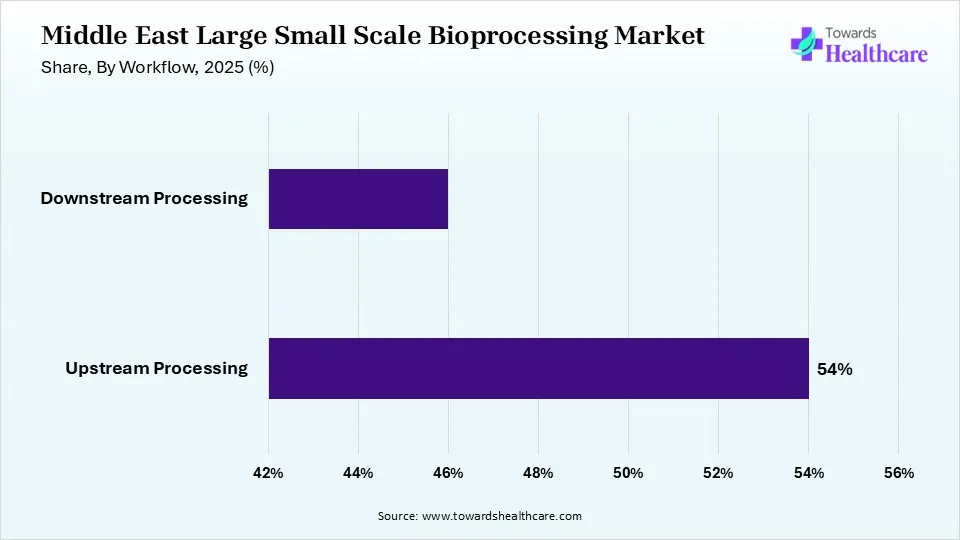
Note: 2025 is the base year; 2035 shares and CAGRs are forecasts.
Sources: Expert interviews, secondary sources, Towards Healthcare database and Towards Healthcare analysts.
Upstream Processing accounted for 54.00% of the market in 2025 and is projected to expand at a CAGR of 9.13% throughout the forecast period. Upstream processing dominates with bioreactors and media. This segment is expected to grow slower than the overall market over the forecast period.
Downstream Processing captured 46.00% of revenue in 2025 and is projected to expand at a CAGR of 10.13% from 2026 to 2035. Downstream processing grows with purification capacity. The downstream processing segment is expected to grow faster than the overall market over the forecast period.
Segment Outlook: Upstream Processing remains the largest workflow segment through 2035, holding about 51.73% of the market in 2035, while Downstream Processing records the highest CAGR of 10.13% from 2026 to 2035. Although Downstream Processing starts from the smallest base, its faster growth shows how demand is shifting within the market.
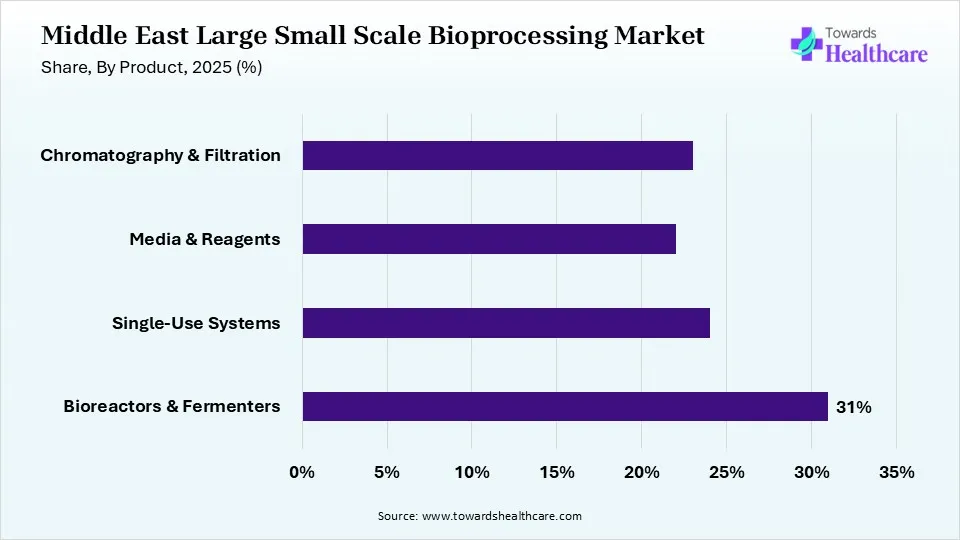
Note: 2025 is the base year; 2035 shares and CAGRs are forecasts.
Sources: Expert interviews, secondary sources, Towards Healthcare database and Towards Healthcare analysts.
Bioreactors & Fermenters held 31.00% of revenue in 2025 and is projected to expand at a CAGR of 8.67% during the forecast period. Bioreactors and fermenters dominated because of significant equipment spending. The bioreactors & fermenters segment is expected to grow slower than the overall market over the forecast period.
Single-Use Systems captured a market share of 24.00% in 2025 and is projected to expand at a CAGR of 11.57% during the forecast period. Single-use systems are growing fastest in new plants. The single-use systems segment is expected to grow faster than the overall market over the forecast period.
Media & Reagents accounted for 22.00% of the market in 2025 and is projected to expand at a CAGR of 9.07% from 2026 to 2035. Media and reagents are recurring consumables. The media & reagents segment is expected to grow slower than the overall market over the forecast period.
Chromatography & Filtration captured 23.00% of the market in 2025 and is projected to expand at a CAGR of 9.07% during the forecast period. Chromatography and filtration purify products. The chromatography & filtration segment is expected to grow slower than the overall market over the forecast period.
Segment Outlook: Bioreactors & Fermenters remains the largest product segment through 2035, holding about 28.46% of the market in 2035, while Single-Use Systems records the highest CAGR of 11.57% from 2026 to 2035. Media & Reagents holds the smallest share today and serves more specialized needs within the market.
Note: 2025 is the base year; 2035 shares and CAGRs are forecasts.
Sources: Expert interviews, secondary sources, Towards Healthcare database and Towards Healthcare analysts.
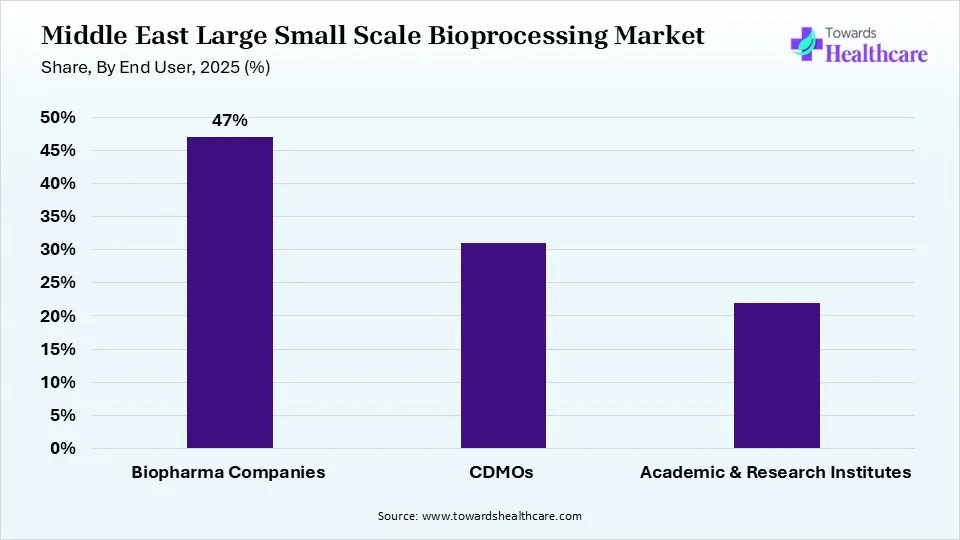
Biopharma Companies held 47.00% of the market in 2025 and is projected to expand at a CAGR of 8.72% during the forecast period. Biopharmaceutical companies hold a leading position. The biopharma companies segment is expected to grow slower than the overall market over the forecast period.
CDMOs captured a market share of 31.00% in 2025 and is projected to expand at a CAGR of 11.12% from 2026 to 2035. CDMOs grow fastest with new national CDMOs. The CDMOs segment is expected to grow faster than the overall market over the forecast period.
Academic & Research Institutes accounted for a 22.00% share in 2025 and is projected to expand at a CAGR of 9.12% over the forecast period. Research institutes support capacity building. The academic & research institutes segment is expected to grow slower than the overall market over the forecast period.
Segment Outlook: Biopharma Companies remain the largest end user segment through 2035, holding about 43.36% of the market in 2035, while CDMOs records the highest CAGR of 11.12% from 2026 to 2035. Academic & Research Institutes holds the smallest share today and serves more specialised needs within the Middle East large small scale bioprocessing market.
Analyst View: Segment shares were allocated from demand, product portfolios and pricing in each category. Large Scale, Upstream Processing, Bioreactors & Fermenters and Biopharma Companies lead their categories because they meet the core needs of today's buyers. We expect Small Scale, Downstream Processing, Single-Use Systems and CDMOs to gain share as newer technologies, users and applications grow faster.
Note: 2025 is the base year; 2035 shares and CAGRs are forecasts.
Sources: Expert interviews, secondary sources, Towards Healthcare database and Towards Healthcare analysts.
Saudi Arabia accounted for 38.00% of the market in 2025 and is projected to expand at a CAGR of 10.33% during the forecast period. Saudi Arabia leads because Vision 2030 funds local biologics and vaccine plants, including the CDMO Lifera and partnerships with global firms. Saudi Arabia is expected to grow faster than the overall market between 2026 and 2035.
UAE The UAE has growing biotech hubs in Abu Dhabi and Dubai. UAE is expected to grow slower than the overall market between 2026 and 2035.
Israel Israel has strong biotech research and manufacturing. Israel is expected to grow slower than the overall market between 2026 and 2035.
Rest of Middle East: The rest of the region includes Jordan, Oman and Bahrain. Rest of Middle East is expected to grow slower than the overall market between 2026 and 2035.
Qatar Qatar invests in research and precision medicine. Qatar is expected to grow slower than the overall market between 2026 and 2035.
Kuwait cKuwait is building pharmaceutical capacity. Kuwait is expected to grow slower than the overall market between 2026 and 2035.
Analyst View: Regional shares were built from demand, installed base, spending and supplier presence in each country. Saudi Arabia leads because of its mature demand base and strong suppliers. We assign Saudi Arabia the highest growth premium because investment, adoption and capacity are expanding fastest there.
| Rank | Company Name | 2025 Share (%) | Key Products / Business | Headquarters |
| 1 | Thermo Fisher Scientific | 13.17% | Bioreactors, media and single-use systems | United States |
| 2 | Sartorius | 11.71% | Bioreactors, filtration and single-use | Germany |
| 3 | Cytiva | 11.22% | Bioprocess equipment and chromatography | United States |
| 4 | Merck KGaA (MilliporeSigma) | 8.54% | Filtration, media and single-use | Germany |
| 5 | Eppendorf | 3.41% | Small-scale bioreactors | Germany |
| 6 | Corning | 2.68% | Cell culture products | United States |
| 7 | Pall (Danaher) | 2.44% | Filtration systems | United States |
| 8 | Avantor | 2.20% | Bioprocess consumables | United States |
| 9 | Repligen | 1.95% | Filtration and chromatography | United States |
| 10 | Getinge (Applikon) | 1.46% | Bioreactors | Sweden |
Note: Company shares are 2025 estimates.
Sources: Company press releases, expert interviews, secondary sources, Towards Healthcare database and Towards Healthcare analysts.
Thermo Fisher Scientific led the market with a 13.17% share of revenue in 2025, followed by Sartorius at 11.71% share and Cytiva at 11.22% share. Thermo Fisher Scientific dominates owing to its bioreactors, media, and single-use systems; Sartorius competes with bioreactors, filtration, and single-use, and Cytiva offers bioprocess equipment and chromatography. Merck KGaA (MilliporeSigma), Eppendorf, Corning, Pall (Danaher), Avantor, Repligen and Getinge (Applikon) compete through filtration, media and single-use, small-scale bioreactors, cell culture products, filtration systems, bioprocess consumables, filtration and chromatography and bioreactors. The top 10 companies accounted for a 58.78% share in 2025, while the remaining 41.22% was shared among regional distributors and system integrators. The market is concentrated among global suppliers selling through distributors, and competition revolves around technical support, local service, turnkey plant delivery, training, and price.
Thermo Fisher Scientific: Thermo Fisher Scientific has its corporate headquarters in the United States. It held 13.17% of the market in 2025. Its offering centers on Bioreactors, media and single-use systems. In the Towards Healthcare Companies Quadrant it is positioned as a Leader.
Sartorius: Sartorius is headquartered in Germany. It held an estimated 11.71% share of the market in 2025. Its offering revolves around Bioreactors, filtration, and single-use. It has been positioned as a leader in the Towards Healthcare companies quadrant.
Cytiva: Cytiva, part of Danaher Corporation, is headquartered in the United States. It held an estimated 11.22% share of the market in 2025. It has a portfolio of Bioprocess equipment and chromatography. In the Towards Healthcare Companies Quadrant it is positioned as a Leader.
Merck KGaA (MilliporeSigma): Merck KGaA (MilliporeSigma) is headquartered in Germany. It held an estimated 8.54% share of the market in 2025. Its offering revolves around Filtration, media and single-use. In the Towards Healthcare Companies Quadrant it is positioned as a Leader.
Eppendorf: Eppendorf has its corporate headquarters in Germany. It held an estimated 3.41% share of the market in 2025. It has a portfolio of Small-scale bioreactors. In the Towards Healthcare Companies Quadrant it is positioned as a Leader.
Corning: Corning has its global headquarters in the United States. It held an estimated 2.68% share of the market in 2025. Its offering centers on Cell culture products. It has been positioned as a leader in the Towards Healthcare companies quadrant.
Pall (Danaher): Pall (Danaher) is headquartered in the United States. It held an estimated 2.44% share of the market in 2025. Its offering revolves around Filtration systems. In the Towards Healthcare Companies Quadrant it is positioned as an Innovator.
Avantor: Avantor has its corporate headquarters in the United States. It held an estimated 2.20% share of the market in 2025. Its offering centres on Bioprocess consumables. In the Towards Healthcare Companies Quadrant it is positioned as an Innovator.
Repligen: Repligen has its global headquarters in the United States. It held an estimated 1.95% share of the market in 2025. It has a portfolio of Filtration and chromatography. It has been positioned as an innovator in the Towards Healthcare companies quadrant.
Getinge (Applikon): Getinge (Applikon) is headquartered in Sweden. It held an estimated 1.46% share of the market in 2025. Its offering centres on Bioreactors. In the Towards Healthcare Companies Quadrant it is positioned as an Innovator.
The Middle East large small scale bioprocessing ecosystem links global suppliers, distributors & integrators, cdmos & producers, research institutes and governments, with each stage adding value before products reach end users.
| Ecosystem Stage | Role in the Market | Key Companies |
| Global Suppliers | Supply equipment and consumables | Thermo Fisher, Sartorius, Cytiva, Merck KGaA |
| Distributors & Integrators | Sell, install and service | Regional distributors |
| CDMOs & Producers | Run plants | Lifera, regional biologics makers |
| Research Institutes | Develop processes | KAUST, KAIMRC, universities |
| Governments | Fund and regulate | SFDA, ministries of health and investment |
Sources: Company press releases, expert interviews, secondary sources, Towards Healthcare database and Towards Healthcare analysts.
Global Suppliers: Supply equipment and consumables. Key participants include Thermo Fisher, Sartorius, Cytiva, Merck KGaA.
Distributors & Integrators: Sell, install and service. Key participants include Regional distributors.
CDMOs & Producers: Run plants. Key participants include Lifera, regional biologics makers.
Research Institutes: Develop processes. Key participants include KAUST, KAIMRC, universities.
Governments: Fund and regulate. Key participants include SFDA, ministries of health and investment.
Value in the Middle East large small scale bioprocessing market flows from upstream material and technology suppliers to manufacturers and service providers, then through distribution partners to end users. Companies that integrate several stages or build long-term relationships with end users capture a larger share of this value.
The Towards Healthcare Companies Quadrant positions key participants in the Middle East large small scale bioprocessing market by market strength, reflecting revenue scale, market share and geographic reach, and by innovation and growth strategy, reflecting product portfolio breadth, R&D intensity and partnerships. Positions reflect each company's estimated 2025 share of the Middle East large small scale bioprocessing market and our assessment of its product innovation, portfolio breadth and partnerships.
Sources: Company press releases, expert interviews, secondary sources, Towards Healthcare database and Towards Healthcare analysts.
Leaders: Thermo Fisher Scientific, Sartorius, Cytiva, Merck KGaA (MilliporeSigma), Eppendorf and Corning combine high market share with broad portfolios and strong innovation.
Innovators: Pall (Danaher), Avantor, Repligen and Getinge (Applikon) bring newer technologies and specialised products.
By Scale
By Workflow
By Product
By End User
By Country
The market is defined as large-scale and small-scale bioprocessing equipment, consumables and services in the Middle East, including bioreactors and fermenters, single-use systems, cell culture media and reagents, chromatography and filtration, and process analytics, for upstream and downstream processing, used for biologics, biosimilars, vaccines and cell therapy manufacturing and research by biopharmaceutical companies, CDMOs and academic and research institutes.
The 2025 base year was built bottom-up from demand volumes and average prices by scale, workflow, product and end user and region, and checked top-down against the market-specific revenues of leading companies and published estimates. Segment, country and company values were allocated from scale, workflow, product and end user and country demand. Key estimates were verified by cross-checking company disclosures, regulatory and industry data and published third-party estimates, and inputs that could not be reconciled were excluded. All segment, regional and company figures were reconciled to the same 2025 base year, and the 2026-2035 forecast, which applies a constant CAGR from the 2025 base, was recalculated and validated.
Analyst View: The market is set for steady expansion as government biomanufacturing programs and related demand keep growing. Our estimate links value to underlying demand, installed base, and pricing, so the forecast follows real adoption rather than headline hype. The main upside comes from national CDMOs and biosimilars, while the main risks are skills shortages and import dependence.
1.3.1 Market Value (USD) and Annual Growth
1.3.2 Historical Market Analysis
1.3.3 Market Growth Analysis and CAGR 2026-2035
2.2.1 Governments fund biomanufacturing
2.2.2 Vaccine security matters
2.2.3 Biosimilars grow
2.2.4 Research expands
2.4.1 Skilled staff are scarce
2.4.2 Imports dominate
2.4.3 Small markets
2.4.4 Regulatory capacity is building
2.7.1 National CDMOs
2.7.2 Biosimilars
2.7.3 Single-use plants
2.7.4 Training
2.8.1 Localisation of biologics
2.8.2 Vaccine self-sufficiency
2.8.3 Single-use plants
2.8.4 Biosimilar production
2.8.5 Training and talent programmes
2.8.6 Cell and gene therapy research
3.1.1 Large Scale: Market Share and CAGR
3.1.2 Small Scale: Market Share and CAGR
3.2.1 Upstream Processing: Market Share and CAGR
3.2.2 Downstream Processing: Market Share and CAGR
3.3.1 Bioreactors & Fermenters: Market Share and CAGR
3.3.2 Single-Use Systems: Market Share and CAGR
3.3.3 Media & Reagents: Market Share and CAGR
3.3.4 Chromatography & Filtration: Market Share and CAGR
3.4.1 Biopharma Companies: Market Share and CAGR
3.4.2 CDMOs: Market Share and CAGR
3.4.3 Academic & Research Institutes: Market Share and CAGR
4.1.1 Market Size and Forecast, 2025-2035
4.1.2 Market Share by Scale
4.1.3 Demand Drivers, Regulation and Local Competition
4.2.1 Market Size and Forecast, 2025-2035
4.2.2 Market Share by Scale
4.2.3 Demand Drivers, Regulation and Local Competition
4.3.1 Market Size and Forecast, 2025-2035
4.3.2 Market Share by Scale
4.3.3 Demand Drivers, Regulation and Local Competition
4.4.1 Market Size and Forecast, 2025-2035
4.4.2 Market Share by Scale
4.4.3 Demand Drivers, Regulation and Local Competition
4.5.1 Market Size and Forecast, 2025-2035
4.5.2 Market Share by Scale
4.5.3 Demand Drivers, Regulation and Local Competition
4.6.1 Market Size and Forecast, 2025-2035
4.6.2 Market Share by Scale
4.6.3 Demand Drivers, Regulation and Local Competition
5.5.1 Product Portfolio Benchmarking
5.5.2 Geographic Presence Benchmarking
5.5.3 Technology and Innovation Benchmarking
6.1.1 Instrument list price and discount analysis
6.1.2 Consumables and reagent pricing per test or sample
6.1.3 Service contract and subscription pricing
6.1.4 Academic vs. biopharma pricing tiers
7.1.1 Pharmaceutical and biotechnology companies
7.1.2 Academic and government research institutes
7.1.3 CROs, CDMOs and core facilities
7.1.4 Clinical and diagnostic laboratories
9.1.1 Key raw materials and component sourcing
9.1.2 OEM and contract manufacturing
9.1.3 Distributor and e-procurement channels
9.1.4 Cold chain and logistics requirements
11.1.1 Automation and high-throughput workflows
11.1.2 Digital, cloud and AI-enabled analysis
11.1.3 Next-generation platforms and consumables
11.1.4 Patent and IP landscape
12.1.1 Research-use-only vs. IVD regulatory pathways
12.1.2 GMP and quality standards for bioprocessing
12.1.3 Biosafety and laboratory standards
12.1.4 Data integrity and compliance requirements
17.1.1 Company Overview
17.1.2 Middle East Large Small Scale Bioprocessing Product Portfolio
17.1.3 Financial Performance and Market Share
17.1.4 Recent Developments and Strategy
17.1.5 SWOT Analysis
17.2.1 Company Overview
17.2.2 Middle East Large Small Scale Bioprocessing Product Portfolio
17.2.3 Financial Performance and Market Share
17.2.4 Recent Developments and Strategy
17.2.5 SWOT Analysis
17.3.1 Company Overview
17.3.2 Middle East Large Small Scale Bioprocessing Product Portfolio
17.3.3 Financial Performance and Market Share
17.3.4 Recent Developments and Strategy
17.3.5 SWOT Analysis
17.4.1 Company Overview
17.4.2 Middle East Large Small Scale Bioprocessing Product Portfolio
17.4.3 Financial Performance and Market Share
17.4.4 Recent Developments and Strategy
17.4.5 SWOT Analysis
17.5.1 Company Overview
17.5.2 Middle East Large Small Scale Bioprocessing Product Portfolio
17.5.3 Financial Performance and Market Share
17.5.4 Recent Developments and Strategy
17.5.5 SWOT Analysis
17.6.1 Company Overview
17.6.2 Middle East Large Small Scale Bioprocessing Product Portfolio
17.6.3 Financial Performance and Market Share
17.6.4 Recent Developments and Strategy
17.6.5 SWOT Analysis
17.7.1 Company Overview
17.7.2 Middle East Large Small Scale Bioprocessing Product Portfolio
17.7.3 Financial Performance and Market Share
17.7.4 Recent Developments and Strategy
17.7.5 SWOT Analysis
17.8.1 Company Overview
17.8.2 Middle East Large Small Scale Bioprocessing Product Portfolio
17.8.3 Financial Performance and Market Share
17.8.4 Recent Developments and Strategy
17.8.5 SWOT Analysis
17.9.1 Company Overview
17.9.2 Middle East Large Small Scale Bioprocessing Product Portfolio
17.9.3 Financial Performance and Market Share
17.9.4 Recent Developments and Strategy
17.9.5 SWOT Analysis
17.10.1 Company Overview
17.10.2 Middle East Large Small Scale Bioprocessing Product Portfolio
17.10.3 Financial Performance and Market Share
17.10.4 Recent Developments and Strategy
17.10.5 SWOT Analysis