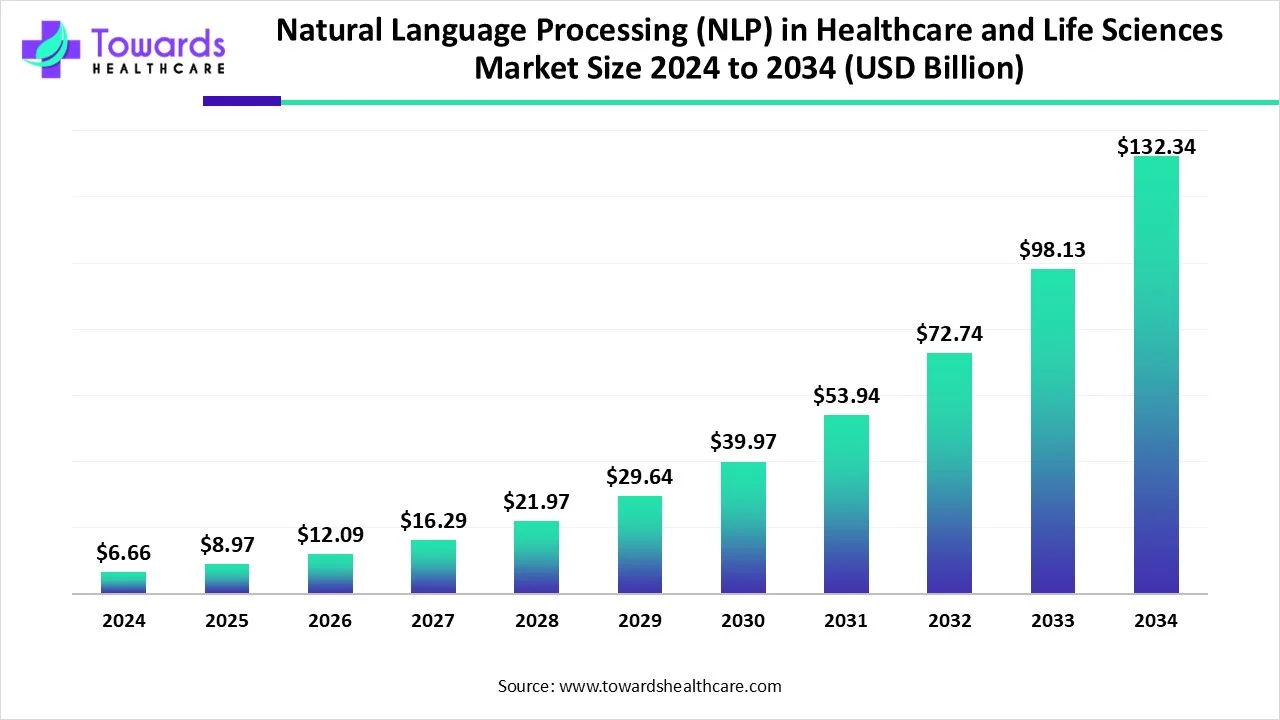
The global natural language processing (NLP) in healthcare and life sciences market size is calculated at USD 8.97 billion in 2025, grew to USD 12.09 billion in 2026, and is projected to reach around USD 176.98 billion by 2035. The market is expanding at a CAGR of 34.74% between 2026 and 2035.
Natural language processing (NLP) is a field of artificial intelligence (AI) that enables machines to comprehend and respond to human speech. It involves the use of machine learning, deep learning, and text analytics to interpret and analyze human language from various sources, including audio recordings, documents, and images. In the healthcare sector, it improves clinical documentation, accelerates clinical trial matching, and supports clinical decisions. In the life sciences sector, NLP expedites the research and development process and monitors reactions to drug administration.
The rising adoption of electronic health records (EHRs) in healthcare organizations favors the use of NLP. Numerous pharmaceutical companies and healthcare organizations are installing advanced technologies to streamline their workflows and stay ahead of other market players. Several government organizations support the adoption of digital technologies through incentives and initiatives. The growing need for predictive analytics to improve significant health concerns boosts the market.
Rising Adoption of EHR
The major growth factor of the market is the rising adoption of electronic health records (EHRs). EHR is a systematized collection of an electronic system to store patient and population health data. The growing demand for improving healthcare delivery and health outcomes promotes the adoption of EHRs. It stores a huge amount of unstructured data daily. It is estimated that more than 96% of U.S. hospitals have adopted EHR systems. Integrating NLP with EHR can convert billions of unstructured data into structured data, improving the diagnostic and prognostic model. NLP models extract and interpret patient information documented in clinical narratives accurately and efficiently.
Data Security and Privacy Concerns
The major challenge of the natural language processing (NLP) in healthcare and life sciences market is data security and privacy concerns. NLP handles a vast amount of data in healthcare and life sciences organizations, such as sensitive patient data and confidential research information. These data are more prone to cyberattacks, leading to identity theft of patients and leakage of essential research information.
Burgeoning Healthcare and Life Sciences Sectors
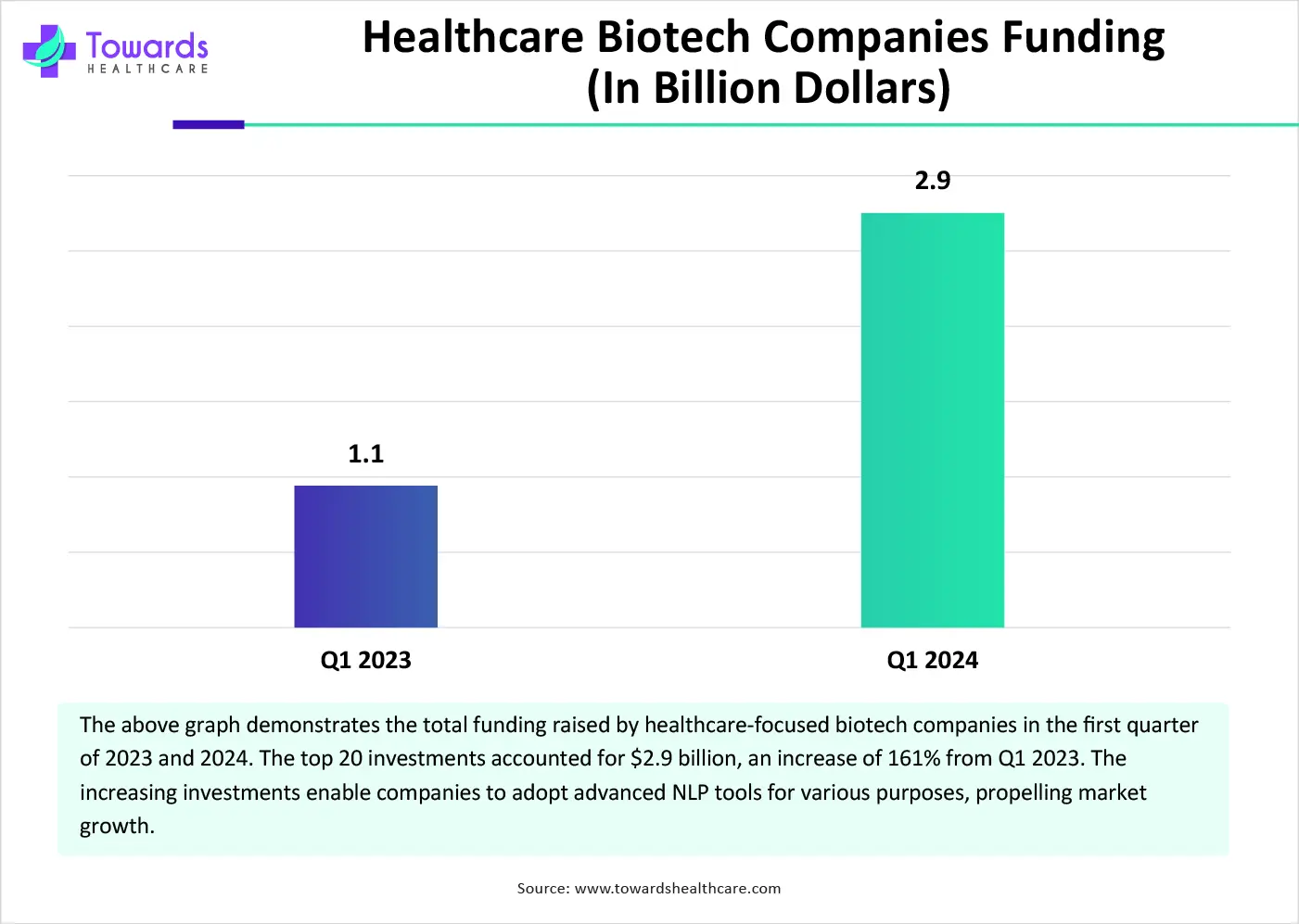
The future of the market is promising, driven by the burgeoning healthcare and life sciences sectors. Established pharmaceutical companies and healthcare organizations are increasingly adopting advanced technologies, such as AI and NLP, to streamline their workflows. NLP has widespread applications in both the healthcare and life sciences sectors, including clinical documentation management, patient sentiment analysis, and drug discovery. The growing research and development activities lead to a rising number of clinical trials, facilitating the use of NLP to recruit suitable subjects and monitor adverse effects. The increasing number of healthcare startups globally owing to favorable venture capital investments further potentiate the adoption of NLP. NLP helps to accelerate the speed of several tasks, reducing human intervention.
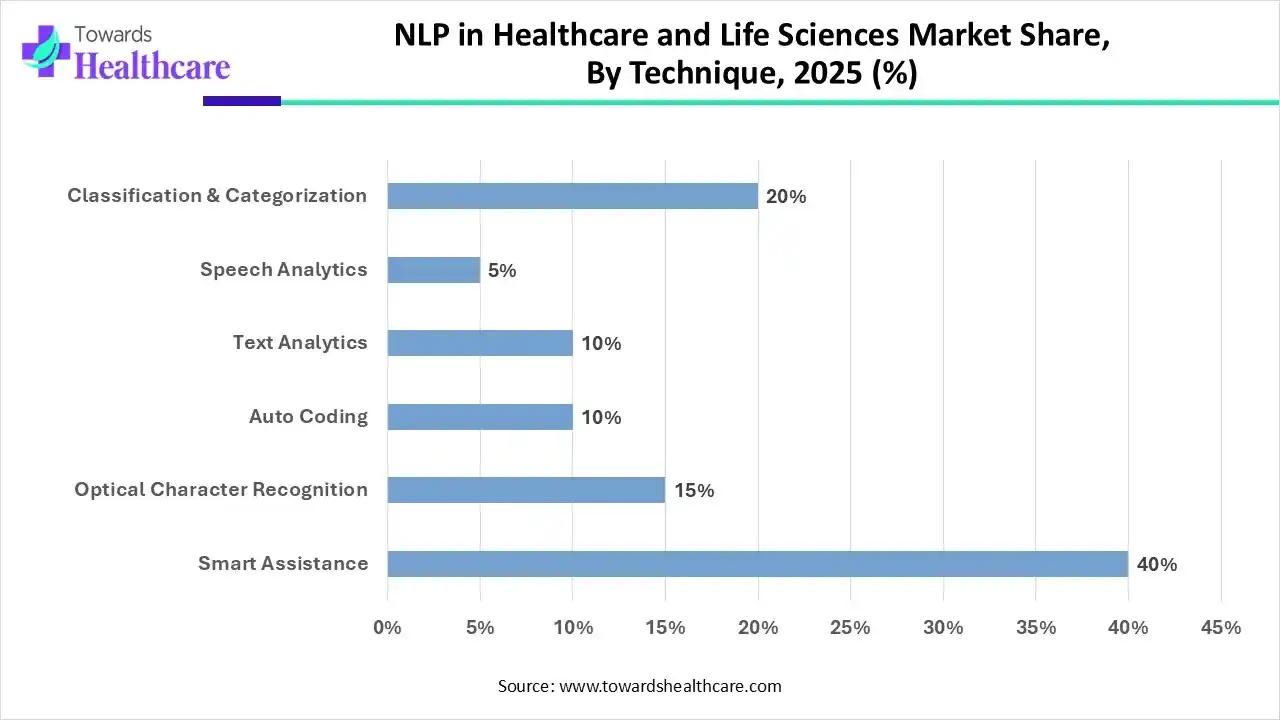
Which Technique Segment Dominated the NLP in Healthcare and Life Sciences Market?
By technique, the smart assistance segment held a dominant presence in the market by 40% in 2025. This segment dominated because NLP provides smart assistance by enabling computers to understand and process human language. It assists healthcare professionals and patients in recording and managing their conversations. The increasing use of chatbots and voice assistance in healthcare and life sciences organizations boosts the segment’s growth. It can also manage human-robot interaction in rehabilitation therapy, including machine translations and user interfaces. The growing demand for smart healthcare enhances patients’ medication adherence. NLP allows systems to comprehend user commands, extract relevant information, and generate appropriate responses.
Classification & Categorization Segment: Fastest-Growing
By technique, the classification & categorization segment is anticipated to grow with the highest CAGR in the natural language processing (NLP) in healthcare and life sciences market during the studied years. NLP is widely used to classify and categorize health-related documents, sorting huge amounts of documents without actually reading them. It also allows healthcare professionals to streamline the transcription process, enhance accuracy, and unlock different information present in medical texts. NLP may help categorize medical data based on patient demographics, medical conditions, procedures, treatments, and outcomes. This simplifies the task of providers and administrative staff, reducing the time for unnecessary tasks and focus more on patient care.
Why Did the Life Science Companies Segment Dominate the NLP in Healthcare and Life Sciences Market?
By end-use, the life science companies segment held a significant share of the market by 45% in 2025. This is because Numerous life science companies like pharmaceutical and biotechnology companies adopt NLP technology to increase productivity, reliability, and make better decisions. NLP expedites the R&D process for new drug discovery and development, augmenting the segment’s growth. It can process large volumes of scientific publications to assist researchers in literature review, reducing their time. NLP can also create summaries of clinical trials or internal research documents. The increasing number of clinical trials also fuels the segment’s growth.
Providers Segment: Fastest-Growing
By end-use, the providers segment is projected to expand rapidly in the natural language processing (NLP) in healthcare and life sciences market in the coming years. NLP helps providers understand patient sentiments and opinions and identify areas for improvement in patient care experiences. It automates medical coding and billing, reducing errors, improving coding accuracy, and accelerating the billing cycle. This leads to faster payments and improved revenue management for healthcare providers. NLP can also convert spoken language into text, allowing providers to create accurate and detailed clinical documentation. Moreover, NLP can also analyze vast patient data and identify the root cause of a disease.
North America dominated the global natural language processing (NLP) in healthcare and life sciences market in 2024. The rising adoption of advanced technologies in healthcare and life sciences companies in North America drives the market. The increasing market competition among established pharmaceutical and biotechnology companies facilitates them to install NLP technology. Government organizations support NLP technology in healthcare through funding and initiatives. The presence of key players also contributes to market growth. Key players such as IBM, Cogent Infotech Corp., and AI Superior held a major share of the market in North America.
U.S. Market Trends
The U.S. NLP in healthcare and life sciences market is driven by large clinical data volumes and strong digital health investment. Hospitals use NLP for clinical documentation, coding, and information extraction. Pharmaceutical companies apply it to research and medical literature. Competition includes technology firms and healthcare specialists. Opportunities remain in clinical workflows, regulatory documentation, and patient data management across healthcare organizations, supporting better efficiency and information access while reducing repetitive administrative work for clinicians and researchers.
Canada Market Trends
Canada is adopting NLP across healthcare systems to manage clinical records, medical coding, and patient information. Public healthcare organizations are seeking tools that reduce administrative workloads. Research institutions also use NLP for biomedical studies and evidence analysis. Privacy requirements shape vendor selection. Opportunities include multilingual documentation, clinical decision support, and healthcare data standardization. Local partnerships can strengthen adoption across provincial systems and research networks, while supporting better use of fragmented healthcare information and improving service coordination.
Asia-Pacific is projected to host the fastest-growing natural language processing (NLP) in healthcare and life sciences market in the coming years. The growing demand for advanced patient care and EHRs augment market growth. The increasing awareness about the benefits of advanced technologies, such as AI and NLP, in healthcare and life sciences companies also potentiate market growth. Several government and private organizations conduct symposiums and conferences to create awareness about NLP applications. The increasing investments, collaborations, and mergers & acquisitions favor the development of NLP software.
China Market Trends
China’s NLP market benefits from large healthcare datasets, expanding digital hospitals, and growing pharmaceutical research. Providers are using language technologies for medical records, coding, and information retrieval. Domestic technology companies compete strongly with international vendors. Government digital health programs support broader adoption. Opportunities include Chinese medical terminology processing, clinical documentation, drug research, and hospital workflow automation, especially as healthcare digitization expands across regional facilities and encourages standardized data exchange between providers, laboratories, and research institutions.
India Market Trends
India is seeing growing NLP use in hospitals, health technology companies, and pharmaceutical research. Demand is linked to large patient volumes and complex medical documentation. Local technology providers compete with global companies through lower-cost solutions and customized services. Opportunities include multilingual clinical records, medical coding, patient communication, and research support. Digital health initiatives and expanding electronic records can accelerate adoption across public and private healthcare networks, while improving access to structured information and reducing documentation burdens.
Europe is observed to grow at a considerable rate in the natural language processing (NLP) in healthcare and life sciences market in the upcoming period. The growing need for AI technologies to enhance productivity favors the adoption of NLP. According to the European Commission, around 13.5% of enterprises in the EU with 10 or more employees used AI technologies in 2024 to conduct their business. The commonly used AI technologies included text mining, natural language generation, and speech recognition. Favorable government initiatives and investments support the use of NLP in healthcare and life science companies in Europe.
France Market Trends
The French government launched the “Healthcare Innovation 2030” initiative with an investment of €7.5 billion ($7.9 billion) to turn France into the European leader in health innovation by 2030. The primary aims of the initiative include creating biotech innovation hotspots, streamlining clinical trial organization, and simplifying the market access system for new treatments.
UK Market Trends
The increasing number of pharma and biotech startups fosters market growth. There are around 7,067 active pharma and biotech companies in the UK as of Q1 2025. Thus, the increasing market competitiveness due to collaborations, investments, and access to skilled labor propels market growth. Moreover, there are 52 NLP providers, both established and startups, in the UK.
Latin America is expected to grow significantly in the NLP in healthcare and life sciences market during the forecast period. The growing demand for precision medicine is increasing the use of NLP in the healthcare and life sciences sectors. Moreover, due to its multilingual feature, it is being used for training and research purposes. At the same time, growing digitalization is increasing its utilization in the healthcare and life science sectors. Thus, this is promoting the market growth.
Brazil Market Trends
Brazil is driven by growing digitalization. This, in turn, is increasing the adoption of NLP along with advanced technologies. The use of NLP in telehealth is increasing due to its multilingual feature. Moreover, it is also being used in research and development in various industries, as well as in institutes. These developments are further supported by the government funding as well.
Mexico Market Trends
The use of NLP in the healthcare and life sciences sectors is increasing in Mexico as it provides data, insights, analysis, etc. This, in turn, increases its use in the management of chronic diseases. At the same time, various developments are being conducted to enhance its application in various industries.
The Middle East & Africa are considered to be a significantly growing area, due to the increasing use of advanced technologies and the growing demand for improved physician-patient conversations. Government organizations launch initiatives and provide incentives to adopt advanced technologies in the healthcare sector. The burgeoning healthcare and life sciences sectors and the increasing number of startups contribute to market growth. Prominent players collaborate to access advanced technologies and develop novel NLP tools.
UAE Market Trends
As of June 2025, there are 135 ongoing clinical trials registered on the clinicaltrials.gov website in the UAE. (Source: Clinical Trials Gov) More than 80% of healthcare facilities in the UAE use electronic records with Universal Electronic Medical Recorder to keep a full medical history of patients for any authorized practitioner within the country. (Source: eHealth)
South Africa Market Trends
According to the WHO International Clinical Trials Registry Platform (ICTRP), 397 clinical trials were conducted in Africa in 2024. (Source: https://www.who.int/observatories/global-observatory-on-health-research-and-development/monitoring/number-of-clinical-trials-by-year-country-who-region-and-income-group) The Council for Scientific and Industrial Research (CSIR) is making efforts to modernize the country’s public sector through the development of smart, integrated digital systems, particularly in the healthcare sector. (Source: DSTI)
By Technique
By End-Use
By Region





Principal Consultant
Payal Rabde is a Healthcare Market Research Analyst at Towards Healthcare Research & Consulting with 4+ years of experience in pharmaceuticals, biotechnology, medical devices, and life sciences.
Learn more about Payal Rabde

Reviewed By
Aditi Shivarkar is a seasoned professional with over 14 years of experience in healthcare market research. As a content reviewer, Aditi ensures the quality and accuracy of all market insights and data presented by the research team.
Learn more about Aditi Shivarkar