Pipeline Programs

CGT Companies Tracked

Manufacturing Facilities


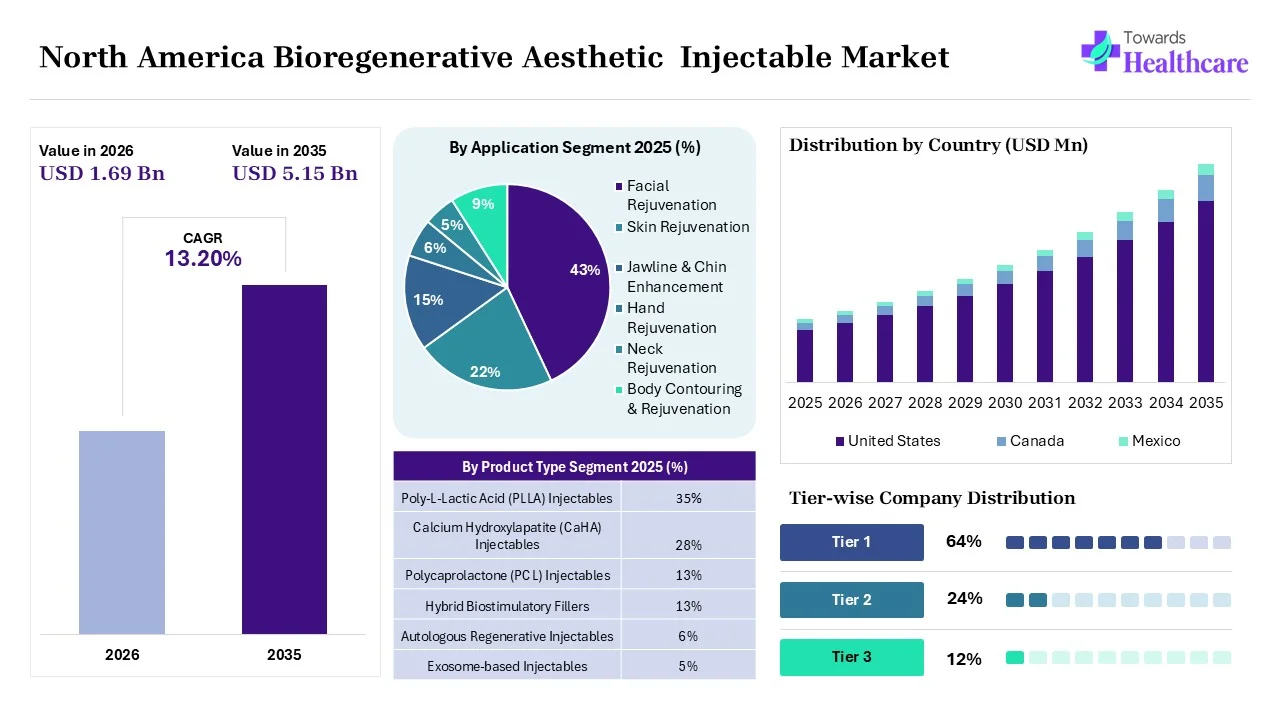
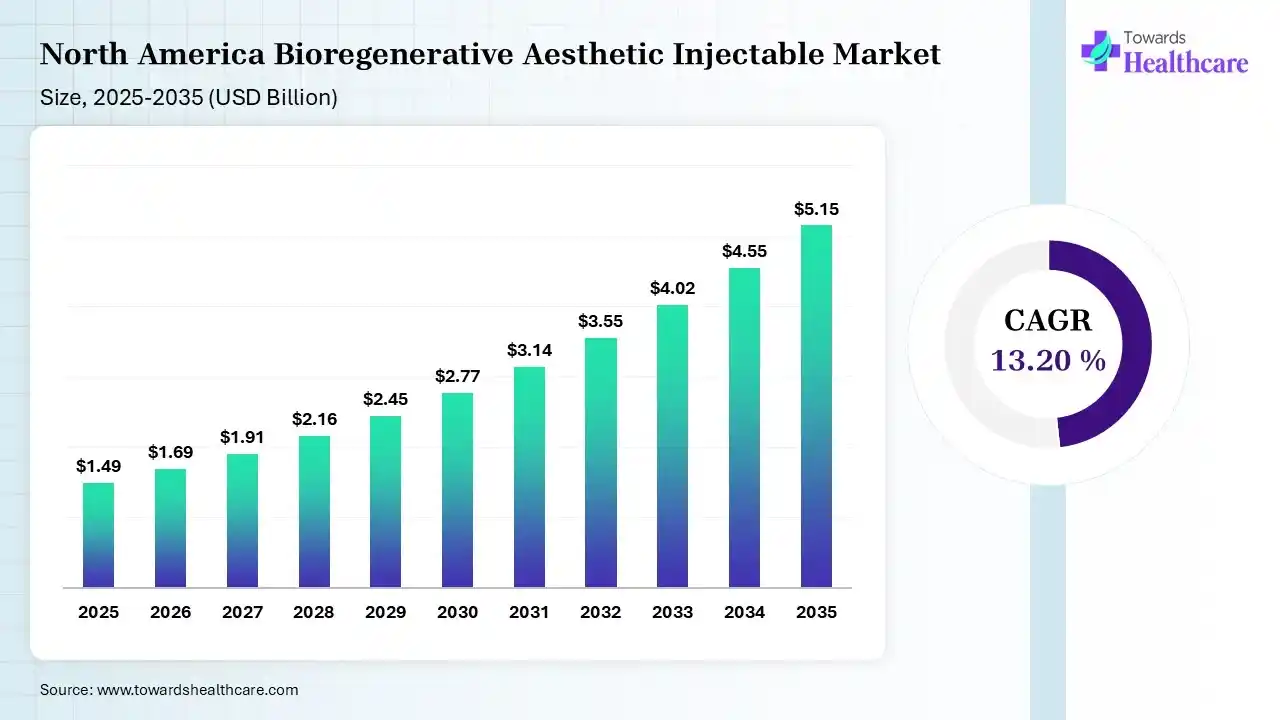
The North America bioregenerative aesthetic injectable market size was estimated at USD 1.49 billion in 2025 and is predicted to increase from USD 1.69 billion in 2026 to approximately USD 5.15 billion by 2035, expanding at a CAGR of 13.20% from 2026 to 2035.
Bioregenerative aesthetic injectables are advanced cosmetic injectables that stimulate collagen production and tissue regeneration while improving facial volume, skin texture, and overall skin quality. They are widely used for anti-ageing, facial contouring, and long-term rejuvenation, offering natural-looking and gradual aesthetic results. The North America bioregenerative aesthetic injectable market is growing due to rising demand for minimally invasive procedures, collagen-stimulating treatment, and long-lasting facial rejuvenation solutions.
Key trends include the growing popularity of regenerative injectables, personalized aesthetics procedures, and combination therapies for enhanced results. Market growth is driven by increasing awareness of non-surgical anti-ageing treatments, rising aesthetic spending, and demand for preventive skincare solutions. Opportunities are emerging through innovation in bioreactive injectables and expansion into younger and male consumer segments, while advancements in PLLA, CaHA, and regenerative filler technologies are improving treatment durability and effectiveness.
The market is growing due to the rising demand for minimally invasive anti-ageing procedures, strong consumer spending on premium aesthetic treatments, and increasing adoption of collagen-stimulating injectables for natural-looking results. Market growth is further supported by the presence of leading aesthetic companies, growing awareness of preventive cosmetic care, and continuous advancements in regenerative technologies across the U.S. and Canada.
AI can significantly influence the market by improving facial assessment, treatment planning, and personalized procedure recommendations. It helps practitioners analyze skin conditions, predict treatment outcomes, and optimize injectable placement for more precise and natural-looking results. AI also supports patient engagement through virtual consultations and data-driven aesthetic planning, while helping companies accelerate product innovation, clinical research, and targeted marketing strategies.
Rising Preference for Collagen-Stimulating Injectables
North America is witnessing growing demand for bioregenerative injectables that stimulate natural collagen production rather than only providing temporary volume. Consumers increasingly prefer treatments offering gradual, subtle, and long-lasting rejuvenation, which is encouraging wider adoption of products such as PLLA- and CaHA-based injectables across aesthetic clinics and medspas.
Expansion of Personalized and Preventive Aesthetic Treatments
The market is shifting toward tailored treatment plans tailored to facial structure, skin quality, and ageing concerns. At the same time, younger consumers are increasingly seeking preventive aesthetic procedures to maintain skin quality and delay visible ageing, which is expected to expand the addressable patient pool for regenerative injectable treatments.
Continued Innovation in Advanced Regenerative Injectable Technologies
Future market growth is likely to be driven by ongoing innovation in bioactive formulations, longer-lasting injectables, and advanced delivery technologies. Companies are focusing on improving safety, treatment durability, and skin-regeneration benefits, which will strengthen product differentiation and support broader use of bioregenerative injectables in aesthetic medicine.
| Table | Scope |
| Market Size in 2026 | USD 1.69 Billion |
| Projected Market Size in 2035 | USD 5.15 Billion |
| CAGR (2026 - 2035) | 13.20% |
| Historical Data | 2020 - 2023 |
| Base Year | 2025 |
| Forecast Period | 2026 - 2035 |
| Measurable Values | USD Millions/Units/Volume |
| Market Segmentation | By Product Type, By Application, By End User, By Gender, By Age Group, By Distribution Channel, By Region |
| Top Key Players | AbbVie / Allergan Aesthetics, Merz Aesthetics, Revance Therapeutics, Evolus, Inc., Prollenium Medical Technologies, Sinclair North America, Benev Company, Inc., Crown Aesthetics |
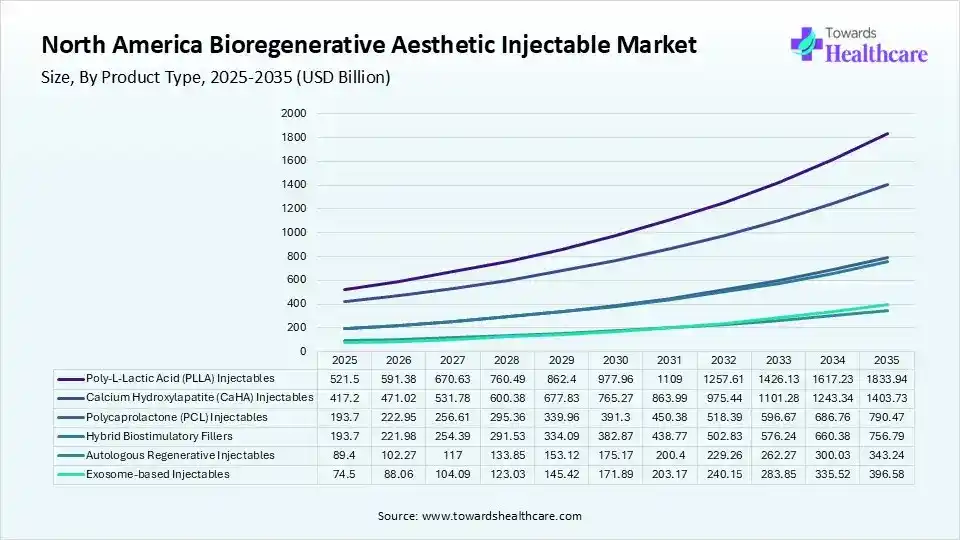
| Segments | Shares % |
| Poly-L-Lactic Acid (PLLA) Injectables | 35% |
| Calcium Hydroxylapatite (CaHA) Injectables | 28% |
| Polycaprolactone (PCL) Injectables | 13% |
| Hybrid Biostimulatory Fillers | 13% |
| Autologous Regenerative Injectables | 6% |
| Exosome-based Injectables | 5% |
The Poly-L-Lactic Acid (PLLA) Injectables Segment Dominated the North America Bioregenerative Aesthetic Injectable Market in 2025
The poly-L-lactic (PLLA) injectables segment held a dominant share of 35% in 2025 due to its strong ability to stimulate collagen production and deliver gradual, natural-looking facial rejuvenation. Its long-lasting results, effectiveness in treating age-related volume loss, and growing use in minimally invasive anti-ageing procedures supported demand. Increasing physician preference for biostimulatory injectables and rising consumer interest in regenerative aesthetic treatments further strengthened PLLA’s market leadership.
The calcium hydroxylapatite (CaHA) injectables segment held the second-largest share of 32% in 2025 due to its ability to provide both immediate volumizing effects and long-term collagen stimulation. Its strong use in facial contouring, wrinkle correction, and skin rejuvenation supports demand across aesthetic clinics. Growing preference for minimally invasive procedures and natural-looking results has further strengthened the adoption of CaHA-based injectables in the region.
The exosome-based injectables segment held a 5% share in 2025 and is expected to grow at the fastest CAGR of 18.2% in the North America bioregenerative aesthetic injectable market during the forecast period due to rising interest in advanced regenerative aesthetics and cell-signaling therapies that support skin repair, collagen production, and tissue rejuvenation. Growing demand for next-generation non-surgical treatments, increasing research in exosome applications, and strong consumer preference for innovative anti-ageing solutions are expected to accelerate adoption during the forecast period.
The Polycaprolactone (PCL) injectables segment held a 13% market share due to its ability to provide immediate volume enhancements along with long-term collagen stimulation. Its extended durability, gradual, regenerative effects, and effectiveness in treating wrinkles, facial volume loss, and skin laxity are supporting adoption. Rising demand for minimally invasive anti-ageing procedures and natural-looking, long-lasting aesthetic outcomes is further accelerating the growth of PCL-based injectables.
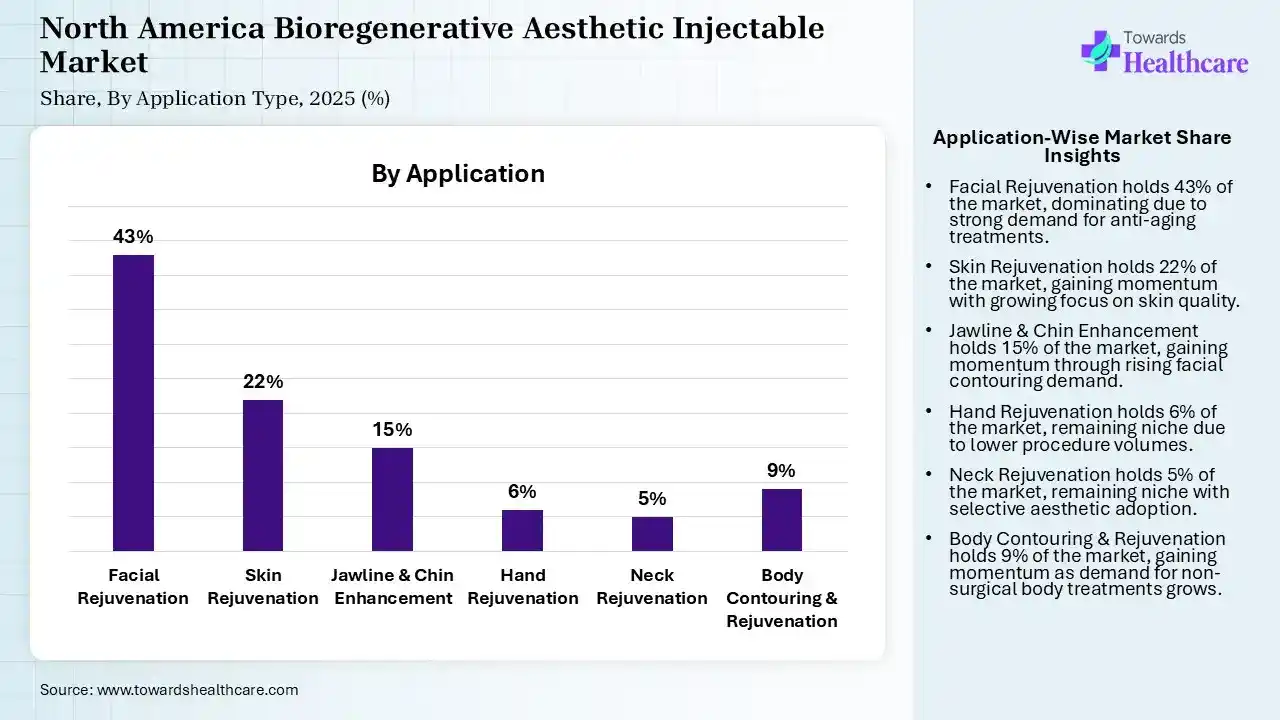
| Segments | Shares % |
| Facial Rejuvenation | 43% |
| Skin Rejuvenation | 22% |
| Jawline & Chin Enhancement | 15% |
| Hand Rejuvenation | 6% |
| Neck Rejuvenation | 5% |
| Body Contouring & Rejuvenation | 9% |
The Facial Rejuvenation Segment Led the North America Bioregenerative Aesthetic Injectable Market in 2025 with the Largest Share
The facial rejuvenation segment dominated the market with a share of 43% in 2025 due to the high demand for non-surgical treatments targeting wrinkling, volume loss, skin laxity, and facial contour enhancement. Increasing consumer preference for minimally invasive anti-ageing procedures, along with growing adoption of collagen-stimulating injectables for natural-looking results, supported segment growth. Strong awareness of facial aesthetics and preventive cosmetic care further reinforced its market leadership.
The skin rejuvenation segment held the second-largest share of 22% in 2025 and is expected to grow at the fastest CAGR of 15% in the market during the forecast period due to increasing demand for treatments that improve skin texture, elasticity, firmness, and overall radiance. Growing consumer interest in minimally invasive anti-ageing solutions, preventive aesthetic care, and collagen-stimulating injectables supported adoption. Rising preference for natural-looking skin enhancements and long-term dermal regeneration further strengthened the segment’s position across aesthetic clinics and medspas.
The jawline & chin enhancement segments held 15% of the North America bioregenerative aesthetic injectable market share due to rising demand for non-surgical facial contouring and profile refinement procedures. Increasing consumer focus on defined facial features, stronger jawline aesthetics, and balanced facial proportions is supporting treatment adoption. The availability of collagen-stimulating injectables that offer structural support, natural-looking outcomes, and long-lasting contour improvements is further accelerating segment growth across aesthetic practices.
The body contouring & rejuvenation segment held a 9% market share due to growing demand for treatments that combine facial sculpting with skin renewal and collagen stimulation. Consumers increasingly prefer minimally invasive procedures that address volume loss, facial definition, and overall skin quality in a single treatment approach. Rising interest in neutral-looking, long-lasting aesthetic outcomes is further supporting the adoption of contouring and rejuvenation injectables.
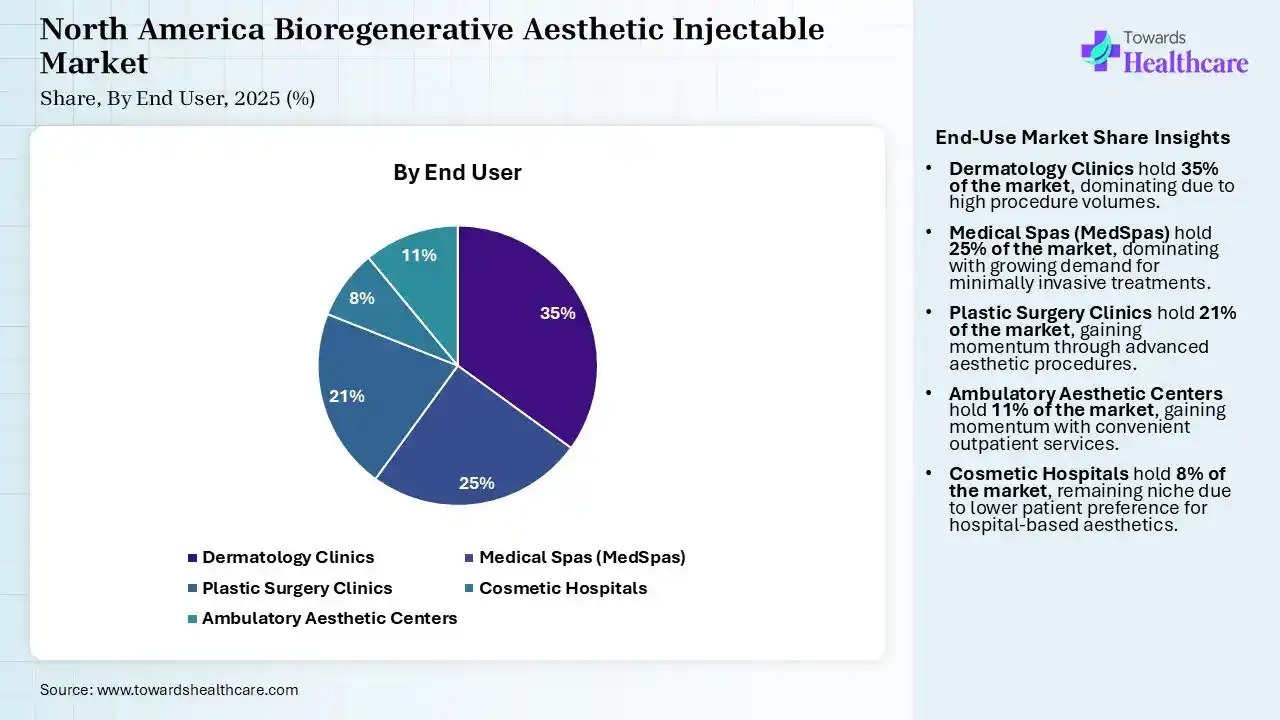
| Segments | Shares % |
| Dermatology Clinics | 35% |
| Medical Spas (MedSpas) | 25% |
| Plastic Surgery Clinics | 21% |
| Cosmetic Hospitals | 8% |
| Ambulatory Aesthetic Centers | 11% |
The Dermatology Clinics Segment Led the Market in 2025 with the Largest Share
The dermatology clinics segment held a dominant share of 35% of the North America bioregenerative aesthetic injectable market in 2025 due to high patient trust, specialized expertise in facial aesthetics, and strong adoption of advanced injectable treatments for skin rejuvenation and anti-ageing. These clinics offer personalized treatment planning, skilled administration of collagen-stimulating injectables, and access to premium aesthetic procedures. Growing consumer preference for medically supervised minimally invasive cosmetic treatment further supported the segment’s market leadership.
The medical spas (MedSpas) segment held the second-largest share of 25% in 2025 and is expected to grow at the fastest CAGR of 15.1% in the market during the forecast period due to growing consumer preference for convenient, wellness-focused, and minimally invasive aesthetic treatments. MediSpas offer a broad range of skin rejuvenation and anti-ageing injectable procedures in more accessible and lifestyle-oriented settings. Rising demand for customized cosmetic services, recurring aesthetic treatments, and non-hospital care environments has further strengthened the segment’s market position.
The plastic surgery clinics segment held a 21% share of the North America bioregenerative aesthetic injectable market due to increasing demand for specialized facial contouring, anti-ageing, and combination aesthetic procedures. These clinics offer advanced expertise in structural facial enhancement and customized treatment planning, making them a preferred setting for premium injectable therapies. Rising consumer interest in long-lasting, natural-looking rejuvenation and medically supervised cosmetic care is further supporting segment growth.
The ambulatory aesthetic centers segment held an 11% market share due to rising demand for convenient, same-day cosmetic procedures in outpatient settings. These centers offer minimally invasive facial rejuvenation and contouring treatments with shorter appointment times, lower procedural burden, and personalized care. Increasing consumer preference for accessible aesthetic services, along with growing adoption of collagen-stimulating injectables outside hospital-based settings, is further supporting segment growth.
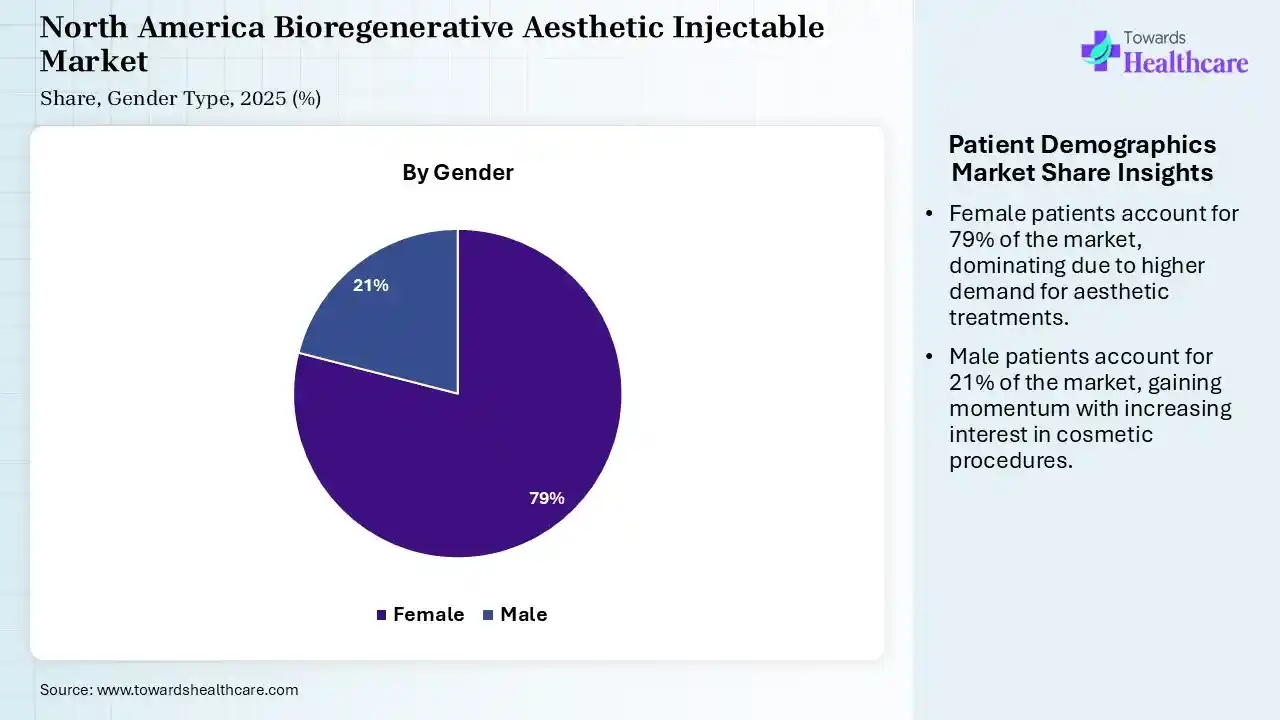
| Segments | Shares % |
| Female | 79% |
| Male | 21% |
The Female Segment Led the North America bioregenerative aesthetic injectable Market in 2025 with the Largest Share
The female segment dominated the market with a share of 79% in 2025 due to higher participation in cosmetic procedures, greater awareness of facial rejuvenation treatments, and strong demand for non-surgical anti-ageing solutions. Women are more likely to seek collagen-stimulating injectables for wrinkle reduction, skin rejuvenation, and facial contour enhancement. Rising spending on premium aesthetic care, along with growing interest in preventive and long-lasting cosmetic treatments, further supported segment leadership.
The male segment held the second-largest share of 21% in 2025 and is expected to grow at the fastest CAGR of 14.8% in the North America bioregenerative aesthetic injectable market during the forecast period due to increasing acceptance of cosmetic procedures among men, rising focus on facial contouring and anti-ageing, and growing demand for minimally invasive treatments. Greater awareness of appearance-focused grooming, professional image enhancement, and natural-looking rejuvenation is further accelerating the adoption of regenerative injectable procedures among male consumers.
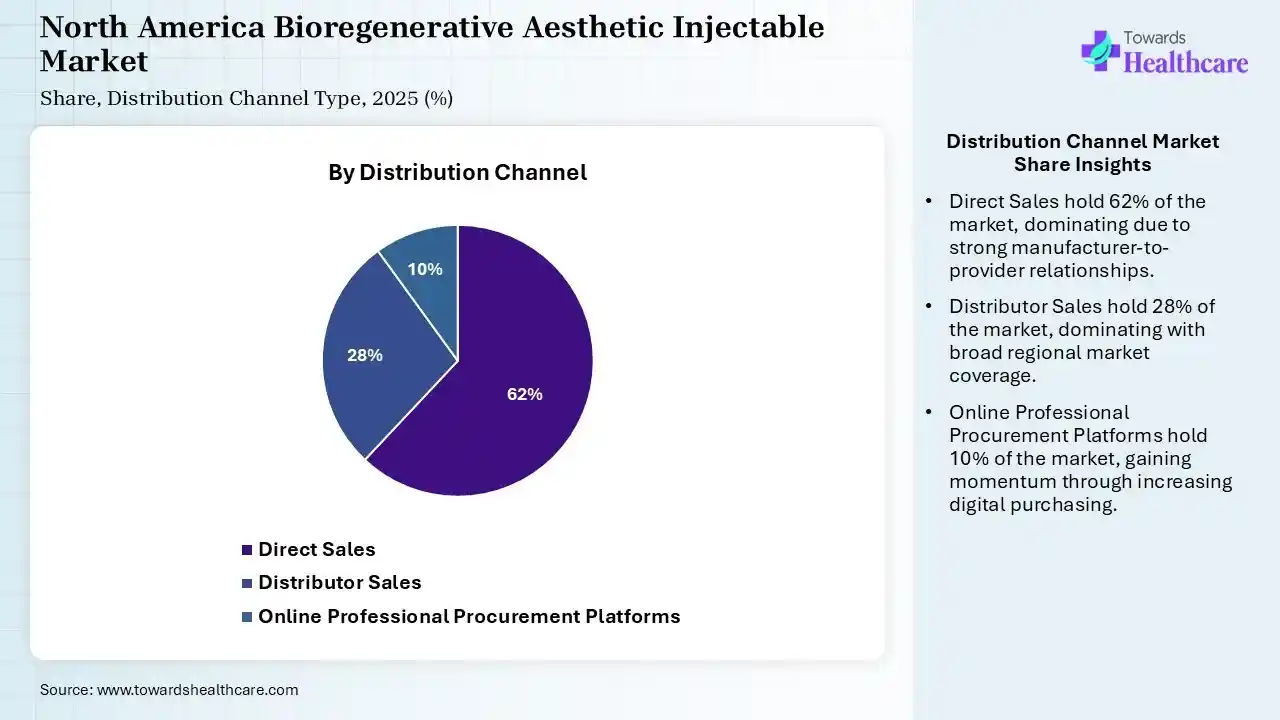
| Segments | Shares % |
| Direct Sales | 62% |
| Distributor Sales | 28% |
| Online Professional Procurement Platforms | 10% |
The Direct Sales Segment Led the Market in 2025 with the Largest Share
The direct sales segment held a dominant share of 62% in 2025 due to strong manufacturer relationships with dermatology clinics, medspas, and aesthetic centers. Direct sales enable better product availability, training support, pricing control, and faster adoption of premium injectable brands. The model also helps companies strengthen customer loyalty, ensure a consistent supply of specialized injectables, and provide tailored commercial support to high-volume aesthetic providers.
The distributor sales segment held the second-largest share of 32% in 2025 due to held the second-largest share of 28% in 2025 due to its ability to expand product reach through distribution, specialty suppliers, and third-party aesthetic networks. This channel supports access to a broader base of medspas, ambulatory aesthetic centers, and smaller clinics. Growing demand for flexible procurements, regional product availability, and wider market penetration has further strengthened this segment’s role in the market.
The online professional procurement platforms segment held a 10% share in 2025 and is expected to grow at the fastest CAGR of 16.2% in the North America bioregenerative aesthetic injectable market during the forecast period due to increasing digitization of aesthetic product purchasing, wider product accessibility, and streamlined ordering for clinics and medspas. These platforms offer convenient inventory management, transparent pricing, and faster access to specialized injectables. Rising preference for efficient procurement workflows, broader brand availability, and tech- enabled purchasing solutions is further accelerating segment growth.
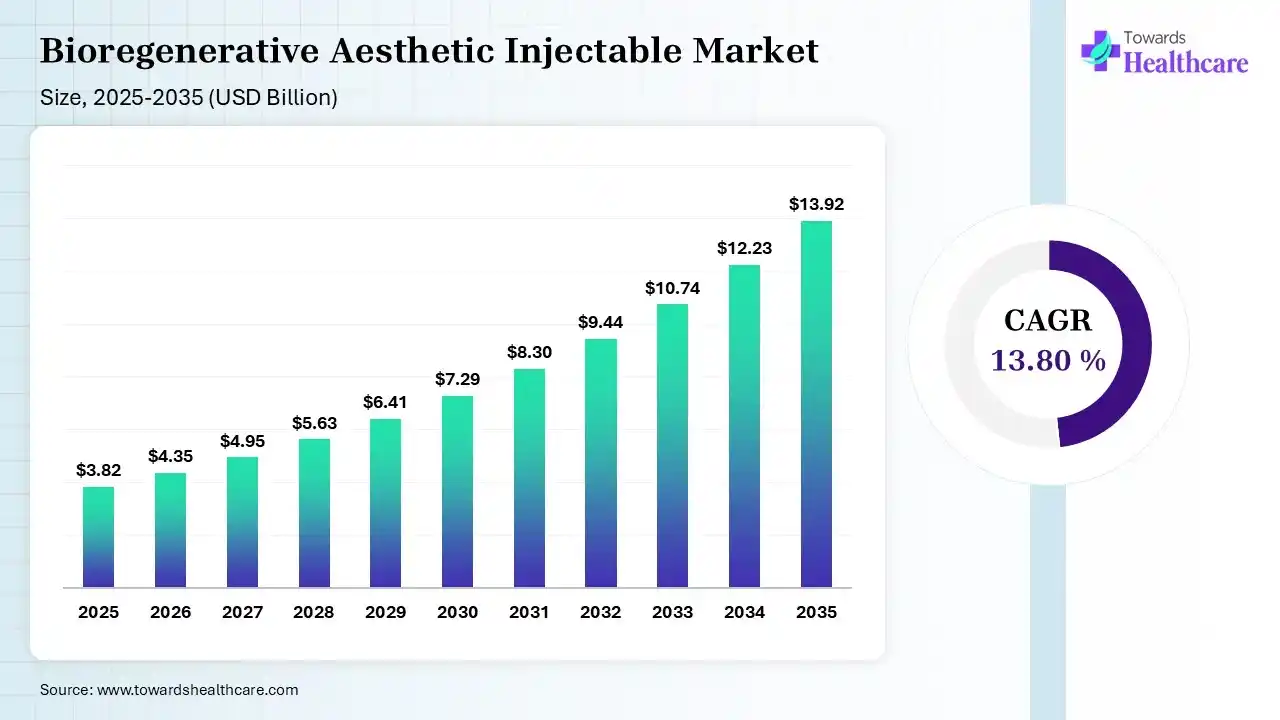
The global bioregenerative aesthetic injectable market size is calculated at US$ 3.82 billion in 2025, grew to US$ 4.35 billion in 2026, and is projected to reach around US$ 13.92 billion by 2035. The market is expanding at a CAGR of 13.80% between 2026 and 2035.
North America bioregenerative aesthetic injectable market is driven by strong demand for minimally invasive anti-ageing procedures, high consumer spending on premium aesthetic treatments, and early adoption of collagen-stimulating injectable technologies. The region also benefits from a well-established network of dermatology clinics, medspas, and aesthetic centers, along with the presence of major market players, growing awareness of preventive cosmetic care, and continuous innovation in regenerative aesthetic solutions.
U.S. Dominated with Strong Aesthetic Demand and Innovation Leadership
The U.S. dominated the North America bioregenerative aesthetic injectable market with a share of 84% in 2025 due to its large aesthetic patient base, high spending on cosmetic procedures, and strong demand for minimally invasive anti-ageing treatments. The country benefited from the presence of major injectable manufacturers, advanced dermatology and medspas networks, rapid adoption of collagen-stimulating products, and growing consumer interest in preventive, regenerative, and natural-looking facial rejuvenation solutions.
Canada Emerges as a Fast-Growing Hub for Regenerative Aesthetics
Canada held an 11% share in 2025 and is expected to grow at the fastest CAGR of 13.8% in the market during the forecast period due to rising demand for minimally invasive anti-ageing treatments, growing awareness of regenerative aesthetic procedures, and expanding access to dermatology clinics and medspas. Increasing consumer spending on facial rejuvenation, adoption of advanced collagen-stimulating injectables, and a steadily evolving aesthetic medicine landscape are further supporting strong market growth during the forecast period.
R&D
Clinical Trials
Patient Support and Services
| Companies | Headquarters | Offerings |
| AbbVie / Allergan Aesthetics | North Chicago, Illinois, U.S. | Facial aesthetic injectables, dermal fillers, anti-ageing, and facial contouring solutions |
| Merz Aesthetics | Raleigh, North Carolina, U.S. | Radiesse (CaHA injectable), collagen-stimulating injectables, facial contouring and skin rejuvenation products |
| Revance Therapeutics | Nashville, Tennessee, U.S. | Aesthetic injectable portfolio, facial wrinkle treatment and next-generation aesthetic solutions |
| Evolus, Inc. | Newport Beach, California, U.S. | Minimally invasive facial aesthetic injectables and wrinkle reduction solutions |
| Prollenium Medical Technologies | Richmond Hill, Ontario, Canada | Dermal fillers, facial rejuvenation injectables, aesthetic enhancement solutions |
| Sinclair North America | Irvine, California, U.S. | Collagen-stimulating and facial rejuvenation injectable solutions |
| Benev Company, Inc. | Mission Viejo, California, U.S. | Regenerative aesthetic solutions, skin rejuvenation injectables, exosome-based aesthetic offerings |
| Crown Aesthetics | Dallas, Texas, U.S. | Aesthetic treatment portfolio, skin rejuvenation and cosmetic enhancement solutions |
In June 2026, “Over the past several years, we have focused on building the scientific, manufacturing, clinical and regulatory foundations required to enter the aesthetics market responsibly and at scale. With our first professional products now listed in the U.S., we are focused on establishing strategic partnerships, building a meaningful commercial presence, and expanding our pipeline of next-generation regenerative aesthetics solutions,” said Katty Dowery, Chief Executive Officer of Cellav.
By Application
By End User
By Gender
By Age Group
By Distribution Channel
By Region










Principal Consultant
Rohan Patil is a seasoned market research professional with over 5+ years of focused experience in the healthcare sector, bringing deep domain expertise, strategic foresight, and analytical precision to every project he undertakes.
Learn more about Rohan Patil

Reviewed By
Aditi Shivarkar is a seasoned professional with over 14 years of experience in healthcare market research. As a content reviewer, Aditi ensures the quality and accuracy of all market insights and data presented by the research team.
Learn more about Aditi Shivarkar