


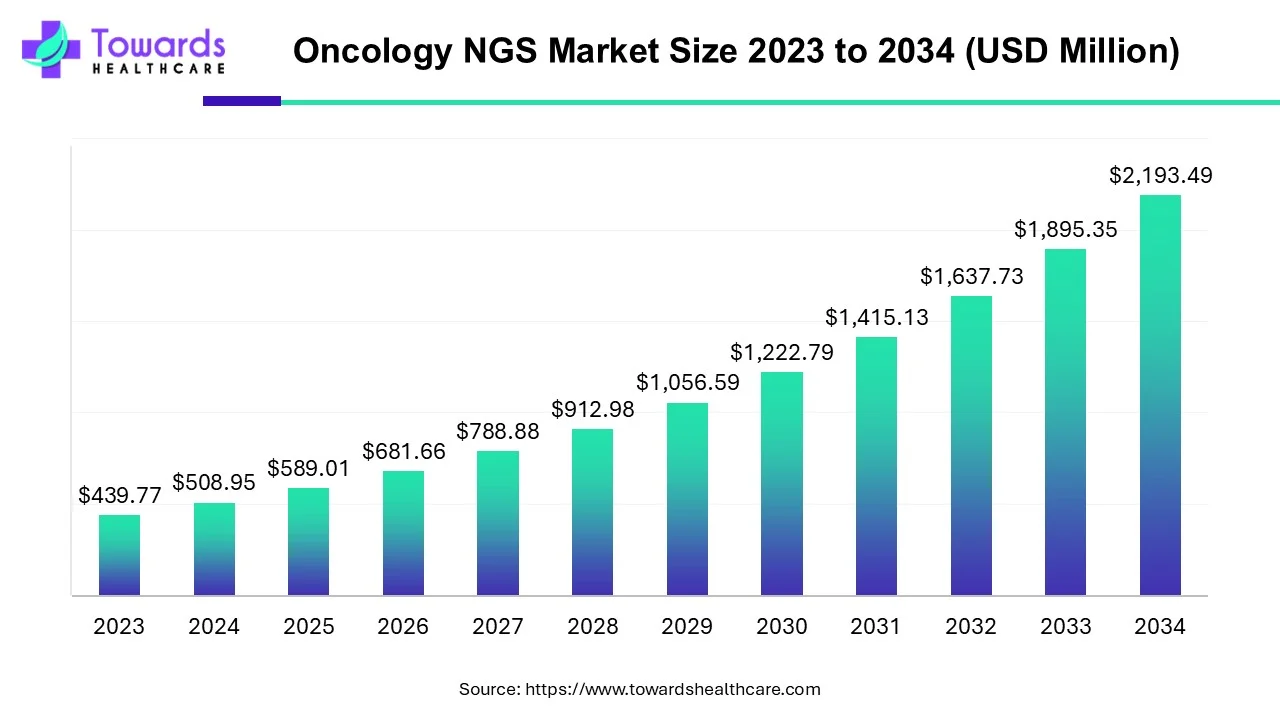
The global oncology NGS market size was calculated at US$ 589.01 million in 2025, grew to US$ 681.66 million in 2026, and is projected to reach around US$ 2538.52 million by 2035. The market is expanding at a CAGR of 15.73% between 2026 and 2035.
| Key Elements | Scope |
| Market Size in 2026 | USD 681.66 Million |
| Projected Market Size in 2035 | USD 2538.52 Million |
| CAGR (2026 - 2035) | 15.73% |
| Leading Region | North America |
| Market Segmentation | By Technology, By Workflow, By Application, By End-use and By Region |
| Top Key Players | Illumina, Inc., Thermo Fisher Scientific, F. Hoffmann-La Roche Ltd., Agilent Technologies, Myriad Genetics, Beijing Genomics Institute (BGI), Perkin Elmer, Foundation Medicine, Pacific Bioscience, Oxford Nanopore Technologies Ltd., Paradigm Diagnostics, Caris Life Sciences, Partek, Inc., Eurofins Scientific S.E., Qiagen N.V. |
NGS has become a valuable technique for gaining a more thorough and precise look into the molecular foundations of individual tumors as genomics-focused pharmacology starts to play a more significant part in cancer therapy. NGS-driven companion diagnostics are generally seen as driving therapy selection to maximize patient outcomes in the future since targeted medicines are emerging as the new standard of care in cancer. The subject of cancer might be significantly impacted by the accuracy, sensitivity, and speed benefits that NGS offers over conventional techniques. NGS removes the need to order several tests to determine the mutation that caused it because it can evaluate many genes in a single experiment.
This multigene strategy offers a more cost-effective option by cutting down on response time and reducing the possibility of using up valuable clinical samples. Furthermore, due to its great sensitivity, NGS can detect mutations in as low as 5% of the DNA extracted from a tumor sample. NGS may enhance the promise of customized therapy and the future of cancer. To find out more, we encourage you to review the materials gathered here.
Next-generation sequencing (NGS) is a potent instrument that has transformed genetic research and created new avenues for technological advancement. Thanks to NGS, researchers and scientists can swiftly and affordably sequence large volumes of genomic material, giving them access to a wealth of data that can be utilized for forensic investigations, medical treatment development, or the discovery of new insights. NGS has the potential to produce even more significant outcomes, insights, and results with the development of artificial intelligence (AI) and machine learning (ML).
Growing Cases of Cancer
The anticipated 20 million new cases of cancer in 2022 are expected to rise by 77% to over 35 million cases in 2050. The fast-increasing worldwide cancer burden is a result of changes in risk factor exposure, many of which are linked to socioeconomic development, as well as population increase and aging. Obesity, alcohol, and tobacco use are the main causes of the rising cancer incidence, while air pollution continues to be a major contributor to environmental risk factors.
Cost and Lack of Professionals
Advanced bioinformatics technologies, quick data processing, and vast data storage capacities are necessary for next-generation sequencing, and they might be expensive. Even while many institutions might be able to afford next-generation sequencing technology, many do not have the people or computing capacity to analyze and interpret the data in a therapeutic manner.
NGS Oncology for Personalized Medicine
NGS is also used to enhance logically planned personalized medication in addition to detecting genetic and new somatic alterations. Numerous research have used NGS to treat cancer in a tailored manner thus far. The advancement of NGS technology has made it feasible to obtain a patient's whole molecular profile in a clinically reasonable amount of time and at a reasonable cost.
What Made Targeted Sequencing and Resequencing the Dominant Segment in the Oncology NGS Market?
By technology, the targeted sequencing and resequencing segment was dominant in the oncology NGS market. TS is a potent method that can strike the greatest possible balance between the overall cost and data load for large-scale executions and the precise and highly sensitive identification of targeted events. In clinical trials and cancer research, TS has been extensively utilized to classify patients into risk groups according to the main gene's mutational state.
The Whole Genome Sequencing Segment: Fastest CAGR
By technology, the whole genome sequencing segment is expected to grow at the fastest CAGR in the oncology NGS market during the forecast period. Before the human genome was decoded, one of the main objectives of cancer researchers was to use whole-genome sequencing (WGS) to get a more thorough knowledge of cancer. Right now, the most effective method for creating a thorough picture of the genomic variation in a tumor without using several different technical platforms is to use a whole-genome approach.
Which Workflow Type Segment Held the Dominating Share of the Oncology NGS Market?
By workflow, the NGS sequencing segment dominated the oncology NGS market and is expected to grow at the fastest rate during the predicted timeframe. Over the past ten years, next-generation sequencing (NGS) has been used more and more in cancer genomics research as new sequencing technology has advanced. In order to enhance individualized cancer treatment, NGS has more recently been used in clinical oncology. NGS is utilized to find new and uncommon cancer mutations, identify carriers of family cancer mutations, and offer scientific justification for suitable targeted treatment.
Why Did the Screening Segment Dominate in the Oncology NGS Market?
By application, the screening segment held the major share of the oncology NGS market. NGS-based cancer sequencing techniques have opened up new research avenues by deepening our understanding of the genesis, control, and course of cancer. These methods assist in identifying alterations in the cancer genome and their effects on the transcriptome, epigenome, and proteome. By evaluating hundreds of targets simultaneously, NGS significantly increases the possibility of the discovery of each sample. Traditional molecular techniques could overlook low-frequency molecular processes linked to carcinogenesis, cancer development, and metastasis, whereas NGS can identify them.
The Companion Diagnostics Segment: Fastest CAGR
By application, the companion diagnostics segment is estimated to achieve the fastest CAGR in the oncology NGS market during 2024-2034. Complementary diagnostic tests have become more necessary as focused medicines have emerged in cancer and other fields. Next-generation sequencing (NGS), which uses a multi-analyte technique to provide extensive biomarker information, is a perfect way to integrate precision medicine into routine clinical practice.
How Laboratories Segment Dominated the Oncology NGS Market?
By end-use, the laboratories segment held the largest share of the oncology NGS market. In terms of developing and refining oncology tests according to certain cancer kinds, laboratories take the lead. The intricate biology of cancer, related research, and biomarkers—whether pharmacodynamic, evidence of mechanism or patient selection biomarkers—are all understood by laboratories in order to provide insightful information that can help design improved results.
The Clinics Segment: Fastest-Growing
By end-use, the clinics segment is estimated to grow at the fastest CAGR in the oncology NGS market during the forecast period. Clinics are gaining attention as they provide highly specialized services. Such clinics are equipped with high-end equipment and trained professionals.
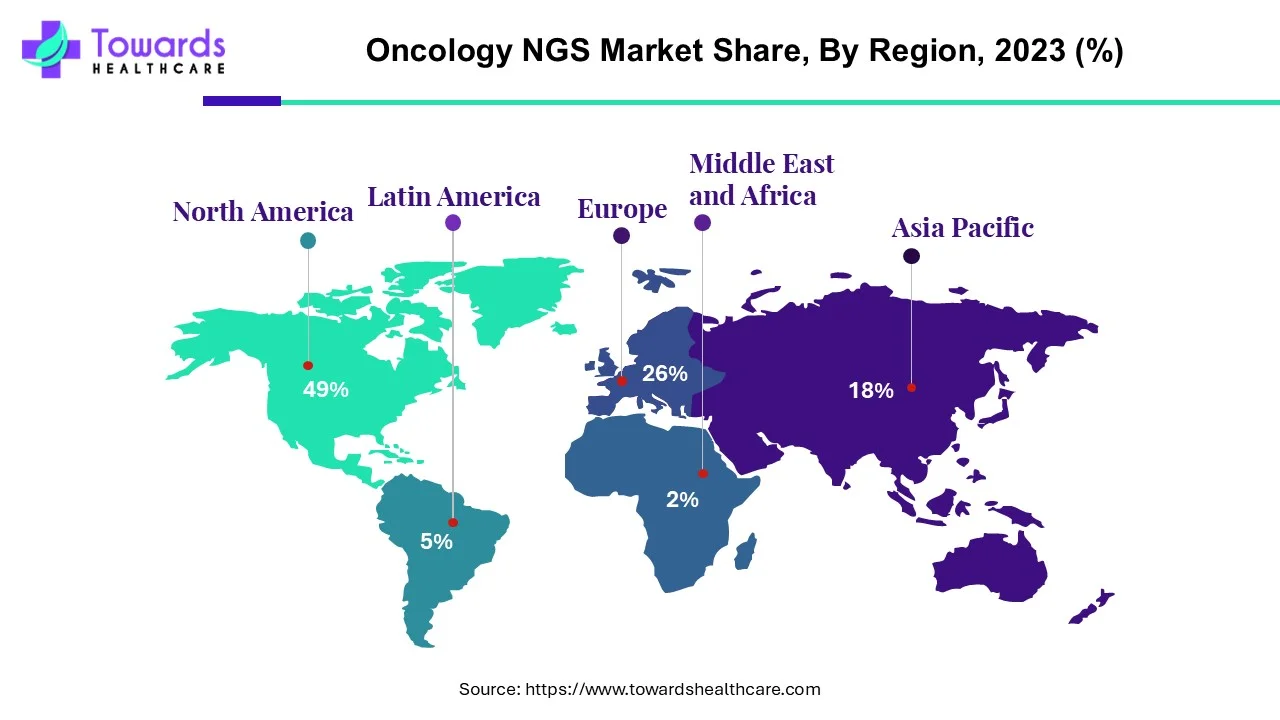
North America dominated the oncology NGS market in 2023. The nation's market is probably going to benefit from the rising incidence of chronic illnesses. The market in North America is also anticipated to grow as a result of the region's high concentration of major competitors, growing Food and Drug Administration approvals of strategic partnerships, and significant expenditure in R&D. In the healthcare sector, personalized medicine has emerged as a key research subject, permeated clinical practice, and is revolutionizing the diagnosis and treatment of several illnesses. Additionally, there is a growing emphasis on creating individualized therapies, a rise in the demand for high-quality research instruments for data reproducibility, and an increase in funding for the creation of structure-based drug designs. To improve their position in the market, major businesses have forged strategic alliances.
U.S. Oncology NGS Market Trends
The U.S. market is growing due to the rising prevalence of cancer, with over 1.9 million new cases expected annually. NGS allows for detailed genetic analysis, enabling the development of targeted therapies and personalized treatment plans. As sequencing costs decrease, NGS technology becomes more accessible, driving its adoption in clinical practice. Regulatory support, including FDA approvals for NGS-based companion diagnostics, further boosts its use. Additionally, the growing focus on precision medicine and the increasing number of FDA-approved NGS tests are contributing to market expansion.
Canada Oncology NGS Market Trends
Canada's market is expanding due to advancements in sequencing technologies that improve accuracy, reduce costs, and shorten turnaround times, making NGS more accessible for clinical use. The growing focus on personalized medicine is driving the adoption of NGS for identifying actionable genetic mutations and optimizing treatment plans for individual patients. Additionally, the integration of NGS in clinical trials for various cancers, such as breast and colorectal, is facilitating the development of targeted therapies, further fueling the market's growth in Canada.
Asia Pacific is estimated to host the fastest-growing oncology NGS market during the forecast period. Driven by elements like the expanding pharmaceutical and healthcare industries, especially in developing nations. Because of the high cancer death rates in the area, there is a need for cutting-edge diagnostic tools like NGS. Sequencing prices have dramatically decreased in China in particular, which has fueled market expansion and promoted economic growth. Leading market companies' aggressive pricing tactics, supportive government regulations, and high investment levels all contribute to the region's clinical oncology NGS market's expansion and provide great prospects for both stakeholders and market participants.
China Oncology NGS Market Trends
China's market is expanding due to the high cancer burden, with over 4 million new cases annually and significant cancer-related deaths. Government initiatives like the $9.2 billion Precision Medicine Initiative, aiming to sequence 100 million genomes by 2030, are boosting the adoption of NGS in cancer care. Technological advancements by companies like BGI Genomics and MGI Tech are making NGS more accessible and cost-effective. Additionally, the increasing integration of NGS into clinical trials and routine diagnostics is facilitating targeted therapies and improving patient outcomes.
India Oncology NGS Market Trends
India's market is expanding due to a growing focus on precision medicine. The increasing availability of NGS technologies in the country is improving the accuracy of cancer diagnostics, allowing for more targeted treatment options. Additionally, the country's rising research and development efforts in genomics and oncology are encouraging the adoption of NGS in clinical settings. Collaborations between academic institutions, hospitals, and biotech companies are accelerating innovations in cancer treatments. Moreover, the rising awareness among healthcare professionals about the benefits of NGS in personalized cancer care is contributing to market growth.
Europe is expected to grow significantly in the oncology NGS market during the forecast period, due to growing demand for personalized treatments. Moreover, the growing government support and expanding healthcare are also increasing their use to develop targeted treatments, promoting the market growth.
UK Oncology NGS Market Trends
The prevalence of a well-developed healthcare sector in the UK is increasing the use of NGS platforms for the detection of various cancers. Additionally, the growing R&D and increasing clinical datasets are also increasing their use in the development of personalized treatment options.
South America is expected to grow significantly in the oncology NGS market during the forecast period, due to the growing adoption of precision oncology. At the same time, the growing incidence of cancer is also increasing its demand for their accurate detection, which is promoting the market growth.
Brazil Oncology NGS Market Trends
The growing focus on precision oncology is increasing the demand for oncology NGS across Brazil. Moreover, the growing non-invasive techniques of cancer detection are also increasing their use, where the growing collaborations are leading to their technological advancements.
The Middle East & Africa are expected to grow at a notable CAGR in the foreseeable future. The increasing prevalence of cancer, advances in genomic technologies, and favorable government initiatives bolster market growth. Researchers evaluate the applications of oncology NGS for patients with rare cancer diseases. The demand for NGS-based testing is increasing in the region and exceeds local capacity. There are about 16 accredited laboratories in the Middle East to perform molecular genetic testing.
UAE Oncology NGS Market Trends
First Stem Cell, Integrated Gulf Biosystems, and DNA GTx are some labs that conduct NGS testing in the UAE. The UAE government is at the forefront of managing cancer and enhancing accessibility across all populations. It has recently expanded mandatory cancer screening nationwide to link preventive tests to health insurance requirements. It also supported the use of advanced diagnostic technologies, including liquid biopsies and genetic testing.
In November 2024, Caris Chairman, Founder, and CEO David Dean Halbert, DSc (h.c.) remarked that the FDA's approval of MI Cancer Seek, the first of its kind, further demonstrates Caris' continued leadership in molecular science and our extreme focus on quality." In order to guarantee that patients have access to vital precision medicine technologies, we are excited to launch MI Cancer Seek.
By Technology
By Workflow
By Application
By End-use
By Region




Principal Consultant
Deepa Pandey is a focused and detail-oriented market research professional with growing expertise in the healthcare sector, delivering high-quality insights across therapeutic areas, diagnostics, biotechnology and healthcare services.
Learn more about Deepa Pandey

Reviewed By
Aditi Shivarkar is a seasoned professional with over 14 years of experience in healthcare market research. As a content reviewer, Aditi ensures the quality and accuracy of all market insights and data presented by the research team.
Learn more about Aditi Shivarkar










