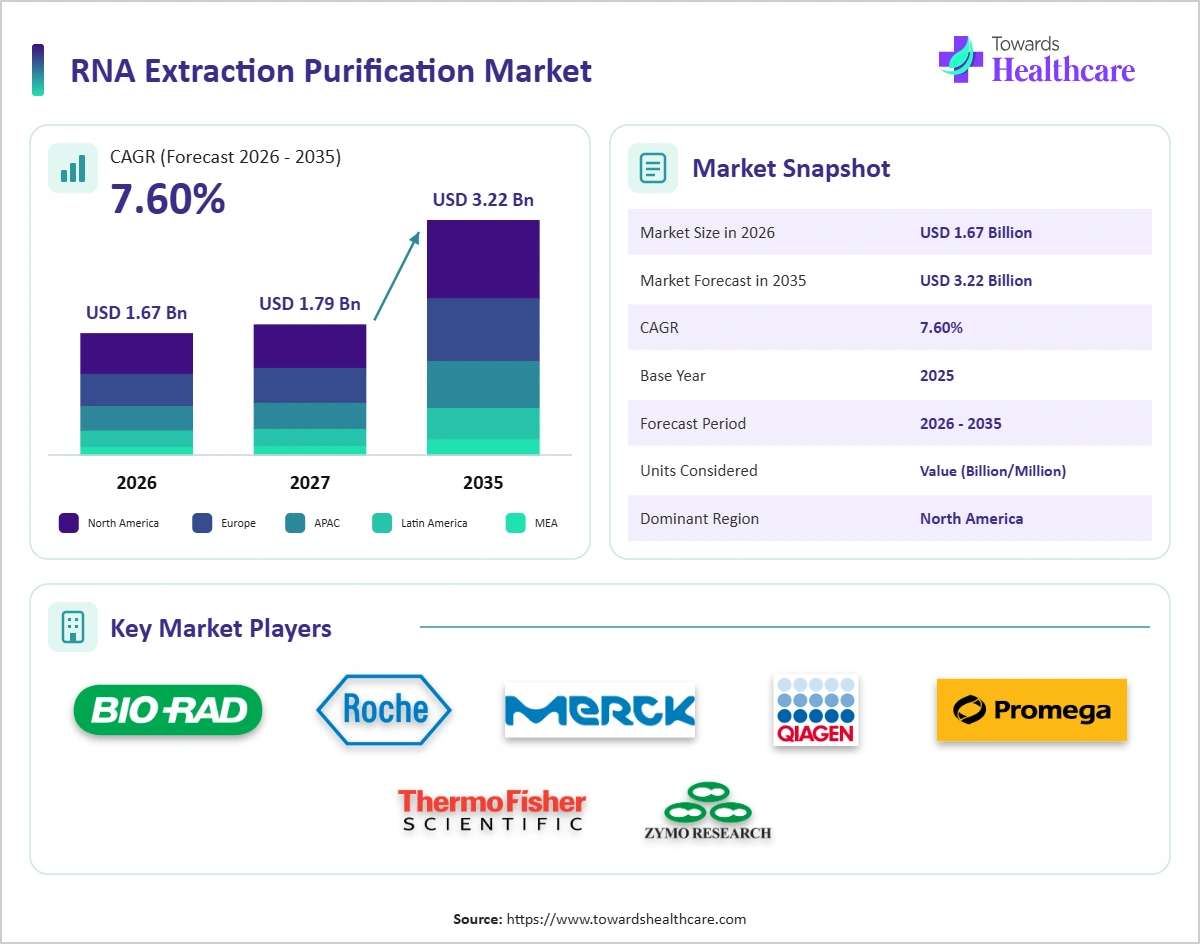
The global RNA extraction and purification market is expected to experience significant growth over the forecast period, increasing from USD 1.55 billion in 2025 to USD 3.22 billion by 2035. The growing application of RNA sequencing, diagnostic testing, and RNA-based drug development is generating greater demand for efficient RNA isolation solutions. Furthermore, advancements in molecular testing and the increasing integration of automation into laboratory workflows are anticipated to strengthen market growth, with revenue projected to reach USD 2.24 billion by 2030, expanding at a CAGR of 7.60% between 2026 and 2035.
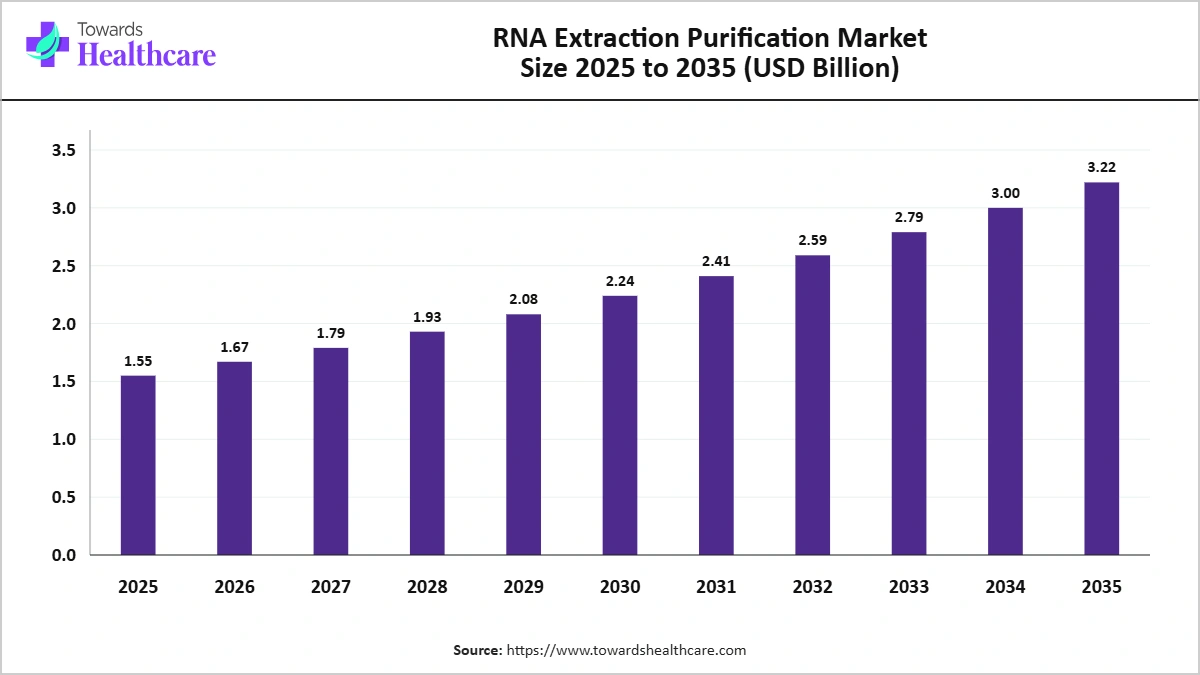
Analyst View: Our estimate starts at the ground level. We built it from extraction volumes across applications, then layered in kit and instrument pricing and the sample technology revenues reported by leading companies.
The RNA extraction purification market grows with sequencing, diagnostics, and RNA drug research. Labs are automating, and magnetic beads are gaining on columns.
| Driver | Impact | ≈ CAGR Contribution | Time Horizon | Key Regions |
| Sequencing growth | High | +2.97 pp | Short to long term | Global, strongest in North America |
| Diagnostics | Medium | +2.50 pp | Medium to long term | Global, fastest uptake in Asia Pacific |
| Staff shortages | Medium | +2.13 pp | Short to medium term | Global |
| RNA drugs | Low | +1.67 pp | Long term | Developed and emerging markets |
Note: Contributions are indicative estimates of each factor's effect on annual growth.
Sources: Expert interviews, secondary sources, Towards Healthcare database and Towards Healthcare analysts.
Sequencing growth, diagnostics, and staff shortages drive most growth in the RNA extraction purification market.
| Restraint | Impact | ≈ Negative CAGR Contribution | Time Horizon | Key Regions |
| Price pressure | High | -0.75 pp | Short to medium term | Global |
| Research budgets | High | -0.55 pp | Medium term | Price-sensitive and emerging markets |
| Direct-to-PCR | Medium | -0.37 pp | Short term | North America and other mature markets |
Note: Contributions are indicative estimates of each factor's effect on annual growth.
Sources: Expert interviews, secondary sources, Towards Healthcare database and Towards Healthcare analysts.
Price pressure is the main restraint, followed by research budget cuts and extraction-free tests.
Small lab automation
Most small and mid-sized labs still extract RNA by hand, which leaves a large installed base ready to upgrade. Affordable benchtop systems give these labs a practical first step into automation without a major investment.
Clinical IVD kits
Kits approved for diagnostic use carry regulatory credibility that research-grade products lack. Suppliers that can meet these standards gain access to a steadier, higher-value market with strong customer loyalty.
Asia labs
New molecular testing and genomics labs are opening across the region as healthcare investment grows. Each new lab needs extraction kits, reagents, and equipment from day one, creating room for suppliers to build early relationships.
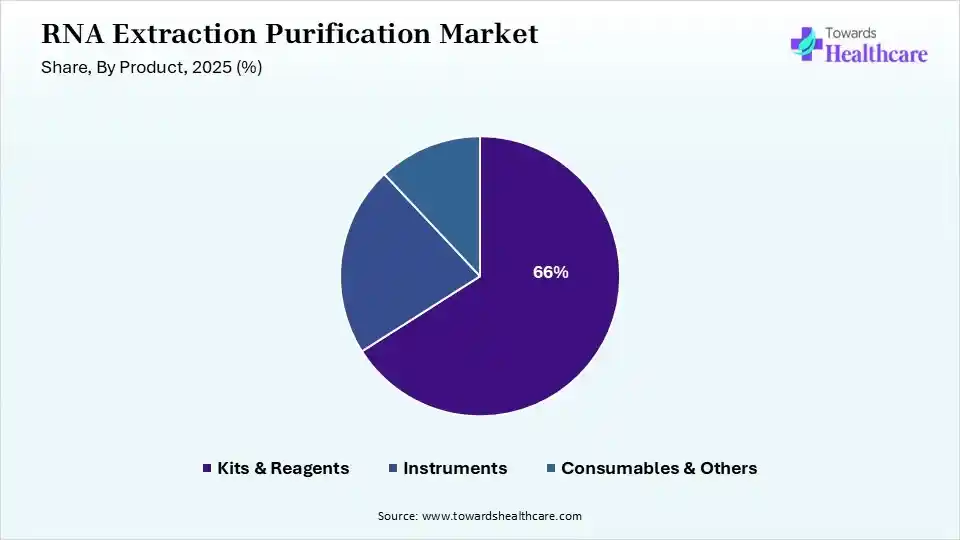
Note: 2025 is the base year; 2035 shares and CAGRs are forecasts.
Sources: Expert interviews, secondary sources, Towards Healthcare database, and Towards Healthcare analysts.
Kits and reagents hold 66.00% of the RNA extraction purification market in 2025, making them the backbone of the industry. Well-known products such as QIAGEN RNeasy and the Thermo Fisher MagMAX and PureLink kits are widely trusted in research and clinical labs. Their appeal lies in ready-to-use chemistry that delivers consistent results with little setup. Because every new batch of samples needs fresh reagents, demand repeats steadily.
Instruments labs are investing in automated systems to cut hands-on time and improve consistency from run to run. QIAGEN launched three new sample preparation systems in 2026, including QIAmini, which is designed for small batches. Compact options like this make automation realistic for smaller labs as well as large facilities.
Consumables and others segment covers supporting items such as tubes, tips, plates, and filters that every extraction workflow needs. Although smaller in share, these products are bought continuously alongside kits and instruments. Demand therefore rises in step with overall extraction volumes.
Column-based methods hold 44.00% of the market, making them the most widely used approach. Spin-column workflows are simple, familiar to most lab staff, and need little specialized equipment. They deliver reliable, clean RNA for routine research and testing. This ease of use keeps them the default choice in many labs, especially those running smaller sample batches.
Magnetic bead methods chemistry avoids centrifugation, which makes it easy to automate and scale for large sample batches. High-throughput labs favor it for speed and consistent recovery. As automation spreads, this method is steadily closing the gap with column-based workflows.
Phenol-chloroform and other methods extraction is a long-established technique that remains useful for difficult samples and for labs that want a low-cost option. It requires more hands-on time and careful handling of hazardous chemicals, which limits its growth. Even so, it keeps a loyal user base in research settings.
Blood & Plasma held 32.00% of the market in 2025 and are growing at 8.14%, faster than the market overall. These samples are easy to collect and sit at the center of molecular diagnostics and liquid biopsy testing. Circulating RNA from a simple blood draw supports less invasive cancer detection and monitoring. That growing clinical use keeps demand for sensitive, low-input extraction kits rising.
Tissue, fresh and frozen tissue remain a core sample source in gene expression and cancer research. FFPE blocks add an archive of preserved clinical samples, though the RNA in them is often degraded. Specialized kits that recover usable RNA from this material open the door to retrospective studies.
Cells cultured cells are a staple of drug discovery, gene expression work, and RNA therapeutic development. They are easy to handle and give consistent starting material for extraction. Growth in single-cell research is also adding demand for kits that work with very small inputs.
Others, such as swabs, plant, and other samples, make up the remainder of the market. Swabs matter for infectious disease testing, where respiratory samples must be processed quickly and reliably. Plant and environmental samples need tailored protocols because they contain compounds that interfere with extraction. Although smaller in share, these niches reward suppliers with specialized, application-specific kits.
Research held 40.00% of the market share in 2025, making it the largest application. Academic, government, and pharmaceutical labs rely on clean RNA for sequencing, gene expression, and transcriptome studies. Steady grant-funded projects keep extraction volumes high from year to year. Because these labs run many sample batches, they are consistent buyers of kits and reagents.
Clinical diagnostics tests for infectious diseases and cancer begin with purified RNA from patient samples. Rising testing volumes and the spread of molecular labs add to demand. Regulated, diagnostic-grade kits also bring higher-value, longer-term customer relationships.
Drug discovery pharmaceutical and biotech teams extract RNA to study how candidate drugs affect gene expression. Research into mRNA and RNAi therapies adds frequent extraction and quality checks at every development stage. As more candidates move through the pipeline, the need for dependable purification tools grows with them.
Analyst View: Instruments, magnetic beads, and diagnostics are gaining share the fastest, reflecting the shift toward automation and clinical testing. Kits and research still make up the largest parts of the market, so the established base remains solid while newer segments close the gap.
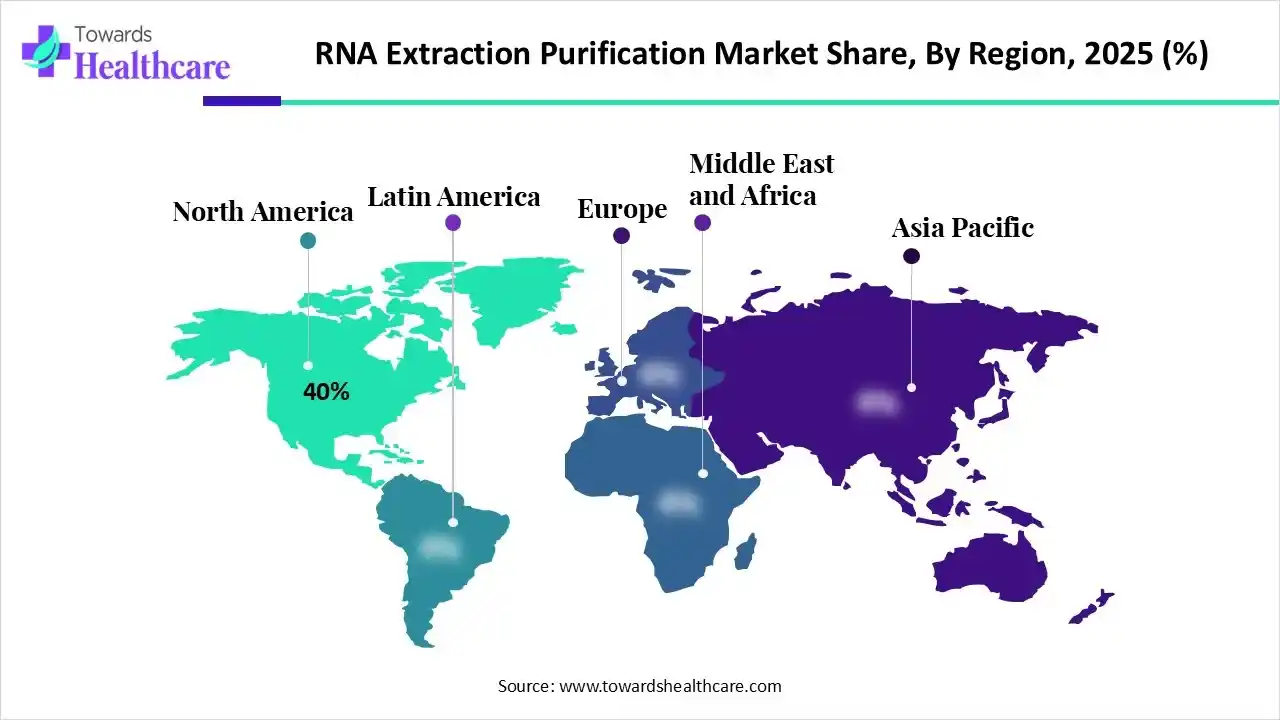
Sources: Expert interviews, secondary sources, Towards Healthcare database, and Towards Healthcare analysts.
North America leads with 40.00% of the market, anchored by large genomics and diagnostic laboratories. Strong funding for sequencing and RNA therapeutics keeps extraction volumes high. Academic centers, hospitals, and pharmaceutical companies all buy kits and automated systems at scale. This dense base of established users keeps the region's position secure.
Europe is home to major suppliers such as QIAGEN and Macherey-Nagel. Having leading kit makers close by gives regional labs easy access to products and technical support. Public research funding remains solid, and molecular diagnostics labs continue to expand. Together, these factors support steady, reliable adoption.
Asia Pacific fastest rate of any region. China and India are expanding molecular testing capacity as healthcare investment rises. New diagnostic and genomics labs need extraction kits, reagents, and equipment from the start. This creates room for suppliers to build early relationships in a fast-growing market.
Latin America demand comes mainly from growing clinical testing and academic research in larger economies such as Brazil and Mexico. Limited budgets and reliance on imported products can slow adoption of advanced systems. Even so, gradual investment in molecular diagnostics offers steady long-term potential.
The Middle East and Africa investment in healthcare infrastructure and genomics programs, particularly in the Gulf countries, is building new demand. Infectious disease testing also drives kit use across the wider region. Although small today, the region offers room to grow as laboratory capacity expands.
Analyst View: North America keeps its lead thanks to its mature research and diagnostics base, while Asia Pacific grows fastest as new molecular labs open. Europe stays a stable second, and Latin America and the Middle East & Africa remain smaller but developing markets.
| Rank | Company Name | 2025 Share (%) | Key Products / Business | Headquarters |
| 1 | QIAGEN | 24.00% | RNeasy kits and QIAsymphony, QIAsprint and QIAmini systems | Netherlands |
| 2 | Thermo Fisher Scientific | 22.00% | MagMAX kits and KingFisher systems | United States |
| 3 | Roche | 8.00% | MagNA Pure systems | Switzerland |
| 4 | Promega | 6.00% | Maxwell systems and kits | United States |
| 5 | Zymo Research | 4.00% | RNA kits | United States |
| 6 | Bio-Rad | 3.00% | RNA kits | United States |
| 7 | Merck KGaA | 3.00% | RNA reagents | Germany |
| 8 | Takara Bio | 3.00% | RNA kits | Japan |
| 9 | Revvity | 3.00% | extraction systems | United States |
| 10 | Macherey-Nagel | 2.00% | NucleoSpin kits | Germany |
Note: Company shares are 2025 estimates.
Sources: Company press releases, expert interviews, secondary sources, Towards Healthcare database, and Towards Healthcare analysts.
QIAGEN led the RNA extraction and purification market in 2025, capturing an estimated 24.00% of revenue. Thermo Fisher Scientific followed closely at 22.00%, with Roche in third at 8.00%. QIAGEN's strength rests on its RNeasy kits and the QIAsymphony, QIAsprint, and QIAmini systems. Thermo Fisher competes with its MagMAX kits and KingFisher instruments, while Roche offers the MagNA Pure systems.
Behind the top three, a group of established names fights for share through their own specialties: Promega with Maxwell systems and kits, Zymo Research, Bio-Rad, Merck KGaA, Takara Bio, Revvity, and Macherey-Nagel with its NucleoSpin kits. Their portfolios range from RNA kits and reagents to full extraction systems.
Taken together, the top 10 companies generated an estimated 78% of 2025 revenue, leaving 22% to be divided among many smaller kit makers. That makes the market concentrated. Companies mainly compete on yield and purity, automation, range of supported sample types, throughput, and price.
QIAGEN, based in the Netherlands, is the market's biggest name, with an estimated 24.00% share in 2025. Its position rests on RNeasy kits and the QIAsymphony, QIAsprint, and QIAmini systems. The Towards Healthcare Companies Quadrant ranks it as a Leader.
Thermo Fisher Scientific, a U.S. company, competes mainly through MagMAX kits and KingFisher systems. It captured roughly 22.00% of 2025 revenue, putting it a close second. The Towards Healthcare Companies Quadrant also rates it a Leader.
Swiss-based Roche took about 8.00% of the market in 2025, supported by its MagNA Pure systems. It appears as a Leader in the Towards Healthcare Companies Quadrant.
Promega, headquartered in the United States, held an estimated 6.00% share in 2025. Its Maxwell systems and kits keep it among the Leaders in the Towards Healthcare Companies Quadrant.
Zymo Research held an estimated 4.00% share in 2025 and is a notable player in the market. The U.S. company focuses on RNA kits and is classed as a Leader in the Towards Healthcare Companies Quadrant.
Bio-Rad built its estimated 3.00% position around RNA kits. The U.S.-based company is shown as a Leader in the Towards Healthcare Companies Quadrant.
Most of Merck KGaA's presence here comes from RNA reagents. The German company held roughly 3.00% of 2025 revenue and is rated an Innovator in the Towards Healthcare Companies Quadrant.
Japan's Takara Bio entered 2026 with an estimated 3.00% share, centered on its range of RNA kits. The Towards Healthcare Companies Quadrant places it as an Innovator.
Revvity, operating from the United States, offers extraction systems that gave it about 3.00% of the market in 2025. It is positioned as an Innovator in the Towards Healthcare Companies Quadrant.
Macherey-Nagel, a German company, has a business here centered on NucleoSpin kits, which earned it about 2.00% of 2025 revenue. The Towards Healthcare Companies Quadrant rates it as an Innovator.
The RNA extraction purification ecosystem links kit makers, instrument makers, labs, downstream platforms, and regulators, with each stage adding value before products reach end users. Purified RNA feeds next-generation sequencing, genomics, and precision medicine tests, and RNA from cell culture supports cell therapy research.
| Ecosystem Stage | Role in the Market | Key Companies |
| Kit Makers | Make kits | QIAGEN, Thermo Fisher, Zymo |
| Instrument Makers | Automate extraction | QIAGEN, Thermo Fisher, Roche |
| Labs | Extract RNA | research and clinical labs |
| Downstream Platforms | Use RNA | PCR, sequencing |
| Regulators | Clear IVD kits | FDA, EU IVDR |
Sources: Company press releases, expert interviews, secondary sources, Towards Healthcare database, and Towards Healthcare analysts.
Kit Makers: Kits must deliver intact, high-quality RNA, since poor yield or degraded samples undermine every test that follows. Manufacturers compete on purity, recovery, and the range of sample types their products can handle. Consistent batch-to-batch performance builds trust with labs. Strong technical support and clear protocols also help keep customers loyal.
Instrument Makers: Automation saves time, and that is the core of what instrument makers sell. Their systems cut hands-on work, reduce handling errors, and keep results consistent from run to run. Compact benchtop options are opening the door for smaller labs as well as large facilities. Many makers also tie their instruments to their own kits, which creates repeat demand for consumables.
Labs: Labs automate to cope with rising sample volumes and limited staff. Moving from manual extraction to automated systems frees technicians for higher-value work. It also lowers variability, which matters for clinical and regulated testing. Budget and workflow fit still shape how quickly each lab makes the switch.
Downstream Platforms: Sequencing, PCR, and other downstream tests need clean RNA to work well. Contaminants or degraded material can distort gene expression data and reduce test accuracy. As these platforms grow more sensitive, they place higher demands on the extraction step. This keeps pressure on suppliers to improve purity and reliability.
Regulators: IVD kits need regulatory clearance before they can be used in clinical diagnostics. Approval requires proof of performance, quality control, and manufacturing consistency. The process takes time and investment, but it creates a barrier that protects established suppliers. Cleared kits earn more trust and tend to hold longer-term customer relationships.
Value in the RNA extraction purification market flows from upstream material and technology suppliers to manufacturers and service providers, then through distribution partners to end users. Companies that integrate several stages or build long-term relationships with end users capture a larger share of this value.
The Towards Healthcare Companies Quadrant positions key participants in the RNA extraction purification market by market strength, reflecting revenue scale, market share and geographic reach, and by innovation and growth strategy, reflecting product portfolio breadth, R&D intensity and partnerships. Positions reflect each company's estimated 2025 share of the RNA extraction purification market and our assessment of its product innovation, portfolio breadth and partnerships.
Sources: Company press releases, expert interviews, secondary sources, Towards Healthcare database and Towards Healthcare analysts.
Leaders: QIAGEN, Thermo Fisher Scientific, Roche, Promega, Zymo Research and Bio-Rad combine high market share with broad portfolios and strong innovation.
Innovators: Merck, Takara Bio, Revvity and Macherey-Nagel bring newer technologies and specialised products.
By Product
By Method
By Sample Type
By Application
By Region
We started by defining the market clearly. It covers the kits, reagents, instruments, and consumables used worldwide to extract and purify RNA. These products rely on column-based, magnetic bead, and other methods. They are used on blood and plasma, tissue, cells, and other samples across research, clinical diagnostics, and drug discovery.
The 2025 base year was built from the bottom up. We combined demand volumes with average prices by product, method, sample type, application, and region. We then checked the result from the top down against market-specific revenues of leading companies and public industry data. Segment, regional, and company values were allocated from the same underlying demand.
To keep the numbers dependable, we verified key estimates against company disclosures, regulatory and industry data, and published third-party estimates. Any input that could not be reconciled was left out. All segment, regional, and company figures were aligned to the same 2025 base year. We also recalculated and validated the 2026-2035 forecast, which applies a constant CAGR from the 2025 base.
Analyst View: We expect the RNA extraction purification market to grow strongly with sequencing and diagnostics. Price pressure on kits is the main limit.