
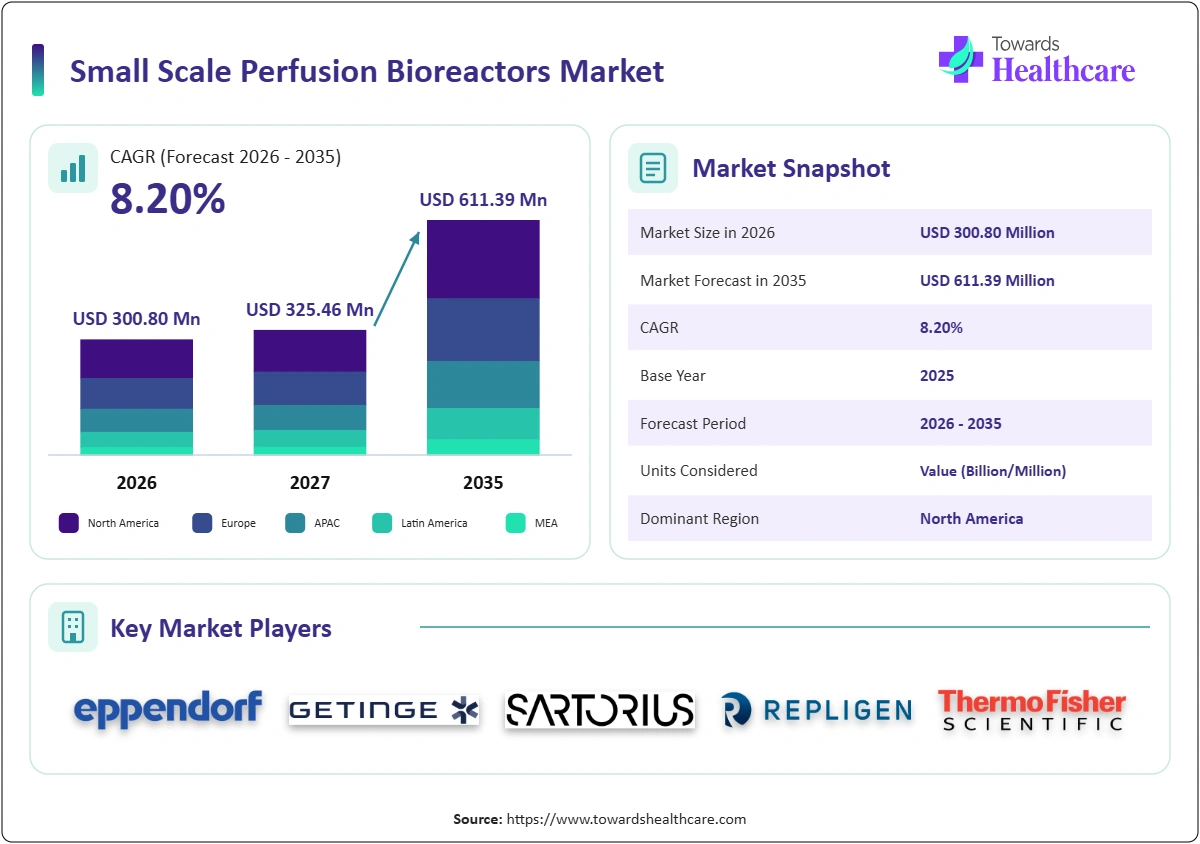
The market is projected to expand from USD 278.00 million in 2025 to USD 611.39 million by the end of the forecast period because biomanufacturers are increasingly adopting intensified and continuous perfusion processes, and every such process must first be developed and optimized in small scale perfusion systems. Market is benefiting from growing biologics pipelines, high-throughput micro-perfusion platforms, cell and gene therapy development, CDMO investment and Asian biomanufacturing expansion. The market is expected to reach USD 412.27 million by 2030 and maintain a CAGR of 8.20% throughout the forecast period.
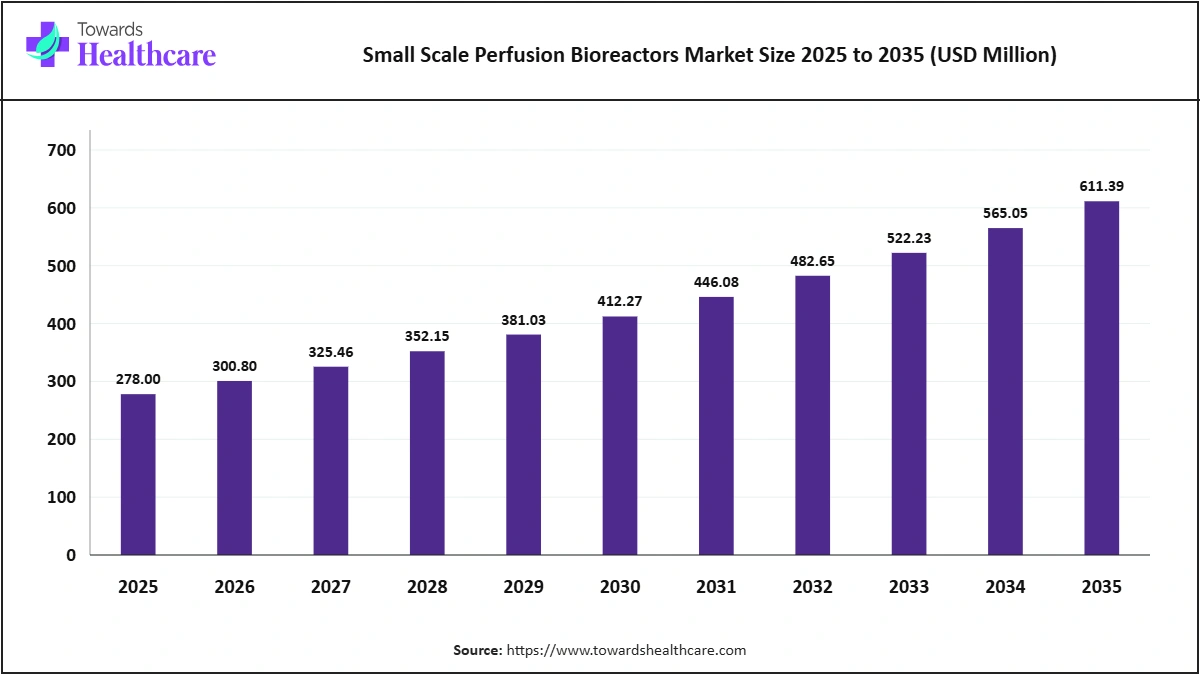
Analyst View: We built the estimate from small scale perfusion system shipments by type, capacity, application, end user and region, multiplied by mean system prices, plus single-use vessels, retention devices, software and service. Shipments highlight biopharmaceutical process development activity, the share of programs using perfusion and new laboratory installations, while consumables follow system utilization. The growth rate is a testament to accelerating adoption of process intensification, which supports a slightly higher rate than comparable estimates, moderated by the complexity of perfusion process development.
Driver: Process intensification is spreading and perfusion requires small-scale models. Biologics pipelines are growing and cell and gene therapy needs high-density culture. Single-use systems help to improve the pace of experiments.
Restraint: Perfusion processes involve significant intricacies. Media consumption is high and the costs of systems and consumables can be steep. The requirement of skilled staff can throttle the pace of growth and scale-down accuracy can be limited.
Opportunity: CDMOs are increasingly investing in perfusion and Asian biomanufacturing capacity is expanding. AI can be useful in optimization of processes. Microbial perfusion opens vaccine applications and consumables add recurring revenue.
Note: 2025 is the base year; 2035 values are forecasts.
Sources: Expert interviews, secondary sources, Towards Healthcare database and Towards Healthcare analysts.
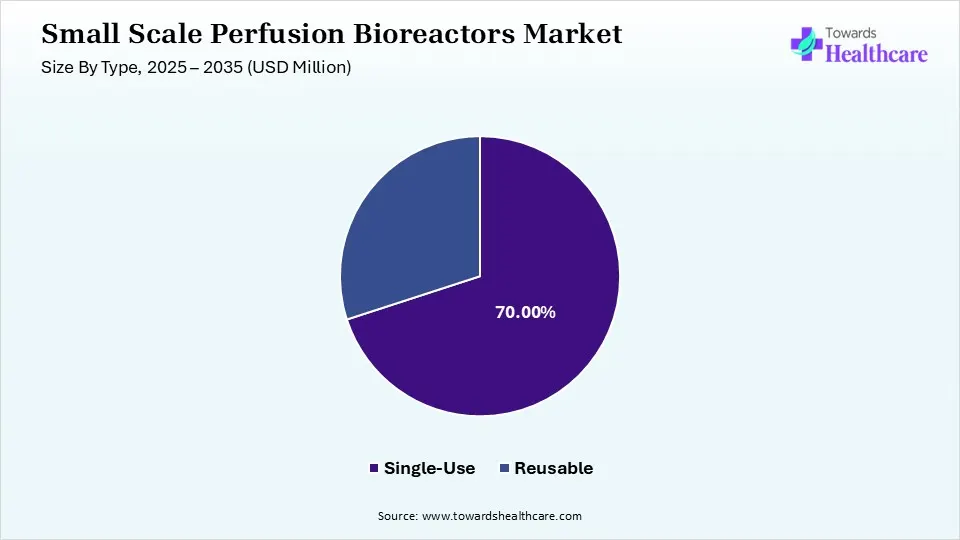
Single-Use held the largest share of 70.00% (USD 194.60 million) in 2025 and is projected to reach USD 435.02 million by 2035, expanding at a CAGR of 8.38% during the forecast period. Single-use systems use pre-sterilized disposable vessels, tubing and cell retention devices. The dominance of this segment can be attributed to the fact that they remove cleaning and sterilization steps, cut contamination risk and allow many short experiments, which suits process development. Sartorius's ambr perfusion systems, Merck's Mobius Breez micro-bioreactor and Thermo Fisher's benchtop single-use bioreactors are examples of single-use systems.
Reusable systems use glass or stainless steel vessels which have been cleaned and autoclaved. This segment continues to be popular in academic laboratories and for long perfusion runs and research where flexibility and lower running costs matter.
Note: 2025 is the base year; 2035 values are forecasts.
Sources: Expert interviews, secondary sources, Towards Healthcare database and Towards Healthcare analysts.
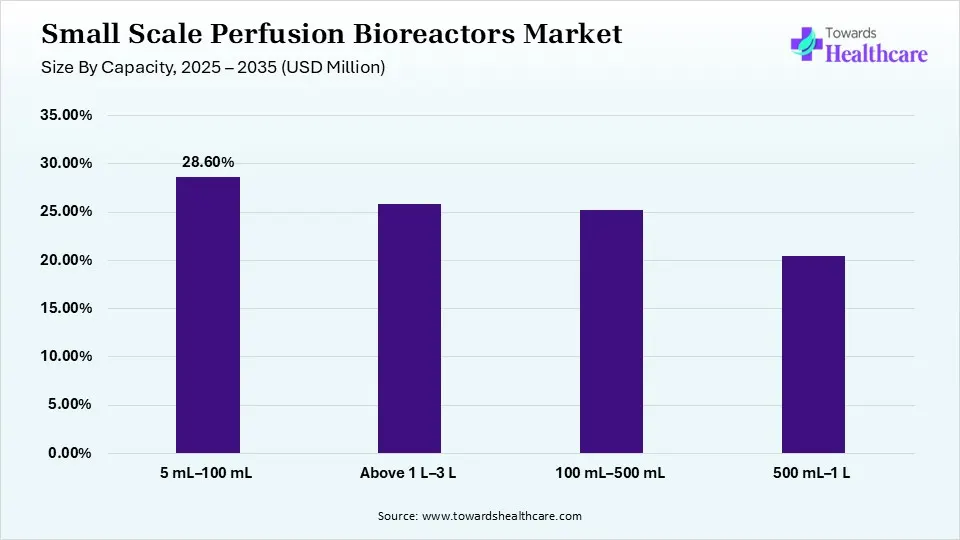
5 mL–100 mL held the major revenue share of 28.60% (USD 79.51 million) in 2025 and is projected to reach USD 165.23 million by 2035, expanding at a CAGR of 7.59% during the forecast period. Systems of 5 mL–100 mL include micro-bioreactors and high-throughput arrays that run many perfusion experiments in parallel with little medium. The dominance of this segment is due to the fact that they allow fast clone selection and media screening for perfusion processes.
Systems above 1 L to 3 L are benchtop vessels that best represent manufacturing-scale perfusion, often used to confirm processes before scale-up. This is the fastest-growing capacity range as companies validate intensified processes and cell therapy developers expand cells at bench scale.
Systems of 100 mL–500 mL, such as mini bioreactors with integrated retention filters, provide excellent balance between throughput and process representativeness.
Systems of 500 mL–1 L are used for process characterization and producing material for analytical testing.
Note: 2025 is the base year; 2035 values are forecasts.
Sources: Expert interviews, secondary sources, Towards Healthcare database and Towards Healthcare analysts.
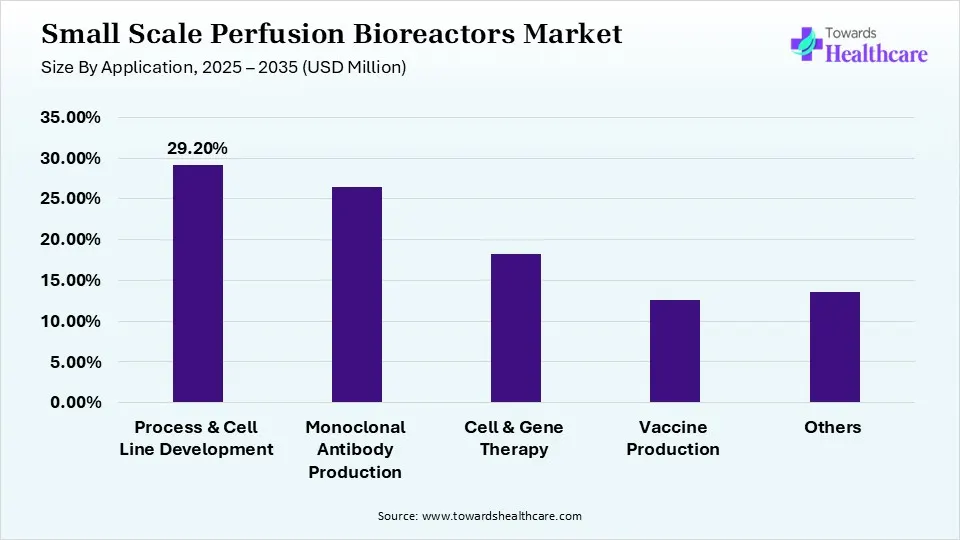
Process & Cell Line Development captured a market share of 29.20% (USD 81.18 million) in 2025 and is forecasted to expand to USD 167.65 million by 2035, growing at a CAGR of 7.52% from 2026 to 2035. Process and cell line development represents the largest application base, as it covers clone screening, media and feed optimization, and design of experiments for perfusion processes before scale-up.
Monoclonal antibody production makes use of small scale perfusion systems to develop intensified and continuous processes, including N-1 seed perfusion and high-density cultures for antibodies and biosimilars.
Cell and gene therapy is growing at the fastest pace in the applications category because perfusion supports high-density expansion of T cells, NK cells and stem cells, and viral vector production benefits from continuous medium exchange.
Vaccine production uses perfusion for viral and recombinant protein vaccine development, including microbial perfusion fermentation in emerging-market vaccine makers.
This segment includes tissue engineering, recombinant proteins and research applications.
Note: 2025 is the base year; 2035 values are forecasts.
Sources: Expert interviews, secondary sources, Towards Healthcare database and Towards Healthcare analysts.
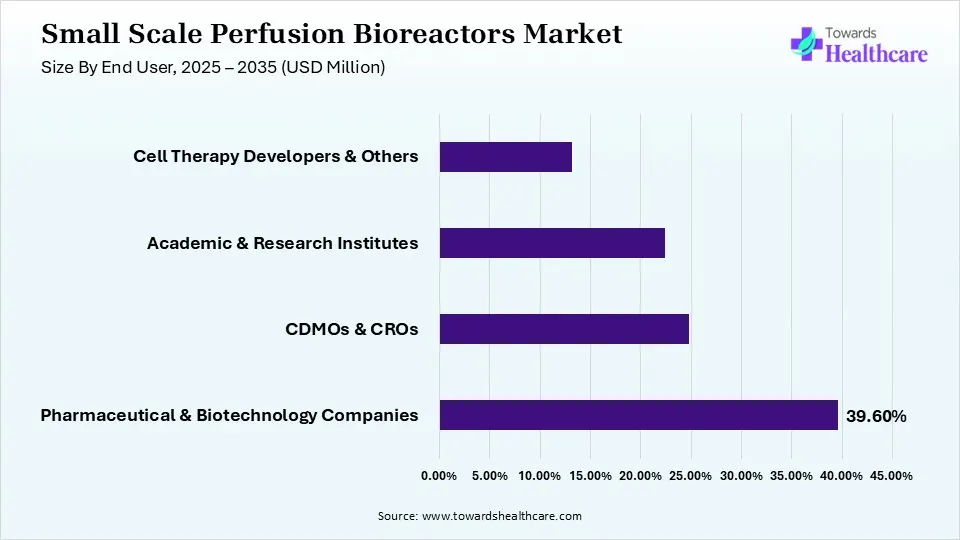
Pharmaceutical & Biotechnology Companies held a market share of 39.60% (USD 110.09 million) in 2025 and is forecasted to expand to USD 229.95 million by 2035, expanding at a CAGR of 7.64% from 2026 to 2035. Pharmaceutical and biotechnology companies are the largest end users of small scale perfusion bioreactors, as they operate process development laboratories to design intensified processes for antibodies, biosimilars and new modalities.
CDMOs & CROs accounted for 24.80% (USD 68.94 million) of revenue in 2025 and is projected to reach USD 166.90 million by 2035, expanding at a CAGR of 9.24% throughout the forecast period. CDMOs and CROs are growing at the highest rate in the end-user category as outsourcing of process development is increasing and CDMOs are increasingly investing in perfusion capabilities to secure continuous manufacturing projects.
Academic & Research Institutes held a market share of 22.40% (USD 62.27 million) in 2025 and is projected to reach USD 134.99 million by the end of the forecast period, expanding at a CAGR of 8.04% from 2026 to 2035. Academic and research institutes use small scale perfusion systems to study cell culture, develop new processes and train bioprocess engineers.
Cell Therapy Developers & Others accounted for 13.20% (USD 36.70 million) of revenue in 2025 and is projected to reach USD 79.55 million by 2035, expanding at a CAGR of 8.04% from 2026 to 2035. Cell therapy developers and others include companies which are developing cell therapies and vaccine manufacturers that use perfusion at small scale.
Analyst View: Segment values were allocated by matching shipments, consumables and prices to types, capacities, applications and end users, using supplier portfolios and process development data. Single-use systems, micro-scale capacity, process development and pharmaceutical users lead. We expect larger benchtop capacities, cell and gene therapy and CDMOs to gain share.
| Region | 2025 Share | 2025 Value (USD Million) | 2035 Value (USD Million) | CAGR 2026–2035 |
| North America | 48.00% | 133.44 | 273.75 | 7.45% |
| Europe | 26.80% | 74.50 | 158.62 | 7.85% |
| Asia Pacific | 19.60% | 54.49 | 145.88 | 10.35% |
| Latin America | 3.20% | 8.90 | 18.94 | 7.85% |
| Middle East & Africa | 2.40% | 6.67 | 14.20 | 7.85% |
Note: 2025 is the base year; 2035 values are forecasts.
Sources: Expert interviews, secondary sources, Towards Healthcare database and Towards Healthcare analysts.
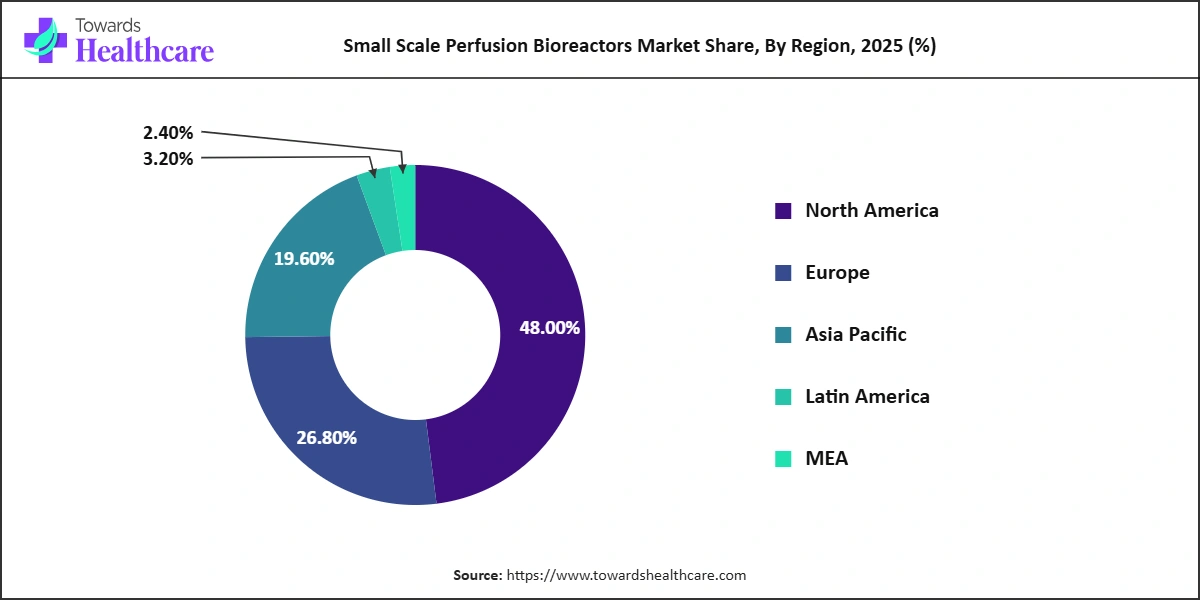
North America captured a market share of 48.00% (USD 133.44 million) in 2025 and is forecasted to expand to USD 273.75 million by 2035, growing at a CAGR of 7.45% from 2026 to 2035. The U.S. has the largest biopharmaceutical process development base, a significant presence of key cell and gene therapy developers and who were early adopters of continuous processing, and encouragement for advanced manufacturing by the FDA. Boston, San Francisco and North Carolina are major regional hubs.
Europe accounted for 26.80% (USD 74.50 million) of revenue in 2025 and is projected to reach USD 158.62 million by 2035, expanding at a CAGR of 7.85% over the forecast period. Europe has strong biopharmaceutical and CDMO sectors and benefits from the presence of key players such as Sartorius, Merck KGaA and Getinge's Applikon. Germany, Switzerland, the UK, Ireland and Belgium have the highest degree of adoption of intensified processing in the region.
Asia Pacific held a market share of 19.60% (USD 54.49 million) in 2025 and is forecasted to expand to USD 145.88 million by the end of the forecast period, expanding at a CAGR of 10.35% from 2026 to 2035. Asia Pacific is the fastest-growing region, owing to swift biomanufacturing growth in China, South Korea and India, large CDMOs such as WuXi Biologics, Samsung Biologics and Celltrion, and vaccine manufacturers adopting perfusion, such as the Serum Institute of India.
Latin America accounted for 3.20% (USD 8.90 million) of revenue in 2025 and is projected to reach USD 18.94 million by 2035, expanding at a CAGR of 7.85% throughout the forecast period. Regional market growth is supported by biologics and vaccine development in Brazil, Argentina and Mexico.
Middle East & Africa held a 2.40% (USD 6.67 million) share in 2025 and is projected to reach USD 14.20 million by the end of the forecast period, growing at a CAGR of 7.85% from 2026 to 2035. The market ecosystem in the region benefits from new biomanufacturing initiatives in Saudi Arabia, the UAE, Israel and South Africa.
Analyst View: Regional shares were built from process development activity, biopharma pipelines and system installations in each region. North America leads because of its R&D base. We assign Asia Pacific the highest growth premium because biomanufacturing and CDMO capacity are expanding at the fastest pace in this region.
| Rank | Company Name | Market-Specific Revenue (USD Million) | 2025 Share | Key Products / Business | Headquarters |
| 1 | Sartorius | 62.00 | 22.30% | ambr 15 and ambr 250 perfusion, Biostat B | Germany |
| 2 | Getinge (Applikon) | 22.00 | 7.91% | Applikon micro-Matrix and benchtop bioreactors | Sweden |
| 3 | Eppendorf | 20.00 | 7.19% | DASbox and BioFlo benchtop systems | Germany |
| 4 | Repligen | 18.00 | 6.47% | XCell ATF and KrosFlo cell retention | United States |
| 5 | Thermo Fisher Scientific | 16.00 | 5.76% | Benchtop single-use bioreactors | United States |
| 6 | Merck KGaA (MilliporeSigma) | 14.00 | 5.04% | Mobius Breez micro-bioreactor | Germany |
| 7 | Cytiva | 14.00 | 5.04% | Benchtop bioreactors and perfusion systems | United States |
| 8 | PBS Biotech | 6.00 | 2.16% | Vertical-Wheel bioreactors | United States |
| 9 | FiberCell Systems | 4.00 | 1.44% | Hollow-fibre perfusion bioreactors | United States |
| 10 | Sunflower Therapeutics | 3.00 | 1.08% | Daisy Petal perfusion bioreactor | United States |
Note: Company revenues and shares are 2025 estimates.
Sources: Company press releases, expert interviews, secondary sources, Towards Healthcare database and Towards Healthcare analysts.
Sartorius holds a leading position because of its ambr high-throughput mini bioreactors, including perfusion-capable ambr 15 and ambr 250 systems, and Biostat benchtop bioreactors. Getinge's Applikon provides micro-bioreactor and benchtop systems, and Eppendorf supplies parallel DASbox and BioFlo benchtop bioreactors. Repligen, Thermo Fisher Scientific, Merck KGaA, Cytiva, PBS Biotech, FiberCell Systems and Sunflower Therapeutics compete through cell retention devices, single-use bioreactors, micro-perfusion systems, benchtop platforms, vertical-wheel, hollow-fiber and microbial perfusion systems.
The top 10 companies accounted for a 64.39% (USD 179.00 million) share in 2025, while the remaining 35.61% (USD 99.00 million) was shared among regional bioreactor manufacturers, academic spin-offs and specialized cell retention suppliers. The market is concentrated around a few bioprocess suppliers, and competition revolves around scale-down accuracy, throughput, cell retention performance, automation and analytics, consumable cost and integration with larger systems. Specialists compete in micro-perfusion, cell therapy and microbial niches.
The small scale perfusion bioreactors ecosystem links component and film suppliers with bioreactor and cell retention makers, software and analytics providers, and biopharma, CDMO and research users.
| Ecosystem Stage | Role in the Market | Key Companies |
| Components & Films | Supply films, sensors, filters and pumps | Film and sensor suppliers, filter makers |
| Bioreactor Makers | Build small scale perfusion systems | Sartorius, Getinge, Eppendorf, Thermo Fisher, Merck KGaA, Cytiva |
| Cell Retention | Provide ATF, TFF and hollow-fibre devices | Repligen, FiberCell Systems |
| Software & Analytics | Provide control, data and PAT tools | Bioreactor makers, analytics suppliers |
| End Users | Develop perfusion processes | Pharma companies, CDMOs, universities, cell therapy developers |
Sources: Company press releases, expert interviews, secondary sources, Towards Healthcare database and Towards Healthcare analysts.
The Towards Healthcare Companies Quadrant positions key participants in the market by market strength, reflecting revenue scale, market share and geographic reach, and by innovation and growth strategy, reflecting product portfolio breadth, research and development intensity and collaborations. Positions reflect each company's estimated 2025 small scale perfusion revenue and our assessment of its technology, product launches and partnerships.
Sources: Company press releases, expert interviews, secondary sources, Towards Healthcare database and Towards Healthcare analysts.
Leaders: Sartorius, Getinge (Applikon), Eppendorf, Repligen, Thermo Fisher Scientific, Merck KGaA (MilliporeSigma) and Cytiva bring together large revenue and perfusion-ready platforms, cell retention and global service.
Innovators: PBS Biotech and Sunflower Therapeutics bring vertical-wheel, micro-perfusion and microbial perfusion systems.
Niche Players: FiberCell Systems serve narrower hollow-fiber segments.
By Type
By Capacity
By Application
By End User
By Region
The market is defined as micro, mini and benchtop perfusion bioreactors up to about 3 liters, cell retention devices, single-use vessels, software and service for process development and research. The 2025 base year was built bottom-up from small scale perfusion system shipments by type, capacity, application, end user and region, prices and consumable use, and checked top-down against the upstream process development revenues of prominent bioprocess suppliers.
Segment, regional and company values were allocated from types, capacities, applications, end users and regional demand. Key estimates were verified by cross-checking company disclosures, regulatory and industry data and published third-party estimates, and inputs that could not be reconciled were excluded. All segment, regional and company figures were reconciled to the same 2025 base year, and the 2026–2035 forecast, which applies a constant CAGR from the 2025 base, was recalculated and validated.
Analyst View: The market is a key enabler of the industry's shift towards intensified and continuous biomanufacturing. Our estimate links demand to system shipments, consumables and prices, so the forecast follows process development activity, perfusion adoption and new modalities. The main upside comes from cell and gene therapy and CDMO investment, while the main risk is the complexity of perfusion processes.