

Pipeline Programs

CGT Companies Tracked

Manufacturing Facilities


The U.S. intravenous solutions market size is predicted to increase from USD 6.19 billion in 2026 to approximately USD 10.82 billion by 2035, expanding at a CAGR of 6.4% from 2026 to 2035. The U.S. intravenous solutions market is growing because of the rising prevalence of chronic and acute health diseases that need fluid therapy, boosted by technological development and increasing healthcare infrastructure.
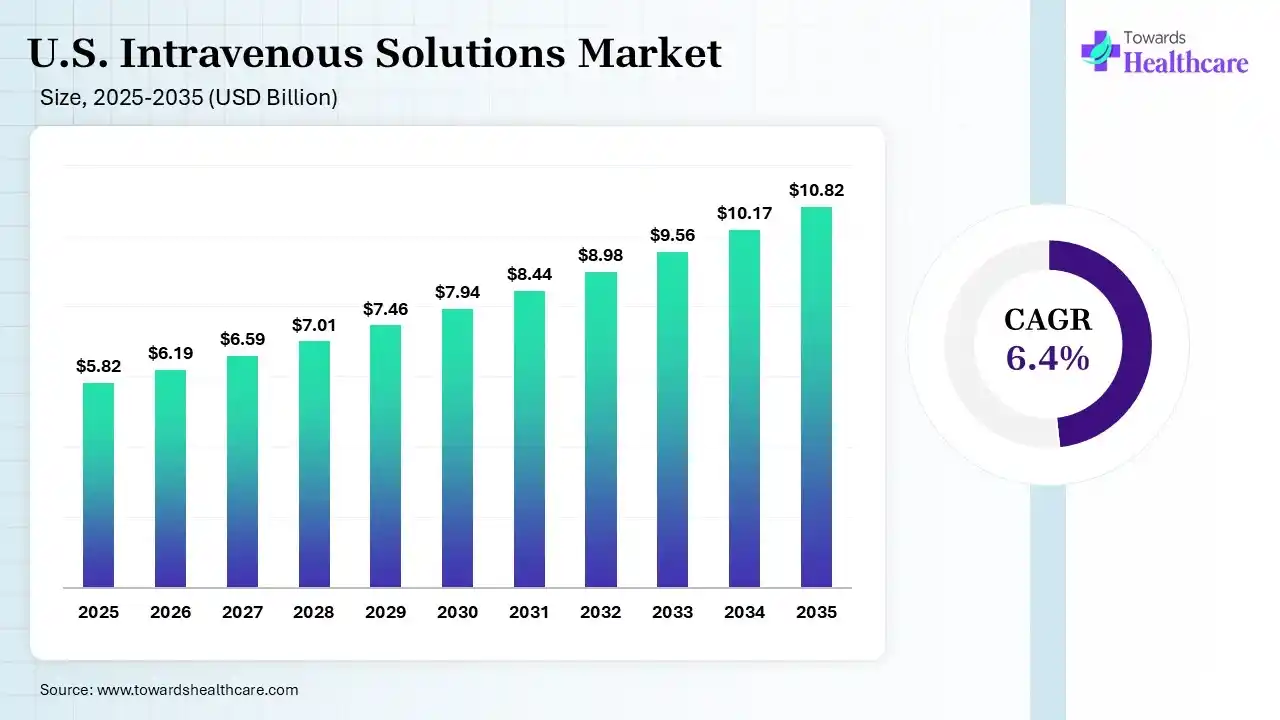
The U.S. intravenous solutions market is growing, as IV fluids are particularly formulated liquids that are injected into a vein to avoid or manage dehydration. They are applicable to patients of various ages who are injured, sick, dehydrated from a workout or heat, or suffering from surgery. IV fluids are liquids injected into an individual’s veins via an IV tube. IV fluids are also applied specifically to treat an emerging electrolyte or acid-base disorder. IV fluids are significant in the management of certain subtypes of hypernatremia, hyponatremia, metabolic alkalosis, and metabolic acidosis. IV fluid restores fluid to the intravascular space, and IV fluids are applied to enable the movement of fluid among compartments due to osmosis.
Intravenous solutions are sterile fluids administered directly into the bloodstream to provide hydration, electrolyte balance, nutrition, blood volume replacement, and medication delivery for patients across acute and chronic settings. The U.S. intravenous solution market is expanding due to the increasing prevalence of chronic diseases, growing hospitalization rates, and rising demand for critical care, surgical, and home infusion therapies. Technological advancements in ready-to-use (RTU) formulations are improving treatment safety and operational efficiency. The growing adoption of biologics and specialty injectable drugs is creating new opportunities for advanced IV delivery systems. Future growth is supported by innovations in personalized infusion therapy, connected healthcare technologies, sustainable packaging, and expanded home healthcare services. Continuous investments in manufacturing capacity and supply chain resilience are further strengthening long-term market development.
AI-driven technology is increasingly playing an important role in different aspects of medical care, involving infusion therapy. Intravenous therapy includes the administration of medications, fluids, or nutrients via an intravenous (IV) line, and AI-based technology improves safety, effectiveness, and patient results. An AI-based algorithm is responsible for processing the sensor data in real-time. It is trained to recognize patterns and irregularities related to blood backflow actions. This training includes a dataset of known backflow events and non-events. An AI-driven auto-shutoff mechanism would engage with different functions of IV services.
| Table | Scope |
| Market Size in 2026 | USD 6.19 Billion |
| Projected Market Size in 2035 | USD 10.82 Billion |
| CAGR (2026 - 2035) | 6.4% |
| Key Applications | Fluid replacement, electrolyte balance, parenteral nutrition, critical care, surgery, emergency medicine, oncology, infectious disease treatment |
| Primary End Users | Hospitals, Ambulatory Surgical Centers (ASCs), Clinics, Home Healthcare Providers, Long-Term Care Facilities |
| Key Growth Drivers | Rising chronic disease burden, increasing surgeries, aging population, expansion of home infusion therapy, smart infusion technologies, healthcare infrastructure investments |
| Measurable Values | USD Millions/Units/Volume |
| Market Segmentation | By Product Type, By Nutritional Content, By Volume, By End User, By Packaging Type, By Distribution Channel |
| Top Key Players | Baxter International Inc., ICU Medical, Inc., B. Braun Medical Inc., Fresenius Kabi USA, Pfizer Inc. |
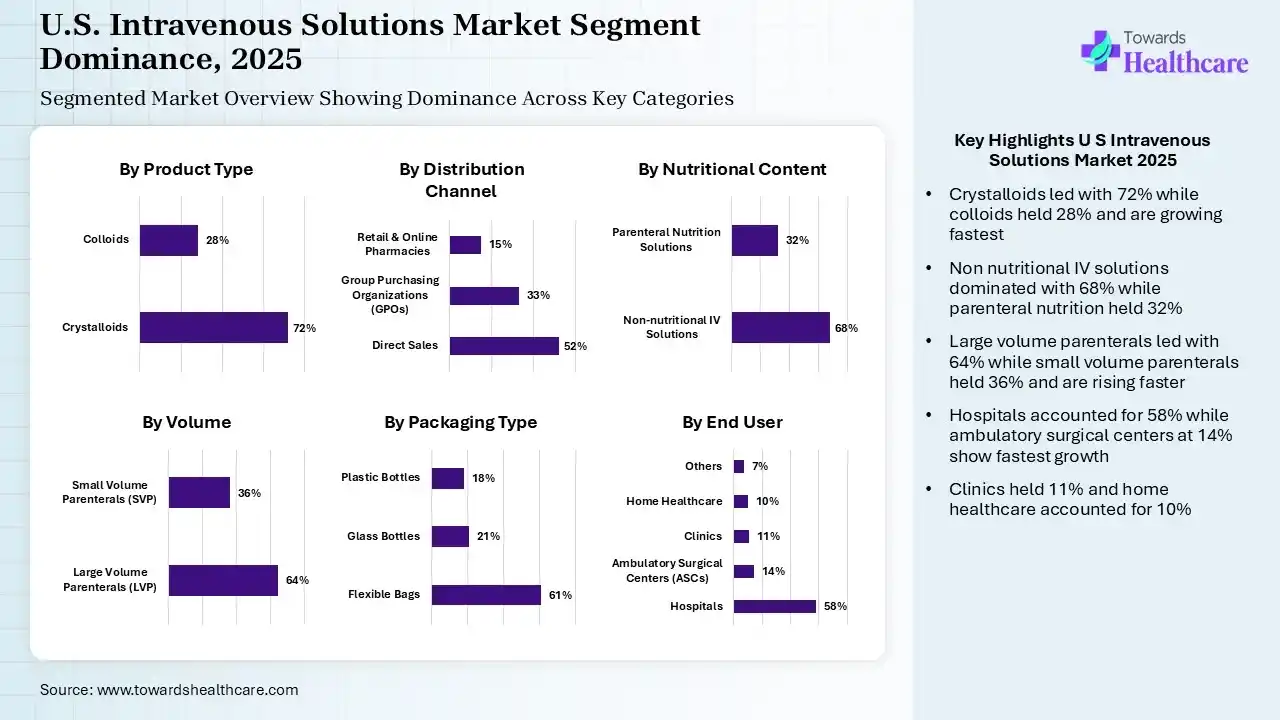
| Segment | Share 2025 (%) |
| Crystalloids | 72% |
| Colloids | 28% |
Crystalloids Segment Led the U.S. Intravenous Solutions Market in 2025
The crystalloids segment contributed the largest market share of 72% in 2025, as crystalloids are most often preferred because of their ease of administration and reduced challenges of allergic reactions. These fluids are further classified on the basis of their electrolyte composition, osmolarity, and metabolic properties. They are applied for growing the intravascular volume in conditions such as dehydration, hypotension, and sepsis.
The colloids segment held the second-largest share of 28%, and is expected to grow at the fastest CAGR of 7.0% in the market, as colloids have larger molecules, are affordable, and also provide swifter volume increase in the intravascular space. Colloids are better than crystalloids at escalating the circulatory volume, because their larger molecules are retained more simply.
| Segment | Share 2025 (%) |
| Non-nutritional IV Solutions | 68% |
| Parenteral Nutrition Solutions | 32% |
Non-nutritional IV Solutions Segment Led the U.S. Intravenous Solutions Market in 2025
The non-nutritional IV solutions segment contributed the largest market share of 68%, as it offers subjective developments in energy levels, mental clarity, and overall well-being following administration. It provides rapid recovery from conditions like dehydration, hangovers, jet lag, and physical exhaustion when managed with IV fluids improved with electrolytes, B vitamins, and vitamin C.
The parenteral nutrition solutions segment held a significant share of 32% of the market in 2025. Parenteral nutrition is the ability to help patients who can’t eat or absorb nutrients via conventional means. It allows nutritional services to be infused for 8 to 18 hours daily. It provides satisfactory nutrients in the face of gastrointestinal dysfunction.
| Segment | Share 2025 (%) |
| Large Volume Parenterals (LVP) | 64% |
| Small Volume Parenterals (SVP) | 36% |
The Large Volume Parenterals (LVP) Segment held the Largest Share in the Market in 2025
The large volume parenterals (LVP) segment contributed the largest U.S. intravenous solutions market share of 64% in 2025, as it is a single-dose injection that is designed for intravenous applications and is packaged in containers labelled as containing more than 100 mL. It is applied to offer fluids, electrolytes, and nutrition intravenously. These solutions in either the plastic bag or the glass bottle flow from the containers to the patient via an administration set.
The small volume parenterals (SVP) segment held a notable share of 36% of the market in 2025, expected to grow at the fastest CAGR of 6.8% of the market, as small volume parenterals have volumes less than 100mL and involve solutions, emulsions, suspensions, and dry powders. It is packaged in various ways based on the intended use.
| Segment | Share 2025 (%) |
| Hospitals | 58% |
| Ambulatory Surgical Centers (ASCs) | 14% |
| Clinics | 11% |
| Home Healthcare | 10% |
| Others | 7% |
The Hospitals Segment held the Largest Share in the Market in 2025
The hospitals segment contributed the largest U.S. intravenous solutions market share of 58% in 2025, as in hospital applicable to manage pain and nausea by rapidly achieving therapeutic levels, and they are more reliably and completely absorbed compared with medications given by various routes of injection. IV infusion therapy delivers blood, fluids, nutrients, and medication directly to the bloodstream to supports to feel better rapidly.
The ambulatory surgical centers (ASCs) segment held the second largest share of 14%, and is expected to grow at the fastest CAGR of 7.1% of the market, as ambulatory infusion centers offer optimum services for field physicians committed to bringing timely, efficient treatments. It is making treatments more effective and patient-friendly. It provides comfortable treatment environments with private or semi-private rooms.
The clinics segment held a notable share of 11% the market, as IV therapy use in clinics delivers fluids straight to the bloodstream, offering rapid and efficient hydration that helps significant organ function and supports to feel better almost rapidly.
The home healthcare segment held a notable share of 10% of the U.S. intravenous solutions market. Home infusion therapy reduces travel expenses, lowers hospital admissions, and limits the likelihood of hospital-acquired infections, eventually creating more positive patient results. Home infusion therapy enhances end-of-life care by increasing the time patients spend with their family at home.
South U.S. is expected to show lucrative growth during the forecast period due to a growing geriatric population. Increasing incidence of chronic diseases is also driving the demand for intravenous solutions. Expanding healthcare infrastructure and surgical procedures are also driving the demand for intravenous solutions.
The presence of advanced healthcare infrastructure in the Northeast U.S. is driving the adoption of various intravenous solutions. A rise in the incidence of chronic disease is also driving their demand. At the same time, increasing surgical procedures and development of biologics are also encouraging their use.
West U.S. is anticipated to show considerable growth during the predicted timeframe due to the presence of well-established healthcare infrastructure. Increasing age-related diseases and cancer cases are also driving the demand for IV therapies. The growing outpatient care and home-based treatments are also supporting their adoption.
The Midwest U.S. is experiencing a rapid expansion in the healthcare infrastructure, which is ultimately driving the demand for IV solutions. Additionally, increasing incidences of diabetes, kidney disorders, cancer, and age-related diseases are also increasing their consumption. The growing outpatient infusion services are also supporting their expansion.
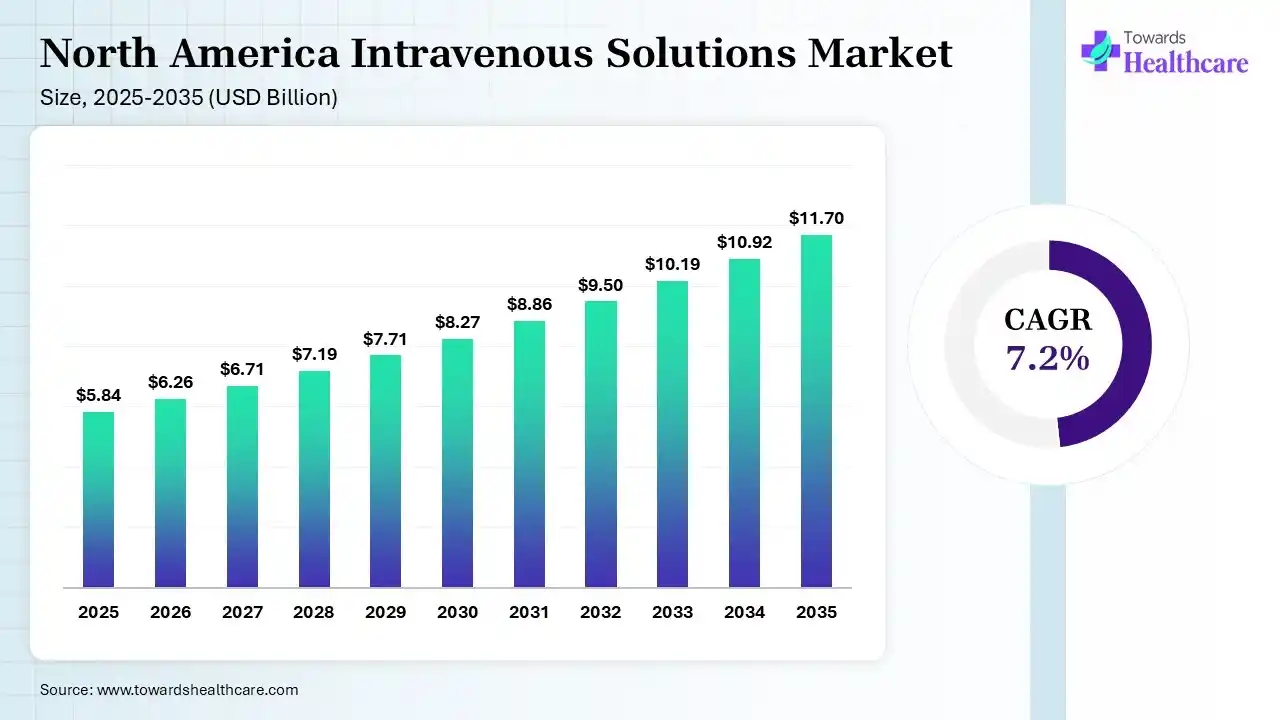
The North America intravenous solutions market size is predicted to increase from USD 6.26 billion in 2026 to approximately USD 11.7 billion by 2035, expanding at a CAGR of 7.2% from 2026 to 2035.
U.S. Strengthens Leadership in the Intravenous Solutions Market
The U.S. intravenous solution market is growing due to the increasing prevalence of chronic diseases, rising hospital admissions, and expanding demand for surgical, emergency, and critical care services. Widespread adoption of home infusion therapy, strong healthcare infrastructure, and continuous investment in sterile manufacturing and smart infusion technologies are driving market expansion. The growing use of biologics and supportive reimbursement policies further contributes to sustained market growth.
|
Ecosystem Segment
|
Key Participants | Role in Market |
| Technology Providers | ICU Medical, Baxter International, B. Braun | Smart infusion pumps, IV administration technologies, infusion monitoring |
| Product Manufacturers | Baxter, Fresenius Kabi, B. Braun, Grifols, Otsuka Pharmaceutical Factory | Production of IV fluids, parenteral nutrition solutions, electrolytes, colloids, crystalloids |
| Service Providers | Option Care Health, CVS Health (Coram), BrightSpring Health Services | Home infusion and patient administration services |
| Platform Providers | Baxter, ICU Medical | Integrated infusion management systems and connected infusion platforms |
| CROs/CDMOs | PCI Pharma Services, Vetter Pharma, Catalent | Sterile manufacturing and development support for injectable products |
| Software Vendors | BD (CareFusion), ICU Medical, Baxter | Infusion management software and medication safety systems |
| Research Institutions | Mayo Clinic, Cleveland Clinic, Johns Hopkins Medicine, NIH | Clinical research, infusion therapy studies, nutritional therapy research |
| End-User Industries | Hospitals, ASCs, Home Healthcare, Specialty Clinics | Consumption and administration of IV solutions |
| Tier 1 | Tier 2 | Tier 3 | |
| Typical Market Influence | 68% | 24% | 8% |
| Tier 1 | ||||
| Company Name | Headquarters | Country | Why Relevant to This Market | Key Products/Services |
| Baxter International | Deerfield, Illinois | USA | Largest IV solutions supplier in North America with extensive manufacturing network | IV solutions, parenteral nutrition, infusion systems |
| Fresenius Kabi | Bad Homburg | Germany | Major supplier of IV drugs, nutrition products, and infusion therapies | IV fluids, clinical nutrition, injectable medicines |
| B. Braun | Melsungen | Germany | Broad IV fluid portfolio and infusion therapy leadership | Crystalloids, infusion systems, IV administration products |
| Tier 2 | ||||
| Company Name | Headquarters | Country | Why Relevant to This Market | Key Products/Services |
| Pfizer | New York, New York | USA | Major injectable and hospital pharmaceutical supplier | IV anti-infectives, injectable therapies |
| Otsuka Pharmaceutical Factory | Naruto, Tokushima | Japan | Leading IV solution manufacturer with U.S. joint venture activities | IV fluids, electrolyte solutions |
| Terumo Corporation | Tokyo | Japan | Strong infusion and vascular access portfolio | Infusion systems and administration products |
| Tier 3 | ||||
| Company Name | Headquarters | Country | Why Relevant to This Market | Key Products/Services |
| Option Care Health | Bannockburn, Illinois | USA | Major home infusion therapy provider benefiting from shift to home care | Home infusion services |
| BrightSpring Health Services | Louisville, Kentucky | USA | Expanding home infusion and specialty pharmacy operations | Home IV administration services |
| Baxter's Hillrom Infusion Business | Chicago, Illinois | USA | Specialized infusion technology operations supporting IV therapy | Infusion monitoring technologies |
In July 2026, "By strengthening our US manufacturing footprint, expanding non-DEHP capabilities, and introducing innovation, we are enhancing supply reliability for North American customers while positioning ourselves to better support future regulatory and legislative requirements”, said Yoshifumi Fujimoto, chief executive officer of Otsuka ICU Medical LLC.
By Product Type
By Nutritional Content
By Volume
By End User
By Packaging Type
By Distribution Channel





Principal Consultant
Payal Rabde is a Healthcare Market Research Analyst at Towards Healthcare Research & Consulting with 4+ years of experience in pharmaceuticals, biotechnology, medical devices, and life sciences.
Learn more about Payal Rabde

Reviewed By
Aditi Shivarkar is a seasoned professional with over 14 years of experience in healthcare market research. As a content reviewer, Aditi ensures the quality and accuracy of all market insights and data presented by the research team.
Learn more about Aditi Shivarkar









