
The U.S. microcarrier beads market is projected to grow from USD 565.00 million in 2025 to USD 1,723.72 million by 2035 because cell therapy and vaccine makers need to grow adherent cells at large scale. Cell therapy scale-up, vaccine capacity, bioreactor adoption, and CDMO growth support strong growth, lifting the market to USD 986.86 million by 2030 and sustaining a CAGR of 11.80% from 2026 to 2035. Microcarriers are used with cell culture media in cell therapy and cell-based vaccine production.
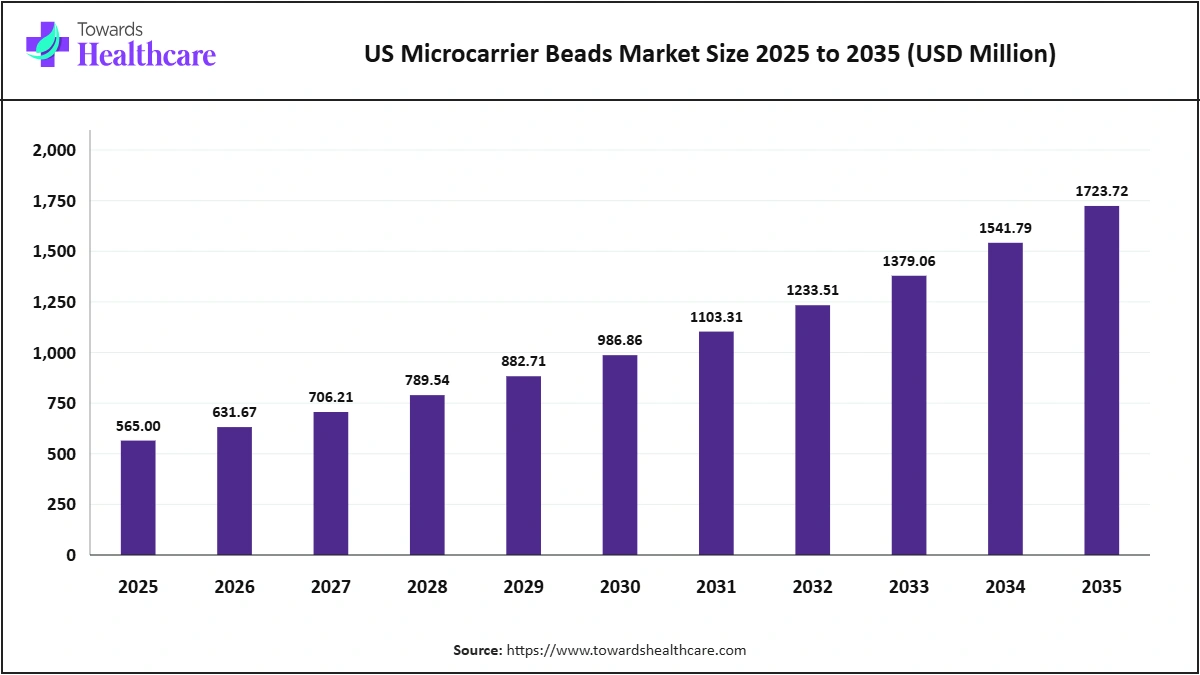
Analyst View: The estimate was developed using U.S. adherent cell culture volumes and the amount of beads used per litre of culture. These volumes were multiplied by the corresponding product prices and cross-checked against supplier revenues and the global microcarrier market estimate, with the U.S. market share applied to arrive at the final value.
Market Drivers - Impact & CAGR Contribution (2026-2035)
| Driver | Impact | ≈ CAGR Contribution | Time Horizon | Key Regions |
| Cell therapies scale | High | +4.61 pp | Short to long term | U.S.-wide, strongest in Northeast |
| Vaccines need capacity | Medium | +3.89 pp | Medium to long term | U.S.-wide, fastest uptake in South |
| Bioreactors replace flasks | Medium | +3.31 pp | Short to medium term | U.S.-wide |
| CDMOs grow | Low | +2.59 pp | Long term | Northeast and South |
Note: Contributions are indicative estimates of each factor's effect on annual growth.
Sources: Expert interviews, secondary sources, Towards Healthcare database, and Towards Healthcare analysts.
Taken together, these drivers add about 14.40 percentage points to the annual growth of the U.S. microcarrier beads market, with cell therapies scale having the largest effect. Their influence is strongest in Northeast, while uptake grows fastest in South.
Market Restraints - Impact & Negative CAGR Contribution (2026-2035)
| Restraint | Impact | ≈ Negative CAGR Contribution | Time Horizon | Key Regions |
| Harvest losses | High | -1.17 pp | Short to medium term | U.S.-wide |
| Process complexity | High | -0.86 pp | Medium term | Smaller and price-sensitive markets |
| Cost | Medium | -0.57 pp | Short term | Northeast and other mature markets |
Note: Contributions are indicative estimates of each factor's effect on annual growth.
Sources: Expert interviews, secondary sources, Towards Healthcare database and Towards Healthcare analysts.
These restraints are expected to reduce annual growth of the U.S. microcarrier beads market by about 2.60 percentage points, led by harvest losses. Their effect eases over the forecast period as suppliers, buyers and regulators adapt, leaving a net CAGR of 11.80% from 2026 to 2035.
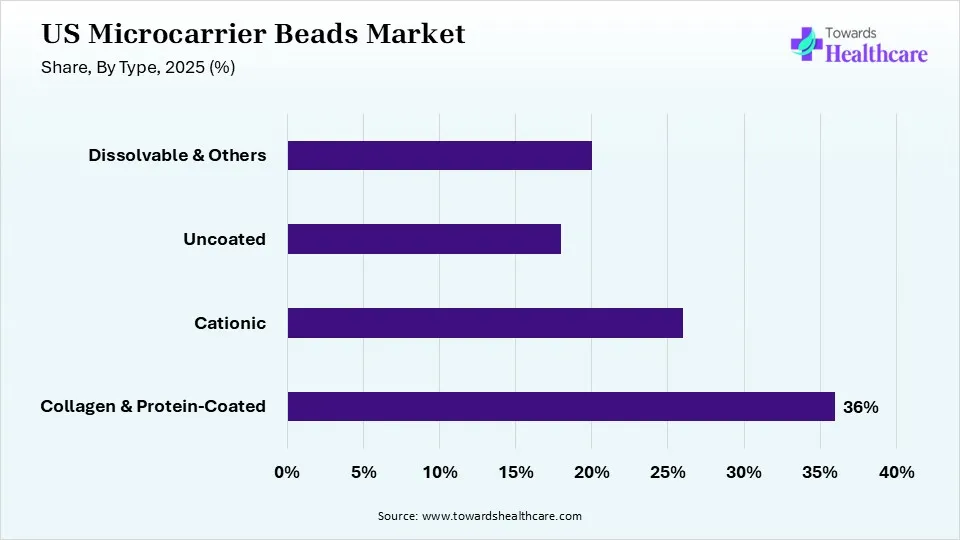
Note: 2025 is the base year; 2035 shares and CAGRs are forecasts.
Sources: Expert interviews, secondary sources, Towards Healthcare database, and Towards Healthcare analysts.
Collagen & Protein-Coated: The Collagen and Protein-Coated Beads segment held the largest share of the U.S. microcarrier beads market in 2025, accounting for 36.00% of total revenue. It is projected to grow at a CAGR of 10.75% from 2026 to 2035. These beads are widely used because their coated surfaces support the attachment and growth of stem cells and other adherent cells. However, the segment is expected to grow at a slower pace than the overall market during the forecast period.
Cationic beads are widely used for vaccine cell lines. The cationic segment is expected to grow slower than the overall market over the forecast period.
These beads are commonly used in cost-sensitive cell culture processes where additional surface coatings are not essential. However, the segment is expected to grow at a slower pace than the overall market during the forecast period.
Dissolvable beads grow fastest because they simplify cell harvest for cell therapy. The dissolvable & others segment is expected to grow faster than the overall market over the forecast period.
Uncoated holds the smallest share today and serves more specialised needs within the U.S. microcarrier beads market.
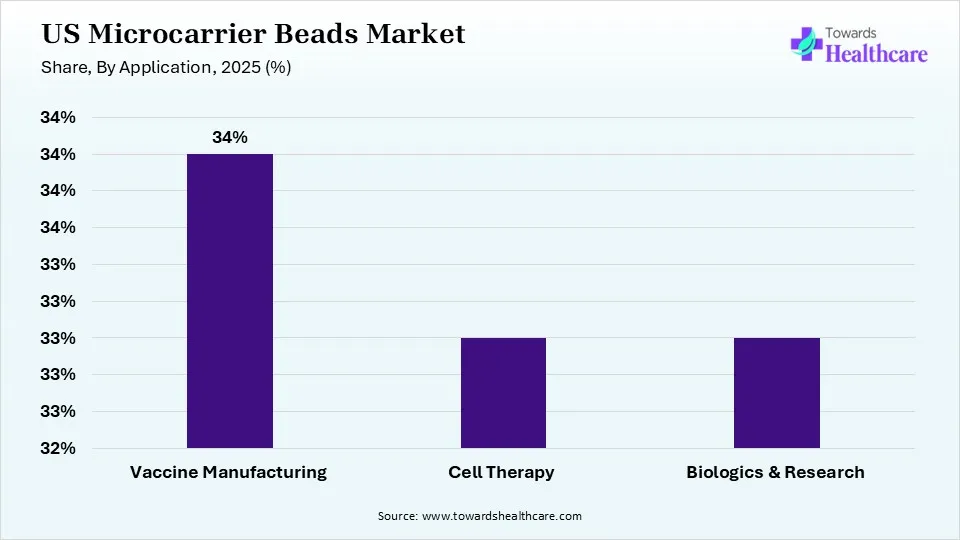
Note: 2025 is the base year; 2035 shares and CAGRs are forecasts.
Sources: Expert interviews, secondary sources, Towards Healthcare database and Towards Healthcare analysts.
Vaccine Manufacturing: This segment accounted for 34.00% of the U.S. microcarrier beads market in 2025 and is projected to expand at a CAGR of 10.45% from 2026 to 2035. Vaccine manufacturing uses microcarriers for Vero and other cell lines. The vaccine manufacturing segment is expected to grow slower than the overall market over the forecast period.
Cell therapy grows fastest as MSC and iPSC therapies scale. The cell therapy segment is expected to grow faster than the overall market over the forecast period.
Demand is supported by the use of microcarrier beads in biologics production and ongoing research activities, including cell culture and process development. However, the segment is expected to grow at a slower pace than the overall market during the forecast period.
Although Cell Therapy starts from the smallest base, its faster growth shows how demand is shifting within the U.S. microcarrier beads market.
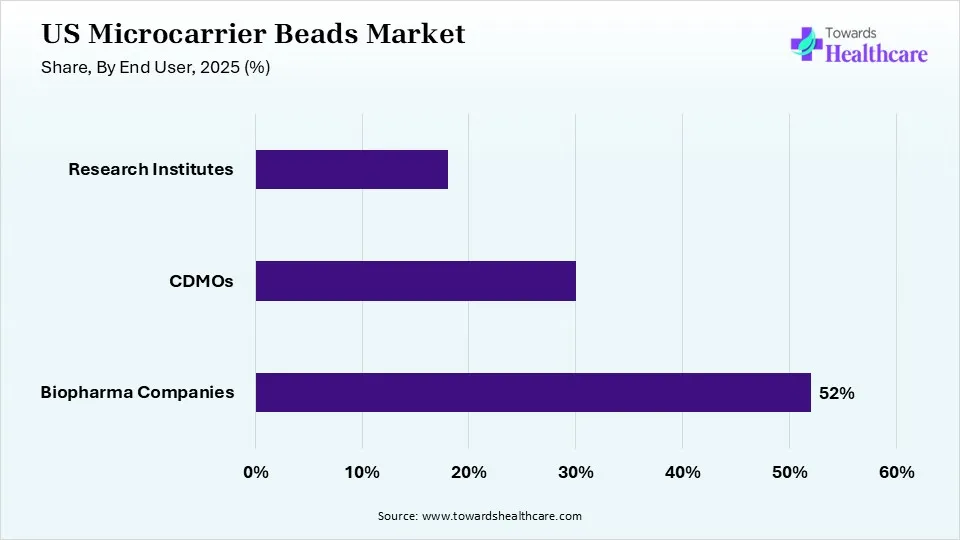
Note: 2025 is the base year; 2035 shares and CAGRs are forecasts.
Sources: Expert interviews, secondary sources, Towards Healthcare database and Towards Healthcare analysts.
Biopharma Companies: This segment accounted for 52.00% of the U.S. microcarrier beads market in 2025 and is projected to expand at a CAGR of 10.96% from 2026 to 2035. Biopharmaceutical companies lead. The biopharma companies segment is expected to grow slower than the overall market over the forecast period.
Growth is driven by increasing outsourcing of cell culture and bioprocessing activities to contract development and manufacturing organizations (CDMOs). As demand for cell therapies and biologics production increases, CDMOs are expanding their manufacturing capabilities. The segment is expected to grow faster than the overall market during the forecast period.
Research institutes develop processes. The research institutes segment is expected to grow slower than the overall market over the forecast period.
Research Institutes hold the smallest share today and serve more specialised needs within the U.S. microcarrier beads market.
Analyst View: Segment shares were estimated based on demand patterns, supplier product portfolios, and pricing across each category. Collagen & Protein-Coated Beads, Vaccine Manufacturing, and Biopharma Companies hold leading positions in their respective segments because they address the current requirements of microcarrier users. Meanwhile, Dissolvable & Other Beads, Cell Therapy and CDMOs are expected to gain market share as new technologies emerge, and demand expands across a wider range of applications and end users.
Note: 2025 is the base year; 2035 shares and CAGRs are forecasts.
Sources: Expert interviews, secondary sources, Towards Healthcare database, and Towards Healthcare analysts.
Northeast: The Northeast region held the largest share of the U.S. microcarrier beads market in 2025, accounting for 36.00% of total revenue. It is projected to grow at a CAGR of 11.27% from 2026 to 2035. Its leading position is supported by the strong presence of cell therapy companies and vaccine manufacturers, particularly in the Boston area. However, the Northeast is expected to grow at a slower pace than the overall market during the forecast period.
West: has cell therapy and biotech clusters in California. West is expected to grow broadly in line with the overall market between 2026 and 2035.
South: Regional growth is supported by the expansion of biomanufacturing activities in states such as North Carolina and Texas, where investments in production capabilities are creating greater demand for microcarrier beads. The South is expected to grow faster than the overall market during the forecast period.
Midwest: This region accounted for 14.00% of the U.S. microcarrier beads market in 2025 and is projected to expand at a CAGR of 11.67% from 2026 to 2035. The Midwest has vaccine and research facilities. Midwest is expected to grow broadly in line with the overall market between 2026 and 2035.
Analyst View: Regional shares were built from demand, installed base, spending, and supplier presence in each region. Northeast leads because of its mature demand base and strong suppliers. We assign South the highest growth premium because investment, adoption, and capacity are expanding fastest there.
| Rank | Company Name | 2025 Share (%) | Key Products / Business | Headquarters |
| 1 | Thermo Fisher Scientific | 16.81% | Nunc and Gibco microcarriers | United States |
| 2 | Cytiva | 15.93% | Cytodex microcarriers | United States |
| 3 | Corning | 12.39% | Corning dissolvable and synthetic microcarriers | United States |
| 4 | Sartorius | 7.43% | Microcarriers and bioreactor systems | Germany |
| 5 | Merck KGaA (MilliporeSigma) | 6.73% | Microcarrier beads | Germany |
| 6 | Eppendorf | 3.19% | Microcarriers and bioreactors | Germany |
| 7 | Lonza | 3.19% | Cell therapy manufacturing | Switzerland |
| 8 | Bio-Techne | 2.12% | Cell culture reagents | United States |
| 9 | PromoCell | 1.42% | Cell culture products | Germany |
| 10 | Teijin Frontier | 1.06% | Microcarriers for cell culture | Japan |
Note: Company shares are 2025 estimates.
Sources: Company press releases, expert interviews, secondary sources, Towards Healthcare database and Towards Healthcare analysts.
Thermo Fisher Scientific led the U.S. microcarrier beads market with an estimated 16.81% share of 2025 revenue, followed by Cytiva at 15.93% share and Corning at 12.39% share. Thermo Fisher Scientific leads with Nunc and Gibco microcarriers, Cytiva competes with Cytodex microcarriers, and Corning offers Corning dissolvable and synthetic microcarriers. Sartorius, Merck KGaA (MilliporeSigma), Eppendorf, Lonza, Bio-Techne, PromoCell and Teijin Frontier compete through microcarriers and bioreactor systems, microcarrier beads, microcarriers and bioreactors, cell therapy manufacturing, cell culture reagents, cell culture products and microcarriers for cell culture.
The top 10 companies accounted for an estimated 70.27% of 2025 revenue, while the remaining 29.73% was shared among smaller bead makers and research suppliers. The U.S. microcarrier beads market is moderately concentrated, and competition centres on cell attachment, harvest yield, GMP documentation, compatibility with bioreactors, supply security and price.
Thermo Fisher Scientific: Thermo Fisher Scientific is headquartered in the United States. It held an estimated 16.81% share of the U.S. microcarrier beads market in 2025. Its offering centres on Nunc and Gibco microcarriers. In the Towards Healthcare Companies Quadrant it is positioned as a Leader.
Cytiva: Cytiva, part of Danaher Corporation, is headquartered in the United States. It held an estimated 15.93% share of the U.S. microcarrier beads market in 2025. Its offering centres on Cytodex microcarriers. In the Towards Healthcare Companies Quadrant it is positioned as a Leader.
Corning: Corning is headquartered in the United States. It held an estimated 12.39% share of the U.S. microcarrier beads market in 2025. Its offering centres on Corning dissolvable and synthetic microcarriers. In the Towards Healthcare Companies Quadrant it is positioned as a Leader.
Sartorius: Sartorius is headquartered in Germany. It held an estimated 7.43% share of the U.S. microcarrier beads market in 2025. Its offering centres on Microcarriers and bioreactor systems. In the Towards Healthcare Companies Quadrant it is positioned as a Leader.
Merck KGaA (MilliporeSigma): Merck KGaA (MilliporeSigma) is headquartered in Germany. It held an estimated 6.73% share of the U.S. microcarrier beads market in 2025. Its offering centres on Microcarrier beads. In the Towards Healthcare Companies Quadrant it is positioned as a Leader.
Eppendorf: Eppendorf is headquartered in Germany. It held an estimated 3.19% share of the U.S. microcarrier beads market in 2025. Its offering centres on Microcarriers and bioreactors. In the Towards Healthcare Companies Quadrant it is positioned as a Leader.
Lonza: Lonza is headquartered in Switzerland. It held an estimated 3.19% share of the U.S. microcarrier beads market in 2025. Its offering centres on Cell therapy manufacturing. In the Towards Healthcare Companies Quadrant it is positioned as an Innovator.
Bio-Techne: Bio-Techne is headquartered in the United States. It held an estimated 2.12% share of the U.S. microcarrier beads market in 2025. Its offering centres on Cell culture reagents. In the Towards Healthcare Companies Quadrant it is positioned as an Innovator.
PromoCell: PromoCell is headquartered in Germany. It held an estimated 1.42% share of the U.S. microcarrier beads market in 2025. Its offering centres on Cell culture products. In the Towards Healthcare Companies Quadrant it is positioned as an Innovator.
Teijin Frontier: Teijin Frontier is headquartered in Japan. It held an estimated 1.06% share of the U.S. microcarrier beads market in 2025. Its offering centres on Microcarriers for cell culture. In the Towards Healthcare Companies Quadrant it is positioned as an Innovator.
The U.S. microcarrier beads ecosystem links bead makers, bioreactor makers, media suppliers, users and regulators, with each stage adding value before products reach end users.
| Ecosystem Stage | Role in the Market | Key Companies |
| Bead Makers | Manufacture microcarriers | Cytiva, Corning, Thermo Fisher |
| Bioreactor Makers | Provide stirred systems | Sartorius, Eppendorf, Thermo Fisher |
| Media Suppliers | Supply cell culture media | Gibco, Lonza |
| Users | Grow adherent cells | Vaccine makers, cell therapy firms, CDMOs |
| Regulators | Approve products | FDA |
Sources: Company press releases, expert interviews, secondary sources, Towards Healthcare database and Towards Healthcare analysts.
Bead Makers: Manufacture microcarriers. Key participants include Cytiva, Corning, Thermo Fisher.
Bioreactor Makers: Provide stirred systems. Key participants include Sartorius, Eppendorf, Thermo Fisher.
Media Suppliers: Supply cell culture media. Key participants include Gibco, Lonza.
Users: Grow adherent cells. Key participants include Vaccine makers, cell therapy firms, CDMOs.
Regulators: Approve products. Key participants include FDA.
Value in the U.S. microcarrier beads market flows from upstream material and technology suppliers to manufacturers and service providers, then through distribution partners to end users. Companies that integrate several stages or build long-term relationships with end users capture a larger share of this value.
The Towards Healthcare Companies Quadrant positions key participants in the U.S. microcarrier beads market by market strength, reflecting revenue scale, market share and geographic reach, and by innovation and growth strategy, reflecting product portfolio breadth, R&D intensity and partnerships. Positions reflect each company's estimated 2025 share of the U.S. microcarrier beads market and our assessment of its product innovation, portfolio breadth and partnerships.
Sources: Company press releases, expert interviews, secondary sources, Towards Healthcare database and Towards Healthcare analysts.
Leaders: Thermo Fisher Scientific, Cytiva, Corning, Sartorius, Merck KGaA (MilliporeSigma) and Eppendorf combine high market share with broad portfolios and strong innovation.
Innovators: Lonza, Bio-Techne, PromoCell and Teijin Frontier bring newer technologies and specialised products.
By Type
By Application
By End User
By Region
The U.S. microcarrier beads market was defined as microcarrier beads used in the United States to grow adherent cells in stirred bioreactors, including collagen-coated, cationic, protein-coated, uncoated, and dissolvable microcarriers made from dextran, polystyrene, and other materials, for vaccine manufacturing, cell therapy, biologics, and research, used by biopharmaceutical companies, CDMOs, and research institutes. The 2025 base year was built bottom-up from demand volumes and average prices by type, application and end user and region, and checked top-down against the market-specific revenues of leading companies and published estimates.
Segment, regional and company values were allocated from type, application and end user and region demand. Key estimates were verified by cross-checking company disclosures, regulatory and industry data and published third-party estimates, and inputs that could not be reconciled were excluded. All segment, regional and company figures were reconciled to the same 2025 base year, and the 2026-2035 forecast, which applies a constant CAGR from the 2025 base, was recalculated and validated.
Analyst View: The U.S. microcarrier beads market is set for steady expansion as cell therapy scale-up and related demand keep growing. Our estimate links value to underlying demand, installed base and pricing, so the forecast follows real adoption rather than headline hype. The main upside comes from dissolvable beads and iPSC therapies, while the main risks are harvest losses and alternative 3D systems.