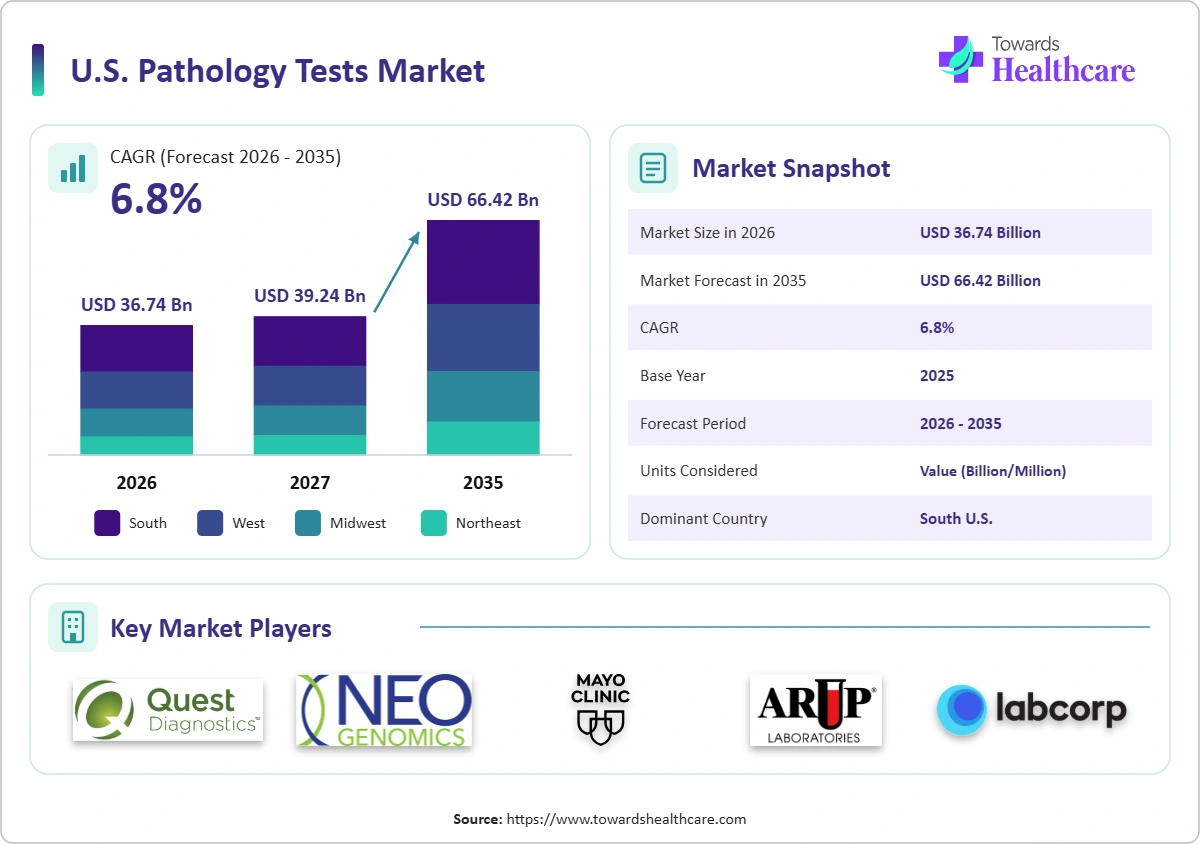
The U.S. pathology tests market is projected to increase from USD 34.40 billion in 2025 to USD 66.42 billion by 2035, supported by the essential role of pathology testing in clinical diagnosis and medical decision-making. An ageing population and rising cancer and chronic disease incidence are increasing the need for diagnostic testing. Additionally, growing adoption of molecular testing, advances in next-generation sequencing and precision medicine, and ongoing laboratory consolidation are supporting market expansion. These factors are expected to drive the market to USD 47.80 billion by 2030, registering a CAGR of 6.80% from 2026 to 2035.
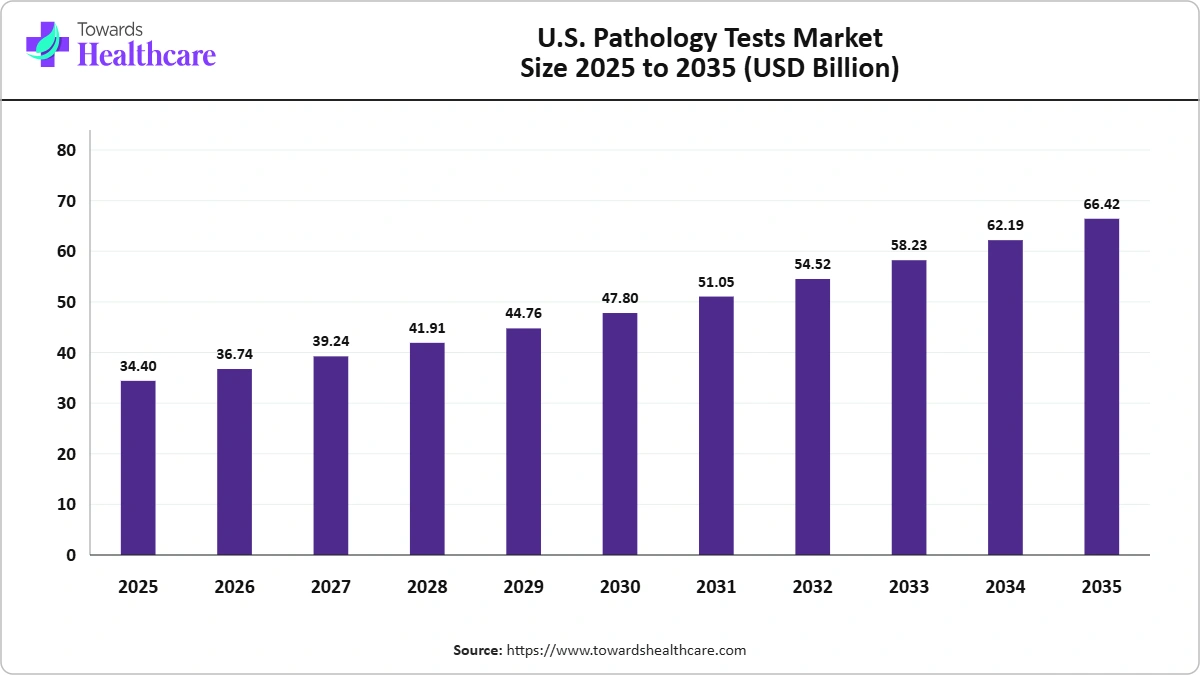
Analyst View: We built the estimate from U.S. pathology test volumes and average reimbursement by type and region, cross-checked against revenues of leading labs and national lab spending. Published estimates for this exact scope are limited, so our value is evidence-based.
| Driver | Impact | ≈ CAGR Contribution | Time Horizon | Key Regions |
| Ageing population | High | +2.65 pp | Short to long term | U.S.-wide, strongest in South |
| Cancer incidence | Medium | +2.24 pp | Medium to long term | U.S.-wide, fastest uptake in West |
| Chronic disease monitoring | Medium | +1.91 pp | Short to medium term | U.S.-wide |
| Molecular testing | Low | +1.49 pp | Long term | South and West |
Note: Contributions are indicative estimates of each factor's effect on annual growth.
Sources: Expert interviews, secondary sources, Towards Healthcare database and Towards Healthcare analysts.
Taken together, these drivers add about 8.30 percentage points to the annual growth of the U.S. pathology tests market, with ageing population having the largest effect. Their influence is strongest in South, while uptake grows fastest in West.
| Restraint | Impact | ≈ Negative CAGR Contribution | Time Horizon | Key Regions |
| Reimbursement cuts | High | -0.67 pp | Short to medium term | U.S.-wide |
| Pathologist and technologist shortages | High | -0.49 pp | Medium term | Smaller and price-sensitive markets |
| Price pressure | Medium | -0.33 pp | Short term | South and other mature markets |
Note: Contributions are indicative estimates of each factor's effect on annual growth.
Sources: Expert interviews, secondary sources, Towards Healthcare database and Towards Healthcare analysts.
These restraints are expected to reduce annual growth of the U.S. pathology tests market by about 1.50 percentage points, led by reimbursement cuts. Their effect eases over the forecast period as suppliers, buyers, and regulators adapt, leaving a net CAGR of 6.80% throughout the forecast timeframe.
Growing adoption of molecular pathology is creating opportunities for advanced cancer diagnostics, genetic testing, and biomarker-based disease assessment. Increasing integration of digital pathology and artificial intelligence is enabling laboratories to improve workflow efficiency, automate image analysis, and support remote diagnostic consultations. Meanwhile, acquisitions of outreach laboratories allow diagnostic networks to expand geographic coverage and testing capabilities. Rising interest in home-based sample collection and specialized testing services is also opening new avenues for market expansion.
Note: 2025 is the base year; 2035 shares and CAGRs are forecasts.
Sources: Expert interviews, secondary sources, Towards Healthcare database and Towards Healthcare analysts.
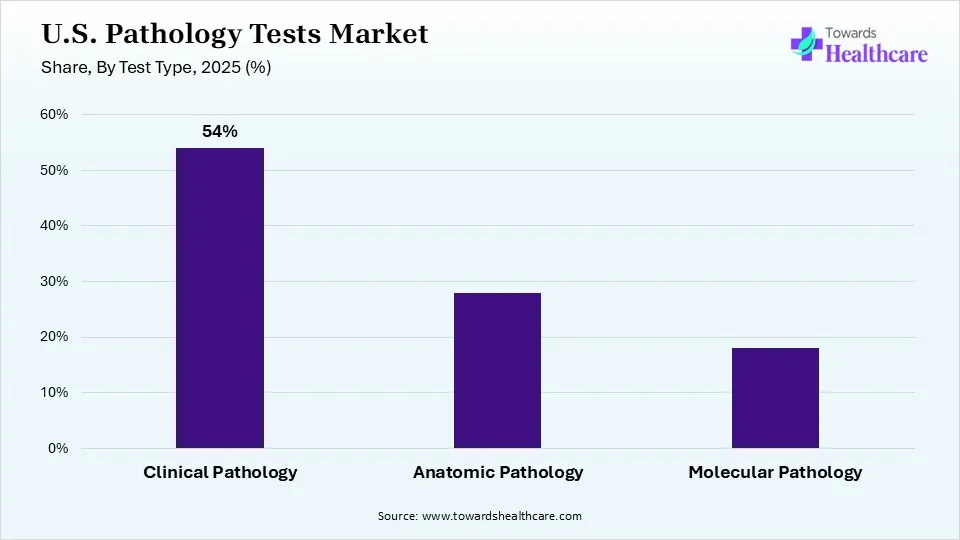
Clinical Pathology: Clinical pathology dominated the U.S. pathology tests market with a 54.00% share in 2025 and is forecast to register a CAGR of 6.12% from 2026 to 2035. Its leading position is supported by the high volume of routine chemistry, hematology, and microbiology tests ordered for disease diagnosis and ongoing health monitoring. However, the segment is expected to grow slower than the overall market during the forecast period.
Anatomic Pathology includes biopsies and cytology for cancer diagnosis. The anatomic pathology segment is expected to grow broadly in line with the overall market over the forecast period.
Molecular Pathology increasing the adoption of tumor profiling, genetic testing, biomarker analysis, and precision medicine is accelerating segment growth. Molecular pathology is expected to outperform the overall market during the forecast period.
Cancer: This segment accounted for 34.00% of the U.S. pathology tests market in 2025 and is projected to expand at a CAGR of 7.19% from 2026 to 2035. Cancer leads because diagnosis and staging rely on pathology. The cancer segment is expected to grow faster than the overall market over the forecast period.
Chronic & Metabolic Disease continued monitoring of diabetes, cardiovascular conditions, and metabolic disorders generates recurring demand for routine chemistry and other laboratory tests. The segment is anticipated to maintain growth broadly comparable to the overall market.
Infectious Disease testing remains large. The infectious disease segment is expected to grow broadly in line with the overall market over the forecast period.
Others category encompasses prenatal screening, transplant-related testing, and other specialized diagnostic procedures. Growing requirements for maternal health assessments and post-transplant monitoring are expected to support steady demand, with growth broadly matching the overall market.
Hospital Laboratories: Hospital laboratories maintained the largest end-user position in the U.S. pathology tests market, capturing a 46.00% share in 2025 and registering a projected CAGR of 6.08% from 2026 to 2035. Their leading contribution is supported by substantial inpatient testing requirements, emergency diagnostics, and hospital outreach services. However, the segment is expected to expand at a slower pace than the overall market during the forecast period.
Independent Reference Laboratories grow fastest as health systems sell outreach labs. The independent reference laboratories segment is expected to grow faster than the overall market over the forecast period.
Physician Office & Other Labs demand is primarily associated with routine diagnostic testing, point-of-care services, and localized patient monitoring. Despite their continued role in decentralized testing, these facilities are expected to grow slower than the overall market during the forecast period.
Analyst View: Segment shares were allocated from demand, product portfolios and pricing in each category. Clinical Pathology, Cancer and Hospital Laboratories lead their categories because they meet the core needs of today's buyers. We expect Molecular Pathology and Independent Reference Laboratories to gain share as newer technologies, users and applications grow faster.
Note: 2025 is the base year; 2035 shares and CAGRs are forecasts.
Sources: Expert interviews, secondary sources, Towards Healthcare database and Towards Healthcare analysts.
South: This region accounted for 37.00% of the U.S. pathology tests market in 2025 and is projected to expand at a CAGR of 6.26% from 2026 to 2035. The South leads because of its large population and many hospital and reference labs. South is expected to grow slower than the overall market between 2026 and 2035.
West regional expansion is supported by the presence of large integrated health systems, advanced molecular diagnostic laboratories, and growing adoption of specialized testing technologies. The region is expected to outperform the overall market throughout the forecast period.
Midwest demand is primarily supported by established healthcare networks, major hospital systems, and extensive outreach laboratory services. Regional growth is expected to remain broadly in line with the overall market during the forecast period.
Northeast region benefits from a strong concentration of academic medical centers, research institutions, and specialized diagnostic facilities, supporting demand for advanced pathology services. Growth is expected to remain broadly aligned with the overall market over the forecast period.
Analyst View: Regional shares were built from demand, installed base, spending and supplier presence in each region. South leads because of its mature demand base and strong suppliers. We assign West the highest growth premium because investment, adoption and capacity are expanding fastest there.
| Rank | Company Name | 2025 Share (%) | Key Products / Business | Headquarters |
| 1 | Labcorp | 14.00% | Clinical, anatomic and molecular testing | United States |
| 2 | Quest Diagnostics | 14.00% | Testing incl. AmeriPath anatomic pathology | United States |
| 3 | Sonic Healthcare USA | 3.00% | Pathology services | United States |
| 4 | Exact Sciences | 2.00% | Cancer testing | United States |
| 5 | Natera | 2.00% | Molecular testing | United States |
| 6 | ARUP Laboratories | 2.00% | Reference testing | United States |
| 7 | Mayo Clinic Laboratories | 2.00% | Reference testing | United States |
| 8 | NeoGenomics | 1.00% | Oncology pathology | United States |
| 9 | Tempus AI | 1.00% | Molecular profiling and AI | United States |
| 10 | PathGroup | 1.00% | Pathology services | United States |
Note: Company shares are 2025 estimates.
Sources: Company press releases, expert interviews, secondary sources, Towards Healthcare database and Towards Healthcare analysts.
Labcorp led the U.S. pathology tests market with an estimated 14.00% share of 2025 revenue, followed by Quest Diagnostics at 14.00% share and Sonic Healthcare USA at 3.00% share. Labcorp leads with clinical, anatomic, and molecular testing; Quest Diagnostics competes with testing incl. AmeriPath anatomic pathology, and Sonic Healthcare USA offers pathology services. Exact Sciences, Natera, ARUP Laboratories, Mayo Clinic Laboratories, NeoGenomics, Tempus AI and PathGroup compete through cancer testing, molecular testing, reference testing, oncology pathology, molecular profiling and AI and pathology services.
The top 10 companies accounted for an estimated 42.01% of 2025 revenue, while the remaining 57.99% was shared among thousands of hospital and community labs. The U.S. pathology tests market is fragmented, and competition centers on test menus, turnaround time, payer contracts, outreach lab acquisitions, digital pathology and AI, and price.
Labcorp: Labcorp, part of Laboratory Corporation of America Holdings, is based in the United States and captured an estimated 14.00% share of the U.S. pathology tests market in 2025. Its broad service portfolio spans clinical, anatomic, and molecular pathology testing. Towards Healthcare classifies the company as a Leader in its Companies Quadrant.
Quest Diagnostics: Quest Diagnostics is headquartered in the United States. It held an estimated 14.00% share of the U.S. pathology tests market in 2025. Its offering centres on Testing incl. AmeriPath anatomic pathology. In the Towards Healthcare Companies Quadrant it is positioned as a Leader.
Sonic Healthcare USA: With its headquarters in the United States, Sonic Healthcare USA represented an estimated 3.00% market share in 2025. The company focuses on pathology services, catering to diverse diagnostic requirements across healthcare providers.Towards Healthcare positions it as a Leader in its Companies Quadrant.
Exact Sciences: Exact Sciences is headquartered in the United States. It held an estimated 2.00% share of the U.S. pathology tests market in 2025. Its offering centres on Cancer testing. In the Towards Healthcare Companies Quadrant it is positioned as a Leader.
Natera: Natera accounted for an estimated 2.00% share of the U.S. pathology tests market in 2025. Based in the United States, the company specializes in molecular testing, including advanced diagnostic applications. Towards Healthcare identifies Natera as a Leader in its Companies Quadrant.
ARUP Laboratories: ARUP Laboratories, headquartered in the United States, captured approximately 2.00% of the market in 2025. Its operations primarily focus on reference testing services, providing specialized diagnostic support to healthcare institutions and laboratories. The company is positioned as a Leader in the Towards Healthcare Companies Quadrant.
Mayo Clinic Laboratories: Mayo Clinic Laboratories is headquartered in the United States. It held an estimated 2.00% share of the U.S. pathology tests market in 2025. Its offering centres on Reference testing. In the Towards Healthcare Quadrant it is positioned as an Innovator.
NeoGenomics: NeoGenomics, based in the United States, held approximately 1.00% of the market in 2025. Its portfolio centers on oncology pathology, with specialized testing services supporting cancer diagnosis and treatment decisions. The company is classified as an Innovator in the Towards Healthcare Companies Quadrant.
Tempus AI: Tempus AI is headquartered in the United States. It held an estimated 1.00% share of the U.S. pathology tests market in 2025. Its offering centres on Molecular profiling and AI. In the Towards Healthcare Companies Quadrant it is positioned as an Innovator.
PathGroup: PathGroup accounted for approximately 1.00% of the U.S. pathology tests market in 2025. The company operates from the United States and provides pathology services to healthcare providers across various diagnostic settings. It holds an Innovator position in the Towards Healthcare Companies Quadrant.
The U.S. pathology tests ecosystem links instrument & reagent suppliers, laboratories, digital pathology & ai, ordering clinicians and payers & regulators, with each stage adding value before products reach end users.
| Ecosystem Stage | Role in the Market | Key Companies |
| Instrument & Reagent Suppliers | Supply analyzers and reagents | Roche, Abbott, Siemens Healthineers |
| Laboratories | Perform tests | Labcorp, Quest, hospital labs |
| Digital Pathology & AI | Digitise and analyse slides | Scanner and AI vendors |
| Ordering Clinicians | Order tests | Physicians |
| Payers & Regulators | Pay and regulate | CMS, insurers, CLIA |
Sources: Company press releases, expert interviews, secondary sources, Towards Healthcare database and Towards Healthcare analysts.
Instrument & Reagent Suppliers: Supply analyzers and reagents. Key participants include Roche, Abbott, Siemens Healthineers.
Laboratories: Perform tests. Key participants include Labcorp, Quest, hospital labs.
Digital Pathology & AI: Digitize and analyze slides. Key participants include Scanner and AI vendors.
Ordering Clinicians: Order tests. Key participants include Physicians.
Payers & Regulators: Pay and regulate. Key participants include CMS, insurers, CLIA.
Value in the U.S. pathology tests market flows from upstream material and technology suppliers to manufacturers and service providers, then through distribution partners to end users. Companies that integrate several stages or build long-term relationships with end users capture a larger share of this value.
The Towards Healthcare Companies Quadrant evaluates key participants in the U.S. pathology tests market based on their market strength and innovation and growth strategies. Market strength is measured through revenue scale, market share, and geographic reach. Innovation and growth strategies are assessed based on product portfolio breadth, R&D intensity, and strategic partnerships. Company positioning considers estimated 2025 market shares alongside our evaluation of product innovation, portfolio diversity, and partnerships.
Sources: Company press releases, expert interviews, secondary sources, Towards Healthcare database and Towards Healthcare analysts.
Leaders: Labcorp, Quest Diagnostics, Sonic Healthcare USA, Exact Sciences, Natera and ARUP Laboratories combine high market share with broad portfolios and strong innovation.
Innovators: Mayo Clinic Laboratories, NeoGenomics, Tempus AI and PathGroup bring newer technologies and specialized products.
By Test Type
By Application
By End User
By Region
The U.S. pathology tests market was defined as pathology tests performed in the United States, including anatomic pathology (histology and cytology), clinical pathology (chemistry, haematology, microbiology and immunology), and molecular pathology and genetic testing, supported by digital pathology, for cancer, infectious disease, chronic disease and other conditions, performed by hospital laboratories, independent reference laboratories, and physician office and other labs. The 2025 base year was built bottom-up from demand volumes and average prices by test type, application and end user and region, and checked top-down against the market-specific revenues of leading companies and published estimates. Segment, regional and company values were allocated from test type, application and end user and region demand.
Key estimates were verified by cross-checking company disclosures, regulatory and industry data and published third-party estimates, and inputs that could not be reconciled were excluded. All segment, regional and company figures were reconciled to the same 2025 base year, and the 2026-2035 forecast, which applies a constant CAGR from the 2025 base, was recalculated and validated.
Analyst View: The U.S. pathology tests market is set for steady expansion as ageing and related demand keep growing. Our estimate links value to underlying demand, installed base and pricing, so the forecast follows real adoption rather than headline hype. The main upside comes from molecular and digital pathology, while the main risks are reimbursement cuts and staff shortages.