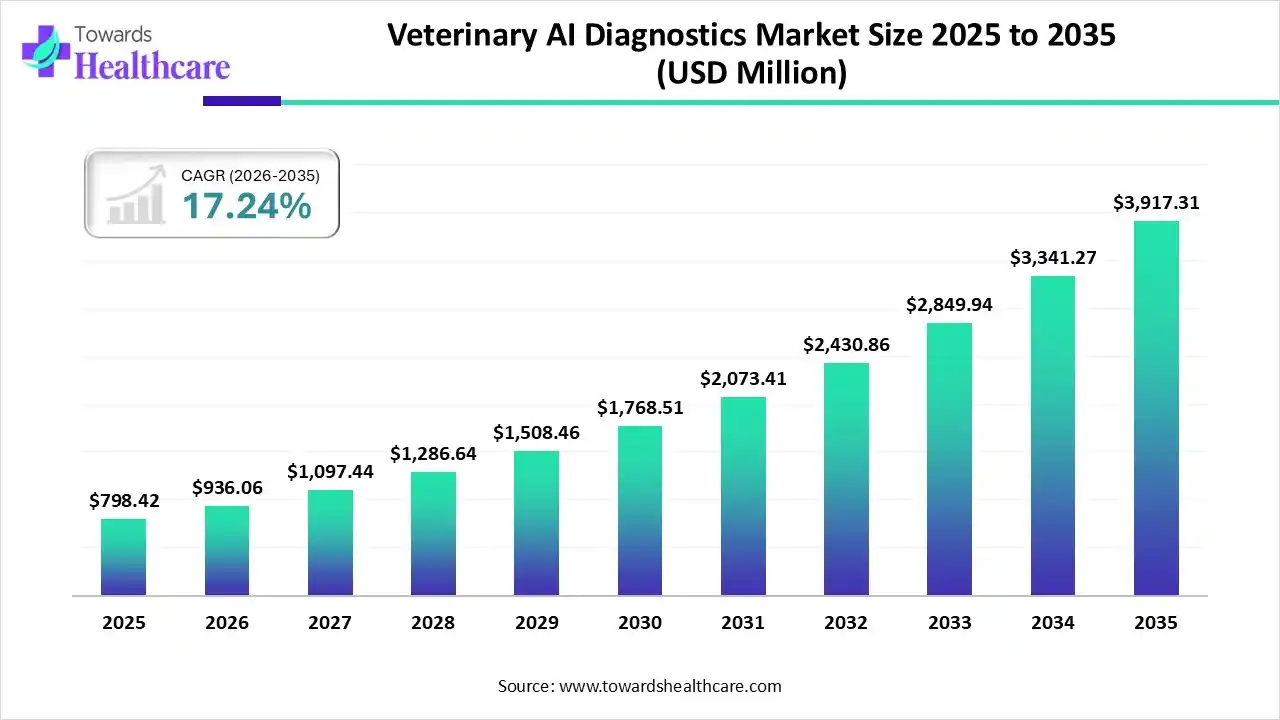
The global veterinary AI diagnostics market size was estimated at USD 798.42 million in 2025 and is predicted to increase from USD 936.06 million in 2026 to approximately USD 3917.31 million by 2035, expanding at a CAGR of 17.25% from 2026 to 2035. The market is growing momentum due to increasing pet ownership, rising demand for early disease detection, and growing adoption of AI-powered imaging and decision-support tools across veterinary clinics and hospitals.
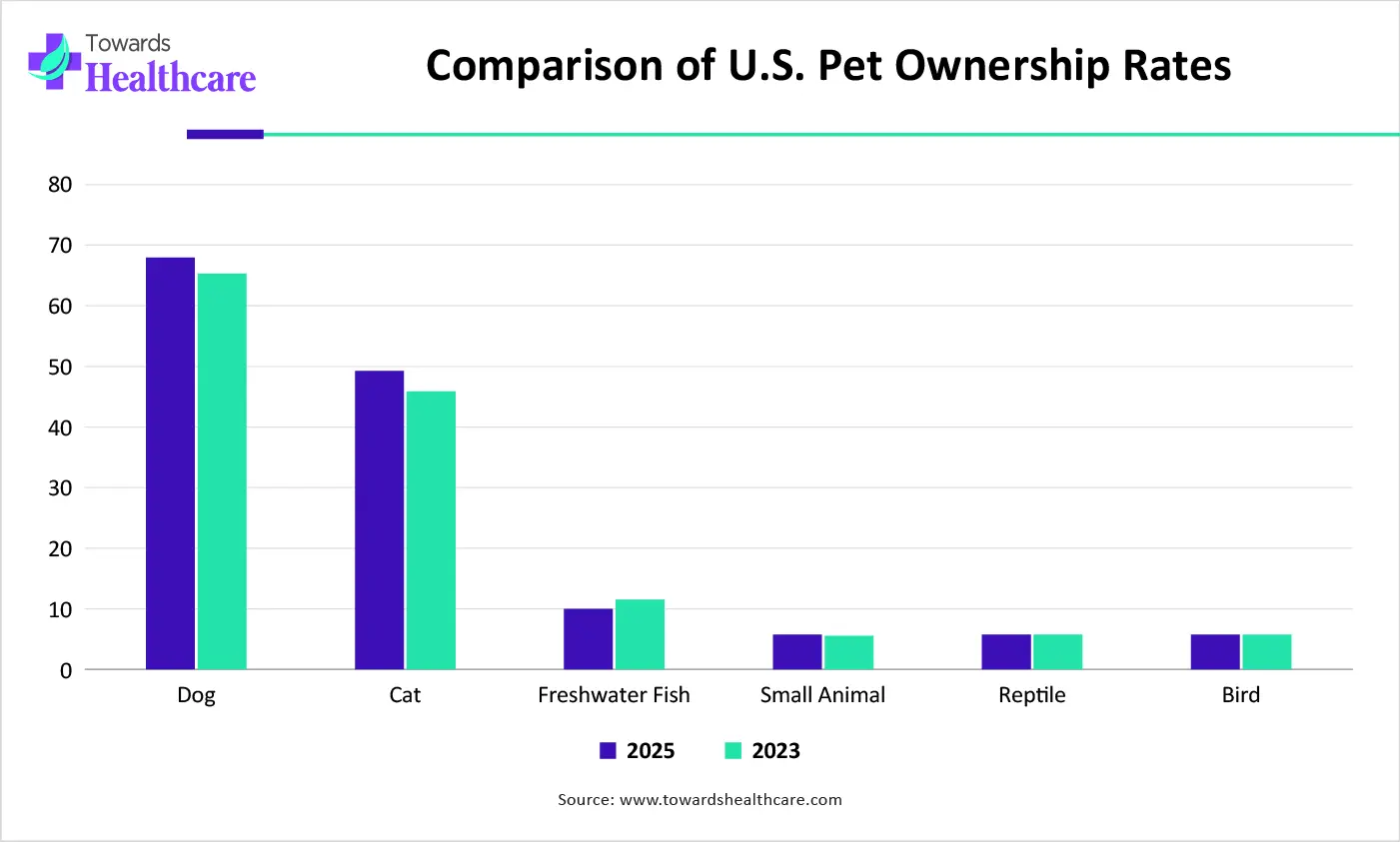
Veterinary AI diagnostics refer to the use of artificial intelligence technologies to analyze animal health data, images, and clinical records to support faster, more accurate disease detection and treatment decisions in veterinary care. The veterinary AI diagnostics market is growing rapidly due to rising pet ownership, increased spending on animal healthcare, and the need for early, accurate disease detection. Advancements in AI-powered imaging, data analytics, and decision-support tools are helping veterinarians improve diagnostic speed and precision. Additionally, shoratges of skilled professionals and growing awareness of preventive animal care are accelerating adoption across clinics and hospitals.
Day by day, the market is aiming at animal health, with a focus on rapid, more accurate analysis of images, bloodwork, & cytology. Subsidiary, a key breakthrough includes diverse modern wearables & remote monitoring devices to boost livestock & pet care. In these cases, AI algorithms assist in tracking behavioral and environmental data to determine early signs of diseases before acute symptoms are seen. Veterinary leaders are shifting towards an integration of clinical notes, lab results, and imaging to offer comprehensive diagnostic profiles.
Veterinary AI diagnostics refers to the use of artificial intelligence technologies, including machine learning, deep learning, and computer vision, to detect, diagnose, and monitor diseases in companion and livestock animals. The veterinary AI diagnostics market is growing due to the increasing prevalence of animal diseases, rising pet ownership, and growing demand for advanced veterinary care. Technological advancements such as AI-assisted medical imaging, automated pathology analysis, cloud-based diagnostic platforms, and wearable animal health monitoring devices are enhancing diagnostic speed and accuracy. Key trends include the integration of AI with telemedicine, electronic veterinary medical records, and predictive analytics for personalized animal care. Future opportunities are driven by precision veterinary medicine, livestock health management, and AI-enabled remote diagnostics. Rising investments in veterinary technology and digital healthcare solutions continue to accelerate innovation, improving clinical outcomes and operational efficiency across veterinary practices.
| Table | Scope |
| Market Size in 2026 | USD 936.06 Million |
| Projected Market Size in 2035 | USD 3917.31 Million |
| CAGR (2026 - 2035) | 17.24% |
| Leading Region | North America by 55% |
| Historical Data | 2020 - 2023 |
| Base Year | 2025 |
| Forecast Period | 2026 - 2035 |
| Measurable Values | USD Millions/Units/Volume |
| Market Segmentation | By Solution, By Animal, By Application, By End Use, By Region |
| Top Key Players | IDEXX Laboratories, Zoetis, SignalPET, Radimal, Vetology, Aiforia, Moichor, Scopio Labs |
Why Did the Software & Services Segment Dominate in the Market in 2025?
The software & services segment dominated the veterinary AI diagnostics market in 2025 due to widespread adoption of cloud-based diagnostic platforms, decision-support tools, and data analytics solutions. These offerings enable faster diagnosis, remote access, continuous updates, and seamless integration with existing veterinary systems. Additionally, growing demand for subscription-based services, training, maintenance, and technical support strengthened this segment's revenue share, making it more scalable and cost-effective than hardware-centric solutions.
Hardware
The hardware segment is expected to grow at the fastest CAGR during the forecast period due to rising adoption of advanced diagnostic devices, imaging systems, and smart monitoring equipment in veterinary practices. Increasing demand for point-of-care testing. Improved sensor accuracy and clinical infrastructure upgrades are driving investments in hardware. Additionally, the expansion of specialty veterinary hospitals and livestock health monitoring is accelerating the deployment of high-performance diagnostic equipment.
How the Companion Animals Segment Dominated the Veterinary AI Diagnostics Market in 2025?
The companion animals segment dominated the market in 2025 due to rising pet ownership, increased humanization of pets, and higher spending on advanced healthcare services. Pet owners increasingly sought early disease detection and personalized treatment, driving the adoption of intelligent diagnostic tools in clinics. Additionally, frequent veterinary visits, growing insurance coverage, and strong awareness of preventive care support the segment’s leading market share.
Production Animals
The production animals segment is expected to grow at the fastest CAGR during the forecast period due to increasing demand for efficient livestock health management and disease prevention. Growing focus on food safety, productivity optimization, and early outbreak detection is driving adoption of advanced diagnostic technologies. Additionally, large-scale farming practices, rising investments in animal health infrastructure, and supportive government initiatives are accelerating market growth across the livestock sector.
How Does the Veterinary Clinics Segment Dominate the Market in 2025?
The veterinary clinics segment dominated the veterinary AI diagnostics market in 2025 due to their role as the primary point of care for companion and production animals. High patient footfall, frequent diagnostic testing, and growing adoption of advanced diagnostic solutions supported market leadership. Clinics also benefited from improved affordability, faster turnaround times, and increasing demand for early disease detection and routine health screening services.
Research & Academic Institutes
The research & academic institutes segment is expected to grow at the fastest CAGR during the forecast period due to increasing focus on animal health research, disease modelling, and technology validation. Rising funding for veterinary research, growing collaboration with technology providers, and adoption of advanced diagnostic platforms for training and innovation are accelerating growth. Additionally, expanding datasets and emphasis on evidence-based veterinary practices are strengthening long-term demand.
Why the Pathology Segment Dominated the Veterinary AI Diagnostics Market?
The pathology segment dominated the market due to its critical role in accurate disease identification and treatment planning. High reliance on histopathology, cytology, and laboratory testing for cancer, infections, and chronic conditions increased diagnostic volumes. The growing need for faster slide analysis, standardized results, and early detection further strengthened pathology adoption across veterinary clinics, hospitals, and diagnostic laboratories.
Imaging
The imaging segment is expected to grow at the fastest CAGR during the forecast period due to rising demand for non-invasive, rapid diagnostic methods. Increasing use of advanced radiography, ultrasound, and digital imaging systems is improving diagnostic accuracy and workflow efficiency. Growing investments in modern veterinary infrastructure, early disease screening, and real-time assessment of injuries and chronic conditions are further accelerating adoption across clinics and hospitals.
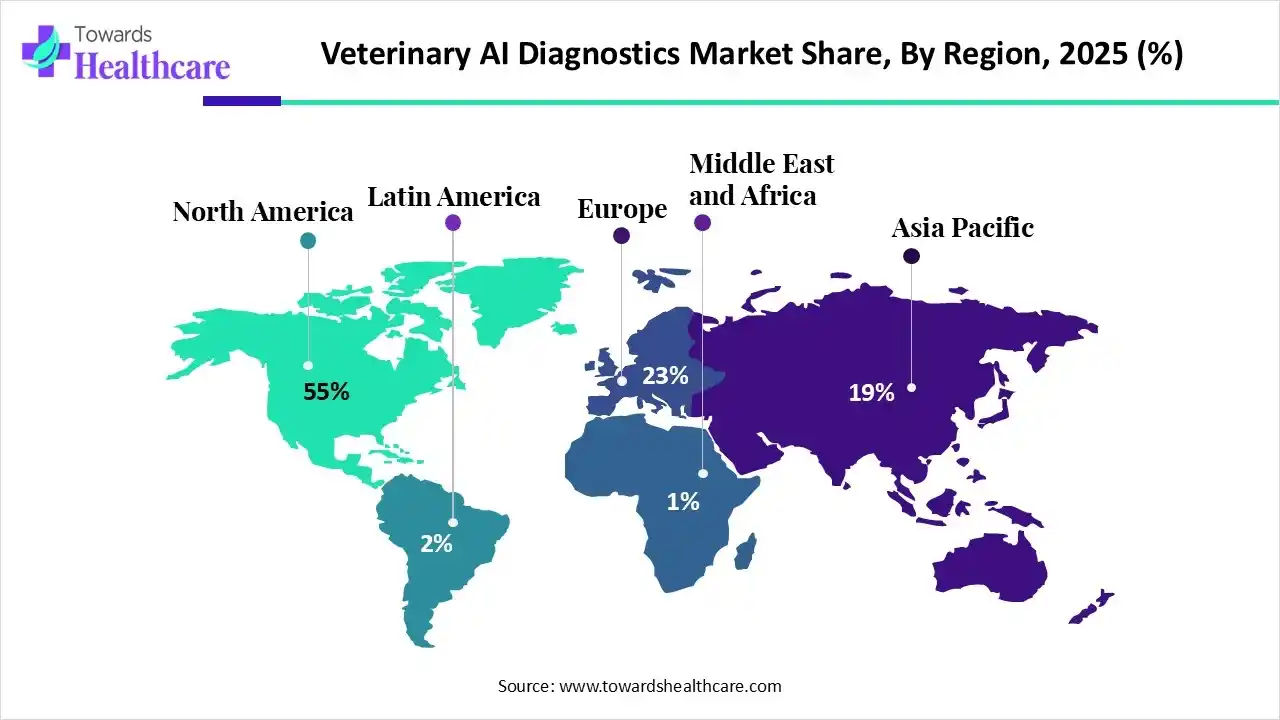
North America dominated the global market by 55% share in 2025 due to high pet ownership, strong spending on animal healthcare, and early adoption of advanced diagnostic technologies. Well-established veterinary infrastructure, presence of leading solution providers, and rising awareness of preventive animal care supported market leadership. Additionally, favorable reimbursement policies, growing pet insurance coverage, and strong research activity further accelerated regional adoption and revenue growth.
U.S. Market Trends
The U.S. led the market in 2025 due to high pet ownership, advanced veterinary infrastructure, and strong adoption of technology-driven diagnostic solutions. Significantly, healthcare spending, widespread availability of specialized veterinary services, and the presence of major industry players supported revenue growth. Additionally, strong research funding, early innovation adoption, and growing pet insurance coverage further strengthened the country’s dominant market position.
Canada Witnesses Strong Growth in the Veterinary AI Diagnostics Market
Canada is witnessing significant growth in the veterinary AI diagnostics market due to increasing pet ownership and rising demand for advanced animal healthcare, and growing adoption of AI-powered diagnostic technologies. Strong investments in veterinary digital health, expanding telemedicine services, and increasing use of AI-based imaging and predictive analytics are improving diagnostic accuracy. Government support for animal health research and a well-developed veterinary care infrastructure further accelerate market growth.
Asia Pacific is anticipated to grow by 19% share at the fastest CAGR during the forecast period due to rising pet adoption, expanding livestock populations, and increasing awareness of animal health. Rapid urbanization, improving veterinary infrastructure, and growing investments in digital diagnostic solutions are accelerating adoption. Additionally, supportive government initiatives expanding research activities and increasing the affordability of advanced veterinary technologies are driving strong regional market growth.
India Market Trends
India is anticipated to grow at a rapid CAGR during the forecast period due to rising pet adoption, expanding livestock population, and increasing awareness of animal health management. Growing investment in veterinary infrastructure, improving access to diagnostic technologies, and rising demand for early disease detection are accelerating adoption. Additionally, the growth of veterinary education and the increasing affordability of advanced diagnostic solutions are strengthening market expansion across the country.
China Emerges as a Fast-Growing Veterinary AI Diagnostics Market
China is experiencing significant growth in the veterinary AI diagnostics market due to its expanding livestock industry, rising pet ownership, and increasing demand for advanced animal healthcare. Rapid adoption of AI diagnostics imaging, automated diagnostics platforms, and precision veterinary technologies is enhancing disease detection and treatment efficiency. Government support for smart agriculture, digital healthcare, and veterinary innovation, along with growing investments in AI research, is further driving market expansion.
Europe is anticipated to grow by 23% share at a notable CAGR during the forecast period due to a strong focus on animal welfare, rising pet insurance adoption, and increasing demand for advanced veterinary diagnostics. Well-established veterinary healthcare systems, growing research initiatives, and a supportive regulatory framework are encouraging technology adoption. Additionally, rising awareness of preventive animal care and expansion of veterinary clinics and hospitals across key countries are contributing to sustained regional market growth.
UK Market Trends
The UK is anticipated to grow at a rapid CAGR during the forecast period due to a strong emphasis on animal welfare, high pet ownership, and increasing adoption of advanced veterinary diagnostic solutions. Growing investment in digital health infrastructure, expanding research collaboration, and rising demand for early and accurate disease detection are accelerating adoption. Additionally, supportive regulatory policies, growth of pet insurance, and expansion of specialty veterinary clinics are strengthening the country’s market trajectory.
Latin America is expanding significantly in the market in 2025. The surge in companion-animal ownership and the focus on pet healthcare increase demand for veterinary AI diagnostics. The shortages of veterinary specialists and the focus on enhancing livestock health increase adoption of veterinary AI diagnostics. The rise in connected diagnostic devices and increasing aquaculture health assessment helps with expansion. The modernization of reference laboratories and the focus on tracking animal health support the overall growth.
Brazil Market Trends
Brazil is a major player in the market. The increased ownership of pets in urban households and the adoption of advanced veterinary care increase demand for veterinary AI diagnostics. The integration of AI in animal hospitals and the rise in AI-based imaging workflows help with expansion. The large livestock base and the rise in commercial breeders increase the adoption of veterinary AI diagnostics. The digital-health initiatives for pets and the rise in practice management software drive the overall growth of the market.
Argentina Market Trends
Argentina is experiencing steady growth in the market. The increased pet ownership in metropolitan areas and the need for rapid disease detection increase adoption of veterinary AI diagnostics. The adoption of AI-based diagnostic systems and the rise in digital radiography help with expansion. The rise in software services and the utilization of portable diagnostic tools boost the overall growth of the market.
Middle East and Africa is growing steadily in the market. The high pet adoption and pet parents' focus on advanced wellness screening increase the use of veterinary AI diagnostics. The massive base of commercial livestock and dependence on routine animal testing increases the use of veterinary AI diagnostics. The focus on the management of zoonotic diseases and the need to monitor wildlife health increases adoption of veterinary AI diagnostics. The modernization of veterinary hospitals and the rise in tele-veterinary platforms drive the overall growth.
United Arab Emirates Market Trends
United Arab Emirates is anticipated to grow at a significant rate in the market. The growing pet humanization and pet parents' preference for preventive healthcare increase the use of veterinary AI diagnostics. The rise in tech-based veterinary hospitals and the rise in automated pathology tools help with the expansion. Increased AI use in animal life sciences and the rise in companion animals help with expansion. The strong biosecurity frameworks and regular check-ups of pets boost the overall growth.
South Africa Market Trends
South Africa is expected to grow at a notable rate in the market. The rise in companion animal humanization and the demand for specialized veterinary care increase adoption of veterinary AI diagnostics. The focus on livestock health management and wildlife conservation increases the use of veterinary AI diagnostics. The rise in in-home pet testing and veterinarian shortages increases demand for veterinary AI diagnostics. The rise in cloud-based pet diagnostics and increased diagnosis of zoonotic diseases supports the overall growth.
R&D
Clinical Trials
Patient Support and Services
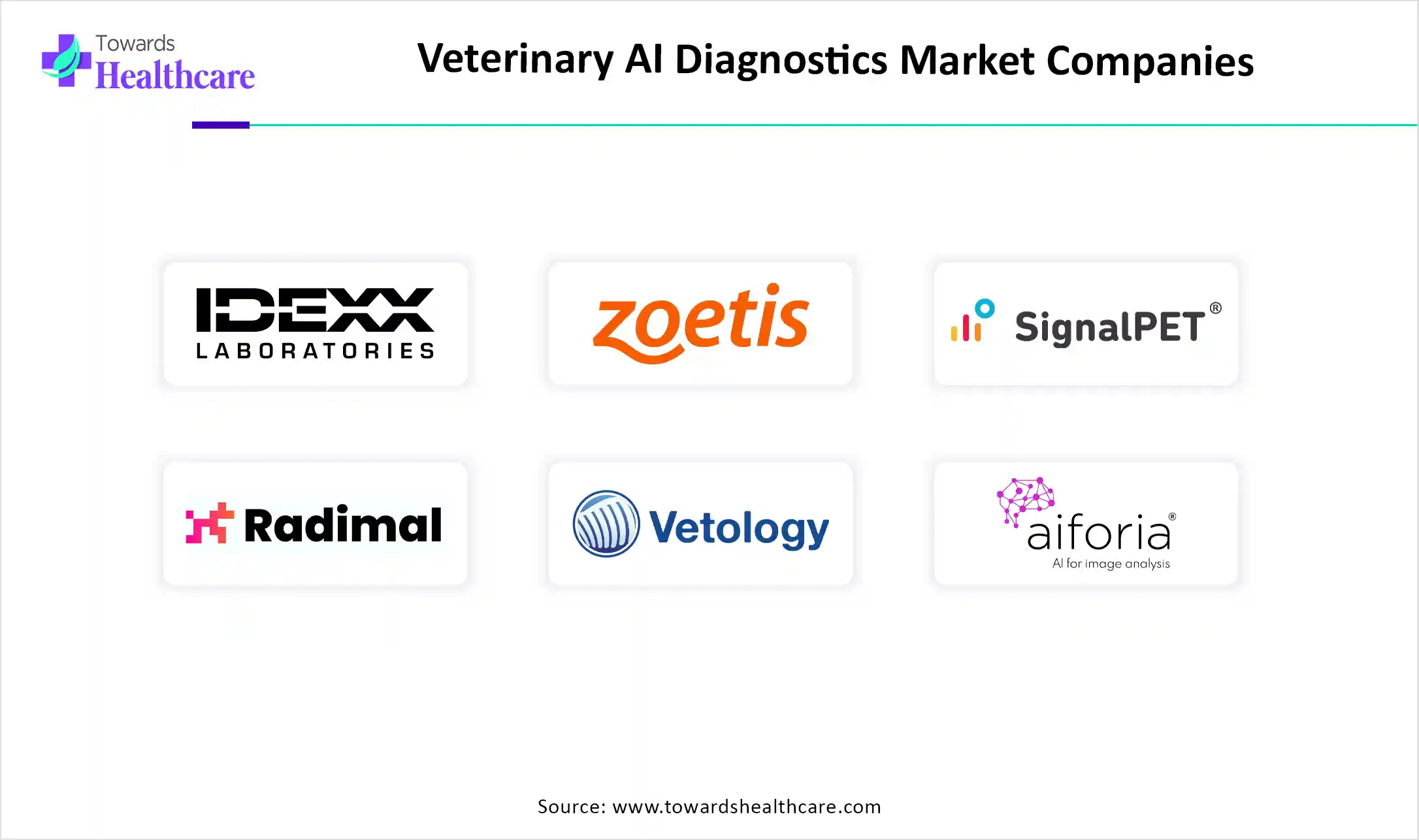
| Companies | Headquarters | Offerings |
| IDEXX Laboratories | Maine, USA | Provides advanced diagnostic solutions, including AI-supported imaging, laboratory testing platforms, and cloud-based data management tools to support faster and more reliable veterinary diagnostics. |
| Zoetis | New Jersey, USA | Offers AI-enabled diagnostic systems for cytology, hematology, and parasite detection, helping veterinarians improve diagnostic accuracy and streamline in-clinic workflows. |
| SignalPET | Texas, USA | Specializes in rapid radiographic interpretation using intelligent software that analyzes X-rays and delivers structured diagnostic insights to support clinical decision-making. |
| Radimal | California, USA | Provides cloud-based radiology interpretation services combining automated image analysis with expert review to enhance diagnostic speed and consistency. |
| Vetology | California, USA | Focuses on radiology screening and diagnostic support solutions that assist veterinarians in identifying abnormalities early through intelligent image evaluation. |
| Aiforia | Helsinki, Finland | Develops deep-learning image analysis platforms for digital pathology, supporting faster and standardized evaluation of tissue and cytology samples in veterinary laboratories. |
| Moichor | California, USA | Delivers in-clinic diagnostic tools for blood and cell analysis, enabling rapid preliminary results and supporting early disease detection. |
| Scopio Labs | Tel Aviv, Israel | Offers high-resolution digital microscopy and analysis platforms that support remote review and enhanced interpretation of blood and pathology samples. |
Strengths
Weaknesses
Opportunities
Threats
By Solution
By Animal
By Application
By End Use
By Region





Principal Consultant
Payal Rabde is a Healthcare Market Research Analyst at Towards Healthcare Research & Consulting with 4+ years of experience in pharmaceuticals, biotechnology, medical devices, and life sciences.
Learn more about Payal Rabde

Reviewed By
Aditi Shivarkar is a seasoned professional with over 14 years of experience in healthcare market research. As a content reviewer, Aditi ensures the quality and accuracy of all market insights and data presented by the research team.
Learn more about Aditi Shivarkar