




 Request Consultation
Today, the sleep wearable market is emerging into a varied phase, as in recent years, the globe was wearing a watch or ring overnight & receive a sleep score the next morning. However, in 2026, this proposition is accelerating with the adoption of innovative key platforms.
Current wearables are answering beyond ‘How did I sleep?’ to What does my sleep mean, what is modifying, & what should I do next?’ Along with transparency, Apple has launched sleep scoring & broadened sleep-apnea notifications. Meanwhile, Samsung has encouraged sleep-apnea risk determination & sleep coaching, whereas Oura has widened from a sleep application into cardiovascular metabolic and precision health intelligence. Moreover, WHOOP is connecting sleep with recovery, performance & healthspan, alongside Google Fitbit and Garmin, which have involved the surging screenless-wearable stream.
Simultaneously, scientific research activities are consistently demonstrating that consumer wearables can be beneficial for longitudinal sleep monitoring, but their sleep-stage predictions are not equivalent to polysomnography, i.e., the clinical gold standard. In accordance with the World Sleep Society, they uncovered specific recommendations for consumer sleep trackers in 2025 & further highlighting that the category is becoming crucial enough to necessitate clearer evidence & utilization standards.
A Key Step: Smart Sleep Wearables Are Shifting From ‘Tracking’ to ‘Explicating’
Let’s first have a look at the evolution timeline, which includes a 4-stage horizontal evolution diagram:
- Generation 1: Measurement : Steps > heart rate > sleep duration.
- Generation 2: Sleep Scoring: Sleep stages > sleep score > sleep consistency.
- Generation 3: Personalized Guidance: Sleep coach > bedtime recommendations > recovery guidance.
- Generation 4: Health Intelligence: Sleep apnea risk > cardiovascular indicators > metabolic signals > longitudinal healthspan.
In short, the sleep wearables category is developing from passive measurement toward platforms that read multiple physiological signals & translate them into precision recommendations.
Alongside, the value sector is shifting upward from sensors & raw measurements to elucidation, customization & longitudinal intelligence.
Specifically, Apple’s Sleep Score shows sleep duration, bedtime consistency, awakenings & sleep stages, whereas WHOOP integrates sleep with strain, recovery & expansive health metrics. Similarly, Oura has strengthened from its original sleep or readiness proposition toward cardiovascular, metabolic & other health insights.
Day by day, device producers are increasingly requiring varied algorithms, longitudinal datasets & software experiences along with excellent hardware. So, in the coming era, the overall competitive distinction will similarly be reported by decision quality, not the number of metrics reflected, especially derived from Apple, WHOOP, & Oura product or feature documentation.
Global Emergence: Sleep Apnea is Becoming the Path From Wellness to Medical Relevance
Briefing on regulatory and clinical adoption timeline:
| 2024 | Samsung receives FDA De Novo clearance for Galaxy Watch sleep-apnea properties. |
| 2025 | Samsung advances availability to 70 markets. |
| 26-Mar | Samsung records availability in 78 markets & underlines at-home sleep-apnea risk detection. |
| 26-May | Apple reinforces sleep-apnea notifications to Apple Watch users in India. |
| 2026 | Samsung’s latest Galaxy Watch platform further unified sleep-apnea assessment with more extensive sleep & health intelligence. |
This indicates that sleep apnea has become one of the most lucid examples of how consumer wearables are migrating from wellness tracking into regulated health-risk determination.
One of the prominent perceptions, sleep apnea is altering the strategic role of the wearable from wellness dashboard to potential early-warning interface. Particularly, Samsung has unveiled a feature that evaluates overnight signals to find signs of moderate-to-severe obstructive sleep apnea. Meanwhile, Apple’s sleep-apnea notification system is designed to identify continuous signs of the condition.
Furthermore, these approaches are developing opportunities throughout: sleep clinics, home sleep testing, digital therapeutics (DTx), remote patient monitoring, physician referral pathways, diagnostic testing, insurance & reimbursement, and clinical research. It will emphasize how those signals link to the downstream clinical pathway.
Source: Samsung Electronics, Apple, and FDA-relevant product authentication information.
Next Trending: The ‘Screenless’ Wearable is Appearing as a Substantial Design Philosoph
Visual Description of Device Architecture Comparison
| Traditional smartwatch | Screenless sleep wearable |
| Display-centric | Sensor-centric |
| Notifications | Minimal or no notifications |
| Higher interaction | Passive monitoring |
| Fitness + communication | Health + wellness monitoring |
| Battery curbs | Longer battery potential |
| Day-first design | 24/7/day-night design |
My research efforts say that Google Fitbit Air & Garmin CIRQA showcase a renewed force toward lightweight, screen-free devices designed to disappear into everyday life. Key insight highlights that the wearable market is starting to treat less interaction as a product characteristic.
However, in May 2026, Google unveiled Fitbit Air as a screenless tracker with sleep tracking, heart-rate monitoring, HRV, SpO2 & up to a week of battery life, that begins at $99.99. Besides this, Garmin rolled out CIRQA in July 2026 as its first screenless smart band that facilitates up to 10 days of battery life by skipping the need for a subscription
Wearables business outcomes: screenless devices can probably enhance overnight adherence as they lower visual distraction, notification stress, device intricacy, charging friction, & perceived smartwatch bulk.
In the coming era, the sleep wearable market will bolster momentum, such as:
Smartwatch > smart ring > screenless band > specialized sleep wearable
Source: Google Fitbit, & Garmin
Powerful Developments: Rings are Becoming a Strategic Option to Watches
A visual format of form-factor competitiveness encompasses:
- Visual format: 2 × 2 positioning matrix
- X-axis: Daytime functionality
- Y-axis: Overnight comfort
- Position:
- Apple Watch – high daytime/medium-high overnight
- Samsung Galaxy Watch – high/medium-high
- WHOOP – medium/very high
- Oura Ring – medium/very high
- Screenless bands – low-medium/high
In one line, the competitive framework is highly segmented by the trade-off between daytime functionality & overnight comfort. Majorly, sleep wearables are no longer interchangeable with smartwatches, while overnight comfort is creating room for rings & screenless bands.
Elevated activities have shown that Oura has continued reaching its ring around sleep, readiness & expansive health insights, whereas WHOOP aims at constant recovery & sleep monitoring & eliminating a conventional smartwatch display. Side by side, the hardware battle is broadly related to where on the body the sensor can generate the best integration of signal quality, comfort & adherence.
Future developments will seek emerging form factors, such as in-ear sensing & other unobstructive sensors, coupled with scientific studies in in-ear electrophysiology monitoring. Sources: Oura, WHOOP and developing wearable-sensing research.
Major Goal: Personalization is Displacing the Generic ‘8 Hours of Sleep’ Message
The global industry has layered architecture, i.e.
Layer 1 -Raw signals: heart rate, HRV, movement, temperature, SpO2, & respiratory rate.
Layer 2 – Sleep interpretation: duration, stages, efficiency, consistency, & wake events.
Layer 3 – Personal context: exercise, stress, previous sleep, chronotype, & daily routine.
Layer 4 – Recommendation: bedtime, recovery, activity adaptation, & sleep behavior.
Moreover, eminent platforms are widely combining physiological signals with behavioral context instead of treating sleep duration as a standalone metric.
With an emphasis on personalization, WHOOP’s Sleep Planner contains circadian rhythm, prior sleep, naps, & regular strain to guide optimal sleep & wake timing. Alongside, Samsung correspondingly leverages longitudinal sleep patterns to offer tailored sleep coaching.
Ongoing business results are exploring strategic advantage that highly emerges from sensor data + personal history + context + recommendation engine. This further develops a much higher barrier to entry than simply adding a sleep sensor.
Forecasting personalization will include chronotype, age, sex, training stress, work schedules, travel, menstrual cycle, disease, and environmental issues.
Sources: WHOOP & Samsung.
Innovative Approaches: Conversational Health Coaching is Leading as the New Interface
A brief focus on the process diagram shows:
Wearable data > sleep trends > precision interpretation > user asks a question > conversational health coach > action recommendation > behavior change
Significant implementations, such as Oura Advisor & Fitbit’s designing personal health coach, represent the transition toward conversational interfaces layered on top of wearable data. Furthermore, regardless of pushing users to inspect charts, platforms are massively attempting to describe what the data means in natural language.
Inclusion of key insight, i.e. a shift from dashboards toward dialogue, spurs the alterations in the competitive advantage from ‘Who has more data?’ to ‘Who can explain the data most beneficially & safely?’. This further develops new competitive essentials throughout clinical evidence, customization, explainability, privacy, safety, hallucination control, and medical limits.
Prospective features may support a winning sleep platform that may widely look like a personal operating system.
Sources: Oura Advisor & Fitbit Personal Health Coach.
Ongoing Expansion: The category is Broadening From Sleep Into Healthspan
The ecosystem diagram has been uncovering:
Sleep > Recovery > Physical activity > cardiovascular fitness > Metabolic health > Long-term health > Healthspan
Primarily, sleep is increasingly being recognized as one component of a widespread longitudinal health model instead of a separate wellness metric.
Along with sleep as an entry point into a vast personal-health intelligence proposition: WHOOP’s 2026 Healthspan provides a combination of sleep consistency & total sleep with activity, heart-rate zones, strength activity, VO2 max, resting heart & lean body mass to derive WHOOP Age and Peace of Aging. On the same side, Oura has advanced its capabilities into cardiovascular age & metabolic health.
Continuous business potential value pools cover longevity, fitness, cardiovascular health, metabolic health, women’s health, stress, recovery, nutrition, and preventive health.
Projecting robust progressions across mature platforms may broadly compete to own the longitudinal health record evolved by consumer wearables.
Sources: WHOOP & Oura.
Premier Identifier: Scientific Validation is Resulting as Commercial Differentiator
An extensive evidence pyramid executes:
From top of Clinical validation/regulatory evidence > independent PSG validation > peer-reviewed research > algorithm validation > internal manufacturer studies > consumer testimonials to Bottom
Globally surging breakthroughs in sleep wearables are leading to more health-centric, the significance of independent validation is escalating. However, scientific reliability is migrating from a nice-to-have brand attribute toward an efficient commercial differentiator.
From a consumer preference study, it was identified that respondents placed significantly greater value on devices that had independent examination & medical support. Especially, the willingness-to-purchase threshold elevated by $30 for assessment & $48 for endorsement as compared with a non-validated device. Alongside, the American Academy of Sleep Medicine has also explored that consumer sleep technologies should not replace medical inspection, specifically where diagnosis or treatment is concerned.
In addition, global manufacturers have been encouraged to invest in PSG comparison studies, independent validation, academic alliances, clinical datasets, regulatory landscapes, & visible methodology. Future competitive marketing & procurement criteria will widely include ‘Validated against PSG’.
Source: PubMed & American Academy of Sleep Medicine
An Enormous Scientific Constraint Remains: Sleep-Stage Accuracy
| Capability | Consumer wearables | PSG |
| Sleep or wake estimation | Stronger | Gold standard |
| Total sleep duration | Relatively strong | Gold standard |
| Sleep-stage classification | More variable | Gold standard |
| Brain-wave measurement | Limited or indirect | Direct EEG |
| Clinical diagnosis | Not generally sufficient | Clinical standard |
This indicates wearables can offer useful longitudinal information, but sleep-stage determination remains materially varied from full polysomnography. However, a 2025 meta-analysis examined consumer wrist-worn sleep trackers against polysomnography, whereas another multi-center validation study evaluated 11 consumer sleep trackers throughout wearable, nearable & airable categories. According to a 2025 European Respiratory Journal validation study, six commercial wrist-worn devices were also compared with PSG, which underscores the continuing significance of independent validation.
In addition, firms should ignore competing solely on the number of sleep-stage metrics explored. With massive advances in sensor fusion, such as PPG, accelerometry, temperature, SpO2 & possibly electrophysiology signal will gradually optimize sleep-state classification.
Source: European Respiratory Society, PubMed and peer-reviewed validation studies.
Substantial Shift: Eventually Sleep Data is Inclining Towards Clinical Conversations
What is Consumer-to-Clinic Data Flow?
Wearable > Sleep Data > Abnormal trend > User awareness > Healthcare consultation > Potential diagnostic testing > Treatment/management
Mainly, wearable data is hugely leading as part of the conversation between consumers & healthcare professionals, even when it does not substitute clinical diagnostics. A stronger emphasis on strategic opportunity is termed a wearable-as-clinical-conversation driver. Whereas the AASM has stated that patients widely give consumer sleep data into clinical ecosystems, coupled with focusing on the fact that such information should be assessed within proper clinical examination.
Moreover, a 2025 Canadian nationally representative survey inspected sleep-wearable use, health-seeking behaviors and insights, addressing the rising relationship between consumer tracking & healthcare involvement.
Furthermore, efficient B2B opportunities in projecting era will consist of: sleep-clinic integrations, remote monitoring, digital therapeutics, clinical research, employer wellness, population health, & physician dashboards. The future sleep wearable industry will impel interconnection between consumer sleep platforms & formal clinical workflows.
Emerging Battery Era: Battery Life and Comfort are Unveiling as Competitive Weapons
Let’s have a look at battery-life competitive scaled frame:
Garmin CIRQA (up to 10 days) > Fitbit Air (up to about one week) > Apple Watch Series 11 (up to 24 hours) > Conventional high-interaction smartwatches.
Collectively, the overall accurate battery performance relies on usage & configuration, while the visual should explicitly label manufacturer-stated maximums instead of suggesting standardized testing.
Thus, long battery life directly assists in consistent overnight monitoring, which makes battery & comfort strategic. Significantly for sleep wearables, battery life is efficiently a data-quality variable as charging disturbances develop gaps in longitudinal monitoring. To raise battery life benefits, a globally unique sleep wearable highly requires:
Low friction + high adherence + continuous sensing + sufficient battery.
Gradually, companies are seeking energy-efficient sensing, expedited charging, enhanced battery density & ultra-low-power physiological sensors as vital streams of competition.
Describing Battleground: The Novel Competitive War Zone is the ‘Sleep Intelligence Stack’
Across the sleep wearable market, the comprehensive consulting-style value-chain architecture shows:
- Hardware Layer: This prominently comprises sensors, PPG, accelerometer, temperature, SpO2, & ECG or related signals.
- Data Layer: This layer includes sleep duration, stages, HRV, respiration, temperature, & movement.
- Intelligence Layer: It consists of algorithms, baseline detection, pattern recognition, risk detection, & personalization.
- Coaching Layer: This significantly covers sleep score, bedtime recommendation, recovery advice, & conversational coaching.
- Health Layer: This includes sleep apnea signals, cardiovascular indicators, metabolic insights, and healthspan.
- Ecosystem Layer: A layer explores clinicians, health systems, insurers, employers, research organizations, & digital health platforms.
Nowadays, the sleep wearable market is leading as a unified technology stack instead of a standalone hardware category. Immersive efforts & development of Oura, WHOOP, Apple, Samsung, Fitbit & Garmin represent that key platforms are actively joining hardware, software, analytics & widespread health ecosystems
These activities are pushing investors and strategic buyers, with the related questions is no longer: ‘Who makes the best sleep tracker?’, but it is ‘Who controls the premium layer of the sleep intelligence stack?’.
Spotlighting the Strategic Bottom Line
In 2026, the sleep wearable market is being transformed by five structural shifts, such as:
| Old Model | Emerging Model |
| Sleep tracking | Sleep intelligence |
| Sleep score | Personalized interpretation |
| Fitness device | Health platform |
| Wellness metric | Early risk signal |
| Dashboard | Conversational coaching |
Hence, the market is highlighting less about counting sleep & more about recognizing the individual over time. Although robust platforms are merging three strategic capabilities, including:
- Continuous sensing, i.e. the device must be comfortable enough to aggregate data constantly.
- Longitudinal intelligence, i.e., an advanced platform must address what is normal for the individual, not simply compare them with a population average.
- Actionability, i.e. the system must convert measurements into recommendations, behavior change or, where properly validated, healthcare escalation.
Therefore, the current competitive landscape covers sleep apnea detection, precision sleep coaching, conversational health assistants, screenless wearables, cardiovascular-age metrics & healthspan at the same level.
At a Glance of Geographical Analysis of Sleep Wearables in Sleep Apnea Prevalence in 2026
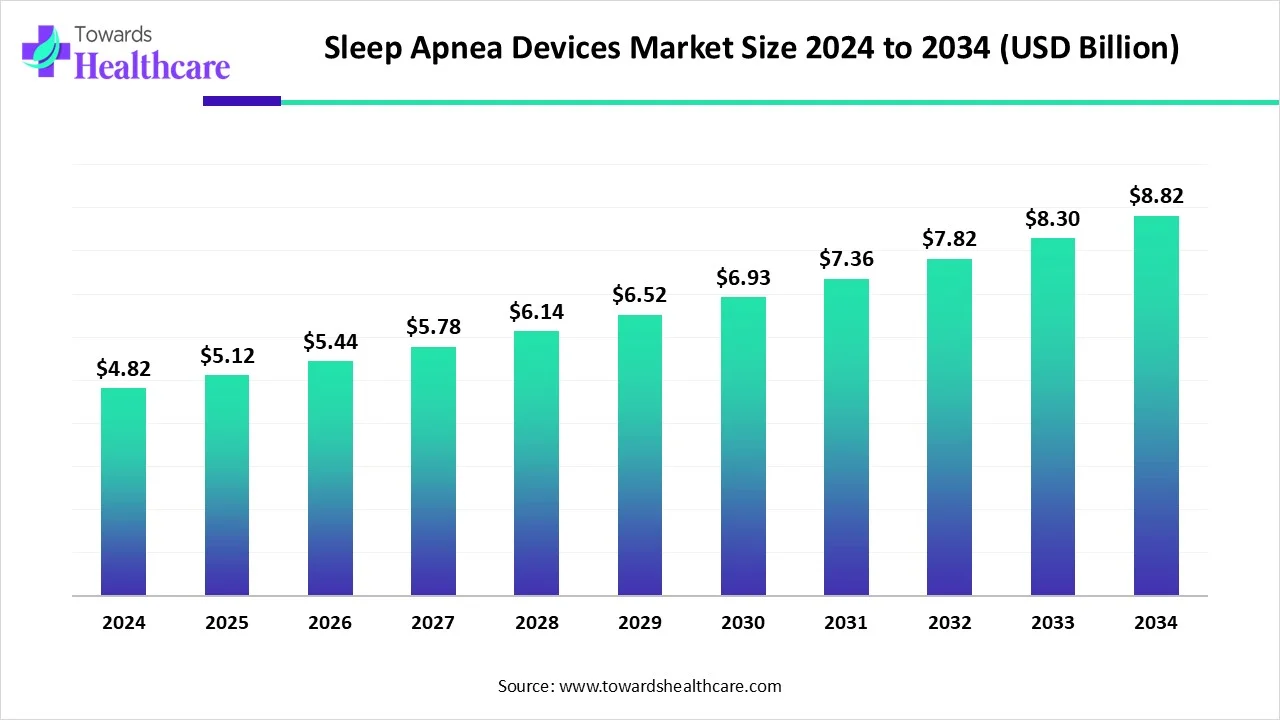
Firstly, according to Towards Healthcare, the global sleep apnea devices market size is calculated at USD 5.12 billion in 2025, grew to USD 5.44 billion in 2026, and is projected to reach around USD 9.38 billion by 2035. The market is expanding at a CAGR of 6.24% between 2026 and 2035. Whereas the global wearable sleep trackers market size is calculated at USD 16.52 billion in 2025, grew to USD 18.31 billion in 2026, and is projected to reach around USD 46.24 billion by 2035. The market is expanding at a CAGR of 10.84% between 2026 and 2035. In 2024. In both markets, North America led in 2025, and Asia-Pacific is anticipated to witness rapid growth in the predicted timeframe.
From some surveys, China registers dominance in the total number of instances across the world, because of its massive population size & increased urban case. Moreover, the United States ranks second worldwide, coupled with the latest health studies that indicate over 83 million adults are living with some form of OSA. Consequently, Brazil & India are registering third & fourth ranks, respectively.
In these cases, the United States shows increased consumer adoption of smartwatches & home sleep monitoring reimbursement growth. Meanwhile in China, it is facing an accelerated burden of OSA, which spurs assertive consumer tech unification & local government health programs inclusion to foster wearable screening. However, India’s urban middle-class adoption of wearable sleep technology is expeditiously raising awareness & fueling first-time clinical consultations for chronic fatigue. Alongside, Brazil’s rigorous regulatory compliance and slower integration of consumer algorithms into formal reimbursement methods.
Reveal Major Recent Developments that Revolutionize the Sleep Wearable Market Growth in 2026
- In July 2026, Garmin launched CIRQA, its foremost screenless smart band, which provides 24/7 health & fitness monitoring, sleep tracking, & up to 10 days of battery life without any need for a subscription. Thus, the company is verifying the screenless wearable concept at a significant incumbent scale. This step elevates competitive pressure on WHOOP, Fitbit, & other screenless or low-interaction wearable platforms.
- In July 2026, Samsung expanded the sleep-intelligence proposition called Galaxy Watch9 & Galaxy Watch Ultra2 that enhanced health & sleep capabilities. Samsung integrates sleep-apnea analysis with sleep insights, tailored baselines, cardiovascular scoring & wider health metrics. This expansion matters because sleep is being combined into an expansive health-management architecture. This leads to increased competition between Samsung, Apple, Oura, & WHOOP.
- In May 2026, Apple announced availability of sleep apnea notifications on Apple Watch in India. This development included a clinically focused sleep feature to another vast market. Alongside, this announcement shows consistent regional growth of medical-adjacent wearable capabilities. Specific strategic competitive variables of this development are regulatory approvals & country-by-country feature availability.
- In May 2026, Google Fitbit rolled out its screenless Fitbit Air at an entry price of $99.99 to implement sleep tracking, HRV, SpO2 and other health monitoring into a small screenless form factor. Along with non-restricted to specialist wearable brands, Google is exploring low-price, low-friction monitoring as a vital part of its health environment.
- In April 2026, WHOOP unveiled Healthspan insights, such as WHOOP Age and Peace of Aging. This resulted in sleep becoming one component in the widespread model including activity, cardiovascular fitness, body composition, & other parameters. This launch further demonstrates the growth of sleep wearables into longevity & preventive health, & positioning as one of the most competitive categories.
- In March 2026, Google Fitbit introduced updates integrating personal health coaching, medical records, sleep science & metabolic research. This shows that wearable-generated information is increasingly being joined with expansive health context. This mainly matters in shifting from raw biometric data toward contextualized health guidance. In terms of business importance, data unification & customization could become more vital competitive differentiators than device specifications alone.
Focusing on Eminent Companies & Organizations
- Apple
- Samsung Electronics
- Google Fitbit
- Oura
- WHOOP
- Garmin
- Withings
- Healthcare, Research & Standards
- U.S. Food and Drug Administration
- American Academy of Sleep Medicine
- World Sleep Society
- National Institutes of Health
- European Respiratory Society
- Sleep clinics and diagnostic providers
Listing Strategic Questions Beyond the Publicly Available Marke
Consumer & Demand Intelligence
- Which sleep metrics most strongly impact wearable purchase decisions across Gen Z, millennials and older consumers?
- How does willingness to pay change between smartwatch, smart ring, screenless band and dedicated sleep devices?
- Which consumers are willing to pay recurring subscriptions, especially for sleep intelligence?
- What percentage of wearable users actively modify their behavior based on sleep recommendations?
- Which sleep features have the highest retention influence after the first 30, 90 and 180 days?
Competitive Intelligence
- Which platform has the powerful defensible longitudinal sleep dataset?
- How do Apple, Oura, WHOOP, Samsung, Fitbit and Garmin compare on sleep-stage accuracy across independent PSG studies?
- Which companies have the strongest regulatory pipeline for additional sleep-related indications?
- Which wearable manufacturers are most likely to broaden from sleep into metabolic, cardiovascular or neurological monitoring?
- How is the competitive position of subscription-based versus non-subscription sleep wearables changing?
Clinical & Regulatory Intelligence
- Which sleep-related biomarkers are closest to becoming commercially validated wearable endpoints?
- Which sleep disorders beyond obstructive sleep apnea have the highest probability of wearable-based screening applications?
- How are FDA, European and Asian regulatory pathways evolving for consumer wearables making health-risk claims?
- Which healthcare systems are actively incorporating consumer-generated sleep data into clinical workflows?
Technology Intelligence
- Which sensor technologies facilitate the greatest potential improvement in sleep-stage classification?
- Could in-ear electrophysiological sensing outperform wrist-based sensing for selected sleep applications?
- Which combinations of PPG, accelerometry, temperature, SpO2 and electrophysiological signals offer the strongest sleep-health signal?
- What is the minimum sensor configuration needed to deliver clinically meaningful sleep-risk detection?
Commercial & Investment Intelligence
- Which sleep wearable companies have the strongest potential to monetize beyond hardware through subscriptions, healthcare partnerships or data services?
- Which emerging companies could become acquisition targets because of proprietary sleep algorithms, datasets, sensors or clinical validation?
High-Value Data & Intelligence Pointers
- According to CDC data, 69.5 % of US. adults experienced sufficient sleep in 2024.
- Whereas 15.4% of U.S. adults recorded trouble falling asleep most days or every day in 2024.
- In 2024, 12.9% of U.S. adults leveraged sleep aids most days or every day.
- Samsung's sleep-apnea feature gained FDA De Novo authorization in 2024, showcasing an important regulatory step for wearable sleep-risk detection.
- Samsung reported reinforcement of its sleep-apnea feature to 70 markets in 2025 and later noted availability in 78 markets in 2026.
- Fitbit Air rolled out in 2026 at a starting price of $99.99, with up to nearly a week of battery life.
- In July 2026, Garmin unveiled CIRQA with up to 10 days of battery life and a screenless design.
- Apple states its Sleep Score algorithm was designed and tested using more than 5 million nights of sleep data from the Apple Heart and Movement Study.
- WHOOP's Healthspan framework employs nine metrics spanning sleep, activity and fitness to calculate WHOOP Age and Pace of Aging.
- A consumer preference study found that independent evaluation surged the purchase-price threshold by $30, while medical endorsement increased it by $48, as compared with a nonvalidated device.
- A 2025 meta-analysis specifically examined the performance of consumer wrist-worn sleep trackers against polysomnography, strengthening the continuing validation gap.
- The World Sleep Society published dedicated recommendations for consumer health trackers monitoring sleep in 2025, representing the rising importance of wearable sleep technology to the professional sleep community.
What Businesses Should Look For Next Across the Sleep Wearable Market?
Can wearables move beyond sleep scoring?
During the forecast period, the premium products will increasingly link sleep to cardiovascular, metabolic, recovery and behavioral outcomes.
Can screenless devices challenge smartwatches?
Particularly, Fitbit Air and Garmin CIRQA show that there is insightful strategic interest in low-distraction, high-adherence form factors.
Will sleep-apnea detection become a standard wearable feature?
The regulatory progress of Samsung and Apple's empowering availability suggests that sleep-related risk detection could become a substantial baseline capability.
Will consumers pay for interpretation?
As basic sleep tracking becomes commoditized, subscriptions may increasingly necessitate justification through coaching, personalization, health insights and longitudinal analysis.
Who will own the sleep data layer?
The long-term strategic prize may not be the device.