


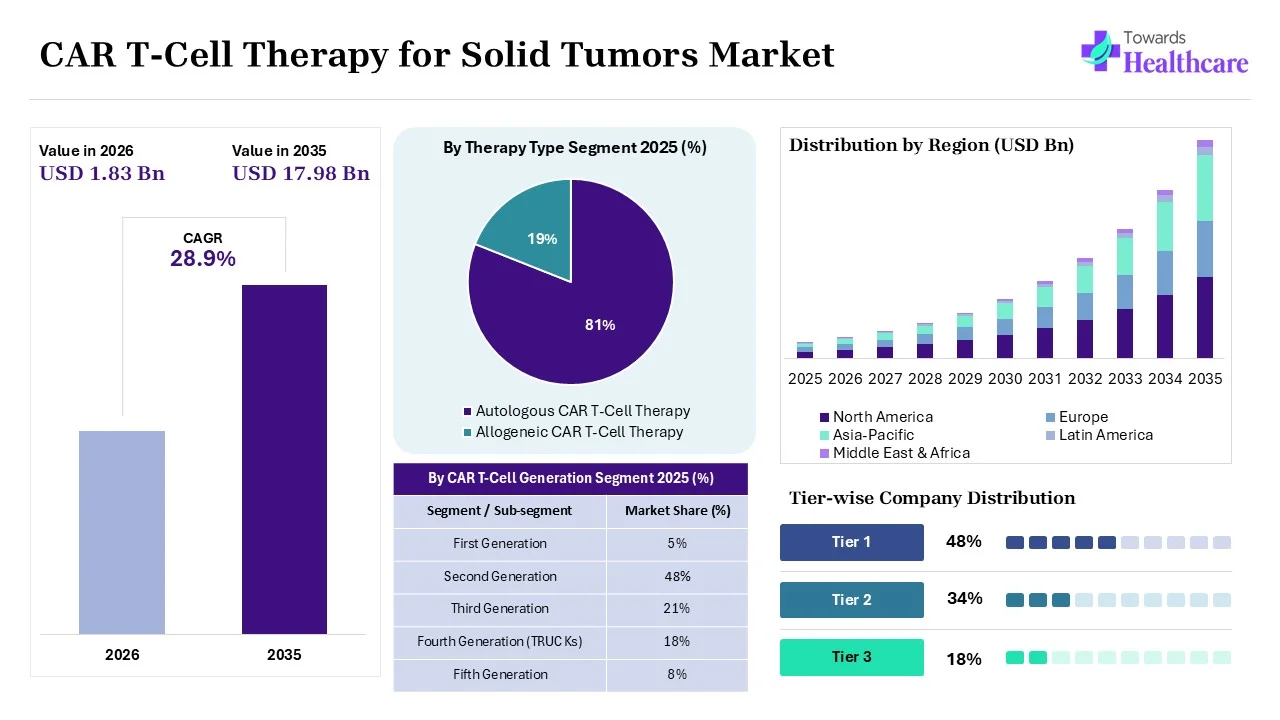
The CAR T-cell therapy for solid tumors market size accounted for USD 1.42 billion in 2025 and is predicted to increase from USD 1.83 billion in 2026 to approximately USD 17.98 billion by 2035, expanding at a CAGR of 28.9% from 2026 to 2035. A rise in diverse cancer cases, advancements in localized delivery, & accelerating biotechnology investment are propelling the market progression.
The CAR T-cell therapy for solid tumors market encompasses an advanced immunotherapy where a patient's own T-cells are extracted, genetically modified in a lab to target specific proteins on cancer cells, & multiplied. With the rising cancer cases, the market has been providing the use of tandem CARs & armored CARs to mitigate tumor evasion. The market has a key scope in combining CAR T-cell therapy with immune checkpoint inhibitors or engineered via CRISPR to eliminate suppressive receptors (like TGF-beta) from the T-cells.
An eventual growth of the CAR T-cell therapy for solid tumors market is promoting novel delivery methods focused on in vivo CAR technology to combat the need to wait weeks for external laboratory manufacturing. Ongoing robust clinical trials are advancing intratumoral injections and direct infusions to bypass physical barriers and boost the localized concentration of CAR T-cells.
The graph represents the number of new cancer cases across the globe in 2025, 2030, 2040, & 2050. The CAR T-cell therapy for solid tumors market will advance highly tailored, curative, living-drug immunotherapies that genetically engineer the patient’s own immune system to destroy tumors. Alongside, the market will promote next-generation solutions, including the implementation of gene-editing technologies, such as CRISPR-Cas9, to develop allogeneic, ‘off-the-shelf’ CAR T-cells.
By target antigen, the HER2 segment held a major share of 19% of the market in 2025, due to the strong clinical pipeline. Alongside, the globe is exploring advanced breast & gastric cancer studies, fuels the segmental expansion. Alongside, the market is shifting towards a combination of HER2-targeted CAR T-cells with standard chemotherapies or other immunotherapies to improve tumor infiltration & effectiveness.
By tumor type, the gastrointestinal cancers segment led with a 27% share of the CAR T-cell therapy for solid tumors market in 2025. Higher number of patients & broader investments in GI oncology are driving the adoption of the latest CAR T-cell therapies. Industry has been emphasising finding new, GI-specific antigens to drive pipeline development, while Claudin 18.2 (CLDN18.2), GPC3, MSLN (Mesothelin), & MUC17 are developing immense clinical and commercial interest.
By CAR T-cell generation, the second generation segment captured a dominant share of 48% share of the market in 2025. Specifically, these generation therapies are integrating co-stimulatory domains, like CD28 and 4-1BB, to enhance T-cell activation and persistence. A strong manufacturing ecosystem is fostering closed, automated, and centralized manufacturing systems, which makes CAR T-cell logistics more reliable.
By therapy type, the autologous CAR T-cell therapy segment captured the largest share of 81% of the market in 2025. This massive share highlights the clinical success and widespread adoption of patient-derived treatments over allogeneic alternatives. Moving forward, this established segment continues to lead clinical pipelines, driving significant commercial investments and regulatory approvals within the oncology landscape.
By end user, the hospitals segment dominated with a 52% share of the CAR T-cell therapy for solid tumors market in 2025. Hospitals are providing advanced oncology infrastructure, with wider access to multidisciplinary care & rising reimbursement support. Also, these hospitals offer operating theatres, intensive care units (ICUs), & accredited transplant centers.
By development stage, the preclinical segment held a major share of 36% in 2025, due to an extensive innovation pipeline & numerous novel targets. Preclinical studies are leveraging immune-checkpoint inhibitors & new payloads to survive and expand within the hypoxic & immunosuppressive solid tumor milieu.
In 2025, North America accounted for a dominant share of 43% of the CAR T-cell therapy for solid tumors market, due to strong biotech investment & the largest clinical trial ecosystem. Gradually, the U.S. FDA’s accelerated programs, including Regenerative Medicine Advanced Therapy (RMAT) designations & breakthrough therapy pathways, are fostering clinical trials & commercialization for newer targets.
Asia Pacific held a 22% share in 2025 & is expected to witness rapid growth in the coming years. Surging government support & increasing prevalence of cancers propel the adoption of novel CAR T-cell therapies. Additionally, this region is a centre for cell processing and contract manufacturing. Whereas CAR T therapies manufactured in China & India cost nearly 40-50% of those in Western countries, while clinical development is drastically more cost-effective, spurring deeper R&D investments.
CARsgen Therapeutics, Gilead Sciences (Kite Pharma), Novartis, & Bristol Myers Squibb (BMS) are expanding as key companies in the market. Whereas CARsgen Therapeutics is known as a dominant player, which has explored CT041 (targeting Claudin18.2) for gastric cancers. On the other hand, Gilead's Kite Pharma & BMS are witnessing dominance in blood cancers.
By Target Antigen
By Tumor Type
By CAR T-Cell Generation
By Therapy Type
By Delivery Route
By End User
By Development Stage
By Region


