


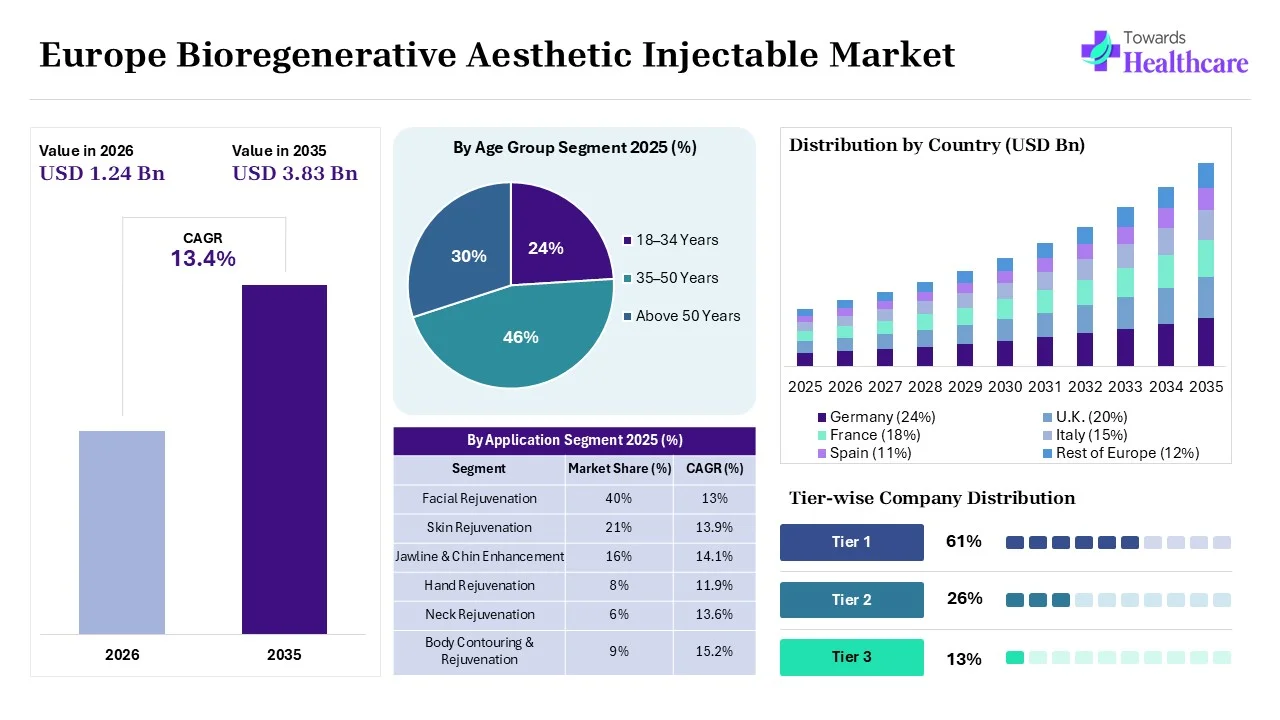
The Europe bioregenerative aesthetic injectable market size was estimated at USD 1.09 billion in 2025 and is predicted to increase from USD 1.24 billion in 2026 to approximately USD 3.83 billion by 2035, expanding at a CAGR of 13.4% from 2026 to 2035. Bioregenerative aesthetic injectable triggers the body’s own collagen creation and tissue repair over time. It makes it softer, more natural, and continues to enhance for months after treatment, which drives the growth of the market.
Bioregenerative aesthetic injectable non-invasive or minimally invasive processes, which are intended to stimulate the body’s natural regenerative processes. Unlike outdated cosmetic interventions that rely on synthetic materials or operation, bioregenerative management works in harmony with the body’s own biology to improve appearance. The skin’s structural integrity is largely based on collagen, but as age increases, the body’s collagen manufacturing gradually fails, causing to the formation of wrinkles, sagging skin, and volume loss. Bioregenerative management targets these challenges by triggering collagen manufacture, efficiently reversing the aging process. Significant application of bioregenerative aesthetic injectable in facial rejuvenation and anti-aging, skin quality enhancement, scar and stretch mark lessening, hair restoration, under-eye rejuvenation, body contouring, and skin tightening.
14 hospitals and clinics are found leading German hospital, 3800 treat around 593,000 outpatient and 139,000 inpatient cases each year.
Plateletâ€Rich Fibrin (PRF):
Emerging biomaterials, collagen with plateletâ€rich fibrin (PRF), presented promising results, separately and in mixture. PRF and collagen show strength for different clinical claims in regenerative medicine. Randomized clinical research is necessary to demonstrate their superiority to standard management and to standardize protocols. Platelet-rich fibrin (PRF) has recently gained attention because of its promising biological characteristics. PRF is a natural autologous biomaterial with demonstrated effectiveness in soft tissue regeneration, wound healing, and aesthetic medicine. As compared to PRP, liquid PRF is a totally natural biomaterial deprived of additives or anticoagulants, needs a simpler and quicker preparation process, and offers a more gradual and continued release of growth factors and cytokines because of its three-dimensional fibrin scaffold.
By product type, the poly-l-lactic acid (PLLA) injectables segment contributed the largest market share of 28% in 2025. PLLA triggers new collagen production in the skin, progressively enhancing elasticity and facial structure. The effects develop over numerous months, subsequent in restoration of facial volume and enhancement in skin firmness. The outputs are long-lasting, often maintained for 2-3 years with occasional top-up management.
By application, the facial rejuvenation segment contributed the largest Europe bioregenerative aesthetic injectable market share of 40%, as bioregenerative aesthetic injectables work well for fine rhytids, also helping to volumize, contour, and rejuvenate the face, neck, and hands. This removes the challenges of allergic reactions or immune system rejection.
By end user, the dermatology clinics segment held a major share of 34% in the market, as aesthetic injections can stimulate profound cellular regeneration at the genuine levels of the skin. It offers significant benefits like reduced scar size, enhanced skin color, and improved overall skin quality.
By gender, the female segment contributed the largest Europe bioregenerative aesthetic injectable market share of 78%, as bio-regenerative dermal fillers provide both rapid and long-term advantages. Consumers will see volume and lift correct away these treatments encourage the female body’s capability to rebuild its own elastin and collagen, the two proteins responsible for young, firm, and smooth skin.
By age group, the 35–50 Years segment contributed the largest market share of 46%, as bioregenerative aesthetic injectable offers significant advantages to this age group, such as immediate lift and delicate volume correction, enhanced skin tone and texture over time, rising collagen and elastin stimulus, reducing downtime, treats multiple zones, involving hard-to-reach region and natural-looking outputs deprived of puffiness or heaviness of the skin.
By distribution channel, the direct sales segment contributed the largest Europe bioregenerative aesthetic injectable market share of 56%, consumers advantage from direct selling due to the convenience and service it delivers, involving personal demonstration and explanation of products, home delivery, and generous satisfaction promises. In direct sales, it lowers the difficulty in the business plans and commission control.
By country, Germany contributed the largest market share of 24%, as this region is the largest in the pharmaceutical sector in Europe and the fourth-largest globally. This region is leading the way in regenerative medicine, but it must do more to remove challenges and ensure that the output of research makes its way. German research and development in the area of tissue engineering and biomaterials research occupies a dominant position in international comparison, which drives the growth of the market.
Leading companies in the Europe bioregenerative aesthetic injectable market are Galderma S.A., Merz Aesthetics, IBSA Group, and Sinclair Pharma. Meanwhile, Galderma S.A. provides Sculptra and Restylane Skinboosters for deep hydration and tissue regeneration. Merz Aesthetics is supporting patients to look better, feel better, and live better. IBSA Group is active in bio-remodelling injectables that improve skin hydration and stimulate collagen and elastin. Sinclair Pharm specializes in long-acting collagen stimulators like PLLA and PCL-based injectables, and regenerative skin.
By Product Type
By Application
By End User
By Gender
By Age Group
By Distribution Channel
By Region


