


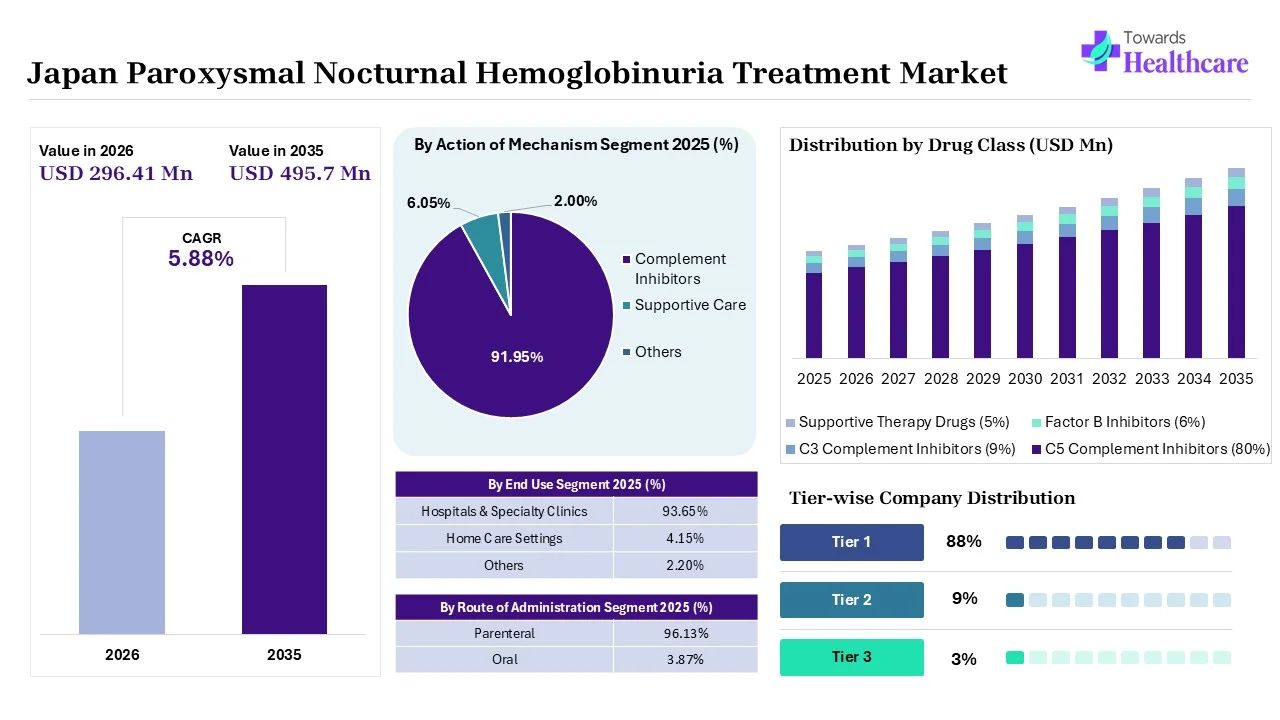
The Japan paroxysmal nocturnal hemoglobinuria treatment market size was valued at US$ 279.95 million in 2025 and is projected to grow to 296.41 million in 2026. Forecasts suggest it will reach approximately US$ 495.7 million by 2035, registering a CAGR of 5.88% during the period. Growing demand for advanced complement inhibitors, expanding government financial subsidisation of orphan drugs, increasing health awareness, growing R&D activities, increasing demand for personalized solutions, and expanding technological innovations are promoting the market growth.
The Japan paroxysmal nocturnal hemoglobinuria treatment refers to the pharmaceutical products, therapies, and healthcare services used for the treatment and management of paroxysmal nocturnal hemoglobinuria across Japan. These treatment options help in controlling hemolysis, preventing blood clots, control complement medicated RBC destruction. They also provide kidney function protection, improve hemoglobin levels, and reduce anemia-related symptoms.
Increasing health awareness is driving the early diagnosis of paroxysmal nocturnal hemoglobinuria in Japan, increasing the demand for its treatment options.
By mechanism type, the complement inhibitors segment accounted for the highest revenue share of 91.95% of the Japan paroxysmal nocturnal hemoglobinuria treatment market in 2025, due to their targeted action. They also helped in reducing complement-mediated RBC destruction and intravascular hemolysis. Their enhanced safety and efficacy also increased their use, which further reduced the need for blood transfusions.
By route of administration type, the parenteral segment held a major revenue share of 96.13% of the Japan paroxysmal nocturnal hemoglobinuria treatment market in 2025, as most PNH treatment options are administered subcutaneously or intravenously. Their enhanced bioavailability and rapid onset of action also increased their acceptance rate. Moreover, they were preferred for the administration of large molecules.
By end use, the hospitals & specialty clinics segment contributed the biggest revenue share of 93.65% of the Japan paroxysmal nocturnal hemoglobinuria treatment market in 2025, driven by the availability of specialized staff and medical expertise. Their advanced diagnostic and treatment facilities also increased their use. Reimbursement support and better disease complication management also increased their preference.
By drug class type, the C5 complement inhibitors segment held the largest revenue share of 80% of the Japan paroxysmal nocturnal hemoglobinuria treatment market in 2025, due to their direct blocking of the C5 protein responsible for complement-mediated RBC destruction. They also helped in reducing intravascular hemolysis, the risk of thrombosis, and fatigue. They also helped in improving hemoglobin levels, which increased their use.
The Japan paroxysmal nocturnal hemoglobinuria treatment market held a significant share in 2025 and is expected to show lucrative growth during the predicted time, due to the presence of advanced healthcare infrastructure and increasing health awareness. The presence of advanced industries and reimbursement policies also increases the adoption and accessibility of various PNH treatment options. The growing demand for personalized medicines is also enhancing the market growth.
AstraZeneca plc registered dominance over the market with its Soliris, Vodyeya, and Ultromiris products, where Chugai Pharmaceuticals was its closest competitor, which offered Piasky. Novartis AG also maintained its position by providing Fabhalta, where Apellis Pharmaceuticals, Inc. also contributed to the market growth with its Empaveli/Aspaveli.
By the Action of the Mechanism
By Route of Administration
By End Use
By Drug Class


