


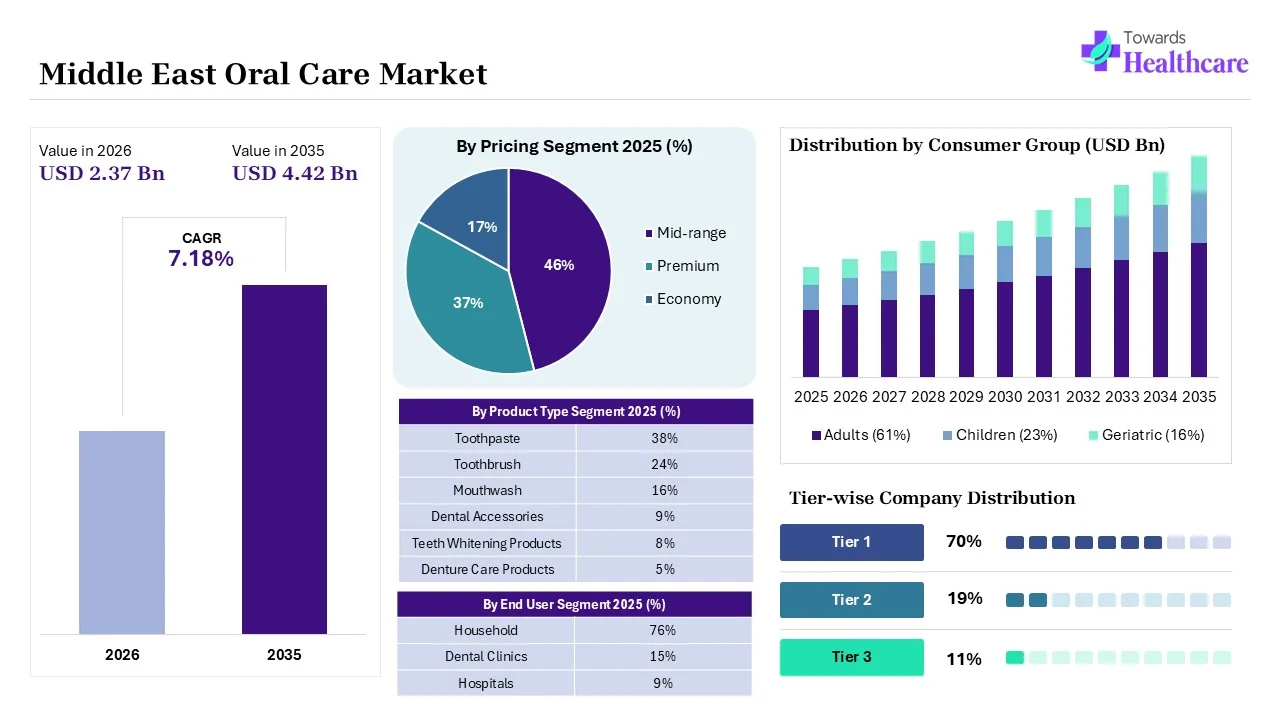
The Middle East oral care market size was reported at US$ 2.21 billion in 2025 and is expected to rise to US$ 2.37 billion in 2026 to reach US$ 4.42 billion by 2035. According to forecasts, it will grow at a CAGR of 7.18%. Taking care of oral health, such as teeth and gums, helps prevent severe diseases, lowers the challenges of challenges from chronic conditions, and helps mental health.
Precise oral hygiene helps prevent different dental challenges, like cavities, gum disease, and bad odour. Oral health is the state of the teeth, mouth, and orofacial structures, which allows patients to perform significant functions like breathing, eating, and speaking, and encompasses psychosocial dimensions such as well-being, self-confidence, and the ability to socialize and work without pain, discomfort, and awkwardness. Oral diseases include a range of diseases and conditions that involve dental caries, periodontal disease, oral cancer, tooth loss, oro-dental trauma, noma, and birth defects like cleft lip and palate. Oral care is an important aspect of overall health, surrounding the practices and habits that keep the mouth, teeth, and gums in decent condition.
Technological development has transformed dental care, making it more specific, safe, and patient-centric. The major application of robotic technology in dentistry education. This technology helps technologies, like robotics, AI, and ML, which support the intended advanced dental technology. This robotics and dentistry integration has a broad range of potential applications. Modern robotics technology has advanced rapidly. Integrating smart robotic technology into dental clinics, specifically as dental assistants, has the potential to significantly improve the existing technical infrastructure. Robotics is renovating dentistry by improving safety, precision, and patient comfort. Increasing their applications in prosthodontics, oral implantology, orthodontics, oral surgery, and endodontics, dental robots assist in technology.
In February 2026, DentalMonitoring, the global leader in AI-powered software as a medical device for remote orthodontic monitoring, secured a combined $100M investment from new investors, including Lazard, Elaia Capital and ISALT, through its Fonds Stratégique des Transitions.
By product type, the toothpaste segment contributed the largest market share of 38% in 2025, as toothpaste is as effective as traditional preparations in preserving oral health. They often comprise natural antibacterial and anti-inflammatory components that aid in decreasing plaque, avoiding gum disease, and enhancing breath freshness. Toothpaste is frequently manufactured with mild, natural components that offer relief for individuals with sensitive teeth and gums.
By Consumer Group, the adults segment contributed the largest Middle East oral care share of 61%, as oral care, avoiding tooth decay, bad breath, and gum disease, helps maintain the condition of the teeth and enhances general health. Application of dental floss to get rid of plaque in hard-to-reach places. Cleaning made easy through the use of premium dental floss in adults.
By distribution channel, the hypermarkets & supermarkets segment held a significant share of 36% in the market, as it provides the convenience of one-stop shopping, enabling customers to purchase daily basics such as toothpaste, mouthwash, and floss, as well as their regular groceries.
By ingredient type, the conventional segment contributed the largest Middle East oral care share of 52%, as ingredients possess anti-inflammatory, antimicrobial, and healing characteristics that encourage oral health without the significant adverse effects related to synthetic chemicals. It actively remineralizes tooth enamel, avoids cavities, fights sensitivity, and controls plaque.
By end user, the household segment contributed the largest market share of 76%, as household oral care is a significant contributor to oral health and supports reducing the need for extensive dental intervention in the future. Household oral hygiene prevents simple cavities from developing into extensive root canals, extractions, and replacement technology.
The Middle East oral care market is growing steadily due to increasing awareness of dental hygiene, rising disposable incomes, and expanding access to advanced oral care products. Growing demand for premium toothpaste, mouthwashes, whitening solutions, and preventive dental treatments is supporting market expansion. Government health initiatives, urbanization, and a rising focus on personal grooming are further driving adoption. Additionally, e-commerce growth and product innovation continue to create new opportunities across the region.
Leading companies of the Middle East oral care market include Colgate-Palmolive, Procter & Gamble, Haleon, and Kenvue. Meanwhile, Colgate-Palmolive provides a broad range of oral care products, involving toothpastes, toothbrushes, dental floss, and mouthwashes. Procter & Gamble, it provides target cavity protection, sensitivity relief, and gum health, alongside specialized lines such as Scope mouthwash and Fixodent denture adhesives. Haleon, it has a broad range of professional, science-driven oral health products to support patients in achieving improved mouths. Kenvue is enhancing public oral health by promoting advanced, science-driven dentistry, which puts the patient at the centre.
By Product Type
By Consumer Group
By Distribution Channel
By Ingredient Type
By End User
By Pricing
By Region


