


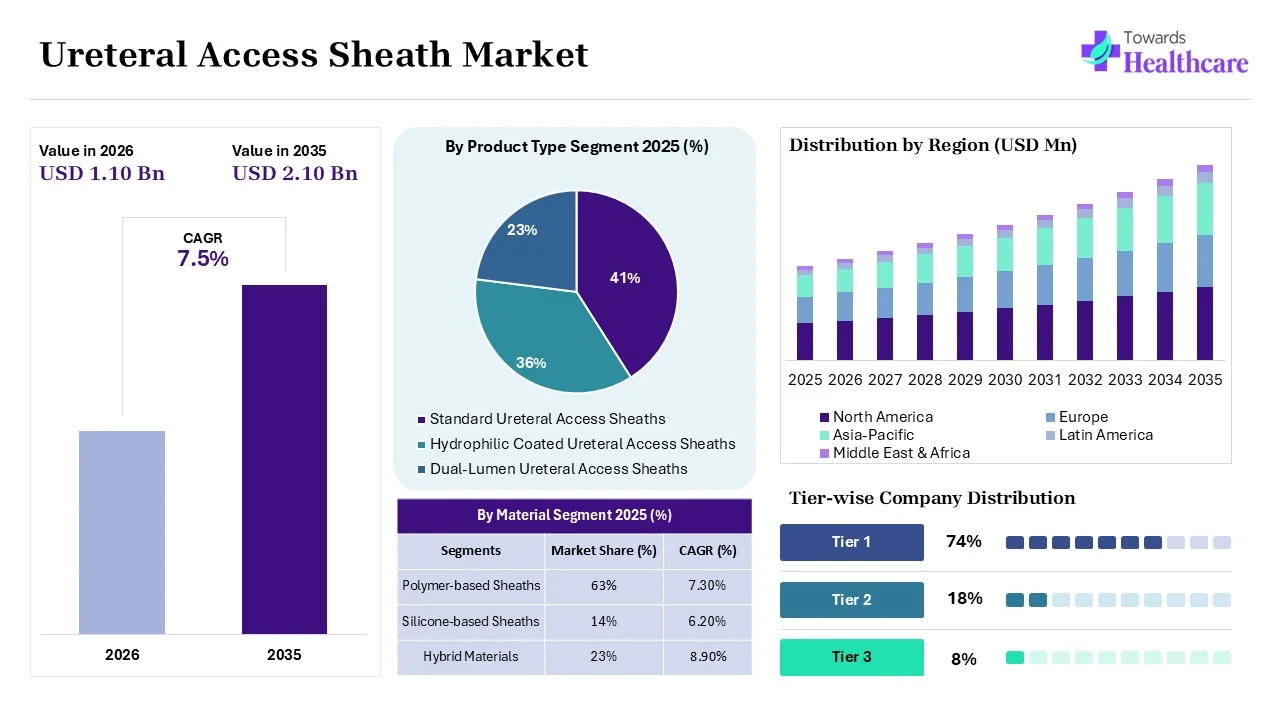
The ureteral access sheath market size accounted for USD 1.02 billion in 2025 and is predicted to increase from USD 1.1 billion in 2026 to approximately USD 2.1 billion by 2035, expanding at a CAGR of 7.5% from 2026 to 2035. Increasing cases of nephrolithiasis, kidney stones, and expanding demand for minimally invasive procedures are driving the growth of the ureteral access sheath market.
The global ureteral access sheath market is defined as the use of a versatile, typically hydrophilic-coated tube placed in the ureter during retrograde intrarenal surgery (RIRS) to develop a protective conduit for repeated endoscopic access to the kidney. The ureteral access sheath has been shown to significantly increase visibility, lower renal pelvic pressure, protect the ureteroscope, & also support fragment extraction. The overall market progression is propelled by the growing cases of nephrolithiasis and the surging adoption of minimally invasive, single-use, or disposable devices.
Recent advances in flexible ureteroscopes (fURS) and high-power holmium laser (HPHL) technology have expanded their uses, making retrograde intrarenal surgery (RIRS) the preferred approach for difficult upper urinary tract stones. Flexible ureteroscopy (fURS) has significantly evolved and is now a common diagnostic and therapeutic method for various upper urinary tract conditions. Improvements in endoscope technology and surgical techniques have increased the application of fURS in treating urolithiasis, including larger and more complex stones. It has proven to be an effective and safe procedure with few contraindications. Ongoing advancements in fURS are likely to broaden its clinical role and potentially replace other treatments as the first-line option for urolithiasis, contributing to the growth of the ureteral access sheath market.
By product type, the standard ureteral access sheaths segment contributed the largest market share of 41% in 2025, as ureteral access sheaths allow multiple ureteral passes, enhancing time effectiveness and procedural standardization in stone treatment. They provide benefits such as facilitating the insertion and removal of the ureteroscope, providing a clearer field of view, and lowering post-operative problems.
By material, the polymer-based sheaths segment contributed the largest ureteral access sheath market share of 63%, as internal polymer sheaths provide a challenge to continue the bore fluid integrity. Exposure to attention and fluid temperature. Polyolefin sheath materials provide various advantages, including durability, flexibility, chemical resistance, environmental resistance, electrical insulation properties, thermal stability, affordability, versatility, and safety.
By length, the medium length (25–35 cm) segment held a significant share of 5 7% in the market. Medium-length ureteral access sheaths (typically ~ 28 cm to 35 cm) offer an ideal middle ground in endourology. They provide ample reach for navigating the lower and mid-ureter without extending too deep into the fragile renal pelvis. It's improved visualization, reduced renal pressures, and simplified access with the use of a ureteral access sheath.
By end user, the hospitals segment contributed the largest ureteral access sheath market share of 61% in 2025, as in-hospital use lowers ureteral trauma while repeated tool insertion. Maintains, reduces intrarenal pressure, and improves visualization during technology. Facilitates rapid and smoother tool exchange and enhances overall surgical effectiveness.
By application, the kidney stone management segment contributed the largest market share of 68%, as recent advancements in imaging technology have significantly enhanced the precision of kidney stone identification and treatment. The ureteral access sheath market is growing due to the fact that high-resolution CT scans and ultrasound imaging have recently allowed for more precise stone localization and size estimation.
By region, the North America segment contributed the largest ureteral access sheath market share of 39% in 2025, as extensive availability of well-furnished outpatient care centers and ambulatory surgical centers (ASCs) simplifies the fast adoption of minimally invasive technology. Increasing partnership between academic urology organisations, research centers, and crucial medical tools manufacturers confirms continuous product innovations and validates their healthcare use, which drives the growth of the ureteral access sheath market.
Leading companies in the ureteral access sheath market include Boston Scientific Corporation, Cook Medical, Coloplast, and Olympus Corporation. Meanwhile, Boston Scientific Corporation has extremely flexible and durable sheaths that facilitate tool exchanges during kidney stone operations. Cook Medical, a significant player well-known for its flexor series of ureteral access sheaths, intended to establish a stable functioning channel and protect the ureter. Coloplast, an important provider of urology and continence care, provides specialized sheaths tailored for minimally invasive stone administration, and Olympus Corporation, which produces access sheaths intended to optimize urological technology, together with their scopes.
By Product Type
By Material
By Size
By Length
By End User
By Usage
By Application
By Distribution Channel
By Region


