The growing demand for remote healthcare services, increasing healthcare professional shortage, demand for preventive healthcare, technological advancements, and healthcare digitization are promoting the market growth
The Rise of the Smart Health Era: The AI Revolution in Virtual Health
The AI in virtual health encompasses the improved remote healthcare services provided by the integration of AI tools with digital healthcare systems and telemedicine platforms. They offer a wide range of applications such as remote patient monitoring, medical image analysis, virtual consultations, administrative automations, clinical decision support, drug discovery support, and personalized treatment planning. Additionally, their chatbots, virtual assistants, and predictive analytics also help in chronic disease management.
Forecasting Innovation: Exploring the Emerging Market Opportunities
- The growing shift towards remote patient monitoring and virtual consultations across the U.S. is increasing the use of AI in virtual health.
- Growing focus on preventive healthcare and demand for personalized medicines are also increasing their use for early disease detection and tailored treatment development.
- To offer patient-centric and flexible healthcare services, the development of AI-driven hybrid models is increasing.
- The expanding digital transformation of healthcare is increasing the use of AI in virtual health for chronic disease management, clinical decision support, and workflow automation.
- Growing technological advancements and healthcare investments are also fueling their innovations.
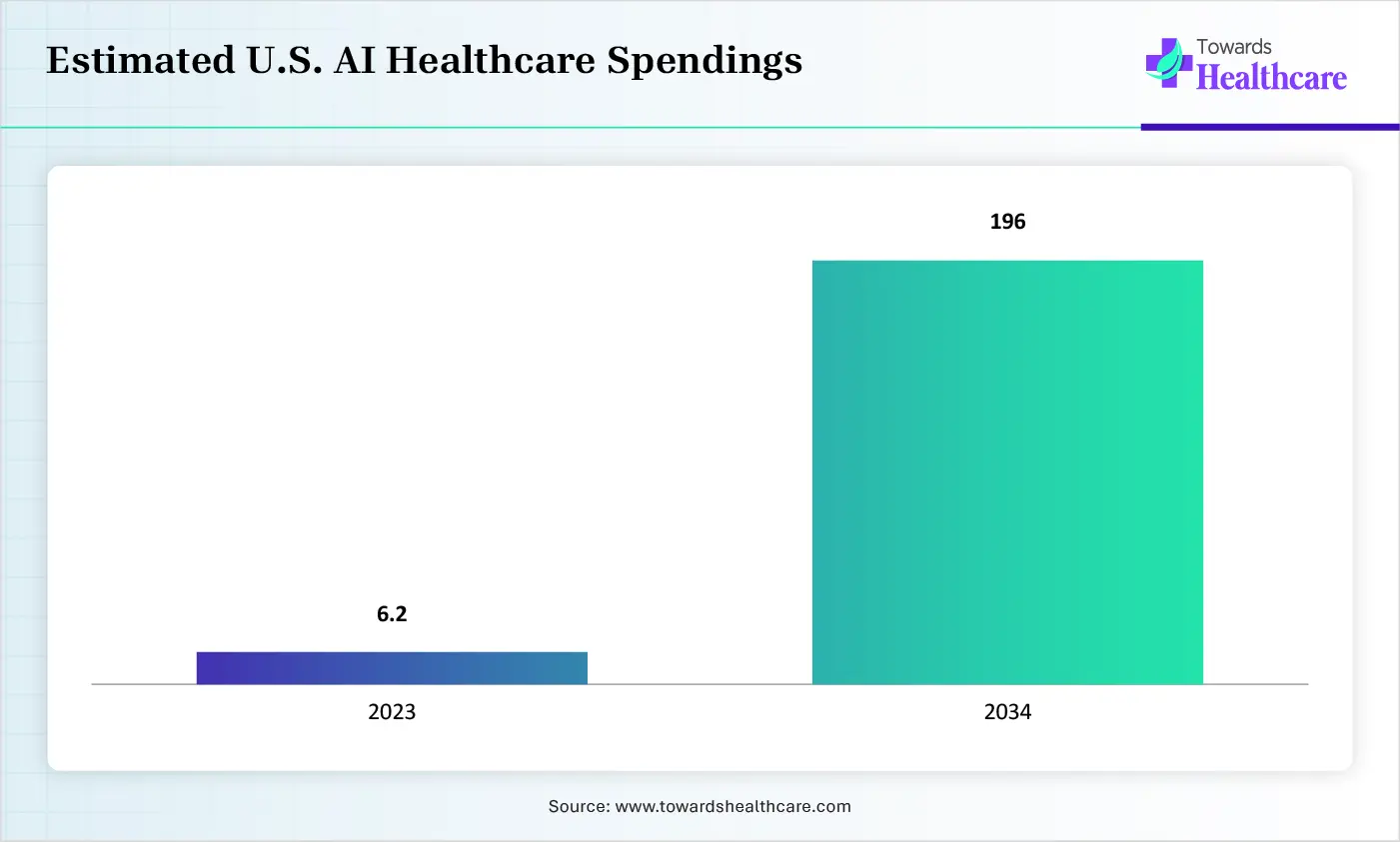
The graph represents an estimated U.S. spending on the research and application of artificial intelligence (AI) in health care for the years 2023 and 2034. It indicates that there will be a growth in AI investments, which will drive its innovation to offer a wide range of healthcare applications. This, in turn, will increase the adoption of AI for virtual healthcare applications as well, which in turn will ultimately promote the market growth.
Market Segmentation Overview
- By component type, the software segment accounted for the highest revenue share of 60% of the U.S. AI in virtual health market in 2025, due to its enhanced scalability, core functionality, and data-driven insights. Their faster innovation cycles, interoperability, and cloud integration also increased their demand. The presence of SaaS models and customization capability also increased their adoption rates.
- By technology type, the machine learning & deep learning segment held a major revenue share of 40% of the U.S. AI in virtual health market in 2025, due to their high diagnostic accuracy, strong pattern recognition, and continuous learning capabilities. Their faster EHR processing and disease progression or risk detection also increased their use. Their integration with telehealth platforms also contributed to their increased use.
- By function type, the virtual consultations & tele?visits segment contributed the biggest revenue share of 30% of the U.S. AI in virtual health market in 2025, as it enhanced the patient convenience by offering enhanced access to healthcare professionals. Their affordable services and integration with healthcare tools also increased their acceptance rates. They were also used for remote patient monitoring and chronic disease management, reducing hospital burden.
- By end user, the healthcare providers segment held the largest revenue share of 50% of the U.S. AI in virtual health market in 2025, due to growth in the use of AI for disease diagnosis, treatment, and management. They also helped in reducing administrative burden and offered regulatory compliance, which increased their use of telehealth services. Their clinical decision support and affordable services also increased their use.
- By deployment type, the cloud?based segment led the U.S. AI in virtual health market with 65% in 2025, due to its enhanced scalability, faster deployments, and remote accessibility. Their seamless data integration, high storage capacity, and continuous updates have also increased their use. Moreover, these applications also promoted their adoption across various hospitals and labs.
Regional Analysis
The U.S. AI in virtual health market is expected to show significant growth due to the presence of a well-established healthcare ecosystem and robust tech leadership. High healthcare spending, a tech-savvy population, and a rise in the adoption of telehealth platforms also increased AI adoption for virtual healthcare applications. Moreover, the growth in the shift towards remote patient monitoring has also increased the use of AI-based virtual assistance and chatbots for consultations, which has enhanced the market growth.
The U.S. Tech Titans: Companies Powering AI Virtual Health
The market was dominated by Teladoc Health with its Virtual Sitter platform, where Microsoft was its closest contender with its Dragon Copilot. GE HealthCare also sustained its market position by offering SonicDL, where Doximity also supported the market growth with its DocsGPT platform.
Segments Covered in the Report
By Component
By Technology
- Machine Learning & Deep Learning
- Natural Language Processing
- Computer Vision
- Others
By Function
- Virtual Consultations & Tele-Visits
- Remote Patient Monitoring (RPM)
- Clinical Decision Support
- Administrative Automation
- Patient Engagement & Experience
- Virtual Health Assistants/Chatbots
By End User
- Healthcare Providers
- Healthcare Payers
- Patients/Consumers
- Homecare Services
- Others
By Deployment
- Cloud-Based
- On-Premise
- Hybrid




