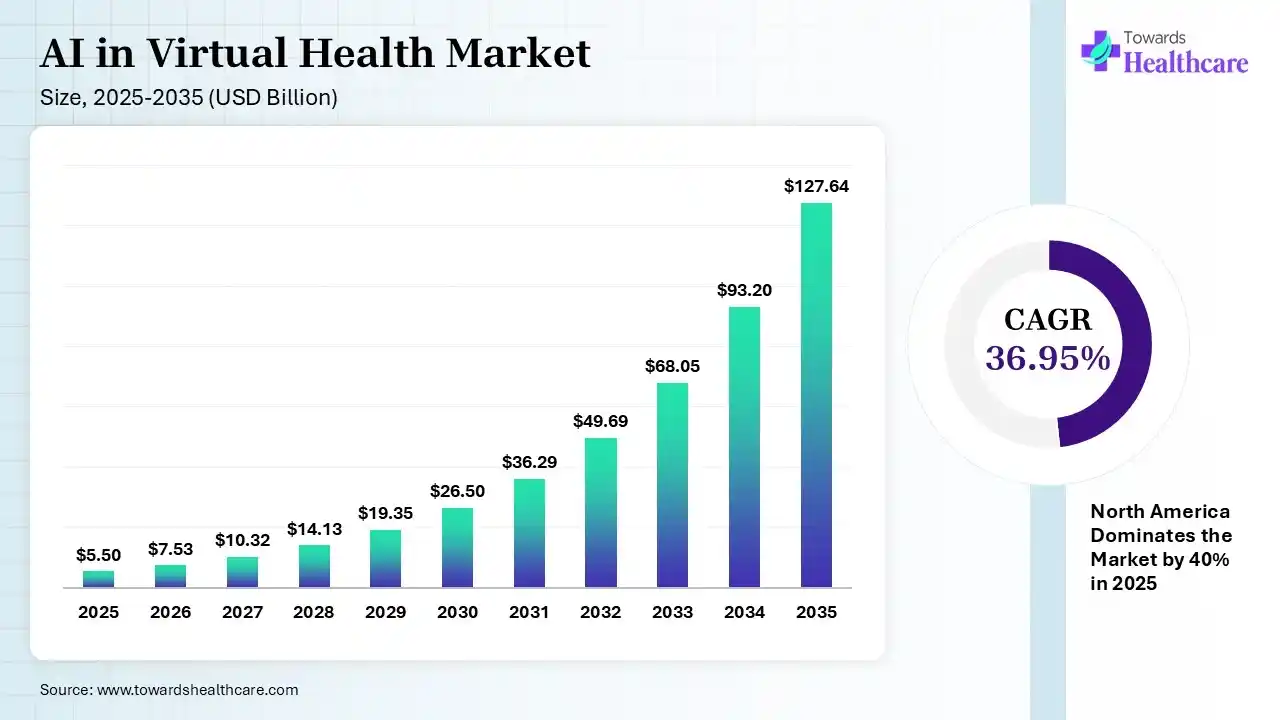
The global AI in virtual health market size was estimated at USD 5.5 billion in 2025 and is predicted to increase from USD 7.53 billion in 2026 to approximately USD 127.64 billion by 2035, expanding at a CAGR of 36.95% from 2026 to 2035. The rapid expansion of healthcare digitalization is increasing the adoption of AI in virtual health. The growing chronic disease burden, smartphone penetration, focus on value-based care, technological advancements, and new platform launches are also enhancing the market growth.
The AI in virtual health market is driven by a rise in the demand for remote healthcare services and to tackle the growing shortage of healthcare professionals. The AI in virtual health refers to the integration of AI tools with digital healthcare systems and telemedicine platforms to offer improved remote healthcare services. These solutions support virtual consultations, remote patient monitoring, disease diagnosis, and personalized care, promoting faster, remote, more accurate, and accessible healthcare services.
A Shift Towards Preventive Care
The growing health awareness is increasing the adoption of AI in virtual health for preventive healthcare, such as early disease detection, identification of complication risks, and continuous remote monitoring. They also offer affordable services and enhanced patient outcomes, which contribute to their increased use.
Blooming Personalized Medicine
The rapid expansion of personalized medicines is increasing the demand for AI in virtual health for accurate disease diagnosis and imaging. It is also used for personalized treatment planning, tailored drug discovery, and development.
Emerging Models
The growing use of virtual assistance, chatbots, telehealth platforms, and remote patient monitoring is increasing the development of new software models. Moreover, platform-as-a-service (PaaS) and subscription models are also being developed.
| Table | Scope |
| Market Size in 2026 | USD 7.53 Billion |
| Projected Market Size in 2035 | USD 127.64 Billion |
| CAGR (2026 - 2035) | 36.95% |
| Leading Region | North America by 40% |
| Historical Data | 2020 - 2023 |
| Base Year | 2025 |
| Forecast Period | 2026 - 2035 |
| Measurable Values | USD Millions/Units/Volume |
| Market Segmentation | By Component, By Technology, By Function, By End User, By Deployment, By Region |
| Top Key Players | Teladoc Health, Doximity, Microsoft, GE HealthCare, Babylon Health, Medtronic, Ada Health, Philips Healthcare, Augmedix, Amwell |
| Segment | Share 2025 (%) |
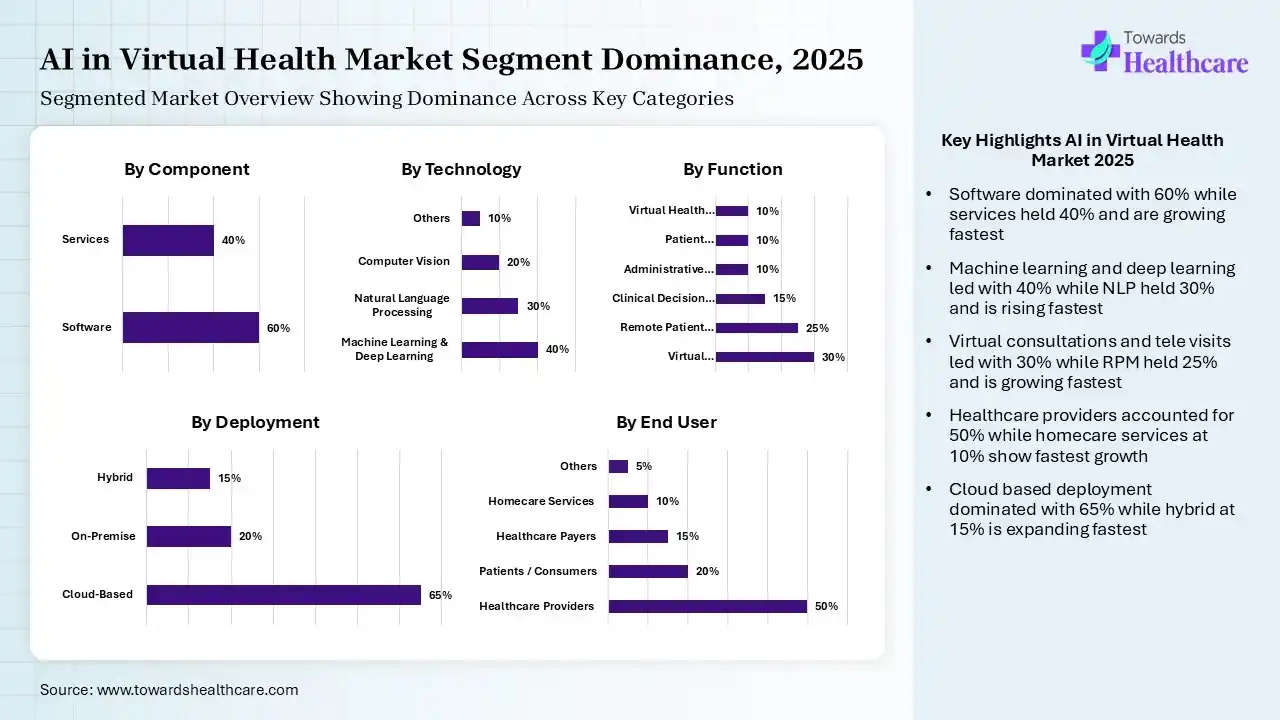
| Software | 60% |
| Services | 40% |
The Software Segment Dominated the Market With 60% in 2025
The software segment led the AI in virtual health market with 60% share in 2025, due to the rapid adoption of scalable AI modules for virtual care workflows and automated documentation. Lower marginal cost and interoperability also increased their use. Their frequent updates and cloud integration also increased their adoption rates and innovations.
The services segment held the second-largest share of 40% of the market in 2025 and is expected to witness the fastest CAGR growth during the forecast period, driven by the rising need for consultancy, integration, and managed AI services to support provider adoption. Growing chronic disease burden and remote healthcare expansion are also increasing their use. The growing demand for personalised healthcare is also increasing its demand.
| Segment | Share 2025 (%) |
| Machine Learning & Deep Learning | 40% |
| Natural Language Processing | 30% |
| Computer Vision | 20% |
| Others | 10% |
The Machine Learning & Deep Learning Segment Dominated the Market With 40% in 2025
The machine learning & deep learning segment accounted for the highest revenue share of 40% of the AI in virtual health market in 2025, as they act as the core for predictive analytics, RPM insights, and clinical data interpretation. Their high diagnostic accuracy and enhanced ability to analyze complex medical data also increased their use. Their predictive analytics and support for personalized medicine development also increased their adoption.
The natural language processing segment held the second-largest share of 30% of the market in 2025 and is expected to show the highest CAGR growth during the forecast period, as it drives virtual assistants and automated clinical communication solutions. Faster decision support and the explosion of unstructured medical data are also increasing their use. Their affordability, presence of large language models, and telemedicine integration are also increasing their demand.
The computer vision segment held 20% of the AI in virtual health market share in 2025, driven by its growing support in image and video content analysis for remote assessments. Growing demand for diagnostic automation and early and accurate disease detection is also increasing their demand. Their real-time analysis, enhanced quality data, and medical image interpretation are also increasing their use.
| Segment | Share 2025 (%) |
| Virtual Consultations & Tele‑Visits | 30% |
| Remote Patient Monitoring (RPM) | 25% |
| Clinical Decision Support | 15% |
| Administrative Automation | 10% |
| Patient Engagement & Experience | 10% |
| Virtual Health Assistants / Chatbots | 10% |
The Virtual Consultations & Tele‑Visits Segment Dominated the Market With 30% in 2025
The virtual consultations & tele‑visits segment held a major revenue share of 30% of the AI in virtual health market in 2025, as they offer increased access to clinicians and a reduction in‑person visits. This enhanced patient convenience and reduced waiting time, which increased the use of AI platforms. Moreover, its virtual assistants also provided symptom analysis, disease monitoring, and disease diagnosis, which prompted a shift towards digital healthcare.
The remote patient monitoring (RPM) segment held the second-largest share of 25% of the market in 2025 and is expected to expand rapidly with the fastest CAGR during the forecast period, due to growing demand for chronic disease management and continuous data analytics. The increasing shift towards preventive care is also increasing the use of various AI solutions. Expanding wearables and IoT devices are also increasing their innovations.
The clinical decision support segment held 15% of the AI in virtual health market share in 2025, driven by improved accuracy of remote diagnostic & triage processes. Growing medical data complexities and rising demand for evidence-based medical support are also increasing their use. Focus on improved patient outcomes, and the shortage of healthcare professionals is also increasing their use.
The administrative automation segment held 10% of the market share in 2025, due to its streamlined billing, scheduling, and documentation. This helps in reducing administrative burden and operational expenses, streamlining patient registration, record management, and claim processing. They help in reducing human errors and promote faster reimbursement cycles, which drives their demand.
| Segment | Share 2025 (%) |
| Healthcare Providers | 50% |
| Patients / Consumers | 20% |
| Healthcare Payers | 15% |
| Homecare Services | 10% |
| Others | 5% |
The Healthcare Providers Segment Dominated the Market With 50% in 2025
The healthcare providers segment contributed the biggest revenue share of 50% of the AI in virtual health market in 2025, due to their high investments in systems to improve care delivery and reduce clinician workload. AI in virtual health also supported the generation and management of large patient datasets, reducing administrative burden. The focus on patient outcome improvement also increased their adoption rates.
The patients/consumers segment held the second-largest share of 20% of the market in 2025, due to growing demand for direct AI‑enabled health tools and self‑service care. Increasing digital health awareness and growing smartphone penetration are also increasing their accessibility. Growing advancements in chatbots, virtual assistants, and wearable devices are also increasing their adoption rates.
The healthcare payers segment held 15% of the AI in virtual health market share in 2025, driven by high adoption of AI to reduce costs and optimize reimbursement workflows. They are also being used for early detection of fraud and false claims, reducing the chances of their rejection. A shift towards value-based care is also increasing their adoption rates.
The homecare services segment held 10% of the market share in 2025 and is expected to gain the highest CAGR during the forecast period, due to growing demand for personalized remote monitoring. The growing geriatric population, demand for chronic disease management, and affordable services are also increasing their use. They are also being utilized to reduce hospital burden and enhance patient comfort and convenience.
| Segment | Share 2025 (%) |
| Cloud‑Based | 65% |
| On‑Premise | 20% |
| Hybrid | 15% |
The Cloud‑Based Segment Dominated the Market With 65% in 2025
The cloud‑based segment held the largest revenue share of 65% of the AI in virtual health market in 2025, due to its rapid scalability and frequent AI model updates. Their lower infrastructure cost and remote accessibility also increased their adoption rates. Additionally, their real-time data analysis and seamless data integration also increased their use and innovations.
The on‑premise segment held the second-largest share of 20% of the market in 2025, driven by high demand by large providers for data control and compliance. Their data security, privacy controls, and high flexibility are also increasing the use of AI in virtual health. Their easy integration, regular updates, and large data processing are also increasing their demand.
The hybrid segment held 15% of the AI in virtual health market share in 2025 and is expected to grow with the highest CAGR during the forecast period, driven by the combination of flexibility and security, which are preferred in regulated environments. Seamless integration, enhanced scalability, and affordable services are also increasing their use. Their growing innovations are also driving their adoption rates.
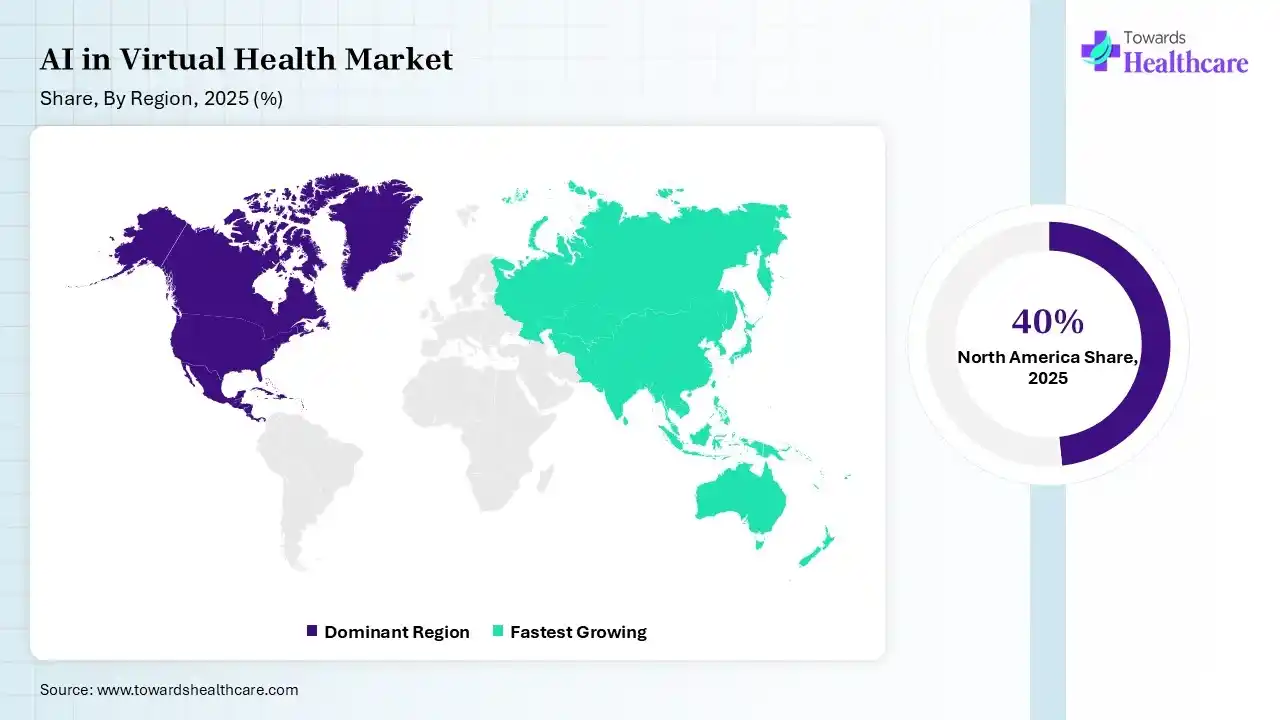
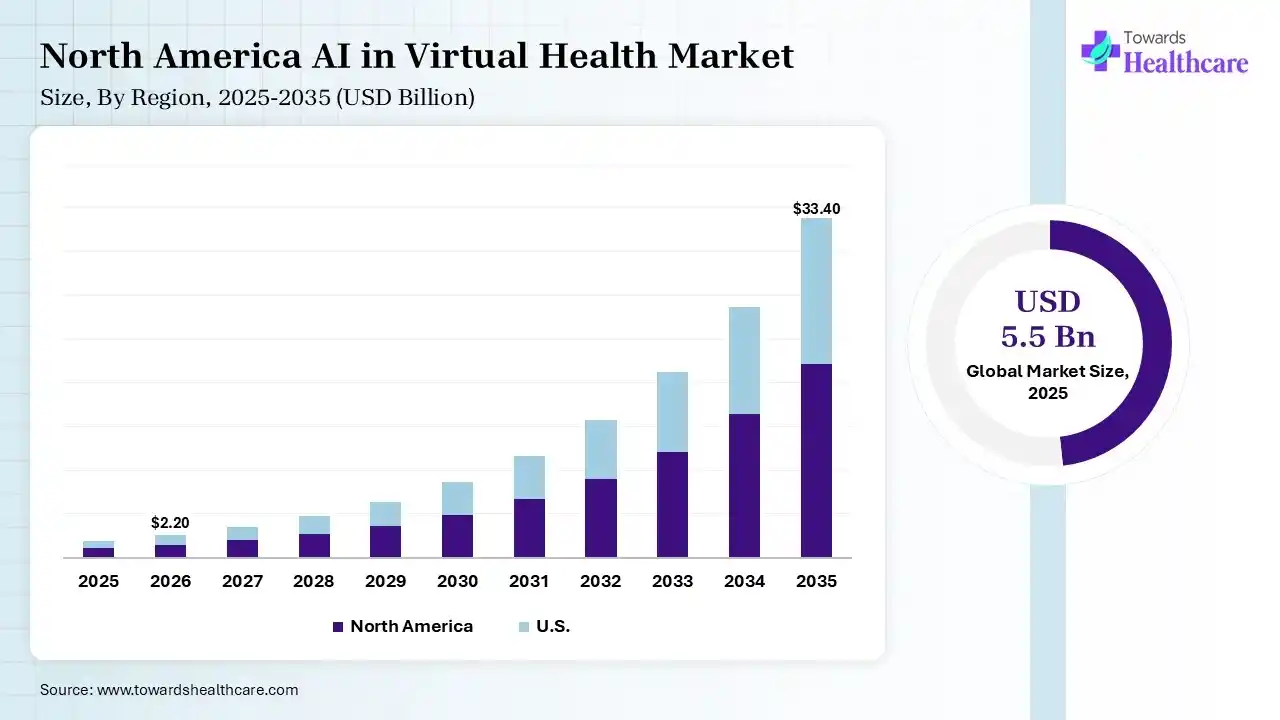
North America dominated the AI in virtual health market with 40% in 2025, due to a mature telehealth infrastructure. This increased the early AI adoption across hospitals and digital health systems for virtual assistance and remote patient monitoring. The presence of key market players also increased the innovation of AI in virtual health, where technological advancements also contributed to the market growth.
U.S. Market Trends
The presence of an advanced healthcare ecosystem in the U.S. is increasing the use of AI in virtual health. High healthcare spending and a robust regulatory framework are also increasing their innovations. Strong tech industries and expanding healthtech startups are also propelling their innovations.
Asia Pacific held 25% share of the AI in virtual health market in 2025 and is expected to grow at the fastest CAGR during the forecast period, due to expanding healthcare digitalization. The presence of a large population and expanding government initiatives is also increasing the adoption of AI in virtual health. Their growing integration with telehealth platforms and smartphones is also increasing their use, enhancing the market growth.
China Market Trends
China consists of a large population and robust government support, which is driving the adoption of various AI solutions for virtual healthcare. Expanding digital ecosystems and tech companies are also increasing their adoption and innovations. Moreover, their virtual assistants and chatbots are also increasing their adoption rates.
| Companies | Headquarters | AI in Virtual Health Solutions |
| Teladoc Health | Purchase, U.S. | Virtual Sitter and Livongo |
| Doximity | San Francisco, U.S. | DocsGPT |
| Microsoft | Redmond, U.S. | Dragon Copilot |
| GE HealthCare | Chicago, U.S. | Caption AI |
| Babylon Health | London, UK | AI symptom checker |
| Medtronic | Dublin, Ireland | Medtronic Care Management Services |
| Ada Health | Berlin, Germany | AI Virtual Health Assistant |
| Philips Healthcare | Amsterdam, Netherlands | AI-drien telehealth platforms |
| Augmedix | San Francisco, U.S. | Augmedix Go |
| Amwell | Boston, U.S. | Converge platform |
Strengths
Weaknesses
Opportunities
Threats
By Component
By Technology
By Function
By End User
By Deployment
By Region






Principal Consultant
Rohan Patil is a seasoned market research professional with over 5+ years of focused experience in the healthcare sector, bringing deep domain expertise, strategic foresight, and analytical precision to every project he undertakes.
Learn more about Rohan Patil

Reviewed By
Aditi Shivarkar is a seasoned professional with over 14 years of experience in healthcare market research. As a content reviewer, Aditi ensures the quality and accuracy of all market insights and data presented by the research team.
Learn more about Aditi Shivarkar