The market progression is propelled by the growing investment in R&D, wider application in diagnosis, & ongoing innovations in technologies by using AI algorithms.
Market Overview
The use of the latest technologies, like microscopic imaging, flow cytometry, & molecular markers to identify, classify, & characterize biological cells as per their particular physical, molecular, or genetic characteristics is termed the U.S. cell identification technology market. This market has a major scope in the clinical & diagnostics sector, where Fluorescence-Activated Cell Sorting (FACS) & image flow cytometry support the detection of circulating tumor cells (CTCs) & rare cells. Also, flow cytometry has a prominent role in leukemia & lymphoma.
Global Market Trends
The global cell identification technology market size was estimated at USD 18.72 billion in 2025 and is predicted to increase from USD 20.52 billion in 2026 to approximately USD 46.82 billion by 2035, expanding at a CAGR of 9.6% from 2026 to 2035.
Market Prospects
In the coming era, the market will have substantial opportunities in faster cancer diagnosis, where machine learning models integrated with microscopy allow the automatic finding of circulating tumor cells (CTCs) in blood samples with greater accuracy. Moreover, the U.S. cell identification technology market will explore image-based assays to record several biological phenotypes simultaneously, enabling the expedited screening of compounds to detect their MoA as per cellular morphological modifications.
Approximate New Cases of Cancers in the U.S. in 2040
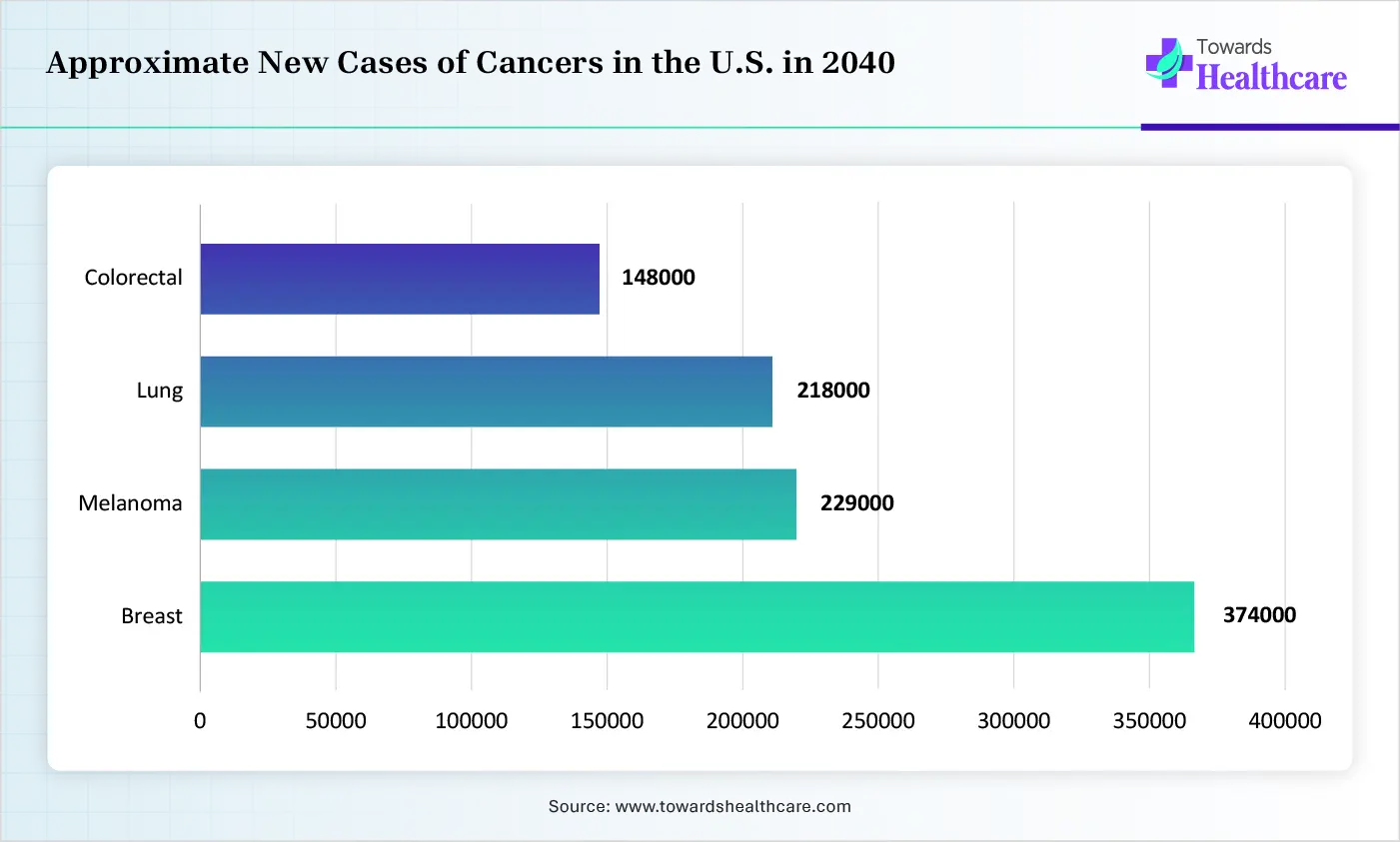
The U.S. cell identification technology market will focus on this rising burden & will leverage advanced cell identification technologies to allow early detection, optimize tailored treatments, & monitoring for recurrence through non-invasive methods. The U.S. will increasingly implement AI to study complex molecular patterns & medical imaging data to detect cancers much earlier & more precisely.
Market Segmentation Overview
- By technology, the flow cytometry segment led with 32% share of the market in 2025. This technology is highly leveraged in immunology & oncology workflows across labs. Also, the U.S players are promoting innovation to bolster throughput & sensitivity. Ongoing advances include spectral cytometry for higher-dimensional, low-compensation analysis & imaging flow cytometry, which integrates flow speed with morphology.
- By product, the consumables & reagents segment held a major share of 44% of the U.S. cell identification technology market in 2025. Its dominance is fueled by a rise in demand from routine lab usage, coupled with the expansion of research activities. The global trend is promoting the use of serum-free, GMP-grade media, bioorthogonal labeling tools, & microfluidic-compatible reagents.
- By applications, the research applications segment dominated with 28% share in 2025. Cell identification technology has a pivotal application in academic & institutional research projects. Alongside, the market is experiencing major funding for life sciences research & extensive progression in stem cell and cancer studies, which raises demand. Certain studies are executing integration of multi-omics data, high-resolution imaging, & AI to gain accurate, non-destructive, & spatially informed cell characterization.
- By end user, the academic & research institutes segment captured 38% share in the U.S. cell identification technology market in 2025. These institutes are widely using technologies with an emphasis on fundamental cellular biology, stem cell research, & disease modeling. Many institutes are acquiring funding support to transform biological research across the world. Also, ongoing academic alliances are pushing groundbreaking research in these technologies.
Top Companies in the U.S. Cell Identification Technology Market
The market has Thermo Fisher Scientific Inc., Danaher Corporation, Becton, Dickinson and Company (BD), and Agilent Technologies, Inc., these four major players, which are empowering flow cytometry, automated cell imaging, & high-throughput cell-sorting technologies. Whereas Thermo Fisher Scientific is the dominant company in the U.S., which executes its integration of AI-enabled high-content imaging & analysis platforms.
Segments Covered in the Report
By Technology
- Flow Cytometry
- Fluorescence-activated Cell Sorting (FACS)
- Magnetic-activated Cell Sorting (MACS)
- PCR-based Techniques
- Quantitative PCR (qPCR)
- Digital PCR (dPCR)
- Next-Generation Sequencing (NGS)
- Single-cell Sequencing
- Bulk Cell Sequencing
- Imaging-based Technologies
- High-content Screening
- Microscopy-based Cell Identification
- Microarray Technology
- Spectroscopy-based Techniques
- Mass Spectrometry
- Raman Spectroscopy
By Product
- Instruments
- Flow Cytometers
- PCR Systems
- Sequencing Platforms
- Imaging Systems
- Consumables & Reagents
- Antibodies
- Assay Kits
- Buffers & Media
- Software & Services
- Data Analysis Software
- Cloud-based Platforms
- Maintenance & Support Services
By Application
- Research Applications
- Cell Biology Research
- Immunology Studies
- Cancer Research
- Stem Cell Research
- Clinical Applications
- Disease Diagnosis
- Personalized Medicine
- Infectious Disease Detection
- Drug Discovery & Development
- Target Identification
- Biomarker Discovery
- Toxicology Studies
By End User
- Academic & Research Institutes
- Pharmaceutical & Biotechnology Companies
- Hospitals & Diagnostic Laboratories
- Contract Research Organizations (CROs)




