


The U.S. chemical indicators market size was estimated at USD 165.3 million in 2025 and is predicted to increase from USD 177.53 billion in 2026 to approximately USD 337.53 million by 2035, expanding at a CAGR of 7.4% from 2026 to 2035. The market is driven by rising demand for sterilization monitoring in hospitals, labs, and biopharma facilities supported by strict infection control and compliance requirements. Growth is further fueled by the adoption of advanced multi-parameter indicators, low-temperature sterilization methods, and continuous innovation in sterility assurance solutions.
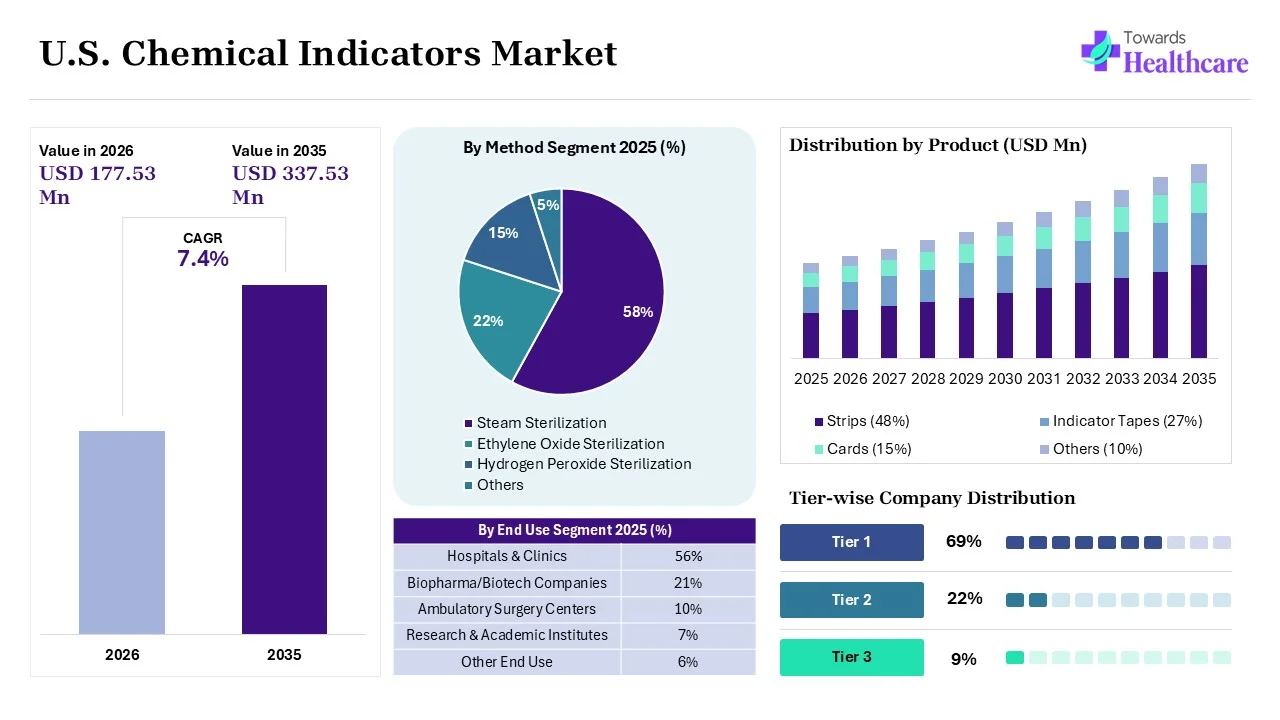
Chemical indicators are sterilization monitoring tools that change color or appearance to show whether specific sterilization conditions have been achieved. The U.S. chemical indicators market is growing due to strict sterilization and infection control standards across hospitals, laboratories, and biopharma facilities. Rising surgical volumes, increasing use of reusable medical devices, and greater emphasis on preventing healthcare-associated infections are boosting demand for reliable sterilization monitoring products. In addition, the adoption of advanced multi-parameter indicators and low-temperature sterilization methods is further supporting market expansion.
The U.S. chemical indicators market is expected to grow steadily, driven by rising surgical volumes, stricter sterilization compliance, and increasing use of reusable and heat-sensitive medical devices. Future growth will likely be supported by greater adoption of advanced multi-parameter indicators, low-temperature sterilization methods, and digital traceability solutions that improve sterilization accuracy, workflow efficiency, and infection control.
| Parameter | Data |
| U.S. regulation for chemical indicators | 21 CFR 880. 2800 |
| FDA Premarket requirement | 510(K) clearance required |
| Types of FDA-cleared healthcare chemical indicators | 3 types of processes: indicators, chemical integrators, and air-removal indicators |
| Stea, sterilization critical parameters monitored | 4 parameter-time, temperature, humidity, EO concentration |
| CDC U.S. hospital HAI burden | 1 in 31 patients has at least one healthcare infection on any given day |
The table presents key 2025 numerical and regulatory data points relevant to the U.S. chemical indicators, covering FDA classification, 510 (K) requirements, major sterilization parameters, and infection-control statistics. It highlights the regulatory framework and sterilization monitoring environment that support demand for chemical indicators across U.S. healthcare settings.
The strips segment held a dominant share of 48% in 2025 due to the widespread use in routine sterilization monitoring across hospitals, clinics, laboratories, and surgical centers. Indicator strips are cost-effective, easy to use, and compatible with steam, ethylene oxide, and hydrogen peroxide sterilization methods. Their ability to provide quick visual confirmation methods. Their ability to provide quick visual confirmation inside packs and trays makes them a preferred choice for daily sterilization assurance and infection control practices.
The steam sterilization segment dominated the U.S. chemical indicators market with a share of 58% in 2025 because it remains the most established, widely used, and cost-effective sterilization method in hospitals and surgical facilities. It is extensively used for sterilizing surgical instruments, trays, and reusable medical devices, generating strong demand for compatible chemical indicators. Its routine use in high-volume healthcare settings and proven reliability in infection control supported the segment’s leading market position.
The hospitals & clinics segment led the U.S. chemical indicators market with a share of 56% in 2025 due to the high volume of surgeries, diagnostic procedures, and reusable reprocessing performed in these settings.These facilities required routine sterilization monitoring to meet strict infection prevention and compliance standards. Their established sterile processing department, large patient inflow, and continuous need for safe instrument turnaround made them the largest end users of chemical indicators.
Leading companies in the market include 3M Health Care, Solventum, Mesa Laboratories, Propper Manufacturing, Crosstex International, Andersen Sterilizers, True Indicating, LLC, and STERIS. These companies are strengthening the market through continued innovation in sterilization indicator strips, tapes, integrating indicators, challenge packs, and monitoring products designed for steam, ethylene oxide, and hydrogen peroxide sterilization. Their focus on product advancement, compliance-driven solutions, and sterilization workflow efficiency is further expanding their presence across hospitals, ambulatory surgery centers, laboratories, and biopharma facilities.
By Product
By Method
By End Use


