


The U.S. endobronchial ultrasound biopsy market size was estimated at USD 412.8 million in 2025 and is predicted to increase from USD 449.54 million in 2026 to approximately USD 968.32 million by 2035, expanding at a CAGR of 8.9% from 2026 to 2035 Growing lung cancer burden, a surge in lung cancer screenings, a shift towards minimally invasive diagnostic procedures, increasing R&D activities, growing demand for precision medicines, a rise in the demand for molecular diagnostics, and expanding technological advancements are promoting the market growth.
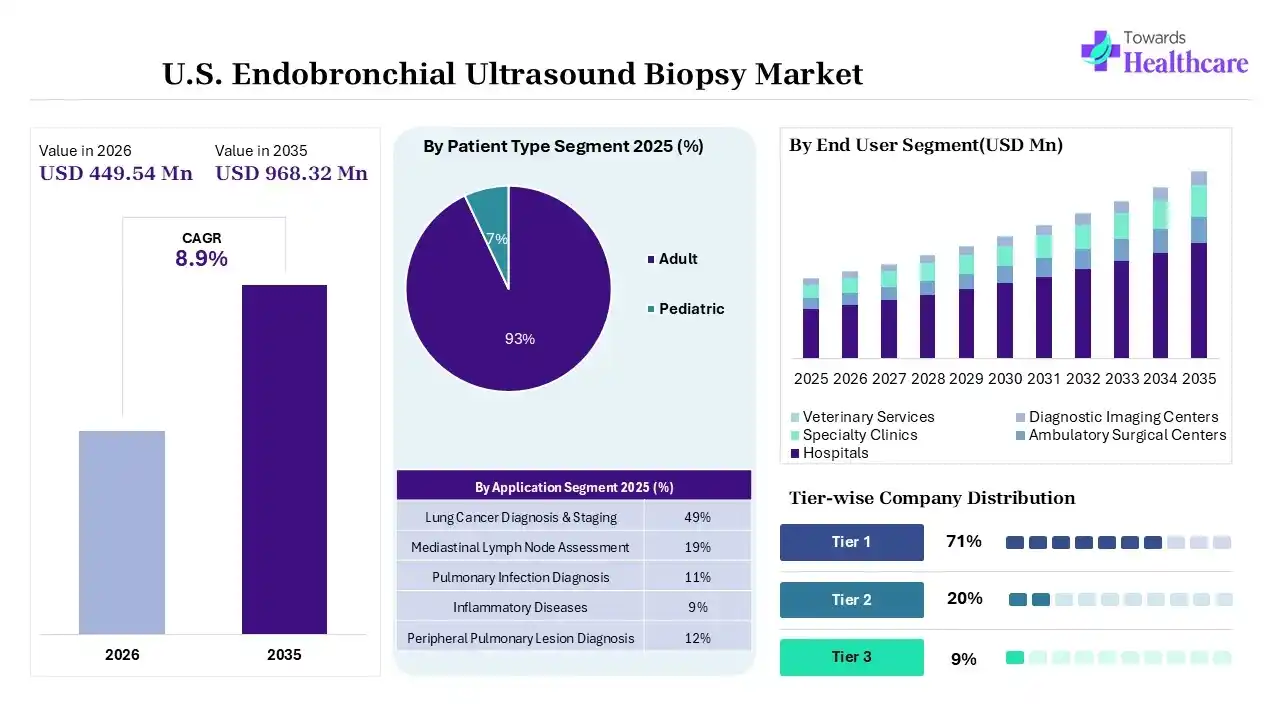
The U.S. endobronchial ultrasound biopsy refers to EBUS-guided biopsy systems, devices, and services for the diagnosis and staging of lung and mediastinal diseases across the U.S. It is used for lung cancer diagnosis, sarcoidosis diagnosis, and infectious disease diagnosis. The mediastinal lymph node evaluation, molecular testing, monitoring disease progression, and oncology R&D activities also fuel their demand.
The graph represents an estimated number of lung & bronchus cancer deaths and new cases in the U.S. for the year 2026. It indicates that there will be a rise in lung cancer burden, which will drive the demand for faster, minimally invasive, and more accurate diagnostic devices. This, in turn, will increase the adoption of endobronchial ultrasound biopsy for early and accurate lung cancer detection, which will ultimately promote market growth.
By procedure type, the EBUS-TBNA segment accounted for the highest revenue share of 58% of the U.S. endobronchial ultrasound biopsy market in 2025, due to its minimally invasive approach and high diagnostic accuracy. It also supported molecular and genetic testing for the development of personalized cancer treatments. Their real-time sampling and affordability also increased their use.
By product type, the EBUS bronchoscopes segment held a major revenue share of 39% of the U.S. endobronchial ultrasound biopsy market in 2025, as it is the core device for biopsy procedures. Their enhanced image quality and procedural efficiency also increased their use. They were also essential for precision medicine development and molecular profiling.
By application type, the lung cancer diagnosis & staging segment contributed the biggest revenue share of 49% of the U.S. endobronchial ultrasound biopsy market in 2025, due to growth in cancer cases. Expanding screening programs and demand for minimally invasive procedures also increased the use of endobronchial ultrasound biopsy. Their high accuracy and sensitivity also increased their use.
By end user, the hospitals segment held the largest revenue share of 62% of the U.S. endobronchial ultrasound biopsy market in 2025, due to the high volume of cancer cases. The presence of advanced EBUS systems and specialists also increased their preference. The reimbursement policies also increased their accessibility.
The U.S. endobronchial ultrasound biopsy market held a significant share and is expected to show notable growth during the predicted time, due to the presence of a well-established healthcare infrastructure and high lung cancer cases. The growth in the demand for precision medicine and molecular diagnostics has also increased the use of endobronchial ultrasound biopsies. Expansion in minimally invasive procedures, cancer screening programs, and technological advancements also increased the market growth.
Olympus Corporation registered dominance over the market with its BF-UC190 Convex Probe EBUS scope, ViziShot 2 EBUS-TBNA needles, and UM-DG28 Radial Probe, where Boston Scientific Corporation was its closest contender, which provided Expect EBUS-TBNA Biopsy Needles and Exalt Model B. Medtronic plc also sustained its position by offering Illumisite Electromagnetic Navigation Bronchoscope (ENB) platform, where Cook Medical also contributed to the market growth with its EchoTip Ultra and EchoTip ProCore EBUS TBNA Needle Systems.
By Procedure Type
By Product Type
By Application
By End User
By Patient Type
By Technology
By Biopsy Needle Size
By Imaging Modality Integration


