


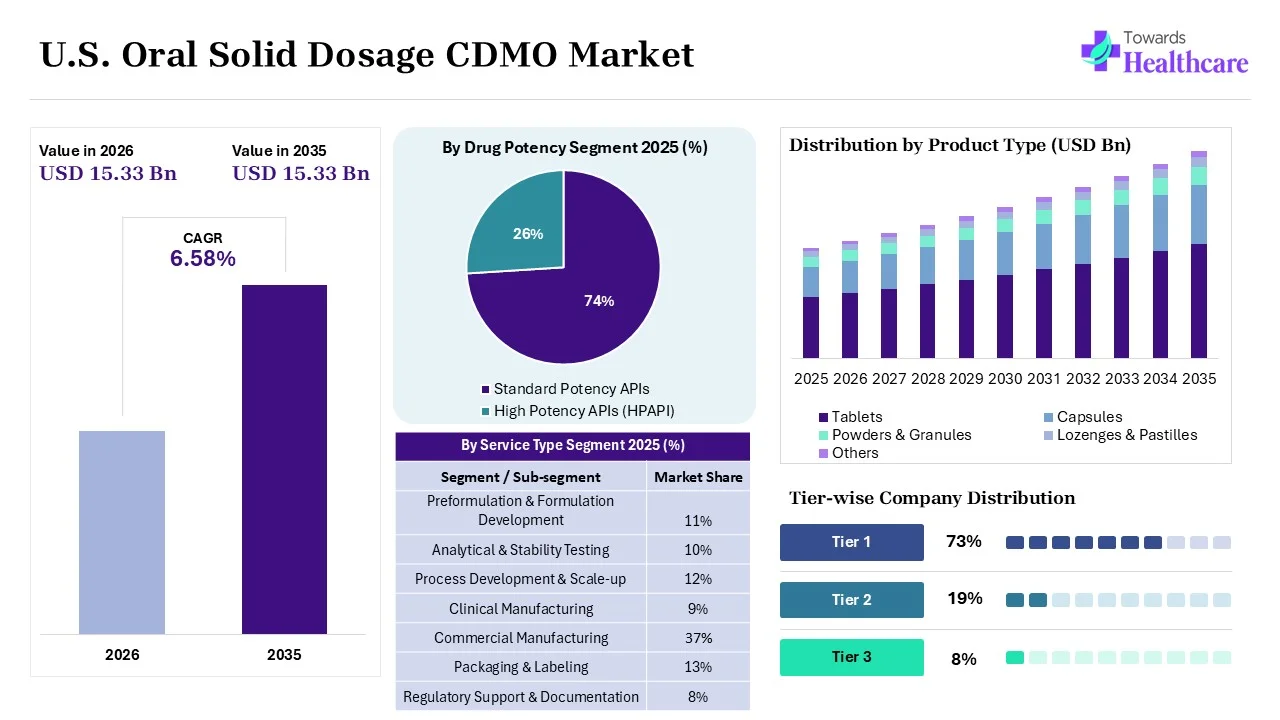
The U.S. oral solid dosage CDMO market size accounted for USD 14.38 billion in 2025 and is predicted to increase from USD 15.33 billion in 2026 to approximately USD 27.2 billion by 2035, expanding at a CAGR of 6.58% from 2026 to 2035. Growing outsourcing of complex formulations, urgent demand for specialized manufacturing technologies, an expanding generic drug pipeline, growing clinical trial manufacturing demand, increasing focus on quality control, and rising demand for specialized formulations are promoting market growth.
The U.S. oral solid dosage CDMO refers to the contract development and manufacturing organizations across the U.S. providing services such as formulation development, manufacturing, and packaging for oral solid dosage forms. They help in the development of oral tablets and capsules, support commercial-scale drug production, offers process optimization services. They also help in reducing manufacturing costs, offer expertise, and ensure regulatory compliance, which encourages their use.
The graph represents the estimated number of U.S. cancer deaths and new cases in the year 2026. It indicates that there will be a growth in the cancer burden in the U.S., which will drive the demand for its oral treatment options. This, in turn, will increase the adoption of oral solid dosage CDMO services for the development of new oral and targeted treatment options for multiple cancer types, which will ultimately promote market growth.
By product type, the tablets segment accounted for the highest revenue share of 56% of the U.S. oral solid dosage CDMO market in 2025, due to their ease of use and enhanced affordability. Their high stability and longer shelf life also increased their use. They were widely prescribed, which increased their production and promoted the use of oral solid dosage CDMOs.
By service type, the commercial manufacturing segment held a major revenue share of 37% of the U.S. oral solid dosage CDMO market in 2025, due to high demand for large-scale production. The need for scalable manufacturing solutions is also increasing their use. Additionally, growing demand for generic oral formulations is also driving their demand.
By therapeutic area type, the cardiovascular diseases segment contributed the biggest revenue share of 21% of the U.S. oral solid dosage CDMO market in 2025, driven by growth in their incidence rates. This increases the use of oral solid formulations. Additionally, frequent prescription of cardiovascular medication also increased their manufacturing volume and collaboration with CDMOs.
By customer type, the large pharmaceutical companies segment held the largest revenue share of 42% of the U.S. oral solid dosage CDMO market in 2025, due to a high volume of drug development. A rise in the need for additional manufacturing capacity and specialized expertise also increased the use of oral solid dosage CDMOs. They were also used for development, research, and marketing.
By end user, the branded drug manufacturers segment led the U.S. oral solid dosage CDMO market with a 44% share in 2025, driven by large-scale commercial production and high investments. Growth in the specialty drug pipeline also increased collaboration with CDMOs. The need for flexible manufacturing capacity has also increased its use.
The U.S. oral solid dosage CDMO market held a significant share and is expected to show notable growth during the predicted time, due to the presence of robust industries. Increasing outsourcing trends and growing demand for oral solid formulation also increase their use. Growing investments, demand for generic products, and personalized medications are also enhancing the market growth.
Catalent, Inc. registered dominance over the market with its Zydis ODT, OptiShell, and OptiMelt products, where Thermo Fisher Scientific Inc. was its closest competitor, which provided Patheon Quadrant and Patheon Quick to Clinic. Lonza Group AG also sustained its position by offering Capsugel, Colorectal-Targeted Caps, and Vcaps Plus, where Cambrex Corporation also contributed to the market growth with its Cambrex HP-OSD and Cambrex MicroSphere products.
By Product Type
By Service Type
By Therapeutic Area
By Customer Type
By End User
By Drug Potency
By Manufacturing Scale
By Release Profile


