


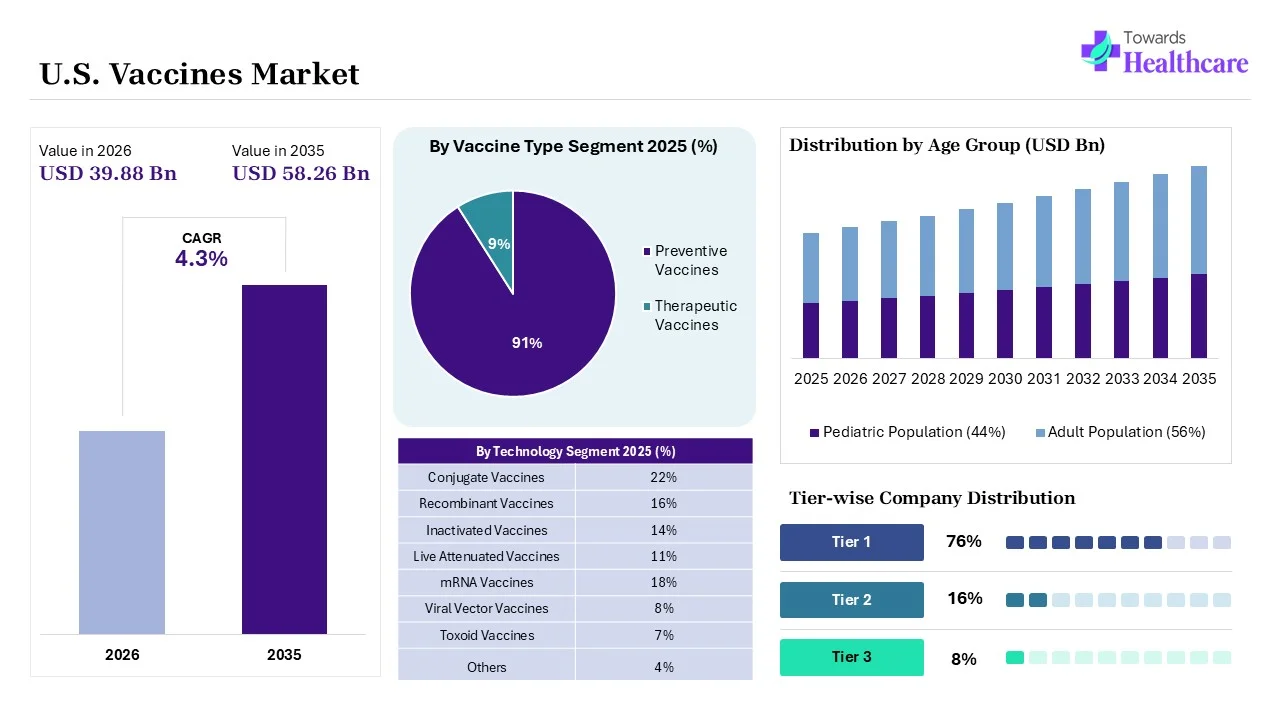
The U.S. Vaccines market size touched US$ 38.24 billion in 2025, with expectations of climbing to US$ 39.88 billion in 2026 and hitting US$ 58.26 billion by 2035, driven by a CAGR of 4.3% over the forecast period. Vaccines are the most affordable strategy for lowering the childhood disease load, specifically as compared with interventions such as clean water and enhanced sanitation, which drive market growth.
Vaccines are products that protect the population against severe, often deadly diseases by supporting the body’s natural defense, the immune system, to fight them off. A vaccine is a suspension of killed, weakened, or fragmented microorganisms or toxins or other biological preparations like those containing antibodies. A vaccine functions as a pharmacologic compound that strengthens a person's immunity against a particular disease. Vaccines significantly influence the immune system via the activity of B and T lymphocytes. The application of vaccines supports getting registered for vaccination. They are like an antidote for these diseases. Vaccines are biological preparations that help the body fight those diseases. It is used to induce long-term humoral and cell-driven immune responses against disease-causing pathogens.
| Disease | Percentage |
| COVID-19 | 9.8% |
| Influenza | 49.8% |
Recent advances in vaccine technologies with specific reference to their application in veterinary medicine. The most talented developments in vaccine technology involved mRNA and DNA vaccines. These technologies are expected to lead to advances beyond infectious diseases, for the treatment or prevention of some types of cancer. Nucleic acid vaccines, mRNA vaccines, vector vaccines, and biomaterial-based vaccines are well-developed trends in the revolutionization of vaccines based on their potential to address issues of recent technology. Major advances in technology, such as viral-vectored vaccines, bacterial-vectored vaccines, and antigen-presenting cells, are more recent strategies.
By vaccine type, the preventive vaccines segment contributed the largest U.S. vaccines market share of 91% in 2025. These types of vaccines are biological preparations given to healthy people to train the immune system to identify and fight off particular pathogens before an infection occurs. Preventive vaccines protect against a broad range of serious, fatal, and infectious diseases.
By technology, the conjugate vaccines segment contributed the largest market share of 22%, as conjugate vaccines are intended to avoid infection by other encapsulated bacteria. The authority driving the advancement of such vaccines has been the need to find a vaccine formulation that reduces bacterial capsular polysaccharides' immunogenicity in those most at risk of infection.
By route of administration, the intramuscular segment held the dominant share of 72% in the U.S. vaccines market, as this route provides rapid and uniform absorption of the drug, particularly the aqueous solutions. IM injection avoids the first-pass metabolism of the medicine. It avoids the gastric factors governing drug absorption. It is most efficient for emergency scenarios like acute psychosis and status epilepticus.
By age group, the adult population segment contributed the largest market share of 56%, as vaccination lowers the challenges of contracting serious illnesses like pneumonia, influenza, shingles, tetanus, and hepatitis. Protection of vulnerable populations, adults receive vaccinations, they protect themselves, and contribute to people's immunity.
By disease type, the influenza segment contributed the largest U.S. vaccines market share of 24%, as the influenza vaccine lowers the challenges of getting the flu. The flu causes fever, headache, body aches, a stuffy nose, and coughing. Its significant benefits are the availability of wide safety data, affordability, and high yields of influenza virus antigens.
By end user, the hospitals segment contributed the largest market share of 32%, as vaccines simulate an infection, activating the immune response in a safe and controlled way. This supports the body's production of antibodies and memory cells, without causing the actual disease. Unlike natural infection, vaccination avoids the challenges of severe illness and complications. Vaccines help the immune response and ensure the body continues to recognise and fight pathogens efficiently.
Leading companies in the U.S. Vaccines Market include Pfizer Inc., Merck & Co. Inc., Moderna, Inc., and GSK. Meanwhile, Pfizer's ELREXFIO potentially enhances progression-free survival for double-class-exposed patients with relapsed or refractory multiple myeloma. Merck Patient Assistance Program offers some Merck medicines and adult vaccines for free to eligible patients. Moderna provides a lower-dose COVID-19 vaccine formulated particularly for adults and older and at-risk persons. GSK provides a wide range of vaccines for appropriate paediatric and adult patients.
By Vaccine Type
By Technology
By Route of Administration
By Age Group
By Disease Indication
By End User
By Distribution Channel


