


The US Food and Drug Administration (FDA) has advised infant formula producers to tighten supplier oversight after botulism outbursts and a contaminated ingredient triggered recalls in multiple markets.
The regulator called on producers and supply chain collaboration to identify where ingredients originate, how suppliers produce them, and whether adequate controls protect infants.
The intervention follows two multistate infant botulism outbreaks associated with powdered formula and a separate contamination event, including nearly 150 suspected and confirmed cases of cereulide intoxication in the 10 countries.
The FDA examined infant botulism outbreaks related to powdered formula from ByHeart and Nara Organics, prompting both organizations to challenge voluntary recalls.
Investigators noticed Clostridium botulinum in organic whole milk powder used by ByHeart. Two samples from one ingredient lot matched a healthcare sample and an infant formula sample via whole genome sequencing.
Organic West Milk supplied the ingredient to Nara Organics, based on the regulator. The FDA continues to examine the root causes of both outbreaks and any related to shared suppliers.
The agency pointed to a worldwide contamination occasion between late 2025 and early 2026 as evidence of how a single ingredient disrupts formula supply chains in several markets.
Authorities traced closely 150 suspected and confirmed cases of cereulide intoxication to contaminated arachidonic acid oil, usually known as ARA oil, used in infant formula. The occurrence triggered downstream recalls globally and led the FDA to place products from an ARA oil provider on import alerts.
According to Towards Healthcare, the infant formula market is projected to experience significant growth, with estimates suggesting the market size will increase from USD 98.89 billion in 2026 to approximately USD 224.73 billion by 2035, representing a compound annual growth rate (CAGR) of 9.55% from 2026 to 2035, driven by infant formulas are perticularly inteded to reproduce human breast milk composition and they are the safe substitutes to breast milk for infants. It offers all of the important nutrients and bioactive substances required for optimum advancement, and it continually changes based on the infant's nutritional needs. Formulas are prudently industrialized to be a healthy and complete source of nutrition, comprising all the significant minerals, vitamins, and nutrients for healthy advancement. Unlike breastfeeding, where supply sometimes fluctuates, formula offers a reliable and measurable quantity of nutrition at every single feeding. Infant formulas are intended to be similar to breast milk. They are controlled to confirm they contain the correct balance of protein, fat, carbohydrates, vitamins, and minerals a baby needs to grow and thrive.
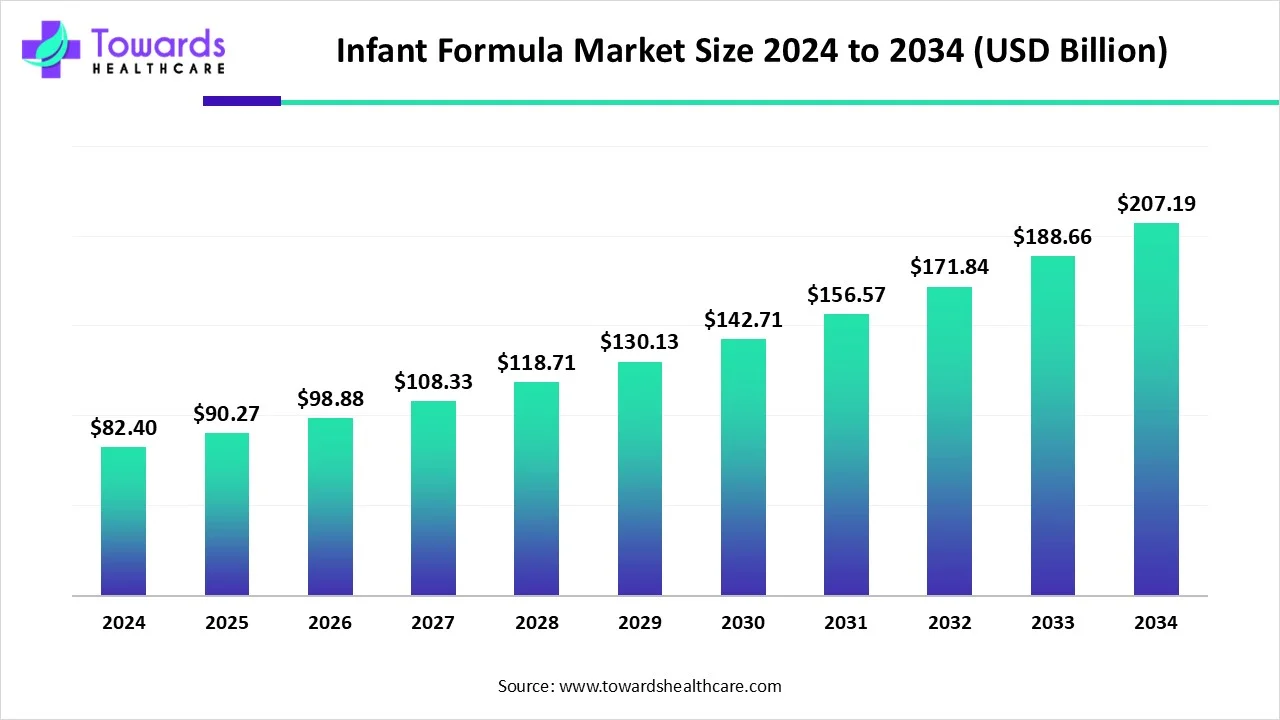
The communication comes months after the FDA finished the largest-ever testing programme for chemical contaminants in infant formula sold in the US.
Scientists analysed more than 300 retail samples, producing over 120,000 data points. They screened processed, ready-to-feed, and concentrated liquid formulas for lead, mercury, cadmium, arsenic, PFAS, phthalates, and pesticides, involving glyphosate and glufosinate.
Many products controlled undetectable or very low contaminant levels, helping the regulator's assessment that the US infant formula supply remains safe. Though the FDA stressed the requirement to keep exposure as low as possible, as newborns are a specifically vulnerable population.
The testing forms part of Operation Stork Speed and the FDA's Closer to Zero initiative, which aims to reinforce formula oversight and lessen contaminant levels in foods consumed by infants and young children.
While the FDA recognized the trouble of controlling spore-forming microorganisms in formula elements, manufacturers required numerous complementary safeguards.
The agency plans to work with industry, academics, and international scientific bodies to detect best practices while conducting its outbreak investigations. Though it also made clear that partnership would not replace enforcement or producers' responsibility for ingredient safety.
The Agency Concluded: "The FDA will continue to use all available tools to protect infants, and we expect industry to uphold these standards to meet that commitment with the gravity our shared responsibility demands."
A recent report by Towards Healthcare highlights that the infant formula market is growing because infant formula is designed as an efficient substitute for breast milk and is formulated to mimic the nutritional composition of breast milk. Infant formulas include accurate quantities of carbohydrate, water, fat, protein, vitamins, and minerals. The composition of infant formula is stringently controlled, and every producer follows established guidelines set by regulatory agencies. All the main components added to the formula, such as protein, lipids, and carbohydrates, have a range of minimum and maximum values for their efficiency. Infant formulas are available in three forms: powder, the affordable form of infant formula which must be incorporated with water before feeding; liquid, which is mixed with an equal amount of water; and ready-to-feed, the costliest form of infant formula that needs no mixing.


