
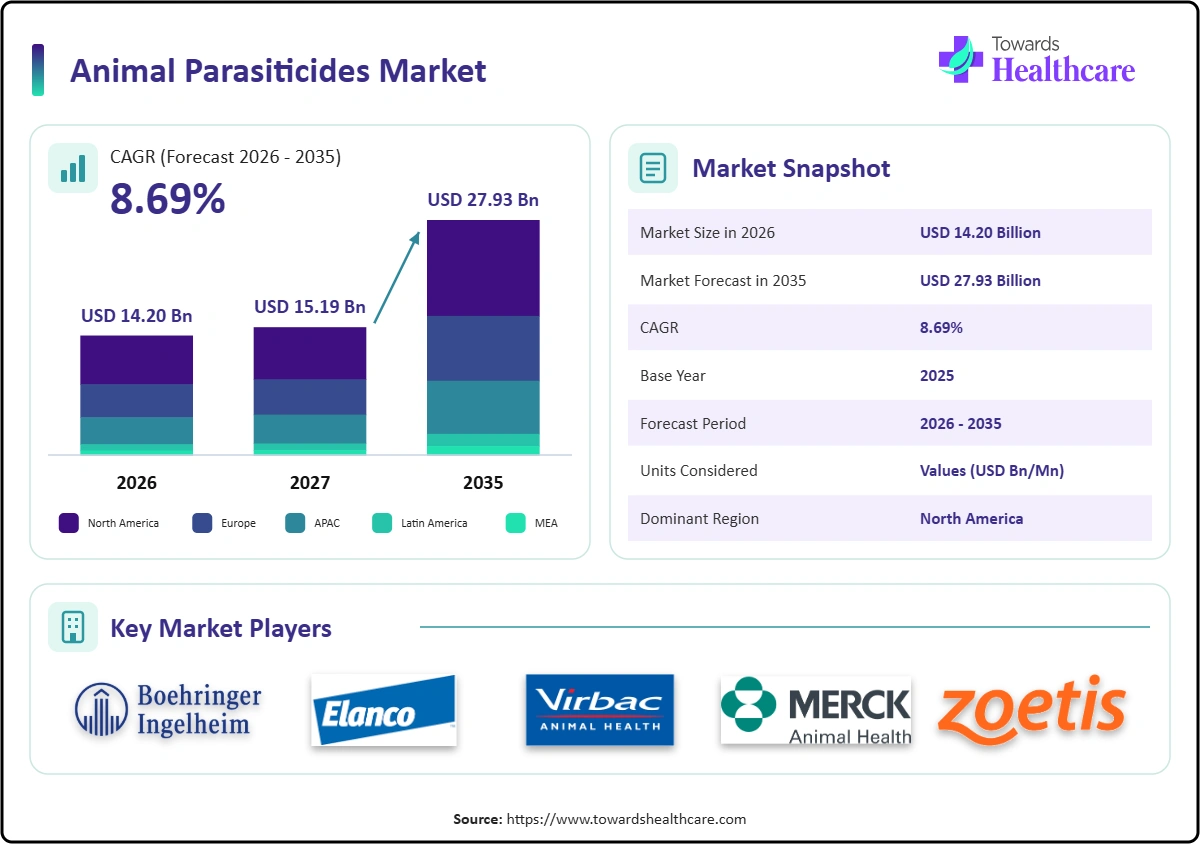
The animal parasiticides market is projected to grow from USD 14.20 billion in 2025 to USD 27.93 billion by 2035, driven by increasing demand for year-round parasite protection among pet owners, greater veterinary adoption of broad-spectrum combination products, and the need for livestock producers to control parasites and protect animal health and productivity. Growing adoption of combination and long-acting treatments, the spread of ticks and vector-borne diseases, emerging threats such as New World screwworm, and rising pet ownership across Asia further support market growth. The market is projected to reach USD 19.92 billion by 2030, registering a CAGR of 7.00% during 2026-2035.
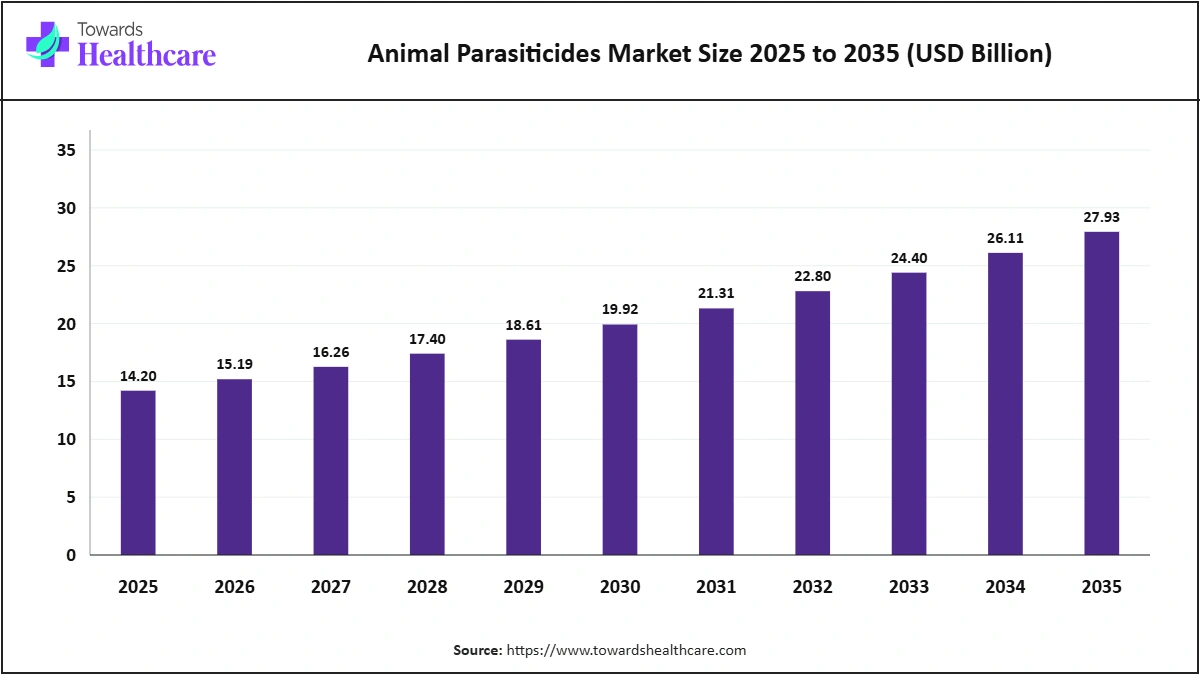
Analyst View: The market is seeing growing demand for preventive pet healthcare and stronger veterinary recommendations for broad-spectrum, long-lasting treatments. Rising parasite threats, livestock health priorities, and increasing pet ownership across Asia Pacific are further strengthening demand and encouraging innovation in parasite control products. The growth rate reflects continued companion animal growth and new product launches, moderated by generic competition and slower livestock demand.
Driver: Rising pet ownership and spending are increasing demand for parasite prevention, while veterinarians' recommendations for year-round protection further support market growth. The spread of ticks and vector-borne diseases, along with the need to protect livestock health and productivity, is creating additional demand for effective treatments.
Restraint: Despite growing demand, generic competition is putting pressure on product prices, while increasing parasite resistance is reducing the effectiveness of some older treatments. Environmental concerns, livestock producers' cost sensitivity, and occasional safety concerns also limit product adoption.
Opportunity: Creating opportunities for long-acting treatments and new modes of action that offer better protection against resistant parasites. Meanwhile, expanding pet ownership across Asia Pacific, targeted treatment through diagnostics, and telehealth services with auto-ship programs offer new avenues for market growth.
| Segments | 2025 Share | 2025 Value (USD Billion) | 2035 Value (USD Billion) | CAGR 2026-2035 |
| Ectoparasiticides | 57.40% | 8.15 | 15.53 | 6.66% |
| Endoparasiticides | 29.40% | 4.17 | 8.26 | 7.06% |
| Endectocides | 13.20% | 1.87 | 4.14 | 8.26% |
Note: 2025 is the base year; 2035 values are forecasts.
Sources: Expert interviews, secondary sources, Towards Healthcare database, and Towards Healthcare analysts.
Ectoparasiticides: This segment accounted for a 57.40% share, reaching USD 8.15 billion of the animal parasiticides market in 2025 and is projected to reach USD 15.53 billion by 2035, at a CAGR of 6.66% from 2026 to 2035. Ectoparasiticides control fleas, ticks, mites, lice, and flies. In companion animals, isoxazoline chewables such as NexGard, Bravecto, Simparica, and Credelio have become the leading products because a single oral dose provides one to three months of flea and tick control. In livestock, pour-ons, sprays, and ear tags control flies, lice and ticks that reduce weight gain and milk yield.
Endoparasiticides: This segment captured 29.40% market share and generated USD 4.17 billion in 2025 and is projected to reach USD 8.26 billion by 2035, expanding at a CAGR of 7.06% from 2026 to 2035. Endoparasiticides control internal parasites such as roundworms, hookworms, tapeworms, heartworm larvae, and protozoa like coccidia. In pets, monthly heartworm preventives and dewormers are core products recommended by veterinarians. In livestock, anthelmintics are used to control gastrointestinal worms in cattle, sheep and goats, although rising resistance to older drug classes is a growing problem that requires new products and better management.
Endectocides: This segment held a 13.20% share and was valued at USD 1.87 billion of the market in 2025 and is estimated to reach USD 4.14 billion by 2035, growing at a CAGR of 8.26% from 2026 to 2035. Endectocides act on both internal and external parasites, including macrocyclic lactones such as ivermectin and moxidectin and combination products for pets that cover fleas, ticks, heartworm, and intestinal worms in one dose. It is the fastest-growing product because combination chewables such as Simparica Trio and NexGard Plus simplify compliance for owners and command premium prices.
| Segments | 2025 Share | 2025 Value (USD Billion) | 2035 Value (USD Billion) | CAGR 2026-2035 |
| Companion Animals | 62.20% | 8.83 | 17.74 | 7.22% |
| Farm Animals | 37.80% | 5.37 | 10.19 | 6.62% |
Note: 2025 is the base year; 2035 values are forecasts.
Sources: Expert interviews, secondary sources, Towards Healthcare database, and Towards Healthcare analysts.
Companion Animals: This segment generated USD 8.83 billion in 2025 and is projected to reach USD 17.74 billion by 2035, exhibiting a CAGR of 7.22% from 2026 to 2035. Companion animals, mainly dogs and cats, dominate because owners spend heavily on monthly and long-acting preventives, and veterinarians promote year-round protection. Dogs represent most companion demand because of flea, tick, and heartworm risks, while cat products are growing. Pet humanization and rising pet ownership in Asia and Latin America support continued growth.
Farm Animals: This segment was valued at USD 5.37 billion of the market in 2025 and is expected to reach USD 10.19 billion by 2035, growing at a CAGR of 6.62% from 2026 to 2035. Farm animals include cattle, sheep, goats, pigs, and poultry. Parasite control is essential for productivity, and cattle account for the largest share through pour-ons, injectables, and drenches. Growth is slower than companion animals because of cost pressure on farmers, generic competition, and resistance concerns, but emerging threats such as New World screwworm add demand.
| Segments | 2025 Share | 2025 Value (USD Billion) | 2035 Value (USD Billion) | CAGR 2026-2035 |
| Oral | 46.80% | 6.65 | 12.57 | 6.59% |
| Topical | 34.60% | 4.91 | 9.66 | 6.99% |
| Injectable | 18.60% | 2.64 | 5.70 | 7.99% |
Note: 2025 is the base year; 2035 values are forecasts.
Sources: Expert interviews, secondary sources, Towards Healthcare database, and Towards Healthcare analysts.
Oral: The oral segment held a 46.80% share and generated USD 6.65 billion in 2025 and is poised to reach USD 12.57 billion by 2035, expanding at a CAGR of 6.59% from 2026 to 2035. Oral products, including flavored chewables and tablets, are the largest route because isoxazoline and combination chewables are easy for owners to give and avoid residue on the coat.
Topical: This segment generated USD 4.91 billion of the animal parasiticides market in 2025 and is projected to reach USD 9.66 billion by 2035, at a CAGR of 6.99% from 2026 to 2035. Topical products include spot-ons, collars, sprays, and pour-ons. They remain important for cats, for owners who prefer not to give oral medicines, and for cattle, where pour-ons are convenient for treating large herds.
Injectable: The injectable segment was valued at USD 2.64 billion in 2025 and is projected to reach USD 5.70 billion by 2035, growing at a CAGR of 7.99% from 2026 to 2035. Injectable products include long-acting heartworm injections for dogs, recently approved long-acting flea and tick injectables, and livestock endectocide injections. This is the fastest-growing route because a single injection given at the clinic can provide six to twelve months of protection, improving compliance.
| Segments | 2025 Share | 2025 Value (USD Billion) | 2035 Value (USD Billion) | CAGR 2026-2035 |
| Prescription | 67.60% | 9.60 | 18.30 | 6.67% |
| Over-the-Counter | 32.40% | 4.60 | 9.63 | 7.67% |
Note: 2025 is the base year; 2035 values are forecasts.
Sources: Expert interviews, secondary sources, Towards Healthcare database, and Towards Healthcare analysts.
Prescription: This segment accounted for a 67.60% share and was valued at USD 9.60 billion in 2025 and is projected to reach USD 18.30 billion by 2035, exhibiting a CAGR of 6.67% from 2026 to 2035. Prescription products include most isoxazolines, heartworm preventives, and combination products, which require veterinary examination and prescription in many markets. They account for most revenue because they are the newest and highest-value products.
Over-the-Counter: The over-the-counter segment reached USD 4.60 billion of the animal parasiticides market in 2025 and is expected to reach USD 9.63 billion by 2035, expanding at a CAGR of 7.67% from 2026 to 2035. Over-the-counter products include some collars, spot-ons, shampoos, and dewormers sold in pet stores, supermarkets, and online, as well as many livestock products. They are growing as online retail expands and as some older products lose prescription status or face generic competition.
| Segments | 2025 Share | 2025 Value (USD Billion) | 2035 Value (USD Billion) | CAGR 2026-2035 |
| Veterinary Hospitals & Clinics | 51.80% | 7.36 | 13.59 | 6.33% |
| Animal Farms | 34.20% | 4.86 | 9.31 | 6.73% |
| Home Care | 14.00% | 1.99 | 5.03 | 9.73% |
Note: 2025 is the base year; 2035 values are forecasts.
Sources: Expert interviews, secondary sources, Towards Healthcare database, and Towards Healthcare analysts.
Veterinary Hospitals & Clinics: The veterinary hospitals & clinics dominated the market and was valued at USD 7.36 billion in 2025 and is projected to reach USD 13.59 billion by 2035, at a CAGR of 6.33% from 2026 to 2035. Veterinary hospitals & clinics are the largest channel because they diagnose parasites, prescribe preventives, and sell or authorize prescription products. Bundled wellness plans that include parasite prevention support clinic sales.
Animal Farms: This segment accounted for a 34.20% share and reached USD 4.86 billion of the animal parasiticides market in 2025 and is expected to reach USD 9.31 billion by 2035, at a CAGR of 6.73% from 2026 to 2035. Animal farms purchase parasiticides through veterinarians, farm supply stores, and distributors to treat herds and flocks. Large cattle operations in North America, Brazil, and Australia are major buyers.
Home Care: Home care is generating USD 1.99 billion of the animal parasiticides market in 2025 and is projected to reach USD 5.03 billion by 2035, expanding at a CAGR of 9.73% from 2026 to 2035. Home care covers products pet owners buy directly through online pharmacies, retail stores, and auto-ship programs. It is the fastest-growing end use as e-commerce and telehealth make it easier to buy preventives, including prescription products authorized remotely.
Analyst View: Segment values were allocated by matching treated animals, doses, and prices to products, animals, routes, types, and end uses, using company revenue mixes and veterinary data. The market is shifting towards convenient, long-lasting, and broad-spectrum treatments, with companion animal care driving much of the demand.
Ectoparasiticides and oral chewables remain popular due to their effectiveness and ease of use, while combination products and long-acting injectables are gaining traction. On the livestock side, the need to protect animal health and productivity continues to support demand, although resistance and cost pressures remain challenges. Growing online pharmacy sales and home-based pet care are also changing how consumers access parasite prevention products.
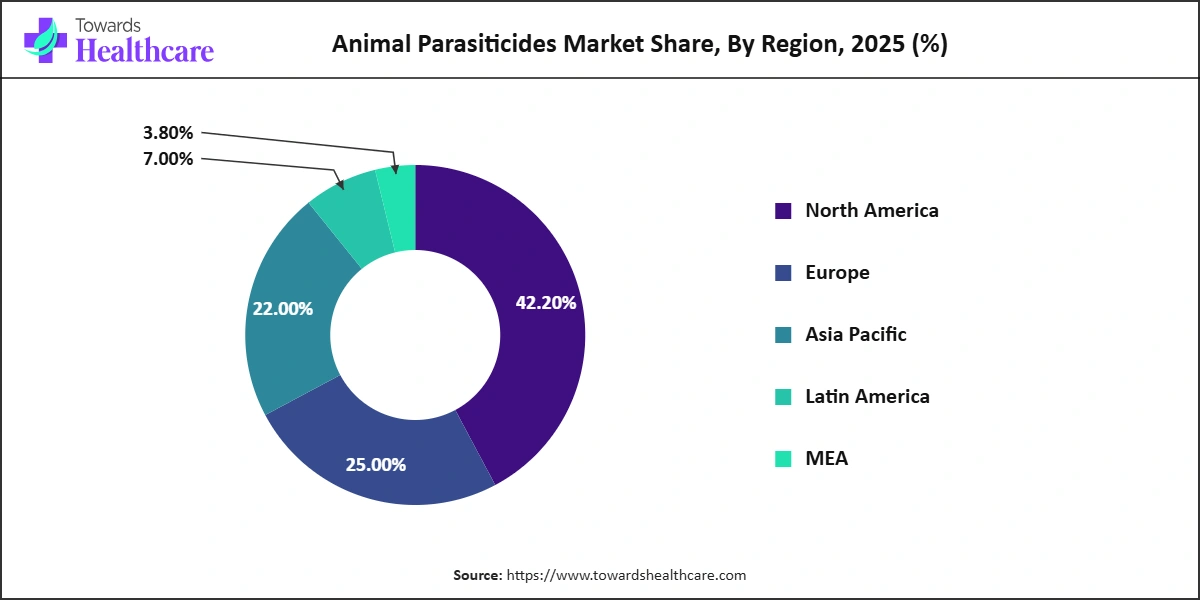
| Region | 2025 Share | 2025 Value (USD Billion) | 2035 Value (USD Billion) | CAGR 2026-2035 |
| North America | 42.20% | 5.99 | 11.03 | 6.29% |
| Europe | 25.00% | 3.55 | 6.78 | 6.69% |
| Asia Pacific | 22.00% | 3.12 | 7.19 | 8.69% |
| Latin America | 7.00% | 0.99 | 1.90 | 6.69% |
| Middle East & Africa | 3.80% | 0.54 | 1.03 | 6.69% |
Note: 2025 is the base year; 2035 values are forecasts.
Sources: Expert interviews, secondary sources, Towards Healthcare database, and Towards Healthcare analysts.
North America: The North America region generated USD 5.99 billion in 2025 and is projected to reach USD 11.03 billion by 2035, at a CAGR of 6.29% from 2026 to 2035. The U.S. has one of the highest rates of pet ownership and veterinary spending in the world, and veterinarians recommend year-round flea, tick, and heartworm prevention because heartworm is endemic in many states. Leading isoxazoline and combination products from Zoetis, Boehringer Ingelheim, Merck, and Elanco generate their largest sales in the region. The large U.S. and Canadian cattle herds add livestock demand, and the northward spread of New World screwworm has prompted emergency approvals for new treatments.
Europe: This region held 25.00% share and reached USD 3.55 billion in the animal parasiticides market in 2025 and is projected to reach USD 6.78 billion by 2035, at a CAGR of 6.69% from 2026 to 2035. Europe has high pet ownership in the UK, Germany, France and Italy, with growing concern about ticks and vector-borne diseases spreading northward as winters become milder. Regulators have raised environmental questions about some flea treatments in waterways, which may shape product use. Livestock parasite control in cattle and sheep, especially in the UK, Ireland and France, is important, with anthelmintic resistance a key issue.
Asia Pacific: Asia Pacific is the fastest-growing region, accounting for a 22.00% share and was valued at USD 3.12 billion in 2025 and is expected to reach USD 7.19 billion by 2035, expanding at a CAGR of 8.69% from 2026 to 2035. Pet ownership and premium pet care are growing rapidly in China, Japan, South Korea, and Australia, and companies are launching isoxazoline products across the region. Australia has large cattle and sheep industries with significant parasite control needs, and India and China have large livestock populations where parasite control is increasing.
Latin America: Latin America is accounted for 7.00% (USD 0.99 billion) of the animal parasiticides market in 2025 and is projected to reach USD 1.90 billion by 2035, at a CAGR of 6.69% from 2026 to 2035. Latin America is supported by Brazil's very large cattle herd, where tick and worm control is essential, and by growing pet ownership in Brazil, Mexico, and Argentina. Tropical climates increase parasite pressure year-round, supporting strong demand for ectoparasiticides and endectocides.
Middle East & Africa: This region generated USD 0.54 billion in 2025 and is estimated to reach USD 1.03 billion by 2035, at a CAGR of 6.69% from 2026 to 2035. The Middle East & Africa are supported by livestock parasite control in sheep, goats, camels, and cattle and by rising pet ownership in the Gulf and South Africa. Tick-borne diseases in African cattle create demand for acaricides.
Analyst View: Regional shares were built from treated animals, doses, and prices in each region. North America leads because of pet prevention spending. We project Asia Pacific is the highest growth premium because pet ownership and livestock parasite control are expanding fastest in this region.
| Rank | Company Name | Market-Specific Revenue (USD Billion) | 2025 Share | Key Products / Business | Headquarters |
| 1 | Zoetis | 2.46 | 17.32% | Simparica, Revolution, ProHeart | United States |
| 2 | Boehringer Ingelheim | 2.10 | 14.79% | NexGard family, Heartgard, Ivomec | Germany |
| 3 | Merck Animal Health | 1.90 | 13.38% | Bravecto, livestock parasiticides | United States |
| 4 | Elanco | 1.40 | 9.86% | Credelio, Seresto, Interceptor | United States |
| 5 | Virbac | 0.45 | 3.17% | Pet and livestock parasiticides | France |
| 6 | Ceva Santé Animale | 0.30 | 2.11% | Parasiticides for pets and livestock | France |
| 7 | Norbrook | 0.18 | 1.27% | Generic livestock parasiticides | United Kingdom |
| 8 | Vetoquinol | 0.15 | 1.06% | Pet parasiticides | France |
| 9 | Dechra | 0.12 | 0.85% | Parasiticides | United Kingdom |
| 10 | Bimeda | 0.10 | 0.70% | Livestock anthelmintics | Ireland |
Note: Company revenues and shares are 2025 estimates.
Sources: Company press releases, expert interviews, secondary sources, Towards Healthcare database and Towards Healthcare analysts.
Zoetis led the animal parasiticides market with 17.32% share (USD 2.46 billion) of 2025 revenue, followed by Boehringer Ingelheim at 14.79% (USD 2.10 billion) and Merck Animal Health at 13.38% (USD 1.90 billion). Zoetis leads through its Simparica franchise, including Simparica Trio, along with Revolution and ProHeart long-acting heartworm injections. Boehringer Ingelheim offers the NexGard family, Heartgard and Ivomec, and Merck Animal Health sells Bravecto, including long-acting formulations, and a broad livestock parasiticide range. Elanco, Virbac, Ceva Santé Animale, Norbrook, Vetoquinol, Dechra and Bimeda compete through Credelio and Seresto, broad pet and livestock portfolios, generics and regional products.
The top 10 companies accounted for 64.51% share (USD 9.16 billion) of 2025 revenue, while the remaining 35.49% (USD 5.04 billion) was shared among generic manufacturers, regional animal health companies and OTC pet product brands. The market is concentrated among the top four animal health companies, and competition centres on spectrum and duration of protection, safety, ease of administration, veterinary relationships, marketing and price. Patent expirations of leading isoxazolines will increase generic competition over the forecast period.
The animal parasiticides ecosystem links active ingredient suppliers with animal health manufacturers, distributors and retailers, veterinarians and farmers and pet owners, under regulatory oversight.
| Ecosystem Stage | Role in the Market | Key Companies |
| Active Ingredients | Supply isoxazolines, macrocyclic lactones and other actives | API manufacturers |
| Animal Health Manufacturers | Develop and produce parasiticides | Zoetis, Boehringer Ingelheim, Merck, Elanco, Virbac, Ceva |
| Distribution & Retail | Distribute and sell products | Veterinary distributors, online pharmacies, pet retailers, farm stores |
| Veterinarians | Diagnose and prescribe | Companion animal and livestock veterinarians |
| End Users & Regulators | Use and approve products | Pet owners, farmers, FDA CVM, EMA, EPA |
Sources: Company press releases, expert interviews, secondary sources, Towards Healthcare database and Towards Healthcare analysts.
The Towards Healthcare Companies Quadrant positions key participants in the animal parasiticides market by market strength, reflecting revenue scale, market share and geographic reach, and by innovation and growth strategy, reflecting product portfolio breadth, R&D intensity and partnerships. Positions reflect each company's estimated 2025 parasiticide revenue and our assessment of its pipeline, product innovation and distribution.
Sources: Company press releases, expert interviews, secondary sources, Towards Healthcare database and Towards Healthcare analysts.
Leaders: Zoetis, Boehringer Ingelheim, Merck Animal Health, and Elanco combine large parasiticide revenue with leading isoxazoline, combination, long-acting products and strong veterinary relationships.
Challengers: Virbac has established portfolios but fewer innovative products.
Innovators: Ceva Santé Animale and Dechra bring regional innovation and specialized parasiticide products.
Niche Players: Norbrook, Vetoquinol, and Bimeda serve generic and regional segments.
By Product
By Animal Type
By Route of Administration
By Type
By End Use
By Region
The animal parasiticides market was defined as ectoparasiticides, endoparasiticides, and endectocides for companion and farm animals in oral, topical, and injectable forms, worldwide. The 2025 base year was built bottom-up from treated companion and farm animals by product, route, and region, doses per year and average prices, and checked top-down against the parasiticide revenue of leading animal health companies. Segment, regional, and company values were allocated from products, animal types, routes, types, end uses, and regional demand. Key estimates were verified by cross-checking company disclosures, regulatory and industry data, and published third-party estimates, and inputs that could not be reconciled were excluded. All segment, regional, and company figures were reconciled to the same 2025 base year, and the 2026-2035 forecast, which applies a constant CAGR from the 2025 base, was recalculated and validated.
Analyst View: The animal parasiticides market is one of the largest animal health categories and expands with pet ownership, prevention compliance, and new product innovation. Our estimate links demand to treated animals, doses, and prices, so the forecast follows pet populations, livestock herds, and launches. The main opportunity comes from combination and long-acting products and Asian pet markets, while the main risks are generic competition and resistance.