
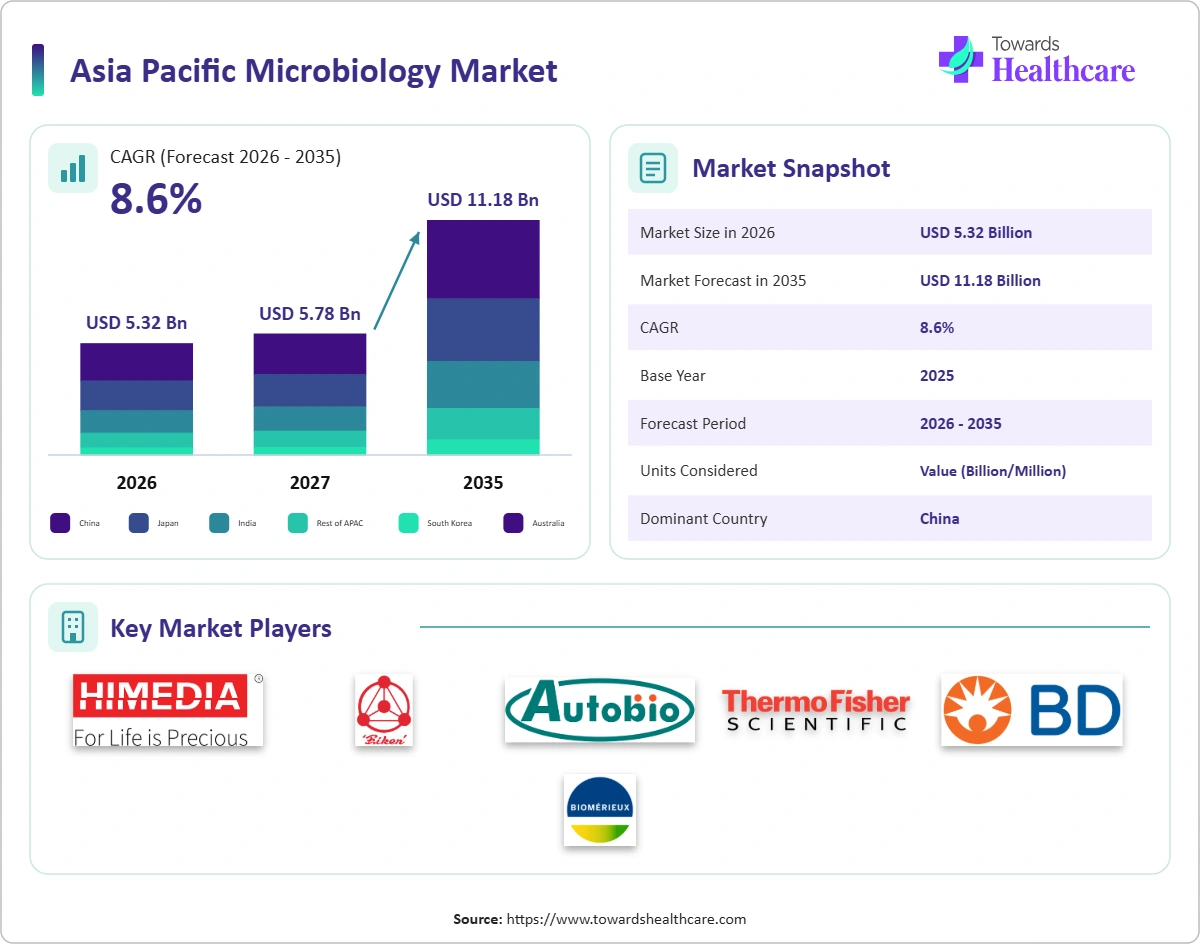
The Asia Pacific microbiology market is likely to grow from USD 4.90 billion in 2025 to USD 11.18 billion by 2035, driven by the need for accurate and timely microbial identification, infection monitoring, antimicrobial resistance surveillance, and quality control across healthcare and industrial applications. Rising infectious disease burdens and the expansion of hospital and diagnostic laboratory infrastructure are supporting recurring demand for microbiology instruments, reagents, kits, and culture media.
The market is expected to reach USD 7.40 billion by 2030 and sustain a CAGR of 8.6% from 2026 to 2035. Expansion in pharmaceutical and biotechnology manufacturing is driving demand for microbiological quality control, sterility testing, and contamination monitoring. Increased food safety regulations and environmental monitoring are also promoting standardized microbiological testing. Advancements in laboratory automation, MALDI-TOF identification, rapid AST, molecular diagnostics, and next-generation sequencing are enhancing testing speed, accuracy, and operational efficiency.
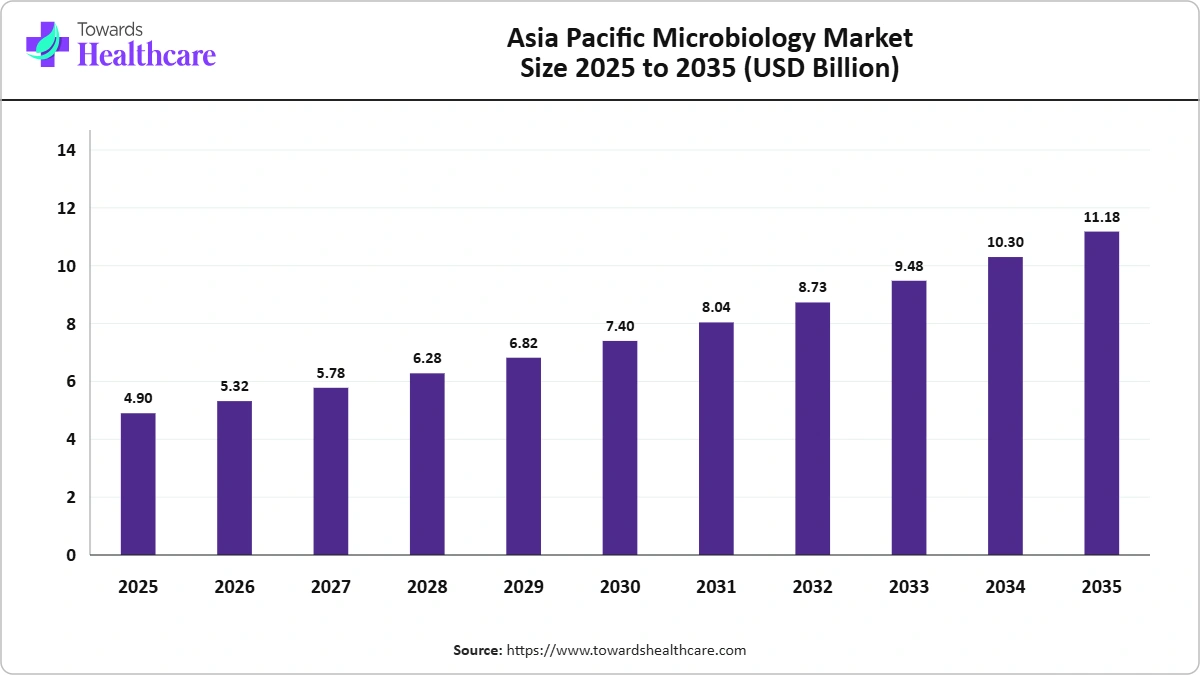
Analyst View: We estimated the market using microbiology test volumes, installed instrument bases, and average product prices across individual countries, cross-validated against Asia Pacific microbiology revenues of leading suppliers. Our assessment incorporates product categories, application requirements, end-user demand, country-level spending, and competitive positioning. Our value sits just above published comparable estimates.
| Driver | Impact | ≈ CAGR Contribution | Time Horizon | Key Regions |
| Infections and antimicrobial resistance | High | +3.36 pp | Short to long term | Asia Pacific-wide, strongest in China |
| Hospital expansion | Medium | +2.83 pp | Medium to long term | Asia Pacific-wide, fastest uptake in India |
| Pharma manufacturing | Medium | +2.41 pp | Short to medium term | Asia Pacific-wide |
| Food safety rules | Low | +1.89 pp | Long term | China and India |
Note: Contributions are indicative estimates of each factor's effect on annual growth.
Sources: Expert interviews, secondary sources, Towards Healthcare database, and Towards Healthcare analysts.
Annual market growth is projected to increase by approximately 10.49 percentage points due to rising infectious disease burdens, antimicrobial resistance, hospital infrastructure expansion, pharmaceutical manufacturing investments, and food safety requirements.
The heightened demand for microbial identification and susceptibility testing in healthcare systems in China. Hospital expansion enhances access to diagnostics, while India's pharmaceutical manufacturing growth boosts microbiological quality control needs.
| Restraint | Impact | ≈ Negative CAGR Contribution | Time Horizon | Key Regions |
| Price pressure and tenders | High | -0.85 pp | Short to medium term | Asia Pacific-wide |
| Skilled staff shortages | High | -0.62 pp | Medium term | Smaller and price-sensitive markets |
| Fragmented markets | Medium | -0.42 pp | Short term | China and other mature markets |
Note: Contributions are indicative estimates of each factor's effect on annual growth.
Sources: Expert interviews, secondary sources, Towards Healthcare database, and Towards Healthcare analysts.
Price competition, skilled laboratory personnel shortages, and fragmented market conditions are estimated to reduce annual market growth by around 1.89 percentage points. Rising testing volumes, pharmaceutical manufacturing expansion, and technological advancements are expected to support continued market growth, resulting in a projected CAGR of 8.6% from 2026 to 2035.
The expansion of healthcare infrastructure and pharmaceutical manufacturing in India represents significant opportunities for microbiology suppliers. Increasing hospital capacity, diagnostic laboratory networks, pharmaceutical production, and antimicrobial resistance surveillance are creating demand for instruments, reagents, culture media, and automated testing platforms. Domestic manufacturing initiatives and expanding research capabilities are also supporting the development of regional supply chains.
Technological advancements in rapid AST, automated microbial identification, MALDI-TOF systems, and molecular syndromic testing improve laboratory productivity and reduce turnaround times. Additionally, improvements in pharmaceutical quality control and rising food safety requirements in Southeast Asia are creating growth opportunities for specialized microbiology products and testing solutions.
Note: 2025 is the base year; 2035 shares and CAGRs are forecasts.
Sources: Expert interviews, secondary sources, Towards Healthcare database and Towards Healthcare analysts.
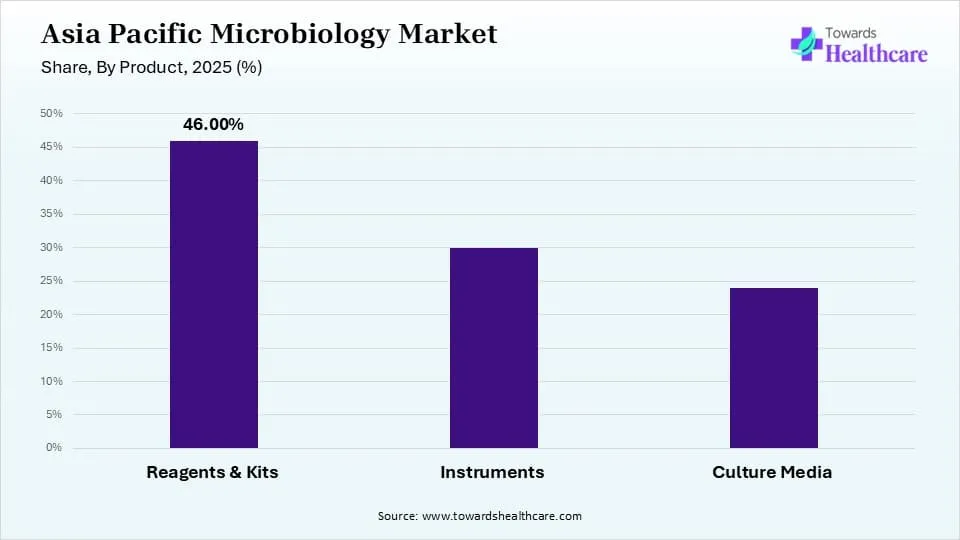
Reagents and kits accounted for 46% of the market in 2025 and are projected to expand at a CAGR of 8.00% from 2026 to 2035. Reagents and kits are essential for clinical diagnostics, pharmaceutical quality control, and environmental microbiology, aiding in microbial identification, pathogen detection, and antimicrobial susceptibility testing. However, the segment is expected to grow slower than the overall market over the forecast period.
Instruments microbiology instruments include systems for microbial identification, antimicrobial susceptibility testing, blood cultures, automated lab functions, and molecular diagnostics. Increased demand for rapid testing and improved lab productivity is prompting hospitals and diagnostics labs to upgrade their equipment. The segment is expected to grow faster than the overall market.
Culture media are crucial for isolating and cultivating microorganisms across clinical, pharmaceutical, food, and environmental applications. The increasing demand for microbiological testing and contamination monitoring in pharmaceuticals is expected to drive growth in this segment.
Segment Outlook: During the forecast period, reagents and kits are expected to retain their position as the largest product segment, although their share is projected to decline from 46% in 2025 to approximately 43.47% in 2035. Instruments are expected to record the highest product-level CAGR of 9.60%, increasing their share to 32.92%. Growing adoption of automated identification and molecular diagnostic platforms is expected to transform the Asia Pacific microbiology market.
Note: 2025 is the base year; 2035 shares and CAGRs are forecasts.
Sources: Expert interviews, secondary sources, Towards Healthcare database and Towards Healthcare analysts.
Clinical Diagnostics accounted for 56% of the market in 2025 and is projected to expand at a CAGR of 8.13% by 2035. Clinical microbiology testing is essential for identifying infectious agents, with hospital admissions and concerns about antimicrobial resistance driving demand for diagnostic reagents, culture media, blood culture systems, and microbial identification instruments. The segment is expected to grow slower than the overall market.
Pharmaceutical and Biotech QC manufacturers use microbiology products for quality control processes such as sterility testing and contamination control. Increased vaccine and biologic production in China and India is driving demand for these solutions, expected to grow faster than the overall market.
Food and Beverage Testing laboratories use microbiological methods to identify foodborne pathogens, monitor contamination, and ensure product safety. The segment is expected to grow broadly in line with the overall market.
Environmental and Others segment focuses on microbiological testing for water quality and wastewater monitoring, driven by heightened attention to water safety and pollution. The demand for culture media, reagents, and laboratory systems is rising, with expectations of overall market growth.
Segment Outlook: Clinical diagnostics is expected to remain the largest application segment through 2035, although its share is projected to decline from 56.00% in 2025 to approximately 53.67% in 2035. Pharmaceutical and biotech quality control is expected to record the highest application-level CAGR of 10.03%, increasing its share to 20.48%. Expanding pharmaceutical manufacturing, biologics production, and contamination control requirements are expected to support this shift in application demand.
Note: 2025 is the base year; 2035 shares and CAGRs are forecasts.
Sources: Expert interviews, secondary sources, Towards Healthcare database and Towards Healthcare analysts.
Hospitals and Diagnostic Labs captured 56% of the market in 2025 and are projected to expand at a CAGR of 8.19% from 2026 to 2035. Hospitals and diagnostic laboratories use microbiology products for infectious disease diagnosis, blood culture testing, and antimicrobial susceptibility testing. Growing healthcare infrastructure and demand for laboratory services are supporting segment expansion. The segment is expected to grow slower than the overall market.
Pharma and Biotech Companies use microbiological testing for sterility assurance, contamination monitoring, raw material testing, and quality control. The growing industry in China and India is increasing demand for specialized microbiology products. The segment is expected to grow faster than the overall market.
Food Companies manufacturers use microbiology testing to monitor pathogens, detect microbial contamination, and ensure compliance with food safety standards. The segment is expected to grow broadly in line with the overall market.
Research Institutes and Others category comprises academic institutions, government laboratories, biotechnology research organizations, and specialized testing facilities, with anticipated growth aligned with the overall market.
Segment Outlook: Through 2035, hospitals and diagnostic laboratories are expected to remain the largest end-user segment, although their share is projected to decline from 56.00% in 2025 to approximately 53.94% in 2035. Pharmaceutical and biotechnology companies are expected to record the highest end-user CAGR of 9.79%, increasing their share to 20.13%. Expanding drug manufacturing and more stringent microbiological quality control practices are expected to support this shift.
Analyst View: In our analysis, segment estimates reveal that market demand is allocated based on testing volumes, product consumption, and end-user purchasing patterns, with reagents, kits, clinical diagnostics, and hospitals leading due to ongoing testing needs. Instruments and pharmaceutical sectors are anticipated to increase market share as automation and advanced diagnostics grow.
Note: 2025 is the base year; 2035 shares and CAGRs are forecasts.
Sources: Expert interviews, secondary sources, Towards Healthcare database and Towards Healthcare analysts.
China accounted for 38% of the market in 2025 and is projected to register a CAGR of 8.17% from 2026 to 2035. The country is a regional leader in demand, bolstered by its strong hospital infrastructure, pharmaceutical manufacturing, and food processing industries. Growth in domestic diagnostic equipment manufacturers and improved laboratory capabilities is increasing the availability of microbiology products, though China's growth is expected to be slightly slower than the overall market.
Japan country benefits from advanced healthcare infrastructure, established pathology networks, sophisticated diagnostic laboratories, and high standards for pharmaceutical and food quality control. Japan is expected to grow broadly in line with the overall market.
India market growth is supported by hospital infrastructure expansion, increasing infectious disease testing requirements, pharmaceutical manufacturing investments, and antimicrobial resistance surveillance programs. India is expected to increase its regional market share to 15.56% by 2035.
The rest of Asia Pacific category encompasses Southeast Asian countries and other emerging markets with developing healthcare systems and growing diagnostic laboratory networks, driven by investment in healthcare services, food safety monitoring, and pharmaceutical production, leading to broad expected growth in microbiology products.
South Korea country's established diagnostic laboratory network and growing biotechnology and pharmaceutical industries support demand for microbiological testing solutions. The adoption of molecular diagnostics and automated laboratory systems is expected to contribute to market expansion. South Korea is expected to grow broadly in line with the overall market.
Australia market is supported by strong pathology networks, healthcare facilities, food safety standards, and pharmaceutical quality assurance. There is a growing demand for microbial identification, clinical diagnostics, and environmental testing, with Australia expected to grow along with the overall market.
Analyst View: In our analysis, during the forecast period, China maintains its leadership through its large healthcare and pharmaceutical manufacturing ecosystem. India is expected to record the fastest growth because healthcare investment, diagnostic adoption, pharmaceutical production, and laboratory capacity are expanding rapidly.
| Rank | Company Name | 2025 Share (%) | Key Products / Business | Headquarters |
| 1 | bioMérieux | 20.00% | VITEK, BACT/ALERT and BIOFIRE | France |
| 2 | BD | 14.00% | BACTEC, Phoenix and Kiestra | United States |
| 3 | Thermo Fisher Scientific | 9.00% | Culture media and AST | United States |
| 4 | Danaher (Beckman Coulter, Cepheid) | 8.00% | MicroScan and molecular tests | United States |
| 5 | Bruker | 5.00% | MALDI Biotyper | United States |
| 6 | Merck KGaA (MilliporeSigma) | 4.00% | Pharma and food microbiology | Germany |
| 7 | Autobio Diagnostics | 4.00% | Microbiology systems | China |
| 8 | Eiken Chemical | 3.00% | Media and LAMP tests | Japan |
| 9 | HiMedia Laboratories | 3.00% | Culture media | India |
| 10 | Hitachi High-Tech | 2.00% | Molecular systems | Japan |
Note: Company shares are 2025 estimates.
Sources: Company press releases, expert interviews, secondary sources, Towards Healthcare database and Towards Healthcare analysts.
In 2025, the leading participants identified in the competitive assessment include bioMérieux, BD, Thermo Fisher Scientific, Danaher, Bruker, Merck KGaA, Autobio Diagnostics, Eiken Chemical, HiMedia Laboratories, and Hitachi High-Tech.
bioMérieux led the market with an estimated 20% share of 2025 revenue, followed by BD at 14% and Thermo Fisher Scientific at 9%. bioMérieux holds a competitive edge with its VITEK microbial identification systems, BACT/ALERT blood culture platforms, and BIOFIRE diagnostics. BD competes with its BACTEC, Phoenix, and Kiestra products, while Thermo Fisher Scientific provides culture media and antimicrobial susceptibility testing solutions.
Other prominent participants include Danaher, Bruker, Merck KGaA, Autobio Diagnostics, Eiken Chemical, HiMedia Laboratories, and Hitachi High-Tech. These companies compete through microbial identification platforms, MALDI-TOF mass spectrometry, pharmaceutical and food microbiology products, domestic microbiology systems, culture media, LAMP-based testing, and molecular diagnostic technologies.
The top 10 companies accounted for an estimated 72% of 2025 revenue, while the remaining approximately 28% was shared among numerous regional and specialized suppliers. The market is moderately concentrated with established international manufacturers, while local Chinese, Indian, and Japanese companies compete by offering cost-effective products and utilizing domestic distribution networks. Key competitive factors include instrument performance, diagnostic accuracy, product variety, automation, turnaround time, regulatory approvals, after-sales service, and consumable pricing.
bioMérieux: bioMérieux, headquartered in France, held an estimated 20% share of the Asia Pacific microbiology market in 2025. Its offering centres on VITEK microbial identification and AST systems, BACT/ALERT blood culture platforms, and BIOFIRE molecular diagnostic solutions. Based on the Towards Healthcare Companies Quadrant assessment, bioMérieux is positioned as a Leader.
BD: BD, headquartered in the United States, accounted for an estimated 14% share of the market in 2025. Its microbiology portfolio includes BACTEC blood culture systems, Phoenix microbial identification and susceptibility testing platforms, and Kiestra laboratory automation solutions. In the Towards Healthcare Companies Quadrant, BD is classified as a Leader.
Thermo Fisher Scientific: Thermo Fisher Scientific, based in the United States, held an estimated 9% share of the market in 2025. Its offering includes microbiology culture media and antimicrobial susceptibility testing products used across clinical, pharmaceutical, food, and research applications. The company is positioned as a Leader in the Towards Healthcare Companies Quadrant.
Danaher (Beckman Coulter, Cepheid): Danaher, headquartered in the United States, accounted for an estimated 8% share of the market in 2025. The company offers MicroScan microbial identification and susceptibility testing solutions, along with molecular diagnostic platforms via Cepheid, leveraging a broad diagnostic technology portfolio and an international market presence. According to the Towards Healthcare Companies Quadrant, Danaher is positioned as a Leader.
Bruker: Bruker, based in the United States, held an estimated 5% share of the market in 2025. Its microbiology offering centres on MALDI Biotyper mass spectrometry systems, which support rapid microbial identification. In the Towards Healthcare Companies Quadrant, Bruker is classified as a Leader.
Merck KGaA (MilliporeSigma): Merck KGaA, headquartered in Germany, accounted for an estimated 4% share of the market in 2025. Its established life sciences portfolio supports demand across industrial and laboratory applications. The company is positioned as a Leader in the Towards Healthcare Companies Quadrant.
Autobio Diagnostics: Autobio Diagnostics, based in China, held an estimated 4% share of the market in 2025. Its domestic market presence and localized product offerings support its competitive position. The company is classified as an Innovator in the Towards Healthcare Companies Quadrant.
Eiken Chemical: Eiken Chemical, headquartered in Japan, accounted for an estimated 3% share of the market in 2025. Its offering includes microbiology media and LAMP-based molecular testing technologies. In the Towards Healthcare Companies Quadrant, Eiken Chemical is positioned as an Innovator.
HiMedia Laboratories: HiMedia Laboratories, based in India, held an estimated 3% share of the market in 2025. Its portfolio features culture media and microbiology lab products for clinical, pharmaceutical, food, and research uses, backed by local manufacturing and distribution that strengthen its regional presence. The company is classified as an Innovator in the Towards Healthcare Companies Quadrant.
Hitachi High-Tech: Hitachi High-Tech, headquartered in Japan, accounted for an estimated 2% share of the market in 2025. The company is strengthening its position through collaborations and commercialization of advanced diagnostic platforms in Japan. According to the Towards Healthcare Companies Quadrant, the company is positioned as an Innovator.
The Asia Pacific microbiology ecosystem connects raw material suppliers, diagnostic manufacturers, distributors, end users, and regulatory authorities. Each stage contributes to the development, manufacturing, distribution, adoption, and oversight of microbiology products used in clinical diagnostics, pharmaceutical quality control, food safety testing, and environmental monitoring.
| Ecosystem Stage | Role in the Market | Key Companies |
| Raw Material Suppliers | Supply media components and antibodies | Raw material makers |
| Diagnostic Makers | Make instruments and reagents | bioMérieux, BD, Thermo Fisher, Bruker |
| Distributors | Supply labs | Local distributors |
| Users | Test samples | Hospitals, pharma, food companies |
| Regulators | Approve products | NMPA, PMDA, CDSCO |
Sources: Company press releases, expert interviews, secondary sources, Towards Healthcare database, and Towards Healthcare analysts.
Raw Material Suppliers: Raw material suppliers are crucial for microbiology product manufacturing, supplying components like culture media, antibodies, enzymes, and diagnostic chemicals, which facilitate the production of reagents, kits, culture media, and diagnostic consumables.
Diagnostic Makers: Diagnostic manufacturers develop microbiology instruments, reagents, identification systems, susceptibility testing platforms, and molecular diagnostic solutions. Key players like bioMérieux, BD, Thermo Fisher Scientific, and Bruker supply technologies for microbiological testing in both clinical and industrial contexts.
Distributors: Distributors link manufacturers with various entities such as hospitals, laboratories, and pharmaceutical companies, providing critical support in product availability and logistics, especially in fragmented and emerging markets.
Users: Microbiology products are utilized by hospitals and diagnostic laboratories for infectious disease testing. Pharmaceutical and biotechnology companies employ these products for sterility assurance and quality control, whereas food companies and research institutions use them for contamination monitoring, food safety, and scientific research.
Regulators: Regulatory authorities outline requirements for product registration, manufacturing quality, safety, and diagnostic performance. Key institutions include China's NMPA, Japan's PMDA, and India's CDSCO.
Value in the Asia Pacific microbiology market flows from upstream material suppliers to diagnostic manufacturers, followed by distribution partners and end users. Regulatory authorities oversee product quality and commercialization throughout the value chain. Companies that integrate manufacturing capabilities, broad diagnostic portfolios, distribution networks, and long-term laboratory relationships can strengthen their competitive positions and capture a larger share of market value.
The Towards Healthcare Companies Quadrant positions key participants in the Asia Pacific microbiology market by market strength, reflecting revenue scale, market share, and geographic reach, and by innovation and growth strategy, reflecting product portfolio breadth, R&D intensity, and partnerships. Positions reflect each company's estimated 2025 share of the Asia Pacific microbiology market and our assessment of its product innovation, portfolio breadth, and partnerships.
Sources: Company press releases, expert interviews, secondary sources, Towards Healthcaredatabase, and Towards Healthcare analysts.
Leaders: bioMérieux, BD, Thermo Fisher Scientific, Danaher (Beckman Coulter, Cepheid), Bruker, and Merck KGaA (MilliporeSigma) combine high market share with broad portfolios and strong innovation.
Innovators: Autobio Diagnostics, Eiken Chemical, HiMedia Laboratories, and Hitachi High-Tech bring newer technologies and specialised products.
By Product
By Application
By End User
By Country
The Asia Pacific microbiology market was estimated using a bottom-up model of microbiology product demand across China, Japan, India, South Korea, Australia, and the rest of Asia Pacific. The assessment considers microbiological testing volumes, installed instrument bases, average selling prices, consumable usage, laboratory capacity, and application-specific demand. Market estimates are differentiated across instruments, reagents, kits, and culture media to reflect variations in product consumption and purchasing patterns.
The market assessment includes microbiology products used in clinical diagnostics, pharmaceutical and biotechnology quality control, food and beverage testing, and environmental and other applications. End-user demand is categorized across hospitals and diagnostic laboratories, pharmaceutical and biotechnology companies, food companies, and research institutes. Products used across multiple applications are allocated according to their primary application and revenue contribution to prevent double counting.
The 2025 base-year estimate was formulated by analyzing product demand, testing activities, and revenues, then validated with data from leading manufacturers and industry reports. It considers factors such as infectious disease prevalence, antimicrobial resistance, and advancements in microbiology. The forecast accounts for pricing trends, regulatory conditions, and competitive environments. All estimates were reconciled to align with the 2025 base year, with projections for 2026-2035 adjusted based on expected market growth rates.
Analyst View: The Asia Pacific microbiology market is expected to expand steadily through 2035, supported by rising infectious disease testing requirements, antimicrobial resistance surveillance, hospital infrastructure expansion, and pharmaceutical manufacturing growth. Reagents and kits will continue to represent the largest product category because of their recurring consumption across microbiological testing procedures, while clinical diagnostics and hospitals and diagnostic laboratories will remain the leading application and end-user segments.
Instruments are anticipated to increase their market share due to laboratory investments in automation, MALDI-TOF identification, rapid AST, and molecular diagnostics. Quality control within pharmaceutical and biotechnology sectors is also projected to grow. India is highlighted as a key market owing to its improving healthcare infrastructure and diagnostic capabilities. However, challenges such as pricing pressures, regulatory fragmentation, and skilled labor shortages may hinder growth in some regions. Suppliers that offer cost-effective, automated diagnostic solutions and maintain robust distribution networks are likely to enhance their competitive standing throughout the forecast period.