
The body composition analyzers market is expected to increase from USD 812.40 million in 2025 to USD 1,583.24 million by 2035 as healthcare professionals, nutritionists, gyms, and individuals substitute body mass index with fat, muscle, and body fluid measurements for obesity, nutrition, and fitness management programs. There is an emerging need for continuous body composition analysis due to GLP-1 weight loss treatment, which reduces muscle and fat, resulting in an increase in the market up to USD 1,134.12 million by 2030 and a CAGR of 6.90% between 2026 and 2035.
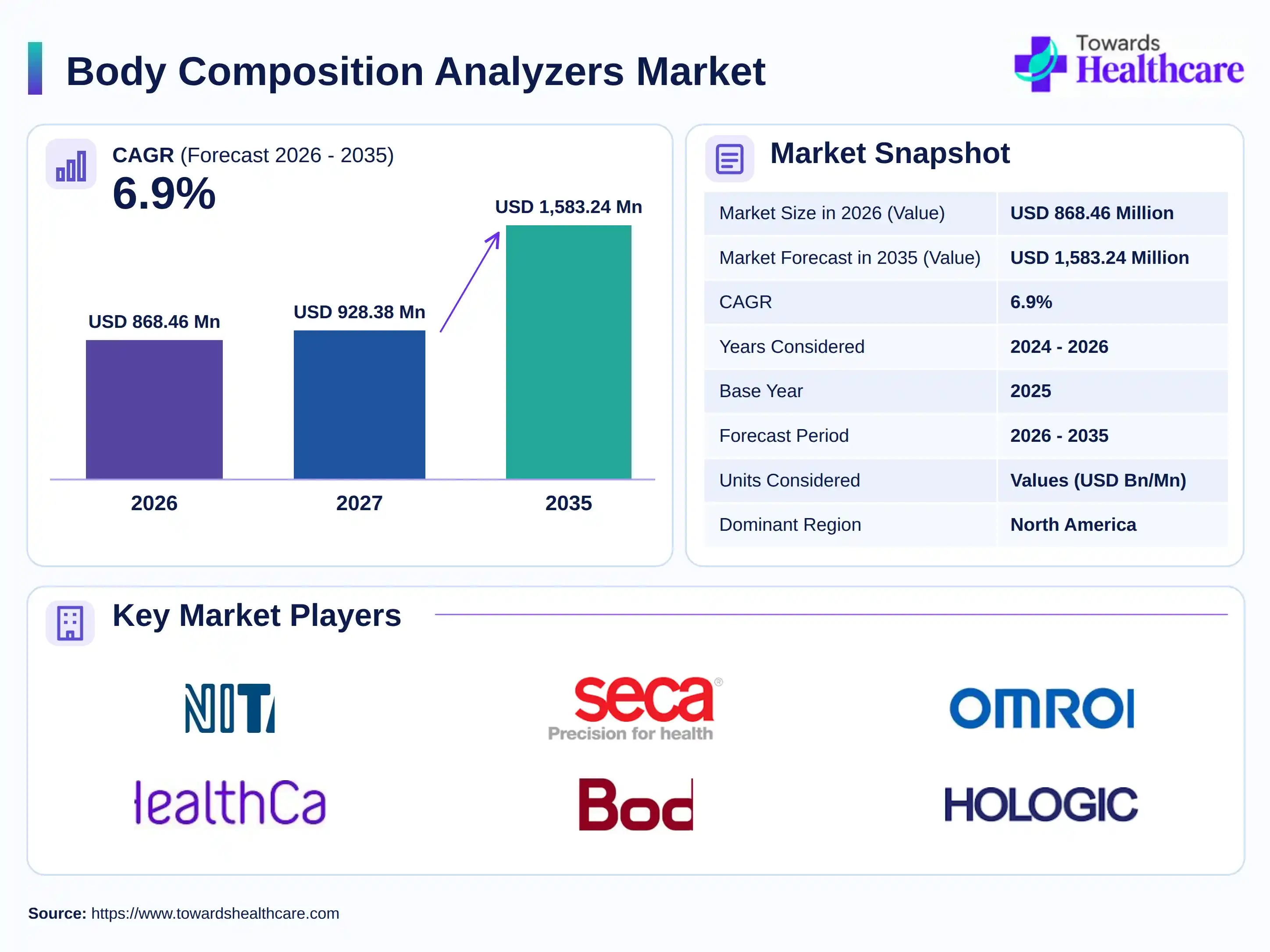
Analyst View: This estimate is based on the installed base and annual unit shipments for bioimpedance, DEXA, plethysmography, and other body composition devices by end user and geography, multiplied by ASPs, and including revenues from software and services. The clinical market segment corresponds to the number of obesity clinics, general practitioners, nephrologists, and nutrition practices; the fitness market segment corresponds to the number of gyms and wellness centers; and the home market segment corresponds to the number of sales of smart scales, with segment-level breakdowns. This figure is benchmarked to the revenues from body composition devices of key manufacturers and published forecasts, putting our base year slightly ahead of those figures. Growth is driven by increased obesity management and GLP-1 monitoring, partly offset by price pressure on consumer devices.
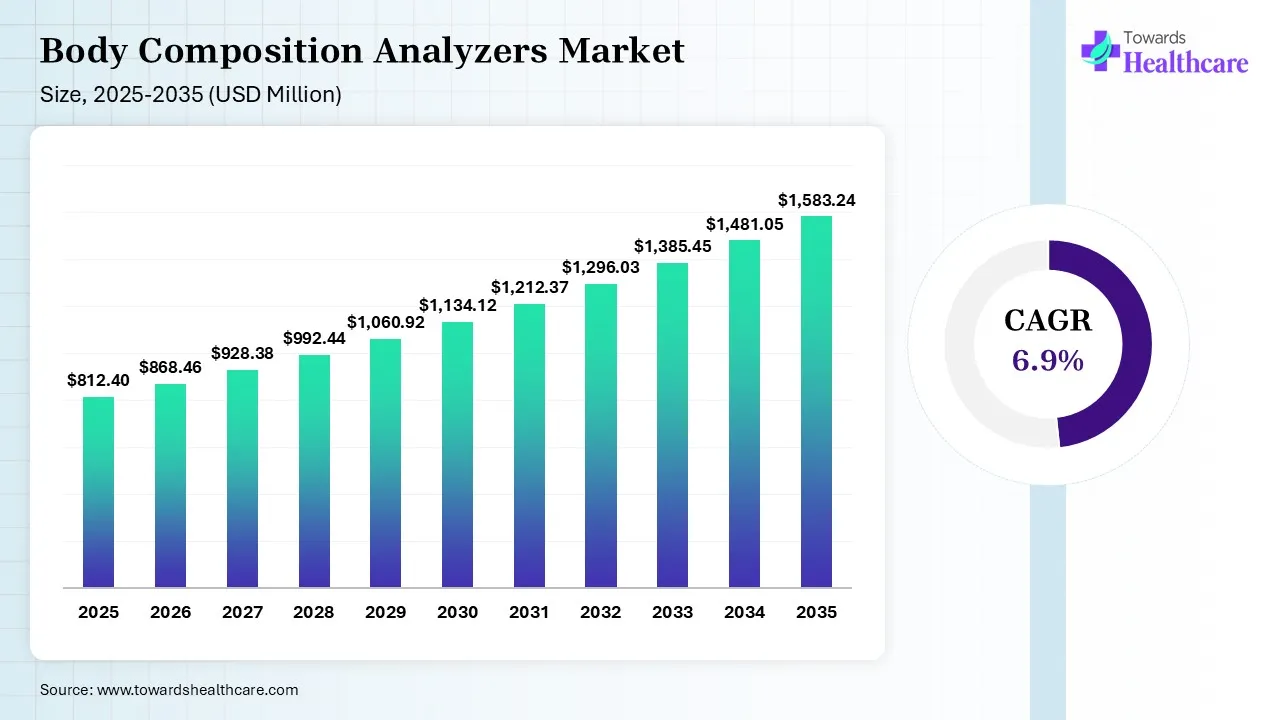
Market Size & Growth Outlook
Regional Market Spotlight
Segmental Spotlight
Sources: Expert interviews, secondary sources, Towards Healthcare database, and Towards Healthcare analysts.
There has been an increase in the number of obese people as well as cases of metabolic diseases globally. There is a growing realization that BMI does not reflect the amount of body fat in the patient. Anti-obesity medications such as GLP-1 will reduce both body fat and muscle. Therefore, there is a need to track the amount of lean mass when patients are undergoing anti-obesity treatments in obesity clinics as well as primary care practices.
Results from bioimpedance analysis are influenced by fluid balance, eating, and physical activity, leading to uncertainty in consumer devices. DEXA and plethysmography devices are costly and need skilled operators, while DEXA has radiation exposure. Insurance coverage for body composition measurement is not widespread in most nations. Price competition amongst consumer scales reduces profits. Variations in devices make comparison impossible.
Body composition can become a common practice in GLP-1 therapy and obesity management programs. Cloud computing, artificial intelligence, and integration with electronic medical records can drive recurring income. Clinical devices can be used in primary care, home care, and telehealth services. Screening for sarcopenia in elderly patients provides a vast additional application area. There are emerging markets with increasing levels of obesity and fitness involvement.
| Segments | 2025 Share | 2025 Market Value |
| Bioimpedance Analyzers | 54.20% | USD 440.32 million |
| DEXA | 22.60% | USD 183.60 million |
| Air Displacement Plethysmography | 8.40% | USD 68.24 million |
| Skinfold Calipers | 6.40% | USD 51.99 million |
| Others | 5.60% | USD 45.49 million |
| Hydrostatic Weighing | 2.80% | USD 22.75 million |
Sources: Expert interviews, secondary sources,Towards Healthcare database, and Towards Healthcare analysts.
The bioimpedance analyzers represented 54.20% (USD 440.32 million) in 2025, as they can calculate fat, muscle, and body water in less than a minute using non-radiation techniques and can be found in different types of equipment, from multi-frequency clinical instruments to home-scale devices. The multi-frequency and segmental instruments give information about visceral fat, phase angle, and limb muscle mass, and that is why they are applicable in the field of obesity, nephrology, oncology nutrition, and sports medicine. DEXA, representing 22.60% (USD 183.60 million), is considered a standard instrument in hospitals and researches in the measurement of fat, lean and bone mass and is considered the most expensive one in each system. Air displacement plethysmography represents 8.40% (USD 68.24 million), being applied in research, pediatrics, and elite sport. The skinfold calipers represent 6.40% (USD 51.99 million) as a cost-effective field instrument.
| Segments | 2025 Share | 2025 Market Value |
| Stationary | 63.80% | USD 518.31 million |
| Portable | 36.20% | USD 294.09 million |
Sources: Expert interviews, secondary sources, Towards Healthcare database, and Towards Healthcare analysts.
Stationary analyzers occupied a 63.80% (USD 518.31 million) share in 2025 due to the fact that hospitals, clinics, and gyms use multi-frequency standing systems and DEXA scanners, which provide the most accurate results through segmental readings. They are often connected with the electronic health records and membership management software and play a significant role in obesity and fitness programs. The portable analyzers, which made up 36.20% (USD 294.09 million) in 2025, represent the fastest-growing category among all other body composition analyzers thanks to their compact design. They consist of clinical devices, hand-held analyzers, and scales.
| Segments | 2025 Share | 2025 Market Value |
| Hospitals & Clinics | 42.60% | USD 346.08 million |
| Fitness Centers & Gyms | 26.40% | USD 214.47 million |
| Home Users | 18.20% | USD 147.86 million |
| Research & Academic Institutes | 7.40% | USD 60.12 million |
| Others | 5.40% | USD 43.87 million |
Sources: Expert interviews, secondary sources,Towards Healthcare database, and Towards Healthcare analysts.
Hospitals and clinics held 42.60% (USD 346.08 million) in 2025, driven by obesity & bariatric programs, nutrition support, dialysis & oncology, where body composition influences treatment decisions. The primary care segment is growing as physicians focus on muscle sparing in patients receiving GLP-1 drugs. Fitness centers & gyms represent 26.40% (USD 214.47 million), as analyzers are used by organizations to motivate their customers and analyze training outcomes; home users represented 18.20% (USD 147.86 million) and were the fastest-growing end user segment; and research & academic institutes comprised 7.40% (USD 60.12 million). Other users include corporate wellness and military programs, representing 5.40% (USD 43.87 million).
Analyst View: Values for the segments were split based on the match of device shipments and installed base by end user and setting to product types and modalities, utilizing average prices for each device class. Bioimpedance takes the lead in terms of value due to its huge number of units sold in all three major settings, while DEXA has high value per system. We anticipate increasing shares for portable bioimpedance analyzers, home users, and primary care as the usage of body composition data expands through GLP-1 drugs and connected healthcare programs.
| Region | 2025 Share | 2025 Market Value |
| North America | 37.80% | USD 307.09 million |
| Asia Pacific | 28.40% | USD 230.72 million |
| Europe | 25.60% | USD 207.97 million |
| Latin America | 4.60% | USD 37.37 million |
| Middle East & Africa | 3.60% | USD 29.25 million |
Sources: Expert interviews, secondary sources, Towards Healthcare database, and Towards Healthcare analysts.
North America accounted for 37.80% (USD 307.09 million) in 2025. High obesity prevalence and widespread GLP-1 use drive demand for muscle and fat tracking in clinics. Large gym chains and strong home smart scale sales add to device volumes. The United States is also the main market for DEXA body composition services.
Asia Pacific accounted for 28.40% (USD 230.72 million) in 2025 and is the fastest-growing region. South Korea and Japan host major bioimpedance makers and have strong health check-up cultures. China and India are adding hospitals, wellness centres, and gyms that use analyzers. Rising metabolic disease awareness supports home device sales.
Europe accounted for 25.60% (USD 207.97 million) in 2025. Clinical nutrition, dialysis, and sports medicine are key users. Germany and Italy host leading device makers. Preventive health and ageing populations increase interest in muscle loss screening.
Latin America accounted for 4.60% (USD 37.37 million) in 2025. High obesity rates in Mexico and Brazil support clinical demand. Expanding fitness chains add gym installations.
The Middle East and Africa accounted for 3.60% (USD 29.25 million) in 2025. High obesity and diabetes rates in the Gulf states support demand. Private hospitals and premium gyms are the main buyers.
Analyst View: The regional shares have been determined through the shipment volumes, clinic-installed base, gym-installed base, home-installed base, and regional pricing for each region. The largest market share is occupied by the North American region due to the high spending on the treatment of obesity and GLP-1 usage. Asia Pacific region is given the highest growth premium due to increased health screenings and fitness participation.
| Rank | Company Name | Market-Specific Revenue (USD Million) | 2025 Share | Key Products / Business | Headquarters |
| 1 | InBody | 128.00 | 15.76% | Multi-frequency segmental bioimpedance analyzers | South Korea |
| 2 | Tanita | 82.00 | 10.09% | Clinical and home body composition monitors | Japan |
| 3 | Hologic | 64.00 | 7.88% | Horizon DXA systems with body composition | United States |
| 4 | Omron Healthcare | 54.00 | 6.65% | Home body composition monitors | Japan |
| 5 | seca | 52.00 | 6.40% | Medical body composition analyzers (mBCA) | Germany |
| 6 | GE HealthCare | 46.00 | 5.66% | Lunar DXA body composition systems | United States |
| 7 | COSMED | 24.00 | 2.95% | BOD POD air displacement plethysmography | Italy |
| 8 | Withings | 22.00 | 2.71% | Connected body composition scales | France |
| 9 | Bodystat | 12.00 | 1.48% | Portable bioimpedance analyzers | United Kingdom |
| 10 | Charder Electronic | 10.00 | 1.23% | Bioimpedance analyzers and medical scales | Taiwan |
Sources: Company press releases, expert interviews, secondary sources, Towards Healthcare database and Towards Healthcare analysts.
InBody was the leader in the body composition analyzers market share with 15.76% (USD 128.00 million) of the 2025 revenue, Tanita was in second place with 10.09% (USD 82.00 million), and Hologic came third with 7.88% (USD 64.00 million). InBody dominated with multichannel segmental analyzers that have wide application in clinics, hospitals, and gyms with cloud-based software, and increasingly with a home product line as well. Tanita is in a strong position with clinical and consumer monitors and enjoys high brand recognition in Asia and Europe. Hologic dominates the DXA product segment, and its products serve as the reference standard for fat, lean, and bone measurement in hospitals and scientific research. Clinical accuracy is emphasized by medical device manufacturers like seca and GE HealthCare, whereas consumer device manufacturers such as Omron and Withings focus on connectivity and price.
The top 10 manufacturers had about 60.81% (USD 494.00 million) share of total market revenue in 2025, whereas the remaining 39.19% (USD 318.40 million) was taken by regional bioimpedance manufacturers, smart scales producers, calipers and plethysmography providers, and body composition analysis software providers. The market of body composition analyzers is moderately consolidated, and the main aspects of competition include clinical accuracy compared with DEXA and MRI, speed, segmental analysis, software and connectivity, and price. Clinical buyers are interested in validation studies and interoperability, whereas consumers are concerned with application interface and price, ensuring room for innovation.
By Product
By Modality
By End User
By Region
The body composition analyzers market was delineated to include bioelectrical impedance analysis devices, DEXA body composition systems, air displacement plethysmography, skinfold calipers, hydrostatic weighing systems, and related software in clinical, fitness, home, and research applications globally. The 2025 base year was constructed using a bottom-up approach from device shipments and the installed base by end users, average selling prices and software and service revenues, and then validated with a top-down approach using the body composition analyzer revenue of leading device manufacturers. Segment, regional, and company numbers were derived from product, modality, end-user, and regional demand for the device. Important numbers were validated through a cross-checking of company disclosures, regulatory and industry data, and third-party estimates, and inputs that could not be reconciled were dropped. All segment, regional, and company numbers were reconciled to the same 2025 base year, and the 2026–2035 forecast, based on a constant CAGR from the 2025 base, was recalculated and validated.
Analyst View: Overall Market - The body composition analyzers market will be shifting from applications in the fitness sector to wider applications in clinics due to treatment of obesity and muscle analysis during GLP-1 administration. Our model takes into consideration shipment volumes, installed base, and pricing per end-user; hence, the forecast will follow that of obesity treatment, fitness activities, and at-home health care. Upsides include adoption by general practice doctors, portable instruments, and software; the risks will include variations in measurements, low reimbursement, and pricing pressures for consumers.