
This body fluid collection diagnostics market will experience growth from USD 38.60 billion in 2025 to USD 77.36 billion by 2035 since laboratories conduct numerous tests on blood, urine, and saliva to diagnose chronic diseases, infections, and cancers, and new sampling techniques have facilitated tests beyond hospitals. Testing procedures such as liquid biopsy that detect DNA in blood from tumours have increased the testing market value to USD 54.65 billion by 2030 and maintained the CAGR of 7.20% from 2026 to 2035.
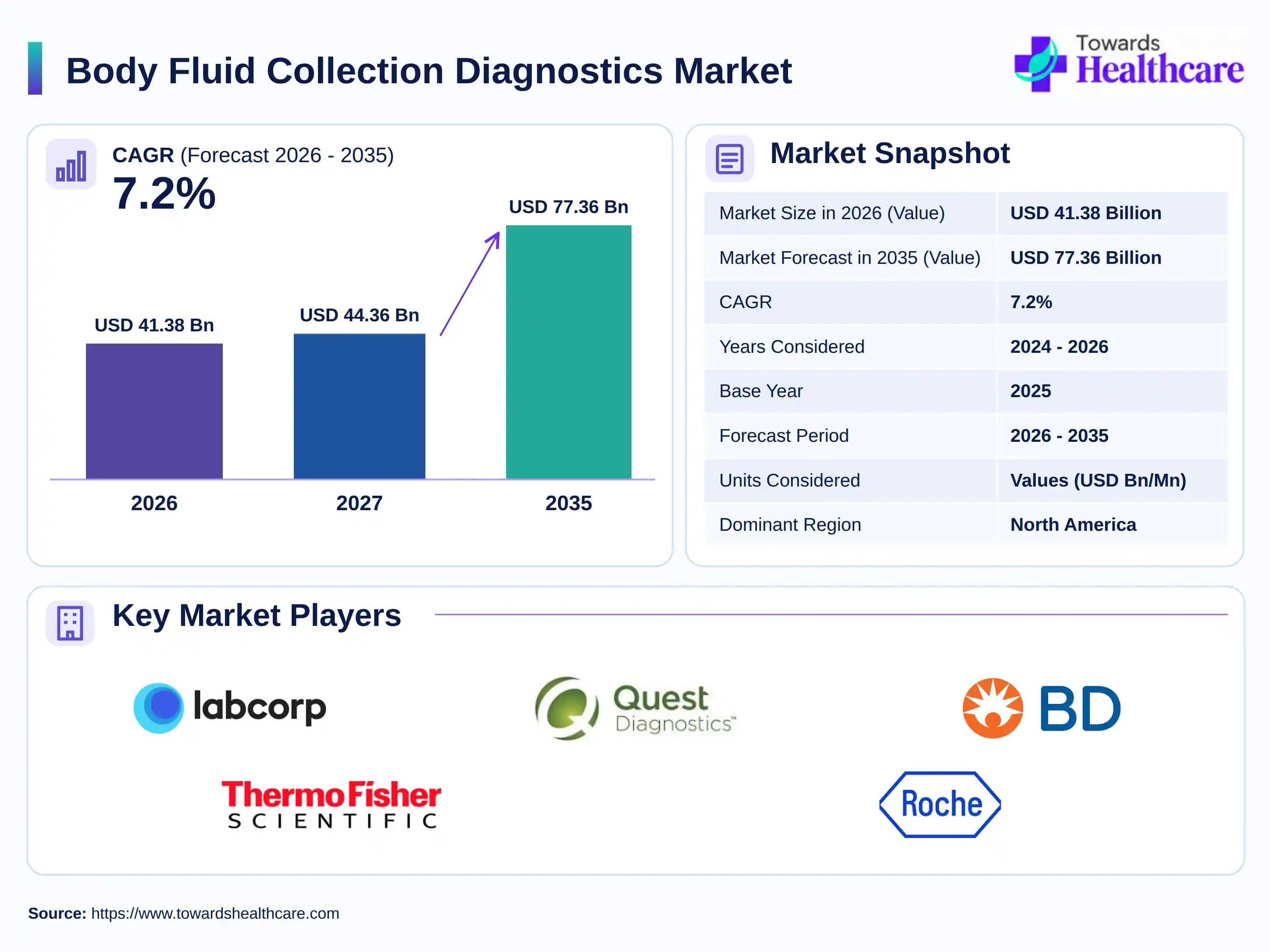
Analyst View: The calculation of the estimate was based on the test volume by type of sample and technology multiplied by the average price of the test, plus sales revenue from the sale of collection devices, kits, and instruments used in the laboratories. The test volume considers both regular and specialty laboratory test activity, oncology testing, infection testing, and increasing use of home and retail collection of samples. The estimate is verified against the diagnostics and collections revenues of the major laboratory, devices, and assays companies as well as the estimates available in the literature, which places our base year slightly higher than the others.
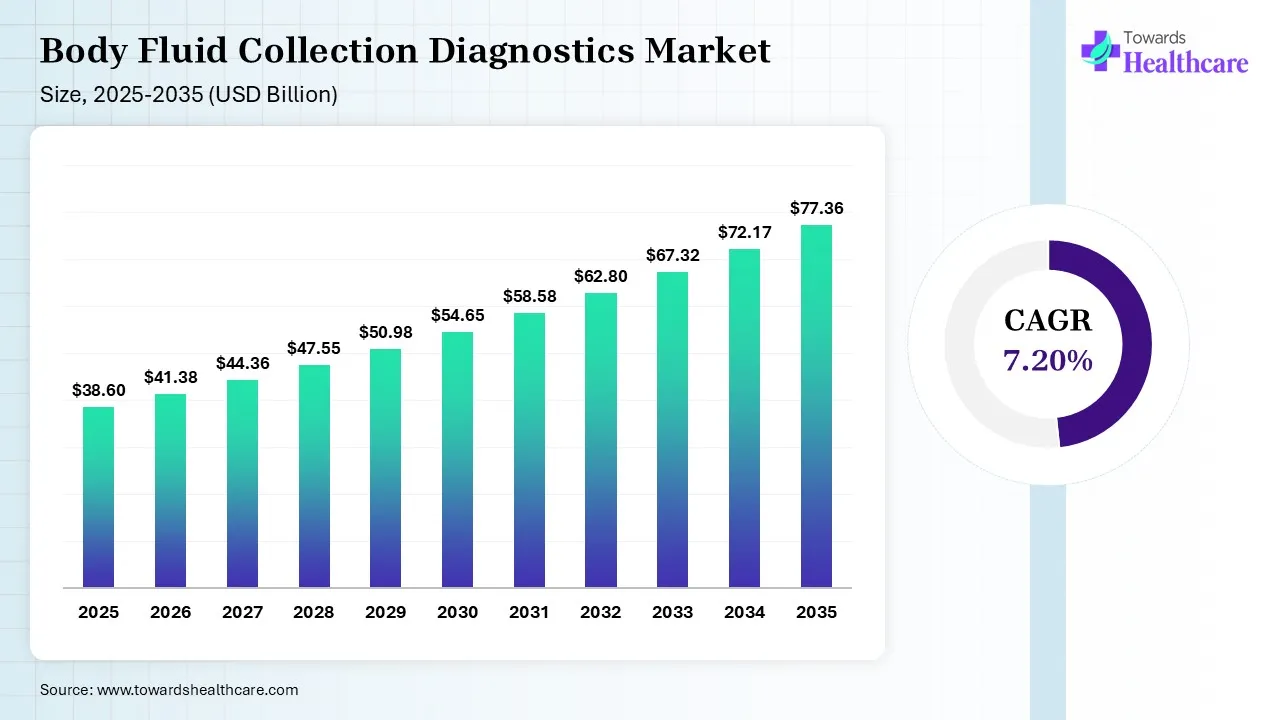
Market Size & Growth Outlook
Regional Market Spotlight
Segmental Spotlight
Sources: Expert interviews, secondary sources, Towards Healthcare database, and Towards Healthcare analysts.
Chronic diseases, cancer, and infectious disease tests will continue to expand as the population ages and more screenings take place. The use of non-invasive samples such as blood drawn from fingertips and saliva will make the testing process easier and extend it beyond hospitals. Testing for tumour DNA from a blood sample is now possible via liquid biopsy, making it easy to choose treatment plans without performing tissue biopsies. More retail pharmacies, urgent care facilities, and telemedicine companies have started offering testing services.
Payments for ordinary testing services are being squeezed, and payment for emerging genomic tests is inconsistent. Capillary and home collection samples may experience quality problems if not collected properly. New regulations like the EU IVD Regulation increase the time and costs associated with test development. Shortage of laboratory personnel and phlebotomists limits capacity. Privacy laws complicate remote collection procedures.
Capillary and home collection samples may benefit rural areas and be used in lieu of phlebotomist collection. Multi-cancer early screening tests on blood may create an enormous market opportunity. Saliva and urine tests can substitute blood in some cases. Automated sample processing and digital order placement can reduce costs. Growing lab capacity in Asia-Pacific and Latin America will provide volume opportunities.
| Segments | 2025 Share | 2025 Market Value |
| Blood | 58.60% | USD 22.62 billion |
| Urine | 21.40% | USD 8.26 billion |
| Saliva | 9.80% | USD 3.78 billion |
| Others | 5.60% | USD 2.16 billion |
| Cerebrospinal Fluid | 4.60% | USD 1.78 billion |
Sources: Expert interviews, secondary sources, Towards Healthcare database, and Towards Healthcare analysts.
The blood category had a share of 58.60% (USD 22.62 billion) due to its use in conducting routine chemical, haematological, infectious disease, hormonal, and oncology diagnostics, including liquid biopsy. The fingertip capillary sampling systems have been approved for conducting routine panels, and hence blood sample testing can be done at clinics and pharmacy laboratories without a phlebotomist. The urine sample has a share of 21.40% (USD 8.26 billion) because of its use in renal, urinary tract, drug, and cancer diagnostics. The saliva sample holds a market share of 9.80% (USD 3.78 billion) and is considered the most rapidly growing sample owing to its non-invasive nature and suitability for home diagnostics of genetic, hormonal, and infectious diseases.
| Segments | 2025 Share | 2025 Market Value |
| Tests & Services | 52.40% | USD 20.23 billion |
| Kits & Consumables | 33.80% | USD 13.05 billion |
| Instruments | 13.80% | USD 5.33 billion |
Sources: Expert interviews, secondary sources, Towards Healthcare database, and Towards Healthcare analysts.
The test and services segment had a market share of 52.40% (USD 20.23 billion) in 2025 since laboratories generate maximum income through testing and reporting of the tests. Specialty services like liquid biopsy and genetic testing command very high costs per test. The kits and consumables segment had a market share of 33.80% (USD 13.05 billion) and included collection tubes, swabs, capillary tubes, reagents, and assay kits, which are used during every test. Instruments have a market share of 13.80% (USD 5.33 billion).
| Segments | 2025 Share | 2025 Market Value |
| PCR | 34.60% | USD 13.36 billion |
| Others (Immunoassays, Clinical Chemistry) | 30.20% | USD 11.66 billion |
| NGS | 28.40% | USD 10.96 billion |
| FISH | 6.80% | USD 2.62 billion |
Sources: Expert interviews, secondary sources, Towards Healthcare database, and Towards Healthcare analysts.
The PCR technique contributed 34.60% (USD 13.36 billion) in 2025, utilized in infectious diseases and oncological mutation and genetic testing of blood, urine, and saliva samples. The immunoassay technique, clinical chemistry techniques, and others contributed 30.20% (USD 11.66 billion), comprising mostly routine testing. Next Generation Sequencing contributed to 28.40% (USD 10.96 billion) due to its rapid growth in the market, since liquid biopsy and comprehensive genomic profiling depend on sequencing of multiple genes at the same time. The FISH method contributes 6.80% (USD 2.62 billion).
| Segments | 2025 Share | 2025 Market Value |
| Diagnostics & Monitoring | 54.20% | USD 20.92 billion |
| Therapeutic Decision Making | 26.40% | USD 10.19 billion |
| Prognostics & Screening | 19.40% | USD 7.49 billion |
Sources: Expert interviews, secondary sources, Towards Healthcare database, and Towards Healthcare analysts.
Diagnostics and monitoring applications constituted 54.20% (USD 20.92 billion) in 2025, which includes the detection of diseases and continuous monitoring of chronic diseases and treatment response. Therapeutic decision-making constitutes 26.40% (USD 10.19 billion) of the total market value, and this segment is expected to be the fastest-growing segment due to genomic blood testing that helps in targeting cancer treatment. Prognostics and screening constitute 19.40% (USD 7.49 billion), which includes cancer screening, prenatal, and risk assessment tests.
Analyst View: Segmentation was done based on matching the volume of tests per sample, technology, and application with their respective average price, and also the addition of device/instrument sales of various products. Blood and tests/services dominate since the majority of revenue generated in diagnostics is through blood tests in laboratories. We expect saliva, NGS, and therapeutic decision-making to become dominant.
| Region | 2025 Share | 2025 Market Value |
| North America | 41.20% | USD 15.90 billion |
| Europe | 26.80% | USD 10.34 billion |
| Asia Pacific | 23.60% | USD 9.11 billion |
| Latin America | 4.60% | USD 1.78 billion |
| Middle East & Africa | 3.80% | USD 1.47 billion |
Sources: 2025 is the base year. Sources: Expert interviews, secondary sources, Towards Healthcare database, and Towards Healthcare analysts.
North America accounted for 41.20% (USD 15.90 billion) in 2025. High testing volumes and large reference laboratories drive revenue. Capillary and home blood collection services are expanding in pharmacies and clinics. Liquid biopsy adoption for cancer care is the most advanced worldwide.
Europe accounted for 26.80% (USD 10.34 billion) in 2025. Cancer screening programmes and centralised laboratories support demand. Molecular testing is growing in Germany, France and the UK. The EU IVD Regulation is raising quality requirements for tests.
Asia Pacific accounted for 23.60% (USD 9.11 billion) in 2025 and is the fastest-growing region. Laboratory networks are expanding in China and India. Rising cancer incidence and health insurance coverage are increasing testing. Japan and South Korea are early adopters of genomic tests.
Latin America accounted for 4.60% (USD 1.78 billion) in 2025. Private laboratory chains in Brazil and Mexico drive growth. Access to molecular tests is improving in urban centres.
The Middle East and Africa accounted for 3.80% (USD 1.47 billion) in 2025. Hospital and laboratory investment in the Gulf states supports demand. Infectious disease testing remains important in Africa.
Analyst View: Regional Shares have been estimated on the basis of test volumes, laboratory capabilities, test pricing per region, and sales of the equipment used. North America has a lead position owing to intense testing activity and reimbursement for genomic tests. The Asia Pacific region earns a substantial growth premium because of rapid developments in laboratory capabilities, insurance coverage, and molecular testing.
| Rank | Company Name | Market-Specific Revenue (USD Billion) | 2025 Share | Key Products / Business | Headquarters |
| 1 | Roche Diagnostics | 3.20 | 8.29% | Immunoassay, molecular and sequencing diagnostics | Switzerland |
| 2 | Thermo Fisher Scientific | 2.80 | 7.25% | PCR, NGS, collection and sample preparation products | United States |
| 3 | Labcorp | 2.60 | 6.74% | Reference laboratory testing services | United States |
| 4 | Quest Diagnostics | 2.40 | 6.22% | Reference laboratory testing services | United States |
| 5 | BD | 1.90 | 4.92% | Vacutainer and MiniDraw blood collection systems | United States |
| 6 | Abbott | 1.80 | 4.66% | Immunoassay and molecular diagnostics | United States |
| 7 | Illumina | 1.10 | 2.85% | Sequencing systems and assays | United States |
| 8 | QIAGEN | 0.90 | 2.33% | Sample collection, preparation and PCR testing | Netherlands |
| 9 | Guardant Health | 0.90 | 2.33% | Liquid biopsy tests | United States |
| 10 | Bio-Rad Laboratories | 0.70 | 1.81% | Diagnostics and digital PCR | United States |
Sources: Company press releases, expert interviews, secondary sources, Towards Healthcare database and Towards Healthcare analysts.
According to the statistics, the market leader in the diagnostics of body fluids was Roche Diagnostics, which was projected to capture 8.29% (USD 3.20 billion) of 2025 revenues, followed by Thermo Fisher Scientific (7.25% (USD 2.80 billion) and Labcorp (6.74% (USD 2.60 billion)). Roche leads with a strong presence in immunoassay and molecular analyzers and a wide range of tests for blood and other body fluids. Thermo Fisher Scientific offers a range of PCR and sequencing systems, collection products, and sample preparation systems. Labcorp and Quest Diagnostics are reference laboratory networks, dealing with millions of blood and urine tests annually, whereas BD is a leading player in blood collection equipment and developing capillary collection with MiniDraw. Specialized vendors, like Guardant Health, rapidly increase their market share in liquid biopsy. Top 10 players captured 47.41% (USD 18.30 billion) of 2025 revenues, whereas the remaining 52.59% (USD 20.30 billion) was shared by other laboratories, collection device manufacturers, assay providers, and genome testing companies. The body fluid diagnostics market is very fragmented by technology, assay/services, and competes on test menu width, accuracy, speed, convenience of sampling, and insurance coverage. Strategic collaborations between the device manufacturer and labs, such as capillary collection in retail locations, are gaining significance for tapping the outpatient population.
By Sample
By Product
By Technology
By Application
By Region
The body fluid collection diagnostics market is defined as collection devices, kits, consumables, instruments, and tests on blood, urine, saliva, cerebrospinal fluid, and other body fluids for diagnostic, monitoring, screening, and therapeutic decisions globally. The base year for 2025 was calculated based on a bottom-up methodology using test volume by sample type and technology, average cost per test, and price of devices, kits, and instruments, and a top-down approach using diagnostics and collection revenue of major laboratory, device, and assay manufacturers. Regional and company revenue was derived from sample types, products, technologies, applications and regional testing volumes. Important assumptions and numbers were cross-verified by comparing against company disclosures, regulations and industry sources, and third-party estimations and inputs that did not match were disregarded. All segments, regions and companies were reconciled to the 2025 base year, and the 2026-2035 forecast, which assumed constant CAGR on the 2025 base year, was revised.
Analyst View: Overall Market - There are several factors that drive the growing body fluid collection diagnostics market as diagnostics are moving closer to patients and becoming more molecularly-oriented for each sample. The forecast we present in this research takes into account volume, pricing, and device sales dynamics, therefore, it directly depends on the number of laboratory tests and implementation of capillary collection and liquid biopsy. The positive dynamics come from liquid biopsy, home/retail collection, and Asian growth, whereas the downside risks are related to price pressure and regulatory costs.