The centrifuge market is projected to grow from USD 2.46 billion in 2025 to USD 4.05 billion by 2035 because centrifuges are essential in nearly every clinical and research lab, and new labs and replacements drive steady demand. Diagnostic testing, research growth, bioprocessing, and replacement cycles support steady growth, lifting the market to USD 3.15 billion by 2030, and sustaining a CAGR of 5.10% from 2026 to 2035.
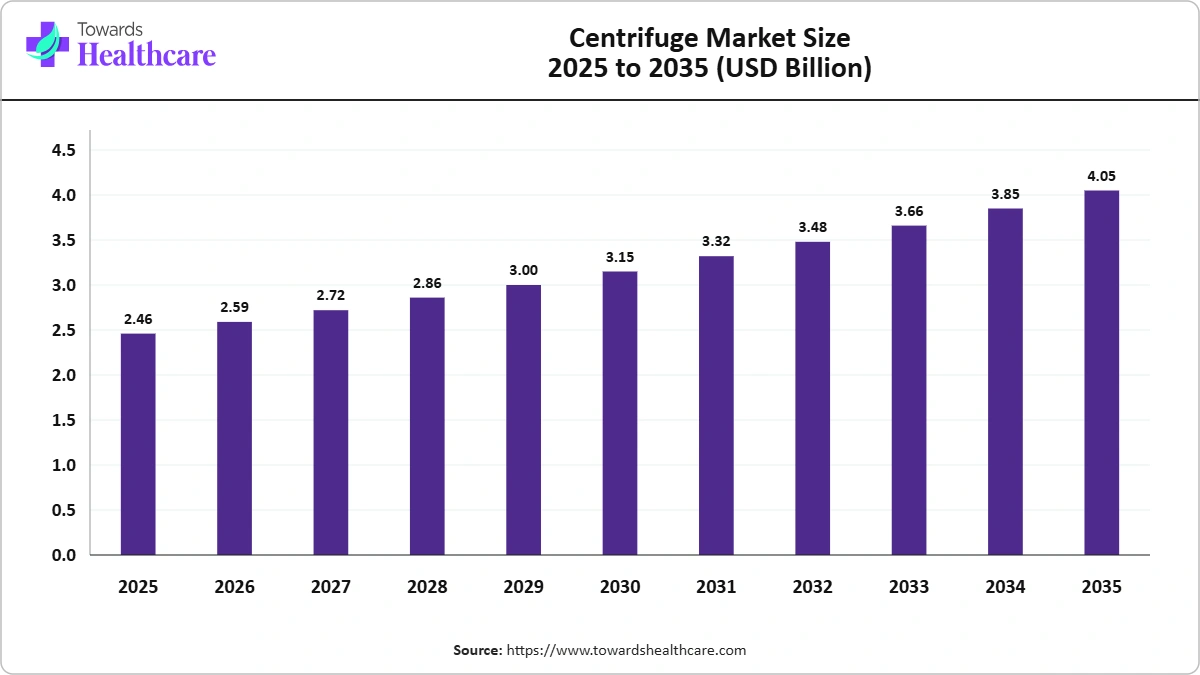
Analyst View: We built the estimate from centrifuge installed base, replacement cycles, new lab placements, and accessory spending by region, against centrifuge revenues of leading suppliers. Our value sits just above published comparable estimates.
| Driver | Impact | ≈ CAGR Contribution | Time Horizon | Key Regions |
| Diagnostic testing grows | High | +1.99 pp | Short to long term | Global, strongest in North America |
| Life science research expands | Medium | +1.68 pp | Medium to long term | Global, fastest uptake in Asia Pacific |
| Bioprocessing needs separation | Medium | +1.43 pp | Short to medium term | Global |
| Lab automation | Low | +1.12 pp | Long term | Developed and emerging markets |
Note: Contributions are indicative estimates of each factor's effect on annual growth.
Sources: Expert interviews, secondary sources, Towards Healthcare database and Towards Healthcare analysts.
Taken together, these drivers add about 6.22 percentage points to the annual growth of the centrifuge market, with diagnostic testing grows having the largest effect. Their influence is strongest in North America, while uptake grows fastest in Asia Pacific.
| Restraint | Impact | ≈ Negative CAGR Contribution | Time Horizon | Key Regions |
| Long product life | High | -0.50 pp | Short to medium term | Global |
| Budget limits | High | -0.37 pp | Medium term | Price-sensitive and emerging markets |
| Price competition from Asian makers | Medium | -0.25 pp | Short term | North America and other mature markets |
Note: Contributions are indicative estimates of each factor's effect on annual growth.
Sources: Expert interviews, secondary sources, Towards Healthcare database and Towards Healthcare analysts.
These restraints are expected to reduce annual growth of the centrifuge market by about 1.12 percentage points, led by long product life. Their effect eases over the forecast period as suppliers, buyers and regulators adapt, leaving a net CAGR of 5.10% from 2026 to 2035.
Growing gene therapy and viral vector manufacturing create demand for advanced ultracentrifuges. Sustainability initiatives, expanding Asian laboratory infrastructure, connected maintenance services, and rising demand for specialized rotors, tubes, and accessories offer additional growth opportunities.
Note: 2025 is the base year; 2035 shares and CAGRs are forecasts.
Sources: Expert interviews, secondary sources, Towards Healthcare database and Towards Healthcare analysts.
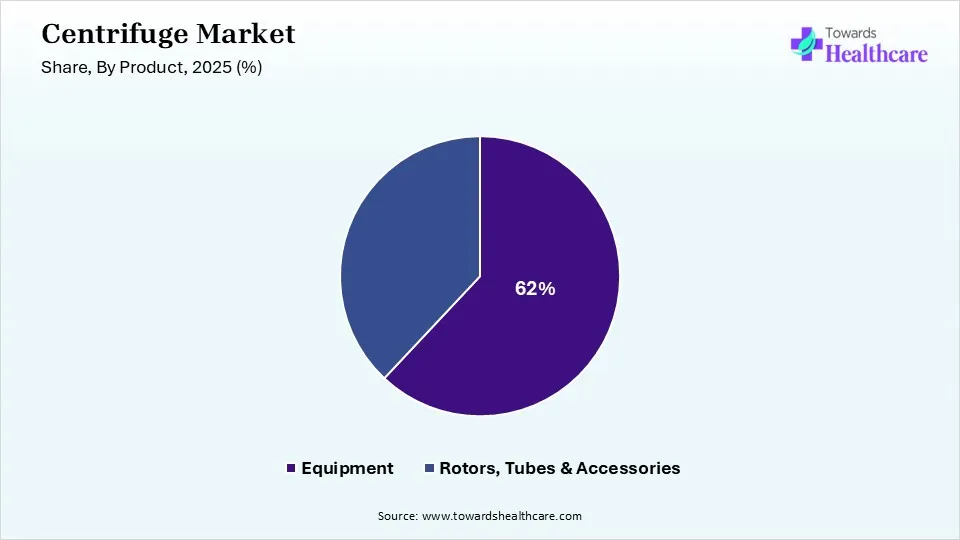
Equipment: The equipment segment dominated the centrifuge market with a 62.00% share in 2025 and is projected to grow at a CAGR of 4.55% from 2026 to 2035. Its leading position reflects laboratories' continued investment in centrifuges as essential instruments for sample preparation and separation. However, the segment is expected to grow slower than the overall market during the forecast period.
Rotors, Tubes & Accessories: Recurring replacement purchases, increasing laboratory testing volumes, and demand for application-specific accessories drive the growth of the segment. The segment is expected to outpace overall market growth during the forecast period.
Note: 2025 is the base year; 2035 shares and CAGRs are forecasts.
Sources: Expert interviews, secondary sources, Towards Healthcare database and Towards Healthcare analysts.
Benchtop Centrifuges: The benchtop centrifuges segment dominated the market with a 48.00% share in 2025 and is projected to grow at a CAGR of 4.58% throughout the forecast timeframe. Its leading position reflects widespread adoption across laboratories, where compact centrifuges serve as essential equipment for routine sample preparation and separation. However, the segment is expected to grow slower than the overall market during the forecast period.
Floor-Standing Centrifuges: Demand is supported by their ability to process larger sample volumes and handle high-throughput applications across hospitals, pharmaceutical companies, and research laboratories. The segment is expected to grow broadly in line with the overall market.
Micro & Mini Centrifuges: Their adoption is driven by increasing applications in molecular biology, genomics, and biotechnology research, where compact equipment supports small-volume sample processing. The segment is expected to grow broadly in line with the overall market during the forecast period.
Ultracentrifuges: Rising demand for gene therapy, vaccine development, viral vector purification, and exosome research is driving adoption of high-speed separation technologies. The segment is expected to outpace overall market growth during the forecast period.
Note: 2025 is the base year; 2035 shares and CAGRs are forecasts.
Sources: Expert interviews, secondary sources, Towards Healthcare database and Towards Healthcare analysts.
Diagnostics & Clinical: The diagnostics & clinical segment dominated the centrifuge market with a 36.00% share in 2025 and is projected to grow at a CAGR of 4.59% from 2026 to 2035. Its leading position reflects the widespread use of centrifuges in clinical laboratories for blood sample separation, diagnostic testing, and routine sample preparation. However, the segment is expected to grow slower than the overall market during the forecast period.
Molecular & Cell Biology: Growth is supported by the increasing use of centrifuges in DNA and RNA extraction, protein isolation, cell separation, and other routine molecular biology research activities. The segment is expected to grow broadly in line with the overall market.
Bioprocessing: Increasing biopharmaceutical production, cell harvesting requirements, and demand for viral vector purification are driving the adoption of advanced centrifugation systems. The segment is expected to outpace overall market growth during the forecast period.
Others: Category includes applications such as blood banking, microbiology, and other specialized laboratory procedures that require sample separation and processing. The segment is expected to grow broadly in line with the overall market during the forecast period.
Note: 2025 is the base year; 2035 shares and CAGRs are forecasts.
Sources: Expert interviews, secondary sources, Towards Healthcare database and Towards Healthcare analysts.
Hospitals & Diagnostic Labs: The hospitals & diagnostic labs segment dominated the centrifuge market with a 38.00% share in 2025 and is projected to grow at a CAGR of 4.50% from 2026 to 2035. Its leading position reflects high sample processing volumes and the routine use of centrifuges in clinical testing, blood analysis, and diagnostic procedures. However, the segment is expected to grow slower than the overall market during the forecast period.
Pharma & Biotech Companies: Increasing investments in drug discovery, biologics manufacturing, vaccine development, and gene therapy are driving demand for advanced centrifugation equipment. The segment is expected to outpace overall market growth during the forecast period.
Academic & Research Institutes: Demand is supported by growing investments in life science research, molecular biology, genomics, and cell-based studies, which require centrifuges for sample preparation and separation. The segment is expected to grow broadly in line with the overall market.
Blood Banks & Others: Growth is driven by the need for blood component separation, plasma processing, and specialized sample preparation across blood banks and other laboratory facilities. The segment is expected to grow broadly in line with the overall market during the forecast period.
Analyst View: Segment shares were allocated from demand, product portfolios and pricing in each category. Equipment, Benchtop Centrifuges, Diagnostics & Clinical and Hospitals & Diagnostic Labs lead their categories because they meet the core needs of today's buyers. We expect Rotors, Tubes & Accessories, Ultracentrifuges, Bioprocessing and Pharma & Biotech Companies to gain share as newer technologies, users and applications grow faster.
Note: 2025 is the base year; 2035 shares and CAGRs are forecasts.
Sources: Expert interviews, secondary sources, Towards Healthcare database and Towards Healthcare analysts.
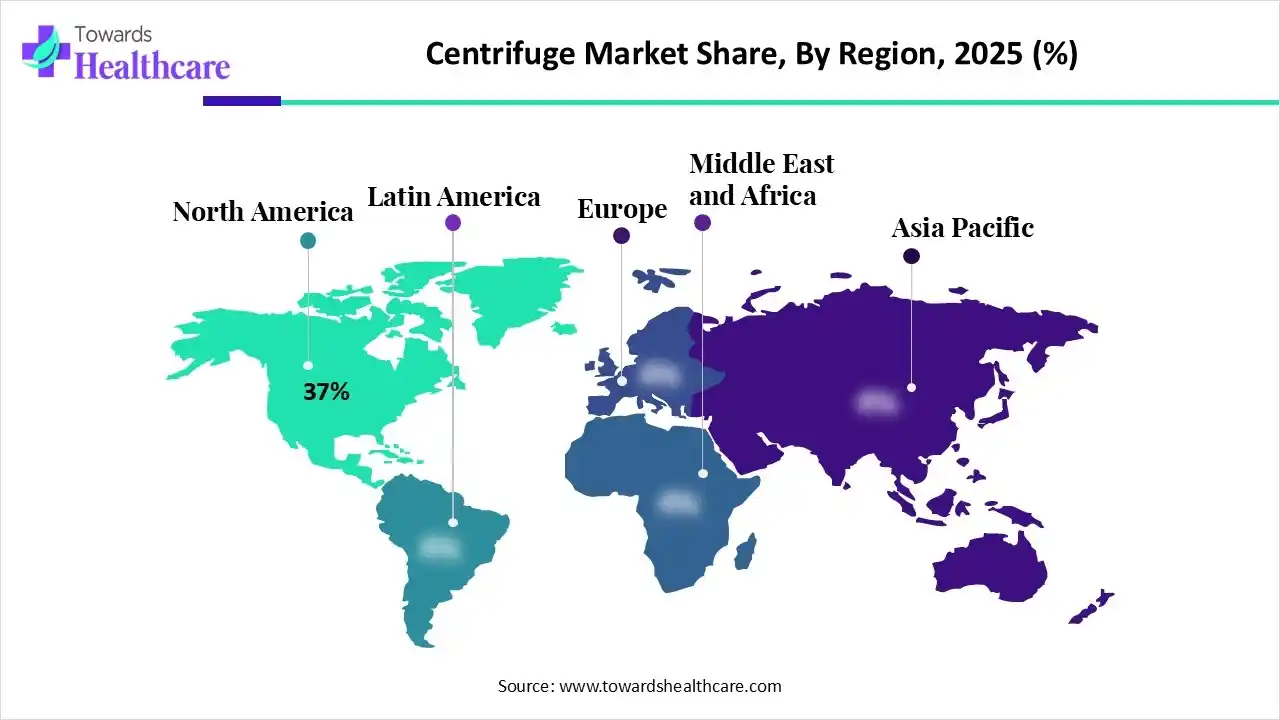
North America: North America dominated the centrifuge market with a 37.00% share in 2025 and is projected to grow at a CAGR of 4.52% throughout the forecast timeframe. Its leading position is supported by an extensive network of clinical laboratories, pharmaceutical companies, biotechnology firms, and research institutions that drive consistent demand for centrifugation equipment. However, the region is expected to grow slower than the overall market during the forecast period.
Europe: Regional growth is supported by the presence of established laboratory equipment manufacturers, advanced healthcare infrastructure, and strong pharmaceutical and academic research capabilities. The region is expected to grow broadly in line with the overall market during the forecast period.
Asia Pacific: Expanding laboratory infrastructure, rising healthcare investments, growing pharmaceutical manufacturing, and the presence of domestic equipment manufacturers in China and India are driving regional demand. The region is expected to outpace overall market growth during the forecast period.
Latin America: Growth is supported by expanding diagnostic laboratory networks, improving healthcare infrastructure, and increasing investments in pharmaceutical research and clinical testing. The region is expected to grow broadly in line with the overall market during the forecast period.
Middle East & Africa: Increasing investments in healthcare infrastructure, diagnostic capabilities, laboratory facilities, and pharmaceutical research are supporting demand for centrifugation equipment. The region is expected to grow broadly in line with the overall market during the forecast period.
Analyst View: Regional shares were built from demand, installed base, spending and supplier presence in each region. North America leads because of its mature demand base and strong suppliers. We assign Asia Pacific the highest growth premium because investment, adoption and capacity are expanding fastest there.
| Rank | Company Name | 2025 Share (%) | Key Products / Business | Headquarters |
| 1 | Thermo Fisher Scientific | 22.00% | Sorvall, Heraeus and M Series centrifuges | United States |
| 2 | Eppendorf | 16.00% | Benchtop and micro centrifuges | Germany |
| 3 | Beckman Coulter (Danaher) | 15.00% | Optima ultracentrifuges and Allegra centrifuges | United States |
| 4 | Andreas Hettich | 7.00% | Clinical and lab centrifuges | Germany |
| 5 | Sigma Laborzentrifugen | 4.00% | Lab centrifuges | Germany |
| 6 | Eppendorf Himac | 4.00% | Ultracentrifuges | Japan |
| 7 | Kubota | 3.00% | Lab centrifuges | Japan |
| 8 | HERMLE Labortechnik | 2.00% | Lab centrifuges | Germany |
| 9 | Corning | 2.00% | Mini centrifuges and tubes | United States |
| 10 | Drucker Diagnostics | 1.00% | Clinical centrifuges | United States |
Note: Company shares are 2025 estimates.
Sources: Company press releases, expert interviews, secondary sources, Towards Healthcare database and Towards Healthcare analysts.
Thermo Fisher Scientific led the centrifuge market with an estimated 22.00% share of 2025 revenue, followed by Eppendorf at 16.00% share and Beckman Coulter (Danaher) at 15.00% share. Thermo Fisher Scientific leads with sorvall, Heraeus and M Series centrifuges, Eppendorf competes with benchtop and micro centrifuges, and Beckman Coulter (Danaher) offers optima ultracentrifuges and Allegra centrifuges. Andreas Hettich, Sigma Laborzentrifugen, Eppendorf Himac, Kubota, HERMLE Labortechnik, Corning and Drucker Diagnostics compete through clinical and lab centrifuges, lab centrifuges, ultracentrifuges, lab centrifuges, lab centrifuges, mini centrifuges and tubes and clinical centrifuges.
The top 10 companies accounted for an estimated 76.02% of 2025 revenue, while the remaining 23.98% was shared among many regional makers in China and India. The centrifuge market is moderately concentrated, and competition targets speed and capacity, rotor range, safety and biocontainment, energy efficiency, service networks, and price.
Thermo Fisher Scientific: Headquartered in the United States, Thermo Fisher Scientific commanded an estimated 22.00% share of the centrifuge market in 2025. The company offers a broad centrifuge portfolio under its Sorvall, Heraeus, and M Series product lines. Towards Healthcare positions the company as a Leader in its Companies Quadrant.
Eppendorf: Based in Germany, Eppendorf captured an estimated 16.00% market share in 2025. Its centrifuge portfolio primarily includes benchtop and micro centrifuges designed for routine laboratory and research applications. The company is classified as a Leader in the Towards Healthcare Companies Quadrant.
Beckman Coulter (Danaher): Operating from the United States, Beckman Coulter, a Danaher company, secured an estimated 15.00% share of the global centrifuge market in 2025. Its product portfolio features Optima ultracentrifuges and Allegra centrifuges, catering to advanced research and laboratory requirements. Towards Healthcare categorizes the company as a Leader.
Andreas Hettich: Germany-based Andreas Hettich accounted for an estimated 7.00% of the centrifuge market in 2025. The company specializes in clinical and laboratory centrifuges that support diverse sample preparation and separation applications. It holds a Leader position in the Towards Healthcare Companies Quadrant.
Sigma Laborzentrifugen: With its headquarters in Germany, Sigma Laborzentrifugen represented approximately 4.00% of the market in 2025. Its product range focuses on laboratory centrifuges serving research, clinical, and industrial applications. The company is positioned as a Leader in the Towards Healthcare Companies Quadrant.
Eppendorf Himac: Headquartered in Japan, Eppendorf Himac maintained an estimated 4.00% market share in 2025. Its portfolio focuses on ultracentrifuges designed for high-speed separation and specialized research applications. Towards Healthcare identifies the company as a Leader in its Companies Quadrant.
Kubota: Japan-based Kubota held an estimated 3.00% share of the centrifuge market in 2025. Its offerings include laboratory centrifuges developed for clinical, research, and biotechnology applications. The company occupies an Innovator position in the Towards Healthcare Companies Quadrant.
HERMLE Labortechnik: Headquartered in Germany, HERMLE Labortechnik represented approximately 2.00% of the global centrifuge market in 2025. The company provides laboratory centrifuges for research institutions, clinical laboratories, and industrial applications. Towards Healthcare classifies it as an Innovator.
Corning: The United States-based Corning captured an estimated 2.00% market share in 2025. Its centrifuge-related portfolio includes mini centrifuges and tubes that support routine laboratory procedures and sample handling. The company is positioned as an Innovator in the Towards Healthcare Companies Quadrant.
Drucker Diagnostics: Based in the United States, Drucker Diagnostics accounted for an estimated 1.00% of the centrifuge market in 2025. Its product portfolio focuses on clinical centrifuges designed for diagnostic laboratories and healthcare facilities. Towards Healthcare places the company in the Innovator category of its Companies Quadrant.
The centrifuge ecosystem links component suppliers, centrifuge makers, distributors, users and standards & regulators, with each stage adding value before products reach end users.
| Ecosystem Stage | Role in the Market | Key Companies |
| Component Suppliers | Supply motors, rotors and refrigeration | Precision component makers |
| Centrifuge Makers | Design and make centrifuges | Thermo Fisher, Eppendorf, Beckman Coulter, Hettich |
| Distributors | Sell to labs | Fisher Scientific, Avantor, regional dealers |
| Users | Spin samples | Hospitals, pharma, universities, blood banks |
| Standards & Regulators | Set safety and refrigerant rules | IEC, EPA, EU F-gas rules |
Sources: Company press releases, expert interviews, secondary sources, Towards Healthcare database and Towards Healthcare analysts.
Component Suppliers: Supply motors, rotors and refrigeration. Key participants include Precision component makers.
Centrifuge Makers: Design and make centrifuges. Key participants include Thermo Fisher, Eppendorf, Beckman Coulter, Hettich.
Distributors: Sell to labs. Key participants include Fisher Scientific, Avantor, regional dealers.
Users: Spin samples. Key participants include Hospitals, pharma, universities, blood banks.
Standards & Regulators: Set safety and refrigerant rules. Key participants include IEC, EPA, EU F-gas rules.
Value in the centrifuge market flows from upstream material and technology suppliers to manufacturers and service providers, then through distribution partners to end users. Companies that integrate several stages or build long-term relationships with end users capture a larger share of this value.
The Towards Healthcare Companies Quadrant evaluates key participants in the centrifuge market based on their overall market strength, including revenue scale, market share, and geographic reach. It also assesses innovation and growth strategies by considering product portfolio breadth, R&D intensity, and strategic partnerships. Positions reflect each company's estimated 2025 share of the centrifuge market and our assessment of its product innovation, portfolio breadth, and partnerships.
Sources: Company press releases, expert interviews, secondary sources, Towards Healthcare database and Towards Healthcare analysts.
Leaders: Thermo Fisher Scientific, Eppendorf, Beckman Coulter (Danaher), Andreas Hettich, Sigma Laborzentrifugen and Eppendorf Himac combine high market share with broad portfolios and strong innovation.
Innovators: Kubota, HERMLE Labortechnik, Corning and Drucker Diagnostics bring newer technologies and specialized products.
By Product
By Type
By Application
By End User
By Region
The centrifuge market was defined as laboratory and clinical centrifuges and related products, including benchtop, floor-standing, micro and mini centrifuges and ultracentrifuges, with rotors, tubes and accessories, refrigerated and non-refrigerated, used for sample preparation, cell and blood separation, molecular biology, diagnostics and bioprocessing by hospitals and diagnostic labs, pharmaceutical and biotechnology companies, academic and research institutes, and blood banks. The 2025 base-year market size was estimated using demand volumes and average selling prices across product, type, application, end-user, and regional segments. The estimates were further validated against market-specific revenues reported by leading companies and published industry data to ensure consistency and reliability. Segment, regional, and company values were allocated from product, type, application, and end user and region demand.
Key estimates were verified by cross-checking company disclosures, regulatory and industry data and published third-party estimates, and inputs that could not be reconciled were excluded. All segment, regional and company figures were reconciled to the same 2025 base year, and the 2026-2035 forecast, which applies a constant CAGR from the 2025 base, was recalculated and validated.
Analyst View: The centrifuge market is set for steady expansion as diagnostic testing and related demand keep growing. Our estimate links value to underlying demand, installed base, and pricing, so the forecast follows real adoption rather than headline hype. The main upside comes from gene therapy, ultracentrifugation, and sustainable models, while the main risks are long product life and budget limits.