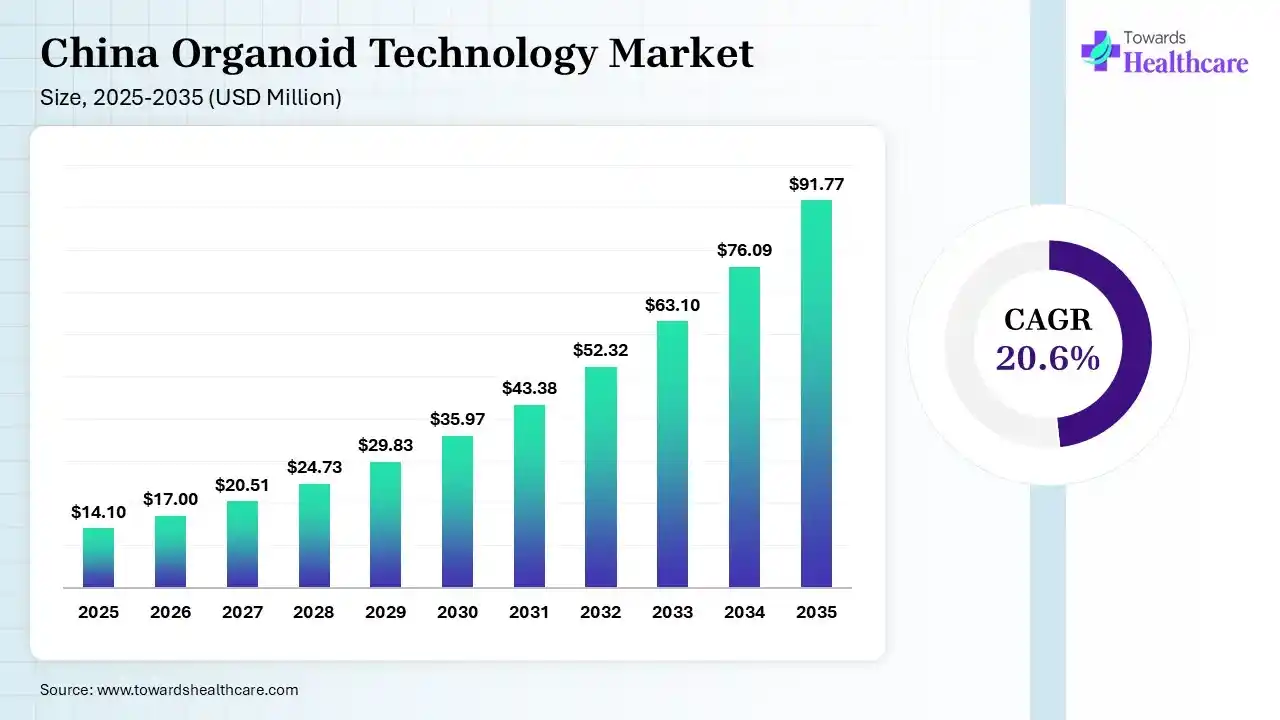
China's organoids technology market is anticipated to increase from USD 17 million in 2026 to around USD 91.77 million by 2035, expanding at a CAGR of 20.6% during 2026-2035, driven by growing adoption of 3D cell culture models in drug discovery, preclinical research, and precision medicine.
Organoid technology refers to three-dimensional cell-culture systems that self-organize from stem cells, progenitor cells, or patient-derived tissue to reproduce selected structural, cellular, and functional characteristics of human organs or tissues. The technology is increasingly being used in drug discovery, toxicity testing, disease modeling, precision medicine, regenerative medicine, and biomedical research. The China Organoid Technology Market covers the development, production, and application of three-dimensional, stem-cell-derived or tissue-derived models that reproduce selected structural and functional characteristics of human organs. China's market is expanding rapidly alongside investment in stem-cell research, biotechnology, precision medicine, and advanced drug-development platforms.
China's opportunity is increasingly shifting from research-grade organoid generation toward standardized, scalable and commercially reproducible platforms. The most attractive opportunities are likely to emerge around patient-derived tumor organoids, pharmaceutical screening, automated organoid production, organoid biobanks and AI-enabled analysis. The market is gradually moving from selling individual organoid models toward selling integrated workflows. Suppliers able to combine culture media, model generation, automation, imaging, sequencing, screening and data analysis can capture more value than companies focused on one laboratory consumable.
China's organoid technology market is an emerging segment of the broader life-sciences and biotechnology industry supported by increasing investment in stem-cell research, drug discovery, precision medicine, and advanced in vitro models. Organoids are three-dimensional cellular structures that reproduce selected architectural and functional characteristics of human organs. Their ability to better represent human biology than many conventional two-dimensional cell cultures has increased interest among pharmaceutical companies, biotechnology companies, hospitals, and academic research institutions.
Organoids represented the largest type segment in 2025; because of their wider use in drug discovery, disease modeling, toxicity testing, and personalized medicine, where they provide a more physiologically relevant model than conventional 2D cell cultures.
The market's high projected growth reflects the increasing use of organoids beyond basic academic research. Pharmaceutical companies are increasingly interested in organoids for drug efficacy testing, toxicity assessment, disease modeling, and patient-specific drug-response studies. In particular, patient-derived organoids can preserve some characteristics of an individual's tumor or tissue, creating opportunities for more personalized research and treatment-development approaches.
China's large pharmaceutical and biotechnology sector provides an important demand base. The country has a substantial pipeline of innovative drugs, particularly in oncology, immunology, and other therapeutic areas where conventional preclinical models may not fully capture human disease biology. Organoids can therefore become an additional tool within pharmaceutical R&D workflows.
Growth is also expected from technological improvements. Standardized culture systems, automated platforms, improved growth media, cryopreservation, and high-throughput screening are making organoid research more scalable. Integration with organ-on-chip technologies, artificial intelligence, imaging, and single-cell sequencing could further increase the commercial value of organoid platforms.
Another important market opportunity is the transition from research-use-only products toward commercial services and clinical applications. Companies can generate revenue through organoid culture kits, culture media, bioreagents, ready-to-use organoids, contract research services, biobanking, and customized drug-screening programs.
However, market expansion will depend on overcoming several challenges, including high production costs, biological variability, lack of standardized protocols, and limited clinical validation. Ethical requirements for human-derived materials may also influence research practices.
China's organoid technology competitive landscape is developing across several categories, including biotechnology companies, pharmaceutical companies, contract research organizations (CROs), and specialized organoid-platform providers. Competition is not limited to finished products. Companies compete across organoid culture systems, cell sources, culture media, extracellular matrices, biobanks, screening platforms, analytical technologies, and research services.
A key competitive trend is the emergence of companies offering patient-derived organoids (PDOs) and tumor-organoid platforms. These models can preserve important characteristics of patient tumors and are being investigated for drug screening, disease modeling, and precision oncology. Recent research has highlighted the potential of tumor organoids to retain tumor heterogeneity and patient-specific molecular characteristics, creating opportunities for pharmaceutical research and personalized treatment development.
Competition is also increasing around organoid standardization and scalability. Pharmaceutical customers require models that can be reproduced across experiments and laboratories. Consequently, suppliers with standardized protocols, quality-controlled cell sources, validated culture media, and automated production capabilities can differentiate their offerings.
Another competitive dimension is technological integration. Companies combining organoids with organ-on-chip systems, AI-based imaging, CRISPR gene editing, single-cell sequencing and multi-omics analysis can offer more comprehensive research platforms. These integrated approaches may be particularly attractive to pharmaceutical companies seeking higher-throughput and more predictive preclinical models.
AimingMed is focused specifically on organoid technology and reports products spanning human cancer organoid kits, normal-tissue organoids, hPSC-derived organoids, mouse models, reagents, and automation equipment. Its services include model establishment, characterization, tumor-organoid drug sensitivity testing, and single-cell sequencing. The company states that it has served more than 1,000 pharmaceutical companies, hospitals, and research institutions globally and operates facilities in Hangzhou, Chengdu, and Yantai, alongside an advanced manufacturing center in Guangzhou.
Shanghai Biochip is important in the automation and standardization layer. In 2025, it introduced an automated organoid production system and helped establish an Intelligent Organoid Innovation and Industry Alliance and an Organoid and Organ-on-Chip Innovation Center.
Crown Bioscience operates organoid screening capabilities in China through its OrganoidXplore platform. Its current platform provides access to 250+ characterized models, covering multiple cancer types, with screening results available in approximately six weeks. Its China platform demonstrates the movement of organoids into large-panel pharmaceutical screening.
China's academic and research ecosystem is also an important competitive force. Universities and research institutes contribute new organoid models, protocols, and disease applications, while commercial companies increasingly seek partnerships to convert academic discoveries into scalable products.
The competitive landscape is therefore shifting from selling individual organoid models toward providing complete organoid technology platforms. These platforms can include tissue acquisition, organoid development, biobanking, screening, sequencing, data analysis, and customized research services.
The market is therefore not simply a competition between organoid-model providers. The larger strategic contest is over workflow ownership, model libraries, clinical data, automation and pharmaceutical customer relationships.
Over the longer term, competitive advantage is likely to depend on reproducibility, scalability, clinical relevance, intellectual property, data resources and integration with pharmaceutical workflows. Companies that can demonstrate that their organoid models generate reliable and commercially useful results may be better positioned to build long-term relationships with pharmaceutical companies and research organizations.
China's organoid technology market can be segmented according to organoid type, application, technology, customer type, business model, and therapeutic area. Understanding these segments is important because organoids are used across several different stages of biomedical research, and each customer group has different requirements.
By organoid type, major categories include intestinal, liver, brain, kidney, lung, gastric, pancreatic, and other organoids. Tumor organoids represent an especially important commercial opportunity because they can be generated from patient tumor samples and used for oncology research, drug screening, and treatment-response studies.
By application, the market includes drug discovery, drug toxicity testing, disease modeling, developmental biology, regenerative medicine and precision medicine. Drug discovery is a major commercial application because pharmaceutical companies can use organoids to evaluate candidate compounds before or alongside traditional preclinical models. Toxicity testing is another important application because organoids may provide more human-relevant information than conventional two-dimensional cell cultures for certain research questions.
Pharmaceutical companies are among the most important commercial customers. They can use organoids for target validation, compound screening, efficacy testing, toxicity assessment, and biomarker development. Large pharmaceutical companies may also establish internal organoid platforms or collaborate with specialized organoid companies.
Biotechnology companies and contract research organizations (CROs) represent another important segment. These organizations can provide organoid development, screening, and testing as services to pharmaceutical companies, creating an outsourcing-based business model.
Academic and government research institutions are significant users of organoid technology for developmental biology, disease mechanisms, stem-cell research, and basic biomedical research. Chinese universities and research institutes are important contributors to organoid technology development.
Hospitals and medical centers represent a growing customer segment, particularly in oncology. Hospitals can provide patient tissue for the creation of patient-derived organoids and potentially use organoid-based testing to investigate treatment responses.
Another emerging customer group is precision-medicine providers. Patient-derived organoids can potentially be integrated into personalized treatment workflows, although broader clinical adoption requires additional validation and regulatory development.
The market can also be divided by business model. Suppliers may sell ready-to-use organoids, culture media, extracellular matrices, growth factors, and equipment. Specialized companies can provide organoid development and screening services, while others can operate biobanks or offer customized research programs.
Geographically, demand is likely to be concentrated initially in China's major biotechnology and pharmaceutical hubs, including Beijing, Shanghai, Guangdong, Jiangsu and Zhejiang, where pharmaceutical R&D, academic research and biotechnology infrastructure are relatively developed.
Customer requirements vary considerably. Pharmaceutical companies generally prioritize reproducibility, scalability, throughput and regulatory-quality data, while academic researchers may prioritize flexibility and model diversity. Hospitals require clinical relevance and standardized protocols.
Technology and innovation represent the core of China's organoid market because the commercial value of organoids depends heavily on their ability to reproduce relevant aspects of human tissue biology consistently and at scale. The technology landscape encompasses stem-cell biology, three-dimensional culture systems, patient-derived organoids, organoid-on-chip platforms, bioprinting, automation, artificial intelligence, and multi-omics analysis.
One of the major technological categories is adult stem-cell-derived organoids. These organoids are generated from tissue-specific stem cells and can reproduce characteristics of organs such as the intestine, liver, stomach, and pancreas. Another important approach uses induced pluripotent stem cells (iPSCs). iPSC-derived organoids can be differentiated into complex tissue models and are particularly relevant to research involving the brain, heart, kidney, and developmental biology.
Patient-derived organoids (PDOs) represent another major innovation area. Tissue obtained from patients can be cultured into three-dimensional models that retain selected characteristics of the original tissue or tumor. In oncology, these models are being investigated for drug-response testing, resistance studies, and biomarker research. Chinese research has increasingly focused on developing patient-derived organoid models for different cancers and evaluating their potential in personalized medicine.
Another rapidly developing technology is organoid-on-chip. These systems combine organoids with microfluidic platforms to reproduce aspects of tissue environments, fluid flow, and interactions between different cell types. The technology could improve physiological relevance and create more sophisticated platforms for drug testing.
High-throughput organoid screening is particularly important for pharmaceutical applications. Traditional organoid culture can be labor-intensive and difficult to standardize. Automation, robotic liquid handling, standardized matrices, and advanced imaging can make large-scale screening more practical.
Artificial intelligence is another emerging area. AI and machine-learning systems can analyze organoid morphology, growth patterns, treatment responses, and imaging data. This could help researchers identify subtle drug-response differences and improve the reproducibility of organoid experiments.
Regulatory and ethical considerations are becoming increasingly important as organoid technology moves from basic research toward pharmaceutical development and potential clinical applications. China's framework is particularly significant because organoid research may involve human stem cells, patient-derived tissues, brain organoids, embryo models, chimeras, and human biological materials.
A major development occurred in April 2025, when China's National Science and Technology Ethics Committee's Life Science Ethics Subcommittee issued the Human Organoid Research Ethical Guidelines. The Ministry of Science and Technology published the guidelines in May 2025. They establish principles including beneficence, risk control, respect for autonomy, scientific necessity, and fairness and justice.
The guidelines are particularly relevant to research involving brain organoids, human stem-cell embryo models and human–non-human animal chimeras, which have greater ethical sensitivity. For certain research categories, institutions are expected to apply enhanced ethical review and specialist oversight. The guidelines also prohibit implantation of human stem-cell embryo models into human or animal uteruses.
Another important issue is the use of patient-derived biological materials. Researchers must address informed consent, donor autonomy, privacy, and appropriate management of biological samples and associated data. These considerations become particularly important when organoids are stored in biobanks or used for commercial drug-development programs.
Therefore, China's regulatory environment is likely to evolve alongside technological development. The establishment of ethical guidance provides a framework for responsible research, while future commercialization will require greater standardization and validation.
For market participants, compliance is becoming a competitive consideration. Companies with strong sample-consent procedures, data governance, quality systems, ethical oversight, and reproducible protocols will be better positioned as organoid research moves closer to clinical and pharmaceutical applications.
Organoid technology is becoming an important tool in pharmaceutical research because it can provide three-dimensional human-tissue models that reproduce selected structural and functional characteristics of organs. These models can complement conventional two-dimensional cell cultures and animal models, particularly in areas where human tissue biology is difficult to reproduce using simpler systems.
One of the most important applications is drug screening. Researchers can expose organoids to different compounds and evaluate changes in cell viability, morphology, molecular pathways, and tissue function. This allows pharmaceutical companies to screen potential drug candidates before advancing them into more expensive development stages.
Organoids are particularly valuable in oncology research. Patient-derived tumor organoids can retain aspects of tumor architecture, heterogeneity, and molecular characteristics. They can therefore be used to investigate drug sensitivity, resistance mechanisms, and combinations of therapies. Recent research describes tumor organoids as useful models for bridging conventional 2D cultures and more complex in vivo systems.
However, organoids are not complete replicas of human organs. Many models lack mature vascular, immune, nervous, or stromal components. Consequently, organoid data generally need to be interpreted alongside other experimental evidence.
For China, the opportunity is particularly significant because of the country's large pharmaceutical R&D ecosystem. Pharmaceutical companies and CROs can potentially use organoids to improve candidate selection, understand mechanisms of action, and generate more human-relevant preclinical data.
Overall, organoids are moving from a specialized research technique toward a pharmaceutical research platform, with the greatest commercial opportunities likely to arise in oncology, toxicity testing, disease modeling, and personalized drug-response research.
Organoid technology has significant potential in China's precision-medicine market because it can create patient-specific biological models that allow researchers to investigate how an individual's tissue or tumor responds to different treatments. This is particularly relevant to oncology, where patients with the same cancer diagnosis can respond differently to the same therapy.
The most important model is the patient-derived organoid (PDO). A tissue sample obtained from a patient can be cultured into a three-dimensional organoid that retains selected characteristics of the original tissue. Researchers can then expose the organoid to different drugs or drug combinations and compare responses.
In cancer research, PDOs are being studied for drug sensitivity testing, resistance analysis, biomarker discovery, and treatment-response prediction. Recent literature describes patient-derived tumor organoids as models that can preserve aspects of tumor heterogeneity and patient-specific molecular characteristics.
China's large oncology patient population and expanding precision-medicine infrastructure create an important potential market. Hospitals can potentially collaborate with organoid companies to collect tissue, establish patient-specific models, and conduct research on treatment responses.
Another emerging area is combining organoids with CRISPR screening. Researchers can manipulate specific genes and observe how those changes affect drug sensitivity or disease progression. This creates opportunities for identifying therapeutic targets and understanding treatment resistance.
However, widespread clinical use still faces challenges. Establishing organoids can require substantial time, specialized expertise, and tissue samples. Not every patient sample will necessarily generate a usable organoid, and the model may not reproduce every component of the patient's tumor microenvironment.
Clinical validation is therefore essential before organoid-based treatment selection becomes routine. Standardized protocols, reproducibility, and evidence demonstrating that organoid drug-response results correlate with patient outcomes will be important.
The organoid technology supply chain consists of several interconnected components, beginning with human or animal biological materials and stem-cell sources and extending through culture reagents, matrices, equipment, organoid production, biobanking, analytical technologies, and end-user applications.
The first stage involves obtaining appropriate cells or tissues. These may include adult stem cells, induced pluripotent stem cells (iPSCs), primary tissue samples or patient tumor samples. For patient-derived organoids, ethical collection, informed consent, and appropriate sample handling are essential.
The next stage includes specialized culture media, growth factors, extracellular matrices, and laboratory consumables. These materials influence organoid growth, morphology, and reproducibility. Variability in reagents can contribute to differences between laboratories.
Manufacturing challenges include maintaining cell identity, genetic stability, morphology, functionality, and batch-to-batch consistency. Organoids can also vary considerably depending on tissue source and culture conditions.
Another challenge is scalability. A research laboratory may successfully produce dozens of organoids, but pharmaceutical applications can require thousands or millions of standardized models. This creates demand for automated culture and quality-control systems.
The supply chain is therefore likely to become increasingly specialized. Some companies may focus on biological materials, others on reagents and matrices, while specialized providers produce organoids or offer screening services.
Over the longer term, commercial success will depend on creating a standardized, scalable, and quality-controlled manufacturing ecosystem. Companies that can reliably produce consistent organoids at pharmaceutical scale could become important suppliers to drug developers, CROs, and hospitals.
China's organoid technology market is expected to be concentrated initially in major biotechnology, pharmaceutical, academic, and healthcare clusters. Organoid research requires advanced laboratories, stem-cell expertise, tissue resources, sequencing infrastructure, and pharmaceutical research capabilities, making large scientific and medical centers particularly important.
Beijing is a major research hub because of its concentration of universities, national research institutions, hospitals, and biotechnology organizations. Its strong biomedical research ecosystem supports organoid development, disease modeling, and pharmaceutical applications.
Shanghai is another important center. The city has a large pharmaceutical and biotechnology industry and advanced hospitals and research institutions. Shanghai has also identified organoid-related technologies among areas of biomedical innovation. Recent municipal initiatives have included support for digestive-system tumor organoid models and brain organoid research.
Guangdong and Shenzhen represent another major cluster because of their biotechnology, pharmaceutical, and medical-device ecosystems. Their strong private-sector research base creates opportunities for commercial organoid platforms, CRO services, and precision-medicine applications.
Jiangsu and Zhejiang are also important because they combine pharmaceutical manufacturing, biotechnology companies, hospitals, and research institutions. Cities such as Suzhou have developed substantial life-science ecosystems that can support organoid commercialization.
The market may therefore develop through regional clusters rather than uniformly across China. Leading cities can function as organoid innovation hubs, while hospitals and pharmaceutical companies in surrounding regions become customers or partners.
Another important regional consideration is access to patient-derived samples. Major cancer centers can provide large numbers of tissue samples, making them valuable partners for tumor-organoid research and biobanking.
Over time, improvements in cryopreservation, standardized production, and digital data management could make organoid resources easier to distribute nationally.
Overall, China's organoid industry is likely to remain concentrated in Beijing, Shanghai, Guangdong, Jiangsu and Zhejiang during the early commercialization phase. As technology becomes standardized and costs decline, adoption can expand to additional hospitals, pharmaceutical companies, and research institutions across the country.
Investment and partnerships are important to China's organoid technology market because commercializing organoids requires expertise from multiple fields, including stem-cell biology, tissue engineering, pharmaceutical development, bioinformatics, AI, clinical medicine, and biotechnology manufacturing.
Investment is coming through several channels. Biotechnology companies are developing organoid platforms, while pharmaceutical companies are exploring organoid-based screening and disease models. Academic institutions contribute basic research and intellectual property, creating opportunities for commercialization through licensing and spin-off companies.
One of the most important partnership models is pharmaceutical company + organoid technology provider. Pharmaceutical companies can use organoid platforms for compound screening, toxicity testing, and disease modeling without having to establish every capability internally.
A second model is hospital + organoid company. Hospitals can provide patient tissue and clinical information, while organoid companies provide laboratory expertise. Such collaborations are particularly relevant to patient-derived tumor organoids and precision oncology.
A third model is academic institution + biotechnology company. Universities and research institutes often develop new organoid models, while commercial companies provide manufacturing, standardization, and commercialization capabilities.
Investment is also increasingly directed toward organoid biobanks and standardized resources. The Chinese Academy of Sciences has emphasized the strategic importance of organoid resource banks for standardization, industrialization, and the development of domestic biological resources.
Partnerships will be especially important for clinical translation because organoid companies need access to patient samples and clinical outcomes to validate their models.
The investment landscape is therefore moving beyond basic research funding toward commercial platforms and integrated service models. Companies that can combine proprietary technology, high-quality biological resources, pharmaceutical partnerships, and scalable manufacturing may be positioned to capture a larger share of the emerging market.
Several factors are driving the development of China's organoid technology market, with the strongest being growth in pharmaceutical R&D, demand for human-relevant preclinical models, expansion of precision medicine, advances in stem-cell research, and increasing interest in reducing dependence on conventional experimental models.
Pharmaceutical companies are increasingly interested in models that can better reproduce aspects of human biology. Organoids provide three-dimensional tissue environments and can be used for disease modeling, drug screening, and toxicity research. Reviews published in 2025 highlight their expanding applications in drug development and precision medicine.
The growth of oncology research is another important driver. Patient-derived tumor organoids can provide models for studying tumor heterogeneity, drug sensitivity, and resistance. This creates opportunities for both pharmaceutical research and precision oncology.
Technological convergence is also accelerating the market. Integration with AI, CRISPR, multi-omics, organ-on-chip systems, and advanced imaging can increase the information obtained from organoid models.
China's evolving regulatory and ethical environment can also support more structured development. The 2025 Human Organoid Research Ethical Guidelines provide principles for responsible research involving human organoids.
However, significant restraints remain. The first is lack of standardization. Different laboratories can produce organoids with different characteristics, limiting reproducibility. Second, organoids often lack complete tissue complexity, including mature vascular, immune, or nervous-system components.
Third, manufacturing can be expensive and labor-intensive. Scaling research-grade organoids into standardized commercial products is technically challenging. Fourth, clinical validation remains limited for many applications. Demonstrating that organoid responses reliably predict patient outcomes is essential before widespread clinical adoption.
Ethical considerations are another restraint for certain research categories, particularly brain organoids, embryo models, and human–animal chimera research. China's guidelines specifically establish additional requirements for these sensitive areas.
Overall, the market has strong technological and commercial drivers, but standardization, scalability, reproducibility, cost, and clinical validation remain the key barriers to large-scale adoption.
China's organoid technology market is expected to evolve from a primarily academic research technology into a broader commercial platform for pharmaceutical development, precision medicine, and biomedical research. The market's future growth will depend on the ability of companies and research institutions to convert promising scientific applications into standardized and scalable products.
In the near term, drug discovery and disease modeling are likely to remain major commercial applications. Pharmaceutical companies can use organoids for compound screening, toxicity evaluation, disease modeling, and mechanism-of-action studies. Oncology is expected to remain particularly important because patient-derived tumor organoids can support research into drug sensitivity and treatment resistance.
In the medium term, the market is likely to expand toward precision medicine and clinical research. Patient-derived organoids could become increasingly integrated with genomic sequencing and other molecular diagnostics to evaluate functional treatment responses. However, clinical adoption will depend on validation demonstrating that organoid results correlate reliably with patient outcomes.
Technology development will also be important. The combination of organoids with AI, CRISPR, multi-omics, organ-on-chip systems, automated culture, and advanced imaging could increase both model complexity and commercial scalability. Recent research identifies these integrated technologies as important directions for the field.
Another major development will be standardized organoid biobanking. National and regional organoid resource banks could provide researchers and pharmaceutical companies with access to well-characterized models. China's research community has identified standardized organoid resources as strategically important to the country's biotechnology development.
Regulation and ethics will become increasingly important as applications move closer to clinical translation. China's 2025 Human Organoid Research Ethical Guidelines provide a framework covering human-derived organoid research, with additional safeguards for sensitive areas such as brain organoids and embryo models.
The market's key challenge will be moving from "proof of concept" to "reproducible commercial platform." Companies that can demonstrate consistent quality, scalable manufacturing, validated drug-response data, and strong pharmaceutical partnerships are likely to have greater opportunities.
By Organoid Type
By Source
By Application
By Product/Service
By End User
By Region


Principal Consultant
Payal Rabde is a Healthcare Market Research Analyst at Towards Healthcare Research & Consulting with 4+ years of experience in pharmaceuticals, biotechnology, medical devices, and life sciences.
Learn more about Payal Rabde

Reviewed By
Aditi Shivarkar is a seasoned professional with over 14 years of experience in healthcare market research. As a content reviewer, Aditi ensures the quality and accuracy of all market insights and data presented by the research team.
Learn more about Aditi Shivarkar