
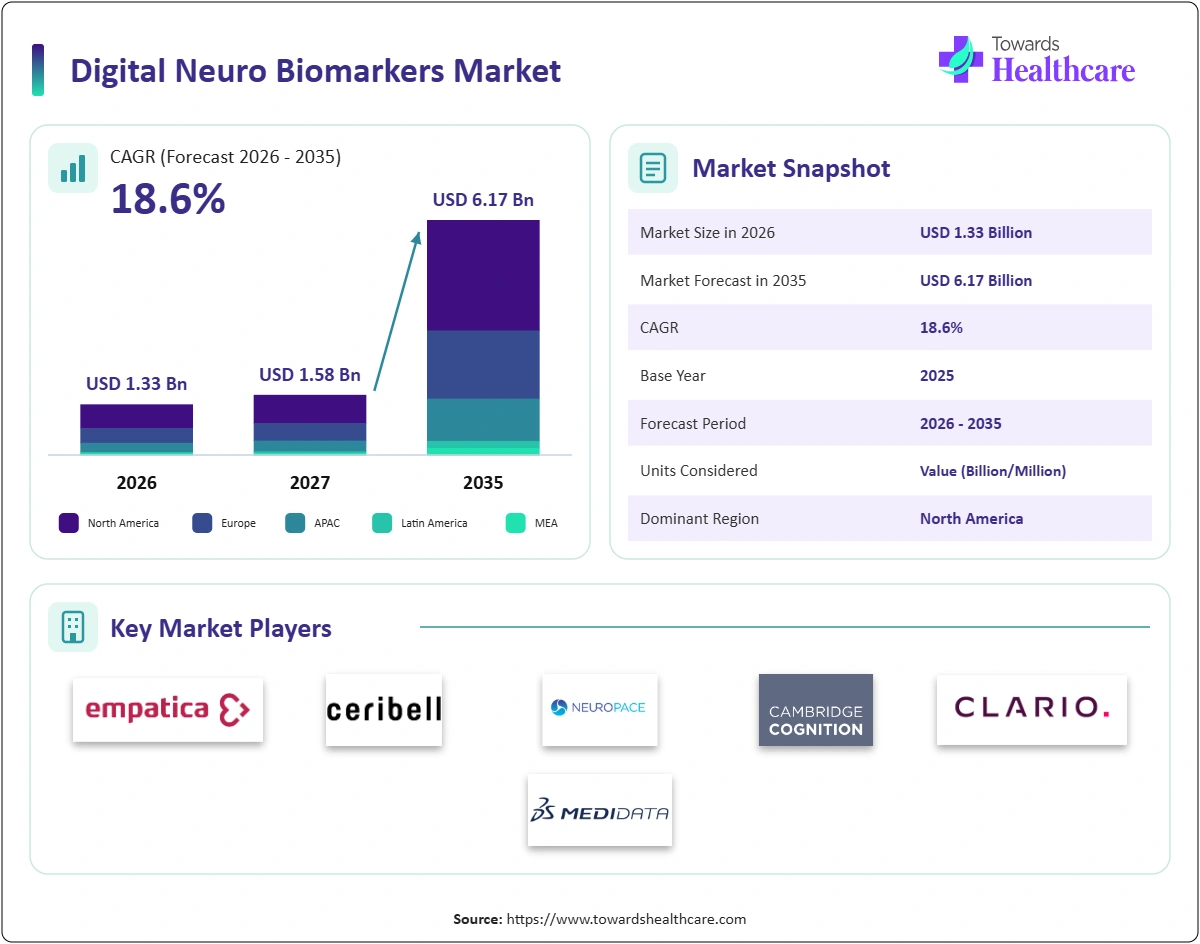
The market is projected to grow from USD 1.12 billion in 2025 to USD 6.17 billion by 2035 because neurological diseases change movement, eyes, speech and cognition long before diagnosis, and digital tools can measure these changes objectively. A strong market growth is being supported by Neurological disease burden, Alzheimer's therapies, digital trial endpoints and cheaper sensors. The market is expected to reach USD 2.63 billion by 2030 and sustain a CAGR of 18.60% during the forecast period. Digital neuro biomarkers support telehealth neurology and precision medicine.
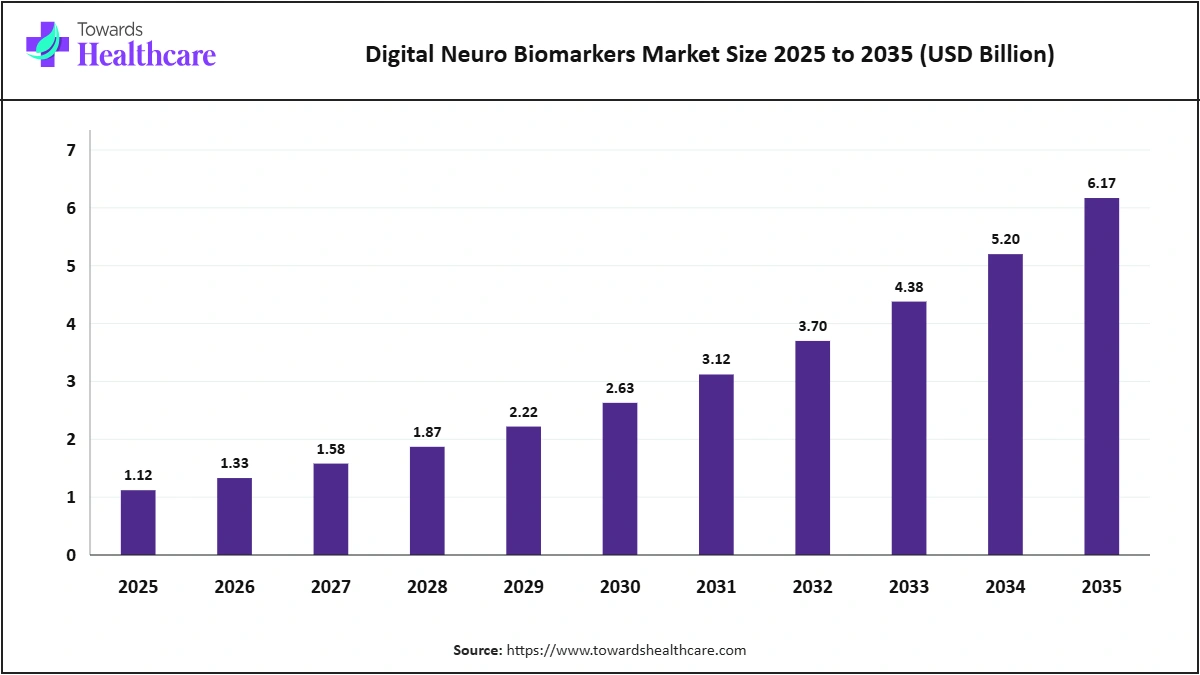
Analyst View: We built the estimate from device placements, software subscriptions and trial contracts by region and average values, cross-checked against digital neurology company activity. Published estimates for this exact scope are limited, so our value is evidence-based.
| Driver | Impact | ≈ CAGR Contribution | Time Horizon | Key Regions |
| Neurological disease burden rises | High | +7.26 pp | Short to long term | Global, strongest in North America |
| New Alzheimer's therapies need early diagnosis | Medium | +6.13 pp | Medium to long term | Global, fastest uptake in Asia Pacific |
| Misdiagnosis is common | Medium | +5.22 pp | Short to medium term | Global |
| Sensors are cheaper | Low | +4.08 pp | Long term | Developed and emerging markets |
Note: Contributions are indicative estimates of each factor's effect on annual growth.
Sources: Expert interviews, secondary sources, Towards Healthcare database and Towards Healthcare analysts.
Taken together, these drivers add about 22.69 percentage points to the annual growth of the market, with neurological disease burden rises having the largest effect. Their influence is strongest in North America, while uptake grows fastest in Asia Pacific.
| Restraint | Impact | ≈ Negative CAGR Contribution | Time Horizon | Key Regions |
| Validation gaps | High | -1.84 pp | Short to medium term | Global |
| Reimbursement limits | High | -1.35 pp | Medium term | Price-sensitive and emerging markets |
| Data privacy | Medium | -0.90 pp | Short term | North America and other mature markets |
Note: Contributions are indicative estimates of each factor's effect on annual growth.
Sources: Expert interviews, secondary sources, Towards Healthcare database and Towards Healthcare analysts.
These restraints are expected to reduce annual growth of the market by about 4.09 percentage points, led by validation gaps. Their effect eases over the forecast period as suppliers, buyers and regulators adapt, leaving a net CAGR of 18.60% from 2026 to 2035.
Digital neurobiomarkers have the potential to facilitate earlier identification of neurological disorders in primary care screening. The demand for objective concussion assessments is increasing, which creates demand for digital biomarker-based testing solutions. Digital endpoints are being increasingly adopted in clinical trials, which expands opportunities for neurobiomarker developers and technology providers. Increasing average age of population in Asia drives the demand for digital neurobiomarkers to support timely diagnosis and long-term neurological monitoring. The demand for remote healthcare is increasing, which fuels the demand for home-based neurological monitoring solutions.
Note: 2025 is the base year; 2035 shares and CAGRs are forecasts.
Sources: Expert interviews, secondary sources, Towards Healthcare database and Towards Healthcare analysts.
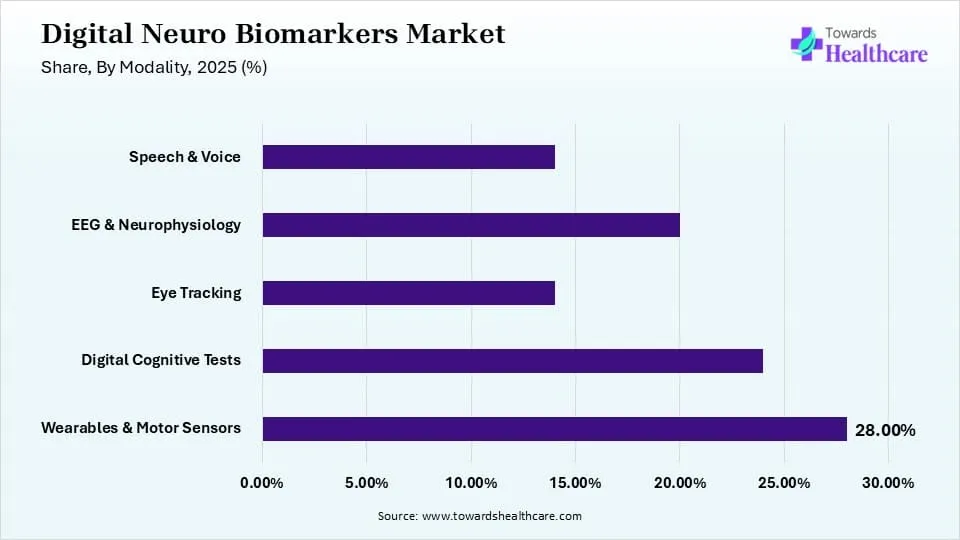
Wearables & Motor Sensors held a 28.00% share in 2025 and is projected to expand at a CAGR of 17.84% from 2026 to 2035. Wearables and motor sensors hold a leading position because gait, tremor, and activity are tracked continuously in Parkinson's and MS. This segment is expected to grow slower than the overall market during the forecast period.
Digital Cognitive Tests digital cognitive tests screen memory and attention. The digital cognitive tests segment is expected to grow at a slower rate than the overall market from 2026 to 2035.
Eye Tracking is growing at the fastest pace because oculomotor patterns reveal early disease. This segment is expected to grow faster than the overall market over the forecast period.
EEG & Neurophysiology detect seizures and brain activity. This segment is expected to grow at a slower rate than the market during the forecast period.
Speech & Voice analysis detects cognitive and motor changes. This segment is expected to grow slower than the overall market throughout the forecast period.
Segment Outlook: Wearables & Motor Sensors continues to be the largest modality segment through 2035, holding about 26.09% of the market in 2035, while Eye Tracking records the highest CAGR of 21.24% from 2026 to 2035. Although Eye Tracking starts from the smallest base, its faster growth shows how demand is shifting within the market.
Note: 2025 is the base year; 2035 shares and CAGRs are forecasts.
Sources: Expert interviews, secondary sources, Towards Healthcare database and Towards Healthcare analysts.
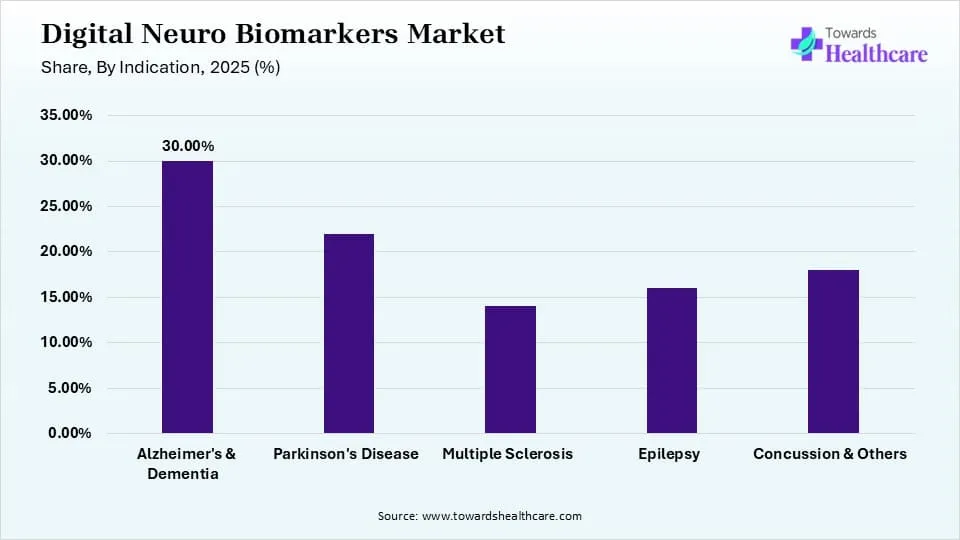
Alzheimer's & Dementia captured 30.00% of the market in 2025 and is projected to expand at a CAGR of 17.93% during the forecast period. Alzheimer's and dementia lead because new therapies need early detection. The alzheimer's & dementia segment is expected to grow at a slower pace than the market from 2026 to 2035.
Parkinson's Disease uses motor and eye biomarkers. This segment is expected to grow broadly in line with the overall market over the forecast period.
Multiple Sclerosis uses gait and cognitive measures. The multiple sclerosis segment is expected to grow broadly in line with the market from 2026 to 2035.
Epilepsy segment is expected to grow broadly in line with the market over the forecast period.
Concussion & Others is expected to grow at the fastest pace owing to portable eye and balance tests. This segment is expected to grow faster than the overall market from 2026 to 2035.
Segment Outlook: Alzheimer's & Dementia remains the largest indication segment through 2035, holding about 28.53% of the market in 2035, while Concussion & Others records the highest CAGR of 20.33% from 2026 to 2035. Multiple Sclerosis holds the smallest share today and serves more specialised needs within the digital neuro biomarkers market.
Note: 2025 is the base year; 2035 shares and CAGRs are forecasts.
Sources: Expert interviews, secondary sources, Towards Healthcare database and Towards Healthcare analysts.
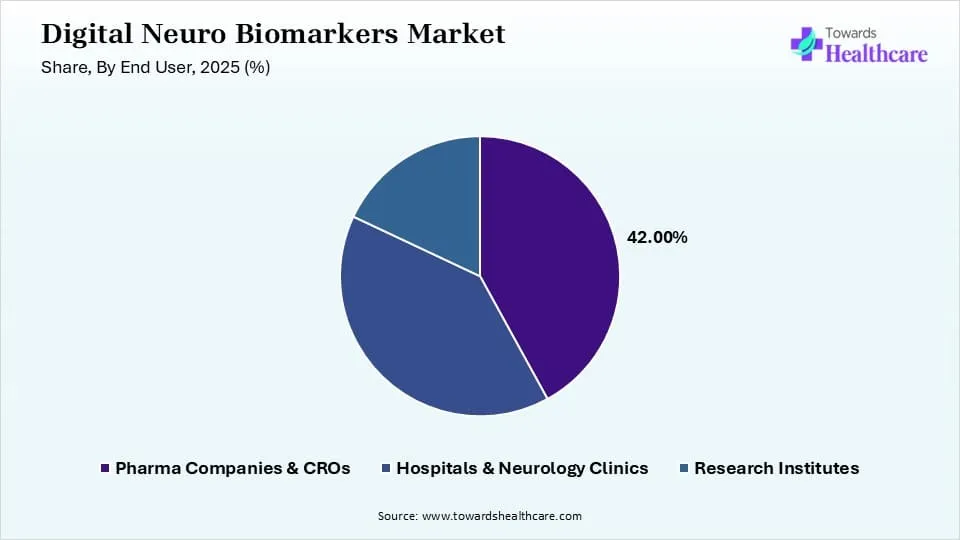
Pharma Companies & CROs captured a 42.00% share in 2025 and is projected to grow at a CAGR of 17.74% during the forecast period. Pharmaceutical companies and CROs hold the largest share because CNS trials use digital endpoints. This segment is expected to grow slower than the overall market during the forecast period.
Hospitals & Neurology Clinics grow fastest as cleared devices enter care. This segment is expected to grow faster than the overall market from 2026 to 2035.
Research Institutes validate new measures. The research institutes segment is expected to grow slower than the market over the forecast period.
Segment Outlook: Pharma Companies & CROs remains the largest end user segment through 2035, holding about 39.06% of the market in 2035, while Hospitals & Neurology Clinics records the highest CAGR of 19.64% from 2026 to 2035. Research Institutes holds the smallest share today and serve more specialised needs within the digital neuro biomarkers market.
Analyst View: Segment shares were allocated from demand, product portfolios and pricing in each category. Wearables & Motor Sensors, Alzheimer's & Dementia and Pharma Companies & CROs lead their categories because they meet the core needs of today's buyers. We expect Eye Tracking, Concussion & Others and Hospitals & Neurology Clinics to gain share as newer technologies, users and applications grow faster.
Note: 2025 is the base year; 2035 shares and CAGRs are forecasts.
Sources: Expert interviews, secondary sources, Towards Healthcare database, and Towards Healthcare analysts.
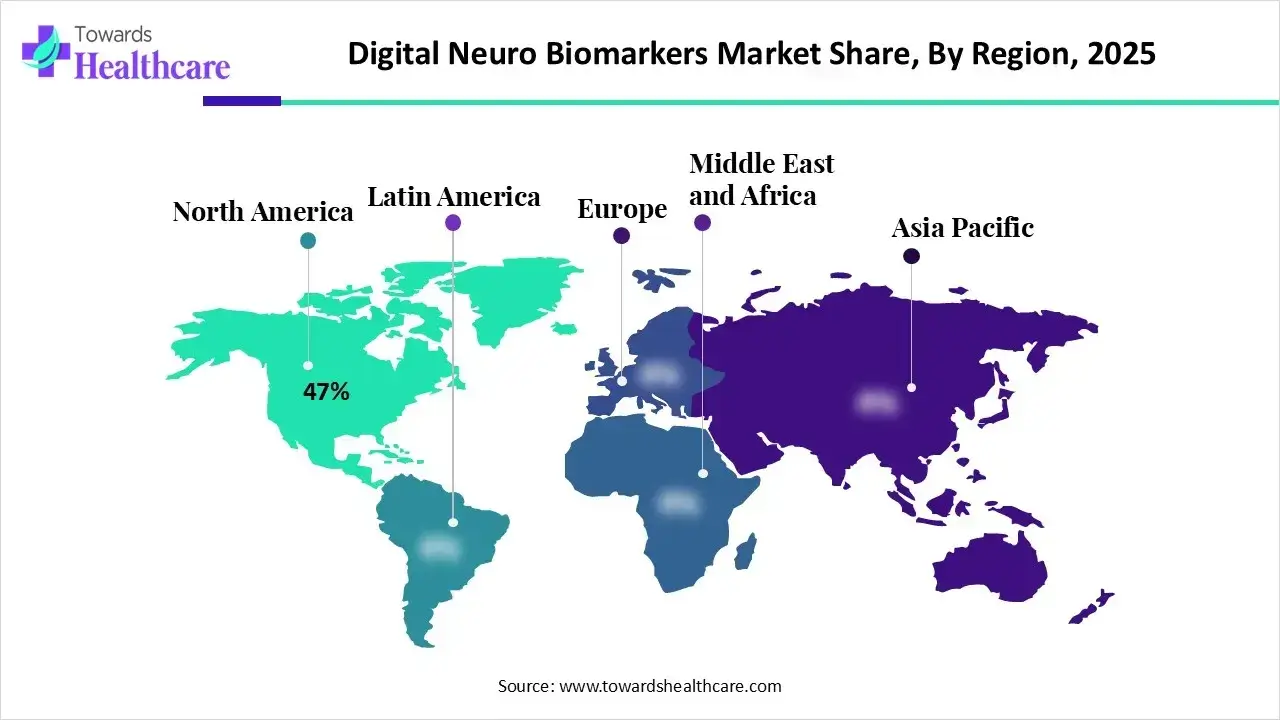
North America captured 47.00% of the market in 2025 and is projected to expand at a CAGR of 18.16% from 2026 to 2035. North America leads because of large CNS trial activity, FDA-cleared neuro devices, and digital health investment. North America is expected to grow slower than the overall market during the forecast period.
Europe has CE-marked neuro devices and strong research networks. Europe is expected to grow broadly in line with the market between 2026 and 2035.
Asia Pacific grows fastest with ageing populations in Japan, China and Korea. Asia Pacific is expected to grow faster than the overall market between 2026 and 2035.
Latin America is an early adopter. Latin America is expected to grow broadly in line with the overall market over the forecast period.
Middle East & Africa invests significantly in digital health. Middle East & Africa region is expected to grow broadly in line with the overall market between 2026 and 2035.
Analyst View: Regional shares were built from demand, installed base, spending, and supplier presence in each region. North America leads because of its mature demand base and strong suppliers. We assign Asia Pacific the highest growth premium because investment, adoption, and capacity are expanding at the fastest rate in this region.
| Rank | Company Name | Key Products / Business | Headquarters |
| 1 | Medidata (Dassault Systèmes) | Sensor cloud and digital trial endpoints | United States |
| 2 | Clario | Digital endpoints for trials | United States |
| 3 | Cambridge Cognition | CANTAB cognitive tests and speech biomarkers | United Kingdom |
| 4 | Linus Health | Digital cognitive assessment | United States |
| 5 | NeuroPace | Responsive neurostimulation with brain data | United States |
| 6 | ActiGraph | Wearable motor and activity measures | United States |
| 7 | Ceribell | Rapid point-of-care EEG | United States |
| 8 | Empatica | Wearable seizure monitoring | United States |
| 9 | SyncThink | EYE-SYNC eye-tracking concussion device | United States |
| 10 | neuroClues | AI eye-tracking headset | Belgium |
Note: Company shares are 2025 estimates.
Sources: Company press releases, expert interviews, secondary sources, Towards Healthcare database and Towards Healthcare analysts.
Medidata (Dassault Systèmes) led the market in 2025, followed by Clario and Cambridge Cognition. Medidata (Dassault Systèmes) holds the leading position owing to its sensor cloud and digital trial endpoints; Clario competes with digital endpoints for trials, and Cambridge Cognition offers CANTAB cognitive tests and speech biomarkers.
Linus Health, NeuroPace, ActiGraph, Ceribell, Empatica, SyncThink and neuroClues compete through digital cognitive assessment, responsive neurostimulation with brain data, wearable motor and activity measures, rapid point-of-care EEG, wearable seizure monitoring, EYE-SYNC eye-tracking concussion device and AI eye-tracking headset. The market is fragmented and early-stage, and competition revolves around clinical validation, regulatory clearance, endpoint acceptance, ease of use, data integration, and pharma partnerships.
Medidata (Dassault Systèmes): Medidata (Dassault Systèmes) is headquartered in the United States. Its offering centres on Sensor Cloud and digital trial endpoints. In the Towards Healthcare Companies Quadrant it is positioned as a Leader.
Clario: Clario has its corporate headquarters in the United States. Its offering revolves around Digital endpoints for trials. Clario has been positioned as a Leader in the Towards Healthcare Companies Quadrant.
Cambridge Cognition: Cambridge Cognition has its global headquarters in the United Kingdom. The company’s portfolio comprises CANTAB cognitive tests and speech biomarkers. In the Towards Healthcare Companies Quadrant it is positioned as a Leader.
Linus Health: Linus Health is headquartered in the United States. Its offering centres on Digital cognitive assessment. The company has been positioned as a Leader in the Towards Healthcare Companies Quadrant.
NeuroPace: NeuroPace is headquartered in the United States. Its offering revolves around Responsive neurostimulation with brain data. In the Towards Healthcare Companies Quadrant it is positioned as a Leader.
ActiGraph: ActiGraph has its corporate headquarters in the United States. Its portfolio comprises Wearable motor and activity measures. ActiGraph is positioned as a Leader in the Towards Healthcare Companies Quadrant.
Ceribell: Ceribell is headquartered in the United States. Its offering centres on Rapid point-of-care EEG. In the Towards Healthcare Companies Quadrant it is positioned as an Innovator.
Empatica: Empatica has its global headquarters in the United States. Its offering revolves around Wearable seizure monitoring. In the Towards Healthcare Companies Quadrant it is positioned as an Innovator.
SyncThink: SyncThink is headquartered in the United States. The company’s portfolio comprises EYE-SYNC eye-tracking concussion device. It has been positioned as an Innovator in the Towards Healthcare Companies Quadrant.
neuroClues: neuroClues is headquartered in Belgium. Its offering centres on AI eye-tracking headset. In the Towards Healthcare Companies Quadrant it is positioned as an Innovator.
The digital neuro biomarkers ecosystem links device & sensor makers, software & biomarker platforms, trial technology providers, users and regulators, with each stage adding value before products reach end users.
| Ecosystem Stage | Role in the Market | Key Companies |
| Device & Sensor Makers | Build headsets, EEG and wearables | Ceribell, Empatica, neuroClues, SyncThink |
| Software & Biomarker Platforms | Build algorithms | Cambridge Cognition, Linus Health |
| Trial Technology Providers | Run digital endpoints | Medidata, Clario |
| Users | Use measures | Pharma, neurologists, hospitals |
| Regulators | Clear devices and endpoints | FDA, EMA, notified bodies |
Sources: Company press releases, expert interviews, secondary sources, Towards Healthcare database and Towards Healthcare analysts.
Device & Sensor Makers: Build headsets, EEG and wearables. Key participants include Ceribell, Empatica, neuroClues, SyncThink.
Software & Biomarker Platforms: Build algorithms. Key participants include Cambridge Cognition, Linus Health.
Trial Technology Providers: Run digital endpoints. Key participants include Medidata, Clario.
Users: Use measures. Key participants include Pharma, neurologists, hospitals.
Regulators: Clear devices and endpoints. Key participants include FDA, EMA, notified bodies.
Value in the digital neuro biomarkers market flows from upstream material and technology suppliers to manufacturers and service providers, then through distribution partners to end users. Companies that integrate several stages or build long-term relationships with end users capture a larger share of this value.
The Towards Healthcare Companies Quadrant positions key participants in the digital neuro biomarkers market by market strength, reflecting revenue scale, market share and geographic reach, and by innovation and growth strategy, reflecting product portfolio breadth, research and development intensity and partnerships. Positions reflect each company's estimated 2025 share of the digital neuro biomarkers market and our assessment of its product innovation, portfolio breadth and partnerships.
Sources: Company press releases, expert interviews, secondary sources, Towards Healthcare database and Towards Healthcare analysts.
Leaders: Medidata (Dassault Systèmes), Clario, Cambridge Cognition, Linus Health, NeuroPace and ActiGraph combine high market share with broad portfolios and strong innovation.
Innovators: Ceribell, Empatica, SyncThink and neuroClues bring newer technologies and specialised products.
By Modality
By Indication
By End User
By Region
The market is defined as digital measures of nervous system function collected through eye tracking, EEG and wearable neurophysiology, speech and voice analysis, gait and motor sensors, and digital cognitive tests, supplied as devices, software and services and used to detect, diagnose and monitor Alzheimer's disease and dementia, Parkinson's disease, multiple sclerosis, epilepsy, concussion and other neurological disorders by pharmaceutical companies and CROs, hospitals and neurology clinics, and research institutes. The 2025 base year was built bottom-up from demand volumes and average prices by modality, indication and end user and region, and checked top-down against the market-specific revenues of leading companies and published estimates. Segment, regional and company values were allocated from modality, indication and end user and region demand. Key estimates were verified by cross-checking company disclosures, regulatory and industry data and published third-party estimates, and inputs that could not be reconciled were excluded. All segment, regional and company figures were reconciled to the same 2025 base year, and the 2026-2035 forecast, which applies a constant CAGR from the 2025 base, was recalculated and validated.
Analyst View:The market is set for steady expansion as neurological disease burden and related demand keep growing. Our estimate links value to underlying demand, installed base and pricing, so the forecast follows real adoption rather than headline hype. The main upside comes from primary care screening and trial endpoints, while the main risks are validation gaps and reimbursement limits.