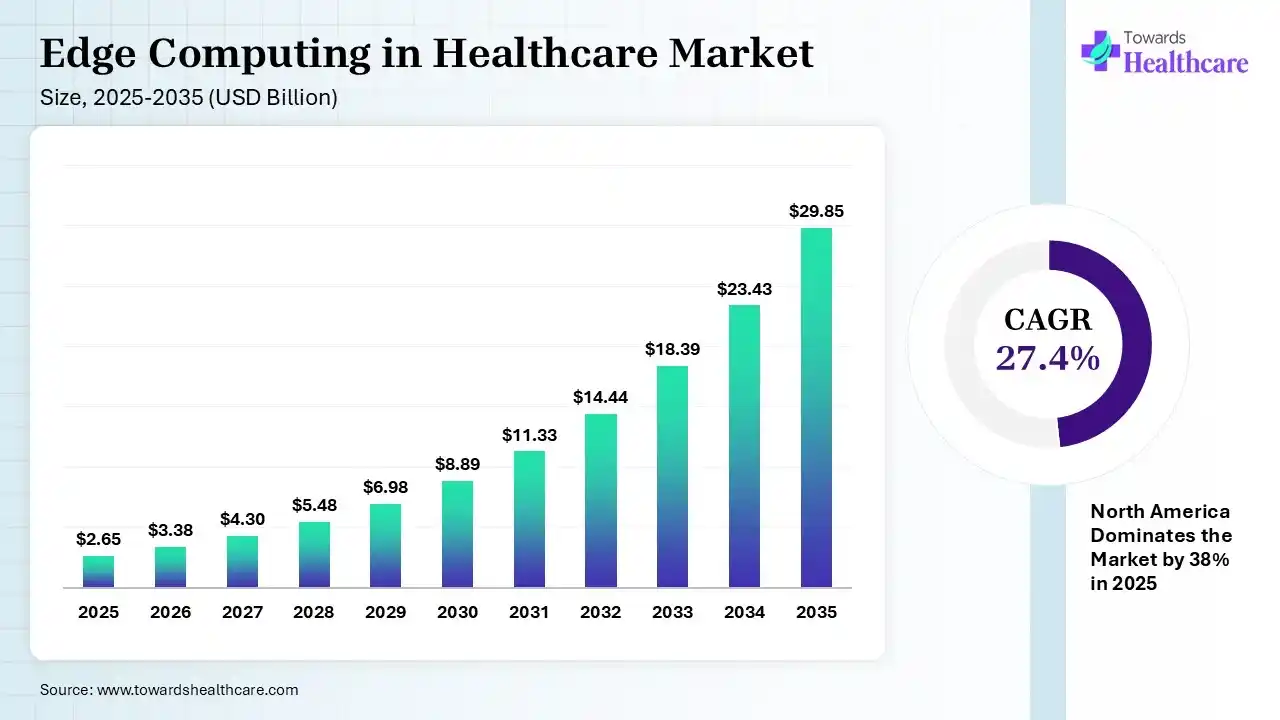
The global edge computing in healthcare market size was estimated at USD 2.65 billion in 2025 and is predicted to increase from USD 3.38 billion in 2026 to approximately USD 29.85 billion by 2035, expanding at a CAGR of 27.4% from 2026 to 2035. The edge computing in healthcare market is increasing as it functions autonomously, even with poor or no internet connectivity.
Edge computing is a fundamental move in how medical care organizations use technology, analyze, and act upon data. Applications of edge computing devices include remotely monitoring patients, automating care delivery, and employing artificial intelligence (AI) systems to improve diagnosis speed and accuracy. These edge computing systems are in place to detect anomalies and other key findings, including potentially life-threatening illnesses, from X-rays and other scans within a short span of time. Edge computing is a novel frontier in medical care systems, one that is being fuelled and enabled by advanced mobile and point-of-care systems.
AI-based edge computing systems offer a lightweight and novel medical care system. AI-powered edge tools process healthcare images locally, directly handling radiology, CT, and X-rays. These edge tools lower diagnostic delays and the requirement for cloud-driven processing. AI-powered edge technologies are already making a difference by supporting the use of less invasive surgeries, lowering radiation exposure in an X-Ray machine, and monitoring patients at risk of falling. AI-driven data processing workflows allow surgeons to focus on finding irregularities that need to be removed, make automatic measurements, track surgical devices, monitor organs that need to be preserved, or identify bleeding in real time.
| Table | Scope |
| Market Size in 2026 | USD 3.38 Billion |
| Projected Market Size in 2035 | USD 29.85 Billion |
| CAGR (2026 - 2035) | 27.4% |
| Leading Region | North America by 38% |
| Historical Data | 2020 - 2023 |
| Base Year | 2025 |
| Forecast Period | 2026 - 2035 |
| Measurable Values | USD Millions/Units/Volume |
| Market Segmentation | By Component, By Deployment Mode, By Application, By End User, By Region |
| Top Key Players | GE HealthCare, Koninklijke Philips N.V., Microsoft, Amazon Web Services, Intel |
| Segment | Share 2025 (%) |
| Hardware | 28% |
| Software | 42% |
| Services | 30% |
The Hardware Segment Led the Edge Computing in Healthcare Market in 2025
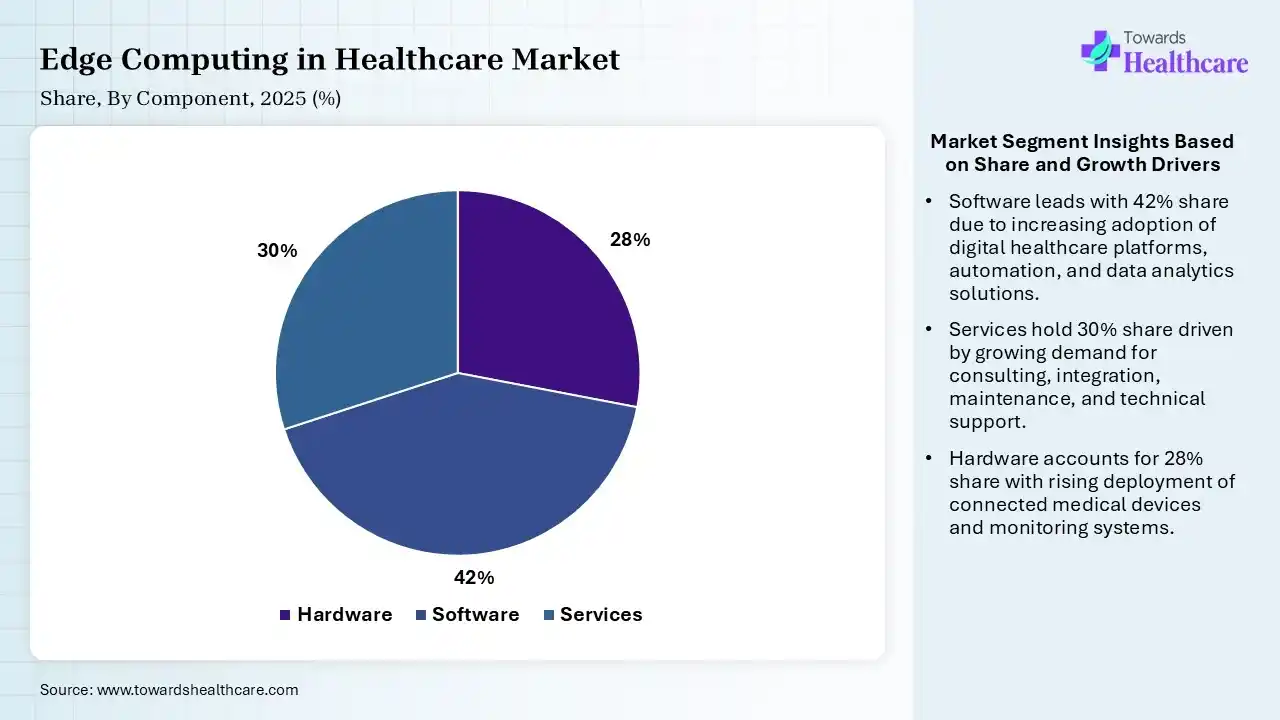
The software segment held the largest share of 42% in the market, and is estimated to be the fastest-growing segment during the forecast period, as edge computing can lessen the amount of information in circulation and enhance effectiveness in the healthcare domain. It offers less latency, enhanced scalability, more advanced data security and privacy, real-time analytics, and reduces expenses.
The services segment held a significant share of 30% in the market, as edge computing services play a significant role by lowering latency and improving data privacy, specifically in patient monitoring systems. It allows for supplementary, precise, and rapid diagnoses. It enables remote surgeries and real-time wearables tracking.
The hardware segment held a market share of 28% in 2025, as hardware edge computing in medical care is the practice of shifting computing power and data processing technology closer to the sources of healthcare data. It plays a significant role by lowering latency and enhancing data privacy, particularly in-patient monitoring technology.
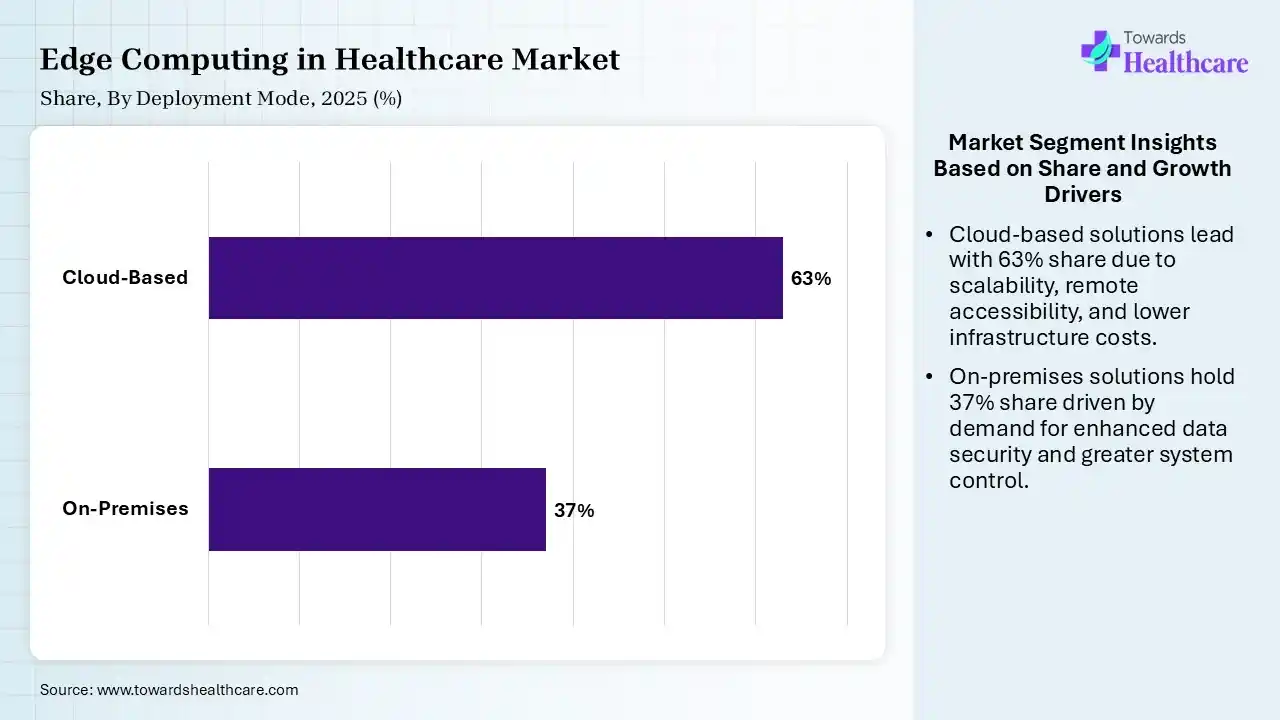
| Segment | Share 2025 (%) |
| On‑Premises | 37% |
| Cloud‑Based | 63% |
Cloud‑Based Segment Led the Edge Computing in Healthcare Market in 2025
The cloud‑based segment contributed the largest market share of 26%, and is estimated to be the fastest-growing during the forecast period, as anti-infective therapy programs provide specialized infusions and specialty therapeutics intended to support managing multifaceted bacterial, viral, and fungal infections in the setting that best fits patient requirements.
The on‑premises segment held a significant share of 37% of the market. An on-premise edge on the hospital site could process data nearby to maintain data privacy and compliance, accumulating data from major sources in the hospital and extracting relevant information. Edge allows right-time announcements to practitioners of unusual patient trends or behaviours. analyzing biometric data, AI-based imaging, and significant signs on-site eliminates the lag of sending data to the cloud.
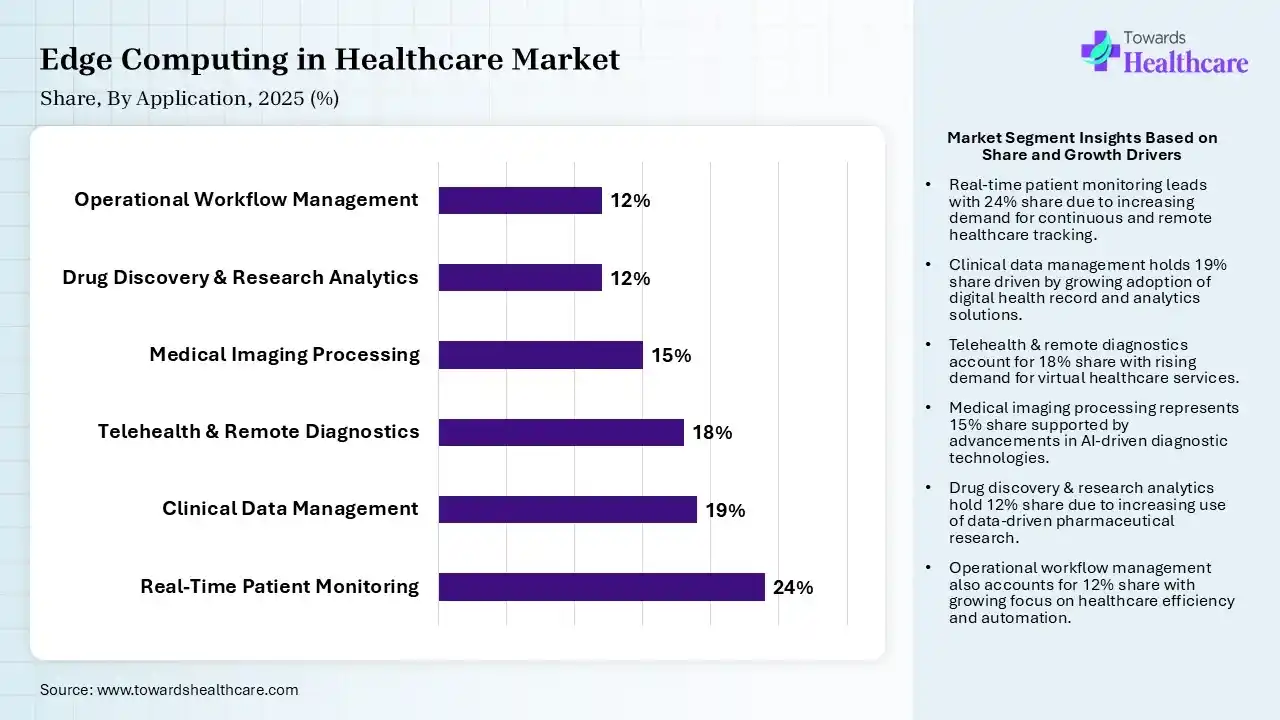
| Segment | Share 2025 (%) |
| Real‑Time Patient Monitoring | 24% |
| Clinical Data Management | 19% |
| Telehealth & Remote Diagnostics | 18% |
| Medical Imaging Processing | 15% |
| Drug Discovery & Research Analytics | 12% |
| Operational Workflow Management | 12% |
The Real‑Time Patient Monitoring Segment led the Edge Computing in Healthcare Market in 2025
The real‑time patient monitoring segment held a dominant share of 24% in the market. RPM facilitates better communication among patients and medical care providers. Telemedicine platforms and digital devices allow real-time interactions, creating it simple to address patient concerns promptly. Enhanced communication fosters stronger patient-driven relationships and ensures that patients feel supported and involved in their care.
The clinical data management segment contributed the largest market share of 19%, as CDM improves the effectiveness of healthcare research processes by automating data entry, authentication, and cleaning. This automation reduces manual mistakes, quickens data collection, and safeguards a smoother workflow through the research lifecycle.
The telehealth & remote diagnostics segment held a significant 18% share of the edge computing in healthcare market, as this technology allows video or smartphone appointments between patients and their medical care practitioner, providing advantages for both health and convenience. It offers access to resources and care for patients in rural areas or areas with provider shortages, enhance efficiency without higher net expenses.
The operational workflow management segment held a significant share of 12% in the market and is expected to grow at the fastest CAGR during the forecast period, as operational workflow automation in medical care transforms operations, improving effectiveness, compliance, and decision-making while lowering expenses. Operational workflow management in healthcare automates repetitive administrative tasks, lowering healthcare errors, and streamlining data sharing.
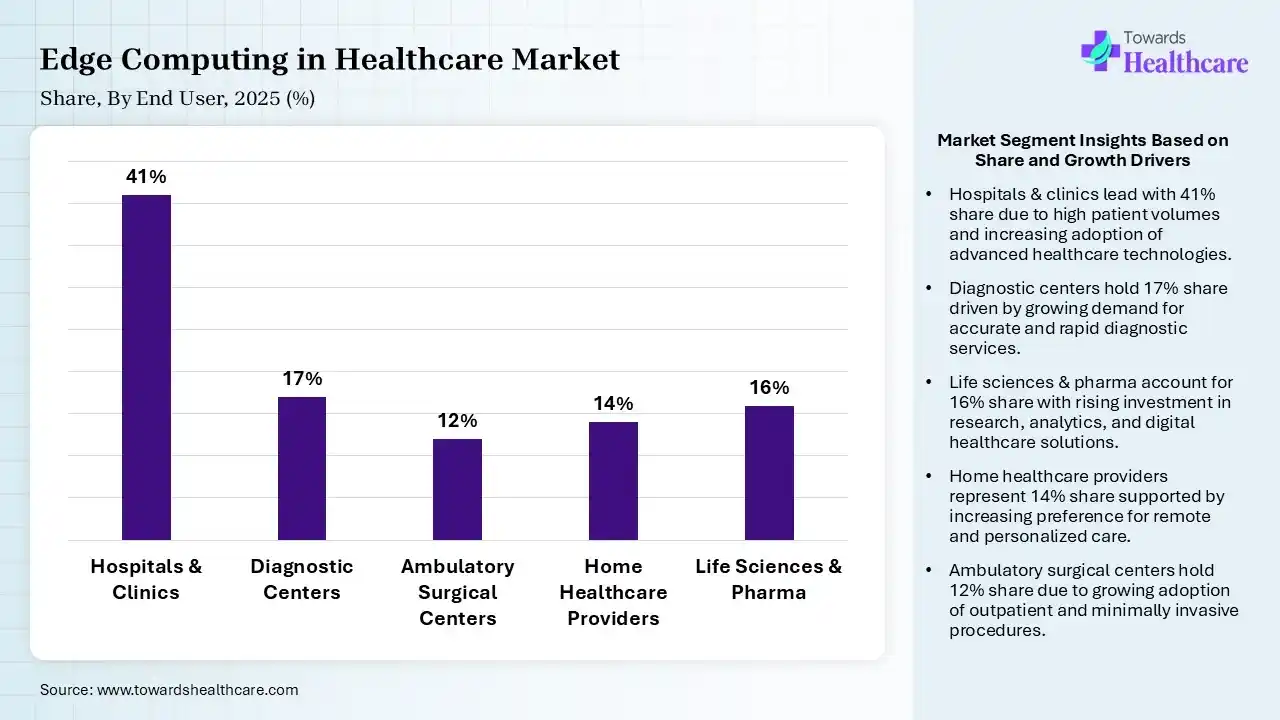
| Segment | Share 2025 (%) |
| Hospitals & Clinics | 41% |
| Diagnostic Centers | 17% |
| Ambulatory Surgical Centers | 12% |
| Home Healthcare Providers | 14% |
| Life Sciences & Pharma | 16% |
The Hospitals & Clinics Segment led the Edge Computing in Healthcare Market in 2025
The hospitals & clinics segment contributed the largest market share of 41%, as processing health data at the edge reduces dormancy, which enhances the performance and precision of the application of data. Edge computing in healthcare brings data processing closer to the source, allowing real-time insights and powering enhanced patient care.
The diagnostic centers segment held a significant share of 17% in the market. Edge data processing enables healthcare data to be captured, analysed, and acted upon at the point of care. AI-based edge devices lower diagnostic delays and the requirement for cloud-driven processing. Edge computing in diagnostic centers processes medical data directly at the source, like on MRI, CT, or X-ray systems.
The life sciences & pharma segment held a significant share of 16% in the edge computing in healthcare market, and is expected to grow at the fastest CAGR during the forecast period, as edge computing in medical care brings data processing nearer to the source, allowing real-time insights and driving improved patient care. Edge computing ensures a vision of processing data close to its generation point, lowering latency and bandwidth usage as compared with traditional cloud computing architectures.
The home healthcare providers segment held a significant share of 14% in the market, as home health care allows patients to recuperate in the comfort and privacy of their own home, at a cost savings of 36-50% over hospitalization. In hospital settings where staff divide their time among many patients, home care offers one-on-one attention.
The ambulatory surgical centers segment held a significant share of 12% in the market, as edge computing in medical care brings data processing closer to the source, allowing real-time insights and powering enhanced patient care. Edge computing enhances resource utilization by lowering the quantity of data transported between endpoints and essential cloud infrastructure.
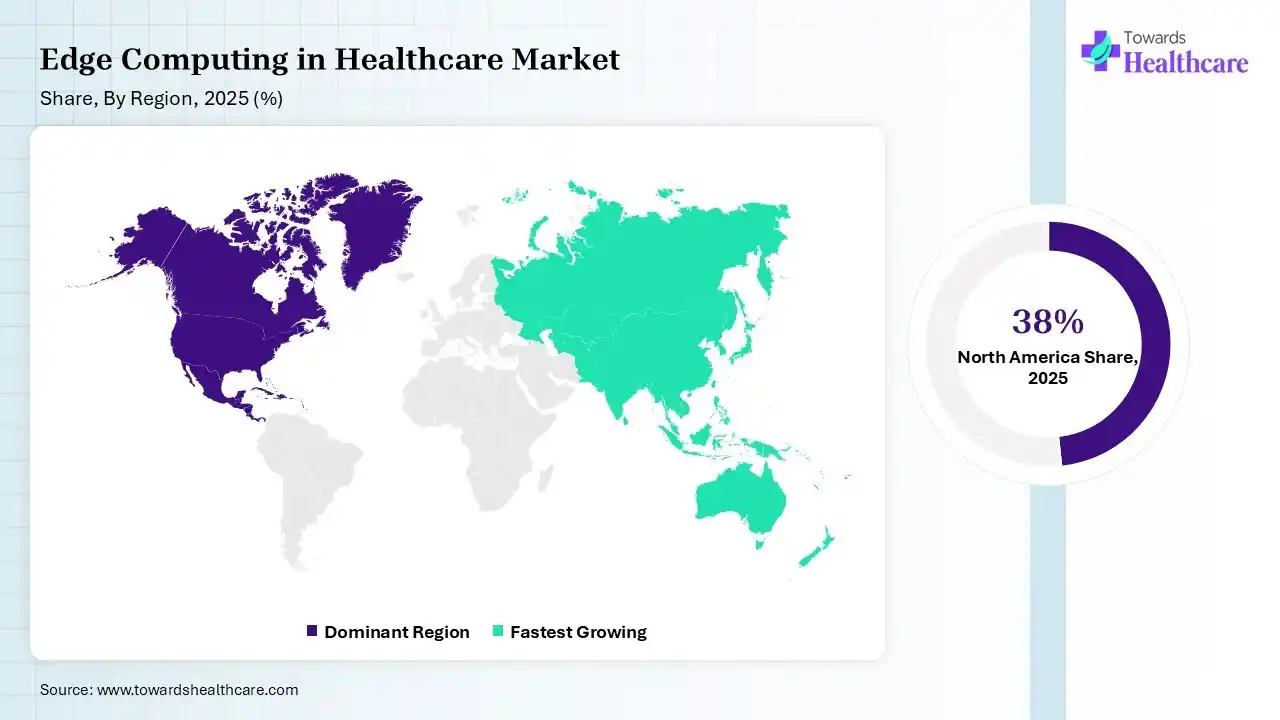
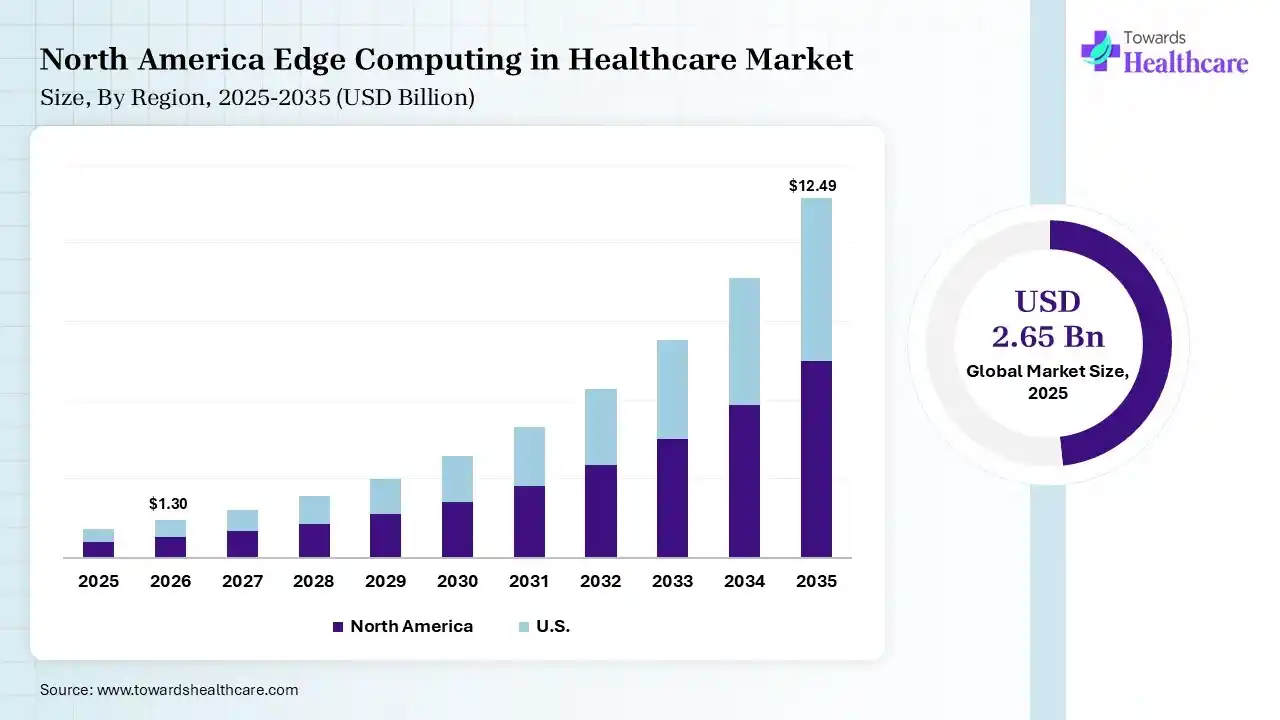
In 2025, North America dominated the edge computing in healthcare market with a share of 38% in 2025, due to the presence of 5G networks and strong overall connectivity in the region, which allows hospitals and clinics to deploy real-time, high-bandwidth applications such as AI-based surgeries and remote patient monitoring. The increasing demand for continuous, near-real-time decision-making in perilous care environments and remote telehealth settings contributes to the growth of the market.
U.S. Market Trends
The U.S. edge computing in healthcare market grows fast as hospitals deploy smart devices directly to patient bedsides. Edge computing processes critical health data instantly without sending it to distant cloud networks. This immediate processing allows smart monitors to alert doctors about sudden heart rate drops in real time, saving lives. Large hospital networks invest heavily in infrastructure to handle massive data flows from wearable sensors. Additionally, strict patient privacy laws encourage local data storage over cloud transfers. This technology ensures secure, lightning-fast diagnostics in busy emergency rooms nationwide.
Canada Market Trends
Canada uses edge computing to bridge massive geographic gaps between remote northern communities and urban medical hubs. Local clinics install edge servers to analyze complex medical images instantly on-site without needing high-speed internet connections. This capability allows rural doctors to diagnose illnesses quickly and start treatments immediately without patient travel. Provincial health systems actively fund these local data setups to reduce expensive medical evacuations. Future outlook focuses on expanding connected ambulances that transmit patient vitals to trauma centers during transit, improving rural survival rates significantly.
Asia Pacific held 27% share of the edge computing in healthcare market, and is expected to have the fastest CAGR during the forecast period, as advanced government guidelines, integrating with the region’s huge technical talent pools, act as a launchpad for AI-based clinical applications and localized Medtech services. Significant spending in 5G networks and smart city initiatives, specifically in China, South Korea, and Japan, contributes to the growth of the market.
India Market Trends
In India, the use of edge computing in medical care is driven by its advanced IT talent, enormous IoT scale, and the urgent requirement to bridge the urban-rural medical divide. With a massive population spread in the remote and rural areas, deploying localized edge nodes enables medical care providers. India's rapid expansion of 5G networks makes the perfect foundation for advanced architecture.
China Market Trends
China drives growth in the edge computing in healthcare market by integrating edge technology into its crowded urban hospitals and community health centers. Smart cameras and sensors process patient flows locally to reduce waiting times and optimize busy clinic schedules. The national government heavily promotes smart medical infrastructure to connect rural clinics with top city specialists seamlessly. Local tech firms manufacture affordable edge-enabled medical equipment, making advanced diagnostics accessible to smaller towns. Looking ahead, China focuses on widespread automated AI diagnostic tools running directly on portable ultrasound machines in diverse communities
| Company | Headquarters | Latest Update |
| GE HealthCare | United States | In January 2026, NXP Semiconductors and GE HealthCare announced a partnership to advance edge AI in healthcare settings, showcasing advanced anesthesia and neonatal care. |
| Koninklijke Philips N.V. | Netherlands | Koninklijke Philips N.V. is significantly advancing edge computing and artificial intelligence in medical care by integrating real-time surgical intelligence. |
| Microsoft | United States | In May 2026, the EY organization and Microsoft Corp. announced a noteworthy evolution of their alliance, spending more than $1 billion over five years and launching a novel initiative to support organizations. |
| Amazon Web Services | United States | Amazon Connect consumer provides advanced configuration capabilities that allow organizations to set up conversational AI. |
| Intel | United States | In May 2026, Intel launched Core Series 2 processors and a medical care Edge AI suite at Embedded World 2026, targeting real-time industrial workloads and AI-based patient monitoring. |
In March 2026, "Intel continues to lead in edge computing, which remains one of our fastest-growing business segments," said Dan Rodriguez, Intel corporate vice president and general manager of the Edge Computing Group. " With the introduction of Core Series 2, our CES launch of Core Ultra Series 3, and our expanding Edge AI Suites, we continue to deliver comprehensive platforms that meet diverse edge customer needs with breakthrough performance, reliability, and integrated AI acceleration."
Strengths
Weakness
Opportunities
Threat
By Component
By Deployment Mode
By Application
By End User
By Region









Principal Consultant
Payal Rabde is a Healthcare Market Research Analyst at Towards Healthcare Research & Consulting with 4+ years of experience in pharmaceuticals, biotechnology, medical devices, and life sciences.
Learn more about Payal Rabde

Reviewed By
Aditi Shivarkar is a seasoned professional with over 14 years of experience in healthcare market research. As a content reviewer, Aditi ensures the quality and accuracy of all market insights and data presented by the research team.
Learn more about Aditi Shivarkar