
The Europe serine proteases market is projected to grow from USD 1,418.60 million in 2025 to USD 3,237.12 million by 2035. Detergent makers are preferring protease to cold-wash and concentrated formulas. Moreover, food companies use proteases to make protein hydrolysates, and feed producers use them to improve protein digestion. Freshly formulated enzymes that sustain at lower temperatures and in harsher formulas expanded the applicability, lifting the market to USD 2,142.94 million by 2030 and sustaining a CAGR of 8.60% from 2026 to 2035.
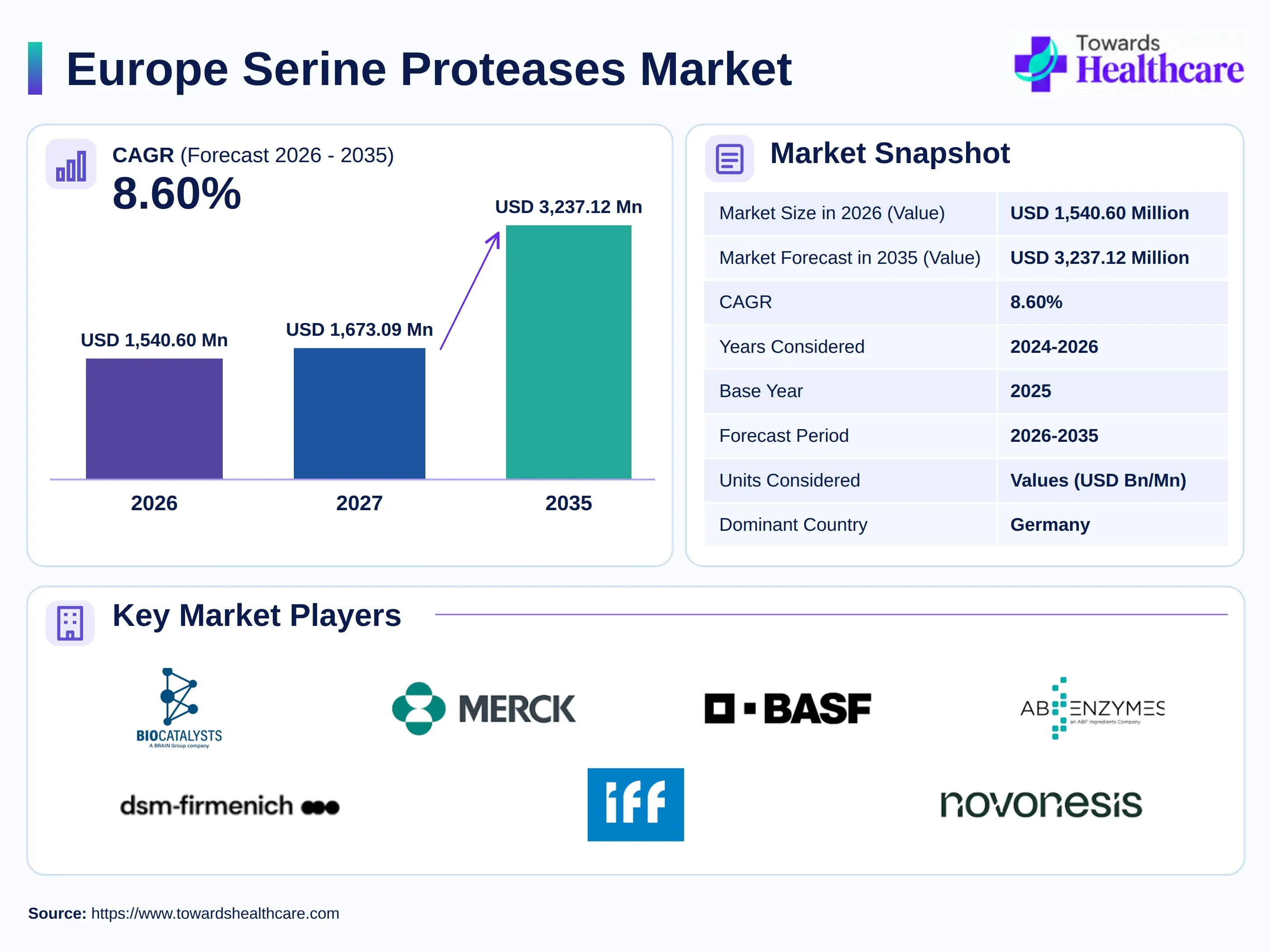 Analyst View: We built the estimate from the volume of detergents, protein hydrolysates, compound feed and pharmaceutical products made in Europe, multiplied by the typical protease dosage and the average enzyme price for each use. Detergent volumes were matched to the share of liquid and powder formulas that contain proteases, and feed volumes to the share of poultry and pig feed that uses protease enzymes. The total revenue was checked against the reported enzyme sales of leading producers in Europe and against published estimates, which places our base year slightly above the comparable figures. The growth rate reflects steady detergent demand, growing integration in food sector, feed and pharmaceutical uses, and gradual price increases for newer engineered enzymes.
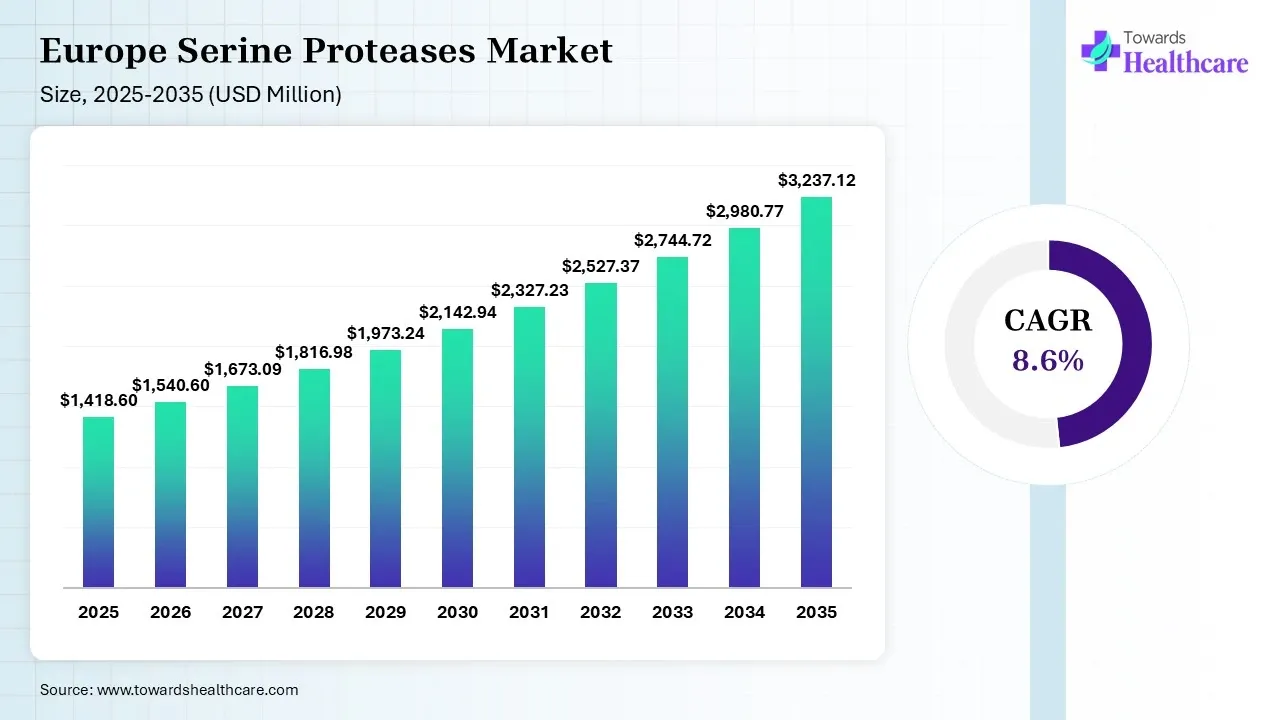
Market Size & Growth Outlook
Regional Market Spotlight
Segmental Spotlight
Driver: European consumers and regulators are preferring lower wash temperatures and more concentrated detergents, which rely on enzymes rather than heat and harsh chemicals. Proteases are the main enzyme in these formulas. Food and feed producers also use proteases to improve protein yield, digestibility, and texture.
Restraint: Detergent demand in Europe is high , and price pressure from large detergent makers limits margin growth. Some proteases can cause respiratory sensitization, which requires strict handling and encapsulation. Approval for food and pharmaceutical uses takes time and adds cost.
Opportunity: Recombinant trypsin and other high-purity proteases offer growth in biologics and cell therapy manufacturing. Proteases for plant-based and alternative proteins can open new food applications. Feed proteases that cut nitrogen emissions align with European environmental rules on livestock farming.
| Segments | 2025 Share | 2025 Market Value |
| Soaps & Detergents | 52.40% | USD 743.35 million |
| Food & Protein Processing | 18.60% | USD 263.86 million |
| Animal Feed | 12.80% | USD 181.58 million |
| Pharmaceuticals | 9.60% | USD 136.19 million |
| Others | 6.60% | USD 93.63 million |
Soaps and detergents accounted for 52.40% (USD 743.35 million) in 2025 because proteases remove blood, food and other stains and allow effective washing at lower temperatures. Food and protein processing, at 18.60% (USD 263.86 million), grows with demand for protein hydrolysates, dairy and meat processing and plant-based foods. Animal feed, at 12.80% (USD 181.58 million), grows as poultry and pig producers use proteases to improve protein digestion and reduce feed costs. Pharmaceuticals, at 9.60% (USD 136.19 million), is the fastest-growing application. The growth is supported by trypsin use in biologics manufacturing and digestive enzyme therapies, while other uses such as leather, textiles and research account for 6.60% (USD 93.63 million).
| Segments | 2025 Share | 2025 Market Value |
| Microbial | 81.40% | USD 1,154.74 million |
| Animal | 13.20% | USD 187.26 million |
| Plant | 5.40% | USD 76.60 million |
Microbial proteases accounted for 81.40% (USD 1,154.74 million) in 2025 because Bacillus-derived subtilisins can be produced at large scale by fermentation and engineered for stability. Animal-derived proteases such as pancreatic trypsin and chymotrypsin account for 13.20% (USD 187.26 million), mainly in pharmaceutical and food uses, while plant-derived enzymes account for 5.40% (USD 76.60 million).
| Segments | 2025 Share | 2025 Market Value |
| Liquid | 58.60% | USD 831.30 million |
| Powder & Granulate | 41.40% | USD 587.30 million |
Liquid proteases accounted for 58.60% (USD 831.30 million) in 2025. The shift to liquid and unit-dose detergents and liquid feed and food dosing is promoting the growth of the segment. Powder and granulate forms account for 41.40% (USD 587.30 million), used mainly in powder detergents and feed premixes.
Analyst View: Segment values were allocated by mapping end-use volumes to protease dosage and price, then checking the split against product portfolios. Detergents lead because they use the largest enzyme volumes, while pharmaceutical and food domains use carry higher prices per kilogram. The pharmaceutical, food and feed applications are predicted to gain share as detergent demand grows more slowly, and liquid forms to gain share as liquid detergents expand.
| Country | 2025 Share | 2025 Market Value |
| Germany | 21.40% | USD 303.58 million |
| France | 14.20% | USD 201.44 million |
| United Kingdom | 13.60% | USD 192.93 million |
| Italy | 10.20% | USD 144.70 million |
| Spain | 8.40% | USD 119.16 million |
| Netherlands | 6.80% | USD 96.46 million |
| Denmark | 5.60% | USD 79.44 million |
| Rest of Europe | 19.80% | USD 280.88 million |
Analyst View: Country shares were built from national production of detergents, processed foods, compound feed and pharmaceuticals, weighted by protease dosage and price. Germany leads because it combines large production across all major uses. We assign the United Kingdom the highest growth premium because pharmaceutical use, which carries higher value, is growing faster there than detergent use.
| Rank | Company Name | Market-Specific Revenue (USD Million) | 2025 Share | Key Products / Business | Headquarters |
| 1 | Novonesis | 390.00 | 27.49% | Detergent, food, feed and pharma proteases (Progress, Blaze, Alcalase) | Denmark |
| 2 | IFF | 230.00 | 16.21% | Detergent and food proteases (Excellenz, Preferenz) | United States |
| 3 | dsm-firmenich | 105.00 | 7.40% | Food and feed proteases | Switzerland |
| 4 | AB Enzymes | 82.00 | 5.78% | Food, feed and technical proteases | Germany |
| 5 | BASF | 48.00 | 3.38% | Detergent enzymes and feed enzymes | Germany |
| 6 | Kerry Group | 40.00 | 2.82% | Food and protein processing proteases | Ireland |
| 7 | Amano Enzyme | 34.00 | 2.40% | Food and pharmaceutical proteases | Japan |
| 8 | Merck KGaA | 30.00 | 2.11% | Research and bioprocessing trypsin and proteases | Germany |
| 9 | Biocatalysts | 22.00 | 1.55% | Specialty food and protein processing enzymes | United Kingdom |
| 10 | Bioseutica | 15.00 | 1.06% | Animal-derived and specialty enzymes | Netherlands |
Novonesis led the Europe serine proteases market with an estimated 27.49% (USD 390.00 million) of 2025 revenue, followed by IFF at 16.21% (USD 230.00 million) and dsm-firmenich at 7.40% (USD 105.00 million). Novonesis leads through its broad detergent, food and feed protease portfolio and Danish fermentation base, IFF through its detergent and food enzyme business built on Danisco and Genencor and dsm-firmenich through food and feed enzymes. The top 10 companies accounted for an estimated 70.21% (USD 996.00 million) of 2025 revenue, while the remaining 29.79% (USD 422.60 million) was shared among smaller enzyme formulators, regional distributors, and pharmaceutical-grade suppliers. The Europe serine proteases market is concentrated in detergent enzymes, where a few producers hold strong positions, while food, feed and pharmaceutical uses are more fragmented and competition centres on enzyme performance, stability and regulatory approvals.
By Application
By Source
By Country
The Europe serine proteases market was defined as serine protease enzymes, including subtilisins, trypsin and chymotrypsin, sold for detergent, food, feed, pharmaceutical and other uses in Europe, counted at producer level. The 2025 base year was built bottom-up from production volumes of detergents, foods, feed and pharmaceuticals, protease dosage and enzyme prices, and checked top-down against the reported European enzyme sales of leading producers. Segment, country and company values were allocated from end-use volumes, producer portfolios and national production statistics. Key estimates were verified by cross-checking company disclosures, regulatory and industry data and published third-party estimates, and inputs that could not be reconciled were excluded. All segment, regional and company figures were reconciled to the same 2025 base year, and the 2026–2035 forecast, which applies a constant CAGR from the 2025 base, was recalculated and validated.
Analyst View: Overall Market -The Europe serine proteases market rests on a large, stable detergent base, with faster growth in food, feed and pharmaceutical uses. Our estimate links demand to production volumes, dosage and price in each use, so the forecast follows changes in detergent formulation and the expansion of higher-value applications. The main upside comes from cold-wash detergents, alternative proteins and bioprocessing, while the main risks are price pressure, mature detergent volumes and slow approvals.