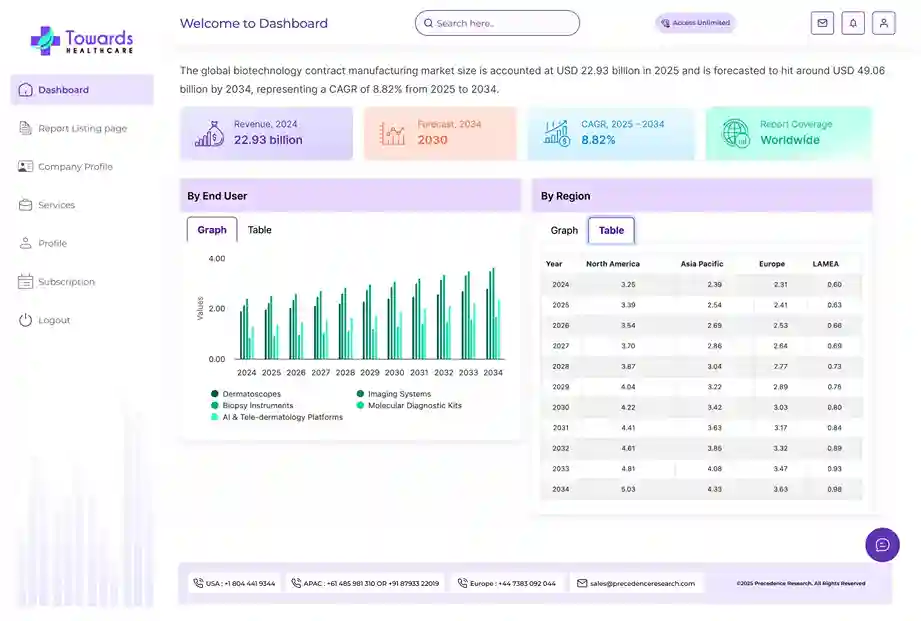
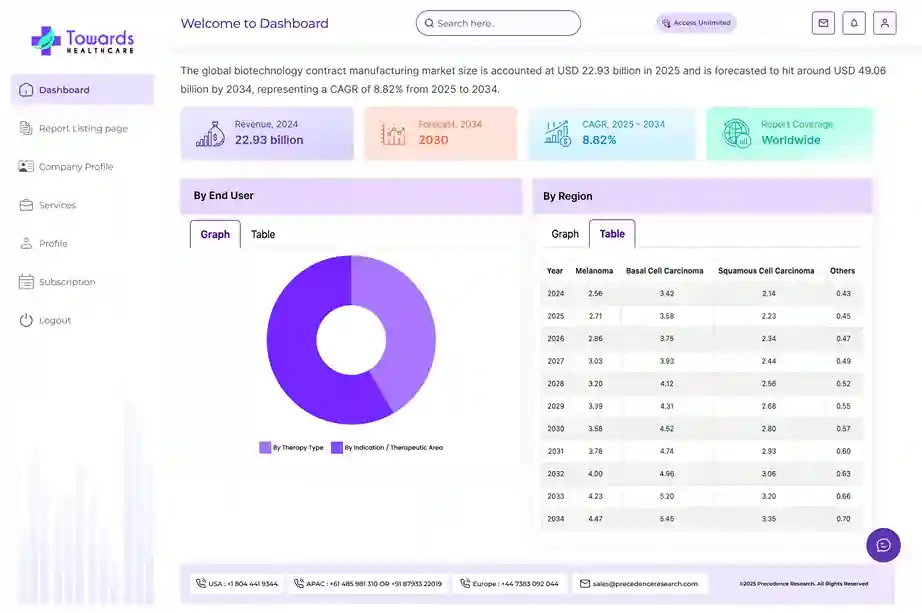
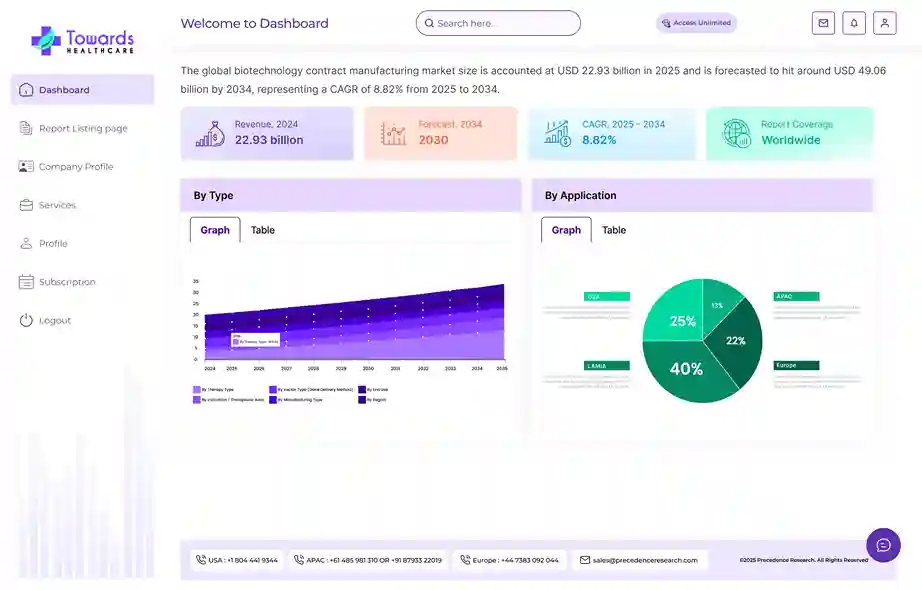
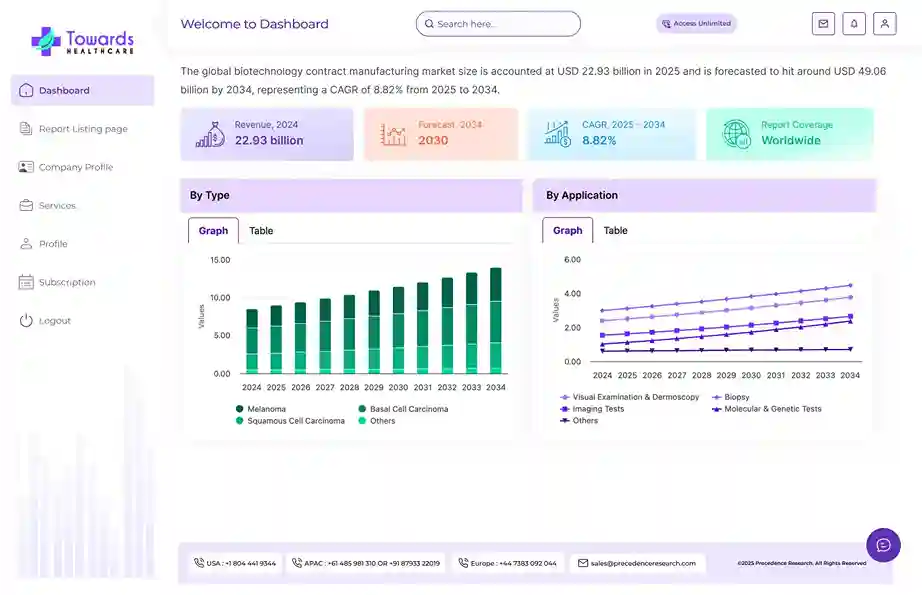
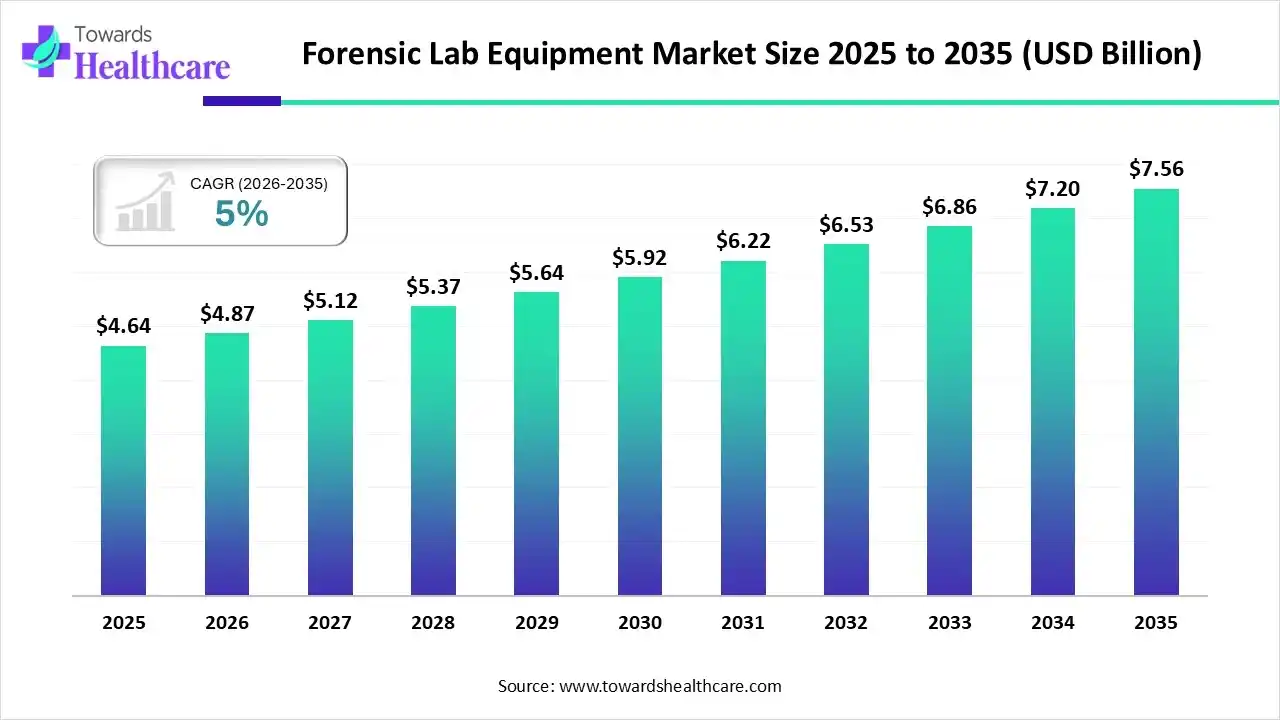
The global forensic lab equipment market size was estimated at USD 4.64 billion in 2025 and is predicted to increase from USD 4.87 billion in 2026 to approximately USD 7.56 billion by 2035, expanding at a CAGR of 5% from 2026 to 2035.
The expanding forensic laboratories and growing crimes are increasing the demand for forensic lab equipment. This is increasing their innovations, AI integrations, and adoption rates, promoting market growth.
The forensic lab equipment market is driven by growing global crime rates and technological breakthroughs. The forensic lab equipment encompasses tools and instruments used for criminal, regulatory, and civil investigations. This equipment helps in the analysis of biological, chemical, physical, and digital evidence to identify suspects or solve crimes.
The forensic lab equipment market comprises specialized technology and instrumentation to analyze evidentiary materials obtained from crime scenes, accidents, and legal investigations. Instruments found in these laboratories may include DNA analyzers, chromatography instruments, microscopes, spectrometers, fingerprint identification systems, toxicology testing devices, and digital forensic tools. These various instruments are used by forensic professionals to identify suspects, determine the cause of incidents, detect the presence of substances, and provide scientifically validated evidence to support the criminal justice system.
The forensic laboratory equipment market continues to grow steadily as a result of an increased number of criminal investigations, a growing need for accurate forensic testing, and increased use of advanced analytical technologies. In addition, there has been an increase in government and law enforcement agencies' investments in modern forensic laboratories to improve the efficiency of investigations and reduce the backlog of cases. Furthermore, recent technological advancements have improved the capacity of forensic laboratories and have helped to spur upgrades for existing laboratory equipment. In addition, the increase in cybercrime, drug-related crimes, and cross-border crime has increased the demand for sophisticated tools to support forensic testing. With the increasing importance of forensic science in both legal and criminal investigations, the demand for modern forensic laboratory equipment throughout the world will continue to rise.
AI offers a wide range of applications where its algorithms help accelerate the identification of individuals by fingerprint matching and facial recognition. It also analyzes large DNA datasets, identifies new synthetic drugs, and offers automation in PCR techniques, which reduces human errors. It is also used in the analysis of digital evidence and crime-solving.
AI-powered tools are supporting laboratories handling more complex cases with a reliable and efficient workflow. More evidence is being classified, and patterns are being recognized by way of compiling evidence using more effective machine learning algorithms. Investigative processes of forensic DNA data processes, through the use of AI, are also helping laboratories to improve their workflows and increase the ability to conduct forensic investigations globally. In addition, AI provides evidence with the ability to be interpreted in real time, providing evidence management, reducing the number of cases on backlog, and improving the decision-making capabilities of forensic investigators to provide them with a faster and more accurate outcome.
Blooming Digital Forensics
The growing digitalization is increasing the use of digital evidence, which is promoting the expansion of digital forensics, driving the adoption of mobile devices, cloud storage, computers, and IoT platforms.
Flourishing Technological Advancements
The companies are developing various next-generation DNA sequencing platforms and portable devices like mobile DNA analyzers and handheld toxicology testers, which are creating new opportunities.
Growing Government Support
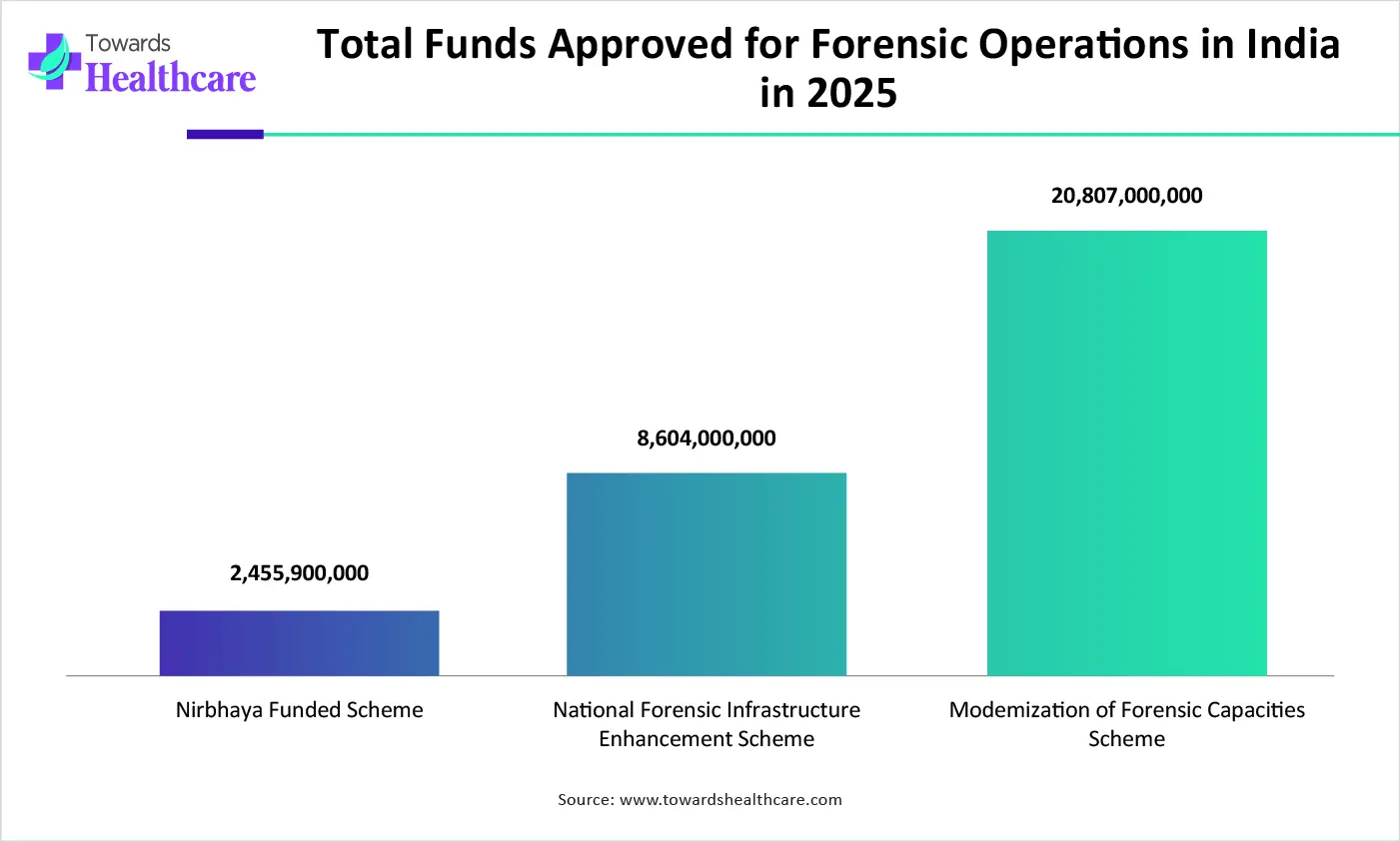
To deal with the growing crime rates, the government investments and policies are increasing, which is promoting the adoption of various advanced forensic lab equipment, and is encouraging their innovations as well.
| Table | Scope |
| Market Size in 2026 | USD 4.87 Billion |
| Projected Market Size in 2035 | USD 7.56 Billion |
| CAGR (2026 - 2035) | 5% |
| Leading Region | North America |
| Key Applications | DNA profiling, crime scene investigation, toxicology analysis, drug testing, forensic pathology, fingerprint analysis, digital forensics |
| Primary End Users | Government forensic laboratories, law enforcement agencies, private forensic laboratories, academic institutions, research organizations |
| Key Challenges | High equipment costs, shortage of skilled forensic professionals, regulatory requirements, complex technology adoption |
| Measurable Values | USD Millions/Units/Volume |
| Market Segmentation | By Type, By End User, By Technology, By Application, By Region |
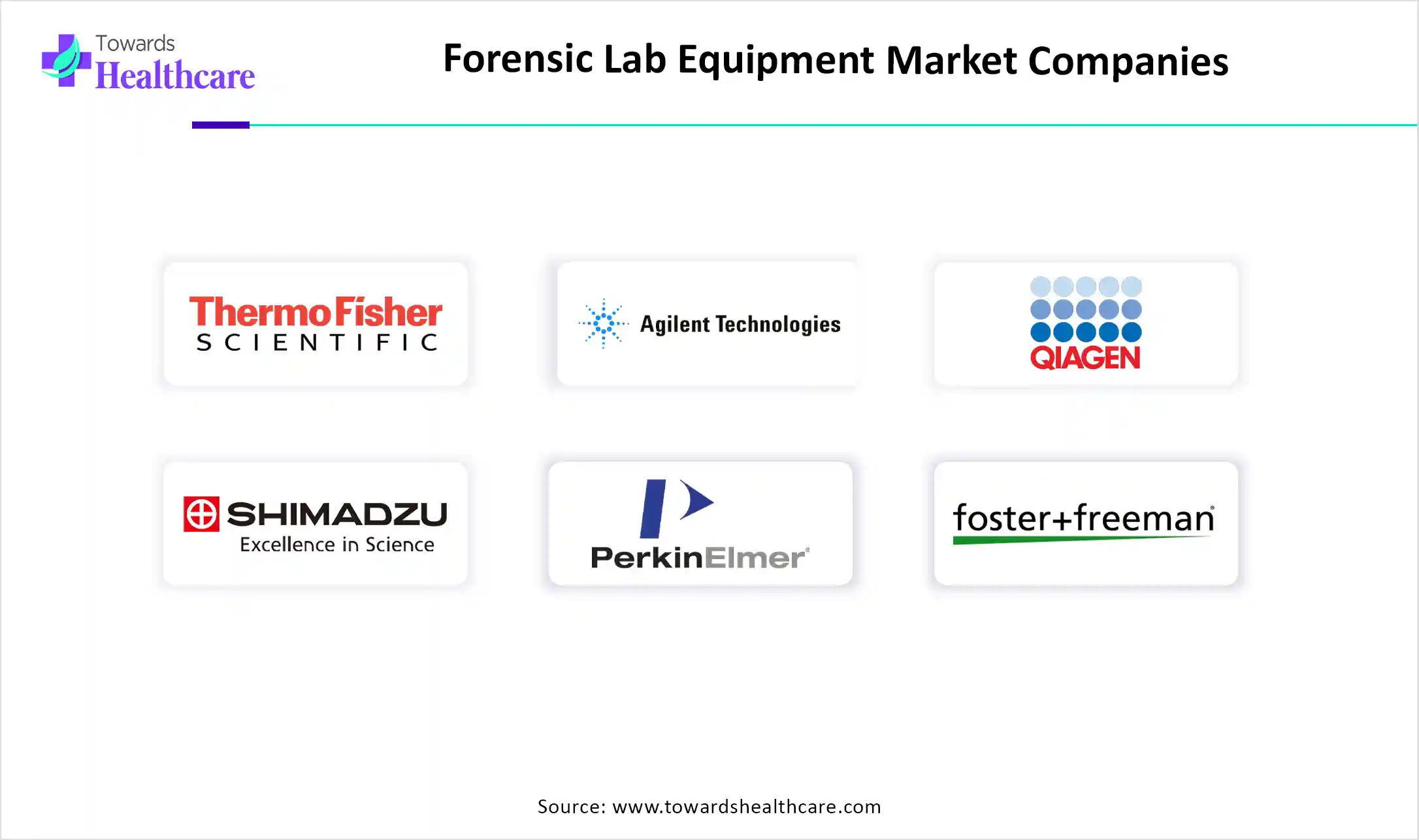
| Top Key Players | Thermo Fisher Scientific Inc., Agilent Technologies, QIAGEN N.V., Shimadzu Corporation, PerkinElmer, Foster+Freeman, Sirchie, Cyint Technologies, Pelorus Technologies, Fingerprint Master |
Why Did the DNA Analysis Equipment Segment Dominate in the Forensic Lab Equipment Market in 2025?
The DNA analysis equipment segment held the largest share in the market in 2025, due to its high accuracy. This increased their use in a wide range of crime scenes. At the same time, the growth in crime rates and advancements in DNA analysis technologies also increased their adoption rates.
Toxicology Equipment
The toxicology equipment segment is expected to show the highest growth during the predicted time, due to growing drug abuse cases. Additionally, increasing poisoning-related crime is also increasing its demand. Moreover, growing stringent regulations are also increasing their use for investigative purposes.
How Government Laboratories Segment Dominated the Forensic Lab Equipment Market in 2025?
The government laboratories segment led the market in 2025, as they are preferred as the primary site of investigation. The growth in crimes also increased their preference, and the growth in government funding also promoted the use of various advanced forensic lab equipment.
Law Enforcement Agencies
The law enforcement agencies segment is expected to show the fastest growth rate during the predicted time, due to the growing number of various crimes. This, in turn, is increasing the demand for rapid and on-site forensic testing equipment. Moreover, the growing government support is also driving the development of various advanced and portable equipment.
Which Technology Type Segment Held the Dominating Share of the Forensic Lab Equipment Market in 2025?
The mass spectrometry segment held the dominating share in the market in 2025, due to its high sensitivity. Additionally, their enhanced accuracy and wide range of applications also increased their use for the drugs testing applications. Furthermore, their rapid analysis also increased their acceptance rates.
PCR Technology
The PCR technology segment is expected to show the highest growth during the upcoming years, due to its faster results and enhanced sensitivity. This is increasing their use in the DNA analysis applications. Furthermore, their ability to offer results with a small sample size is increasing their acceptance rates.
What Made DNA Profiling the Dominant Segment in the Forensic Lab Equipment Market in 2025?
The DNA profiling segment led the market in 2025, due to its enhanced accuracy, which increased its use in the identification of individuals. Moreover, they also offered results with minute or degraded biological samples, which increased their use in a wide range of crime investigations.
Drug Testing
The drug testing segment is expected to show the fastest growth rate during the upcoming years, due to growing drug-related crimes. The increasing drug abuse and workplace regulations are also increasing their use. They are also being used in the identification of synthetic and designer drugs, driving their adoption rates.
North America dominated the forensic lab equipment market in 2025, due to the presence of advanced forensic laboratories, which increased the early adoption of forensic lab equipment. The growth in government investments and regulations also increased their adoption rates, which contributed to the market growth.
U.S. Market Trends
The growing adoption of advanced forensic lab equipment and government investments in the U.S. are creating new opportunities. Additionally, growing stringent regulations and expanding forensic labs are also increasing their demand, which is promoting their R&D and early adoption.
Canada Market Trends
The growth of Canada’s forensic lab equipment market is increasing steadily due to increased funding for criminal investigations, advances in forensic science technology, and the increased need for accurate evidence evaluation. Government agencies and forensic labs are using high-tech analytical equipment to increase rates of case resolutions and to promote public safety.
Mexico Market Trends
The Mexican forensic lab equipment market is expanding due to the government’s desire to combat crime, develop forensic capabilities, and improve the level of law enforcement infrastructure. An increase in the need for DNA analysis, toxicology testing, and digital forensics is promoting the growth of this market.
Asia Pacific is expected to host the fastest-growing forensic lab equipment market during the forecast period, due to growing government investments. The growing crime rates and expanding forensic labs are also increasing their demand. Additionally, increasing innovations and stringent regulations are also enhancing the market growth.
India Market Trends
The growing government initiatives in India are expanding the forensic infrastructure, driving the demand for various forensic equipment. The growing crime rates and expanding DNA databases are also increasing the adoption of advanced technologies, where growth in the skilled personnel is also increasing their use.
Japan Market Trends
Japan’s forensic lab equipment market benefits from technological advances and a strong commitment from the Japanese government to provide a high-quality law enforcement system. Increased use of DNA profiling, toxicology testing, and digital forensics will contribute to the growth of the Japanese forensic lab equipment market.
China Market Trends
China is one of the fastest-growing forensic lab equipment markets in the world, largely due to expanding capabilities in forensic science, increasing government investment in public safety, and new technological methods. The rising need for precision analytical instruments and forensic testing methods is driving the continued growth of this market.
Europe is expected to grow significantly in the forensic lab equipment market during the forecast period, due to increasing adoption of advanced technologies. At the same time, the presence of robust forensics infrastructure and regulatory framework is also encouraging their use, where growing government funding is also promoting the market growth.
UK Market Trends
The UK consists of advanced forensic infrastructures, which are increasing the adoption of advanced technologies. The growing government investments and expanding digital forensics are also increasing their demand, where companies are collaborating to develop advanced equipment.
Germany Market Trends
Germany is a prominent market for forensic lab equipment in the European region, attributed to its well-established forensic research infrastructure, solid judicial system, and highly developed technology for analysis. The demand for DNA analysis, trace evidence analysis, and toxicological testing is propelling the growth of the forensic lab equipment market.
Netherlands Market Trends
The Netherlands' growth in the forensic lab equipment sector is consistent and on the rise, driven by world-class forensic science programs, increased demand from law enforcement for investigative support, and strong research bases for forensic science applications. The implementation of cutting-edge laboratory equipment is enhancing the overall effectiveness and impact of forensics by increasing laboratory accuracy and improving lab operational efficiency.
| Category | Key Players / Ecosystem Role | Explanation |
| Technology Providers | Thermo Fisher Scientific, Agilent Technologies, SCIEX, Waters Corporation | Provide analytical technologies such as mass spectrometry, chromatography, spectroscopy, and molecular analysis systems used in forensic laboratories |
| Product Manufacturers | QIAGEN, Promega, Illumina, Shimadzu, PerkinElmer | Develop DNA analysis tools, sequencing platforms, PCR systems, and laboratory instruments |
| Service Providers | Foster + Freeman, Sirchie, SPEX Forensics | Supply forensic investigation equipment, crime scene tools, evidence collection systems, and laboratory solutions |
| Platform Providers | Cellebrite, Magnet Forensics, OpenText | Provide digital forensic platforms for evidence extraction, investigation, and analysis |
| CROs/CDMOs | Not a major category in this market | Forensic equipment does not rely heavily on CRO/CDMO outsourcing |
| Software Vendors | Cellebrite, Magnet Forensics, MSAB | Provide digital investigation software and forensic data analysis platforms |
| Research Institutions | National forensic laboratories, university forensic science programs | Develop forensic methods, validation studies, and investigative technologies |
| End-User Industries | Government agencies, police departments, judicial systems, security organizations | Major buyers and users of forensic laboratory technologies |
R&D
Clinical Trials and Regulatory Approvals
Packaging and Serialization
Patient Support and Services
| Tier 1 | Tier 2 | Tier 3 | |
| Market Influence (%) | 62% | 27% | 11% |
| Tier 1 | ||||
| Company Name | Headquarters | Country | Why Relevant to This Market | Key Products/Services |
| Thermo Fisher Scientific | Waltham, Massachusetts, USA | USA | Global leader in analytical science and life science instrumentation with strong forensic laboratory adoption | Mass spectrometry systems, chromatography systems, DNA analysis solutions, forensic toxicology instruments |
| Agilent Technologies | Santa Clara, California, USA | USA | Major analytical instrumentation provider widely used in forensic chemistry and toxicology laboratories | GC-MS, LC-MS, chromatography systems, forensic analysis solutions |
| QIAGEN | Venlo, Netherlands | Netherlands | Leading molecular diagnostics company with strong forensic DNA analysis presence | DNA extraction kits, PCR solutions, forensic identification technologies |
| Tier 2 | ||||
| Company Name | Headquarters | Country | Why Relevant to This Market | Key Products/Services |
| PerkinElmer | Shelton, Connecticut, USA | USA | Provides analytical and laboratory technologies used in forensic applications | Spectroscopy, chromatography, analytical instruments |
| Promega Corporation | Madison, Wisconsin, USA | USA | Specialized provider of forensic DNA testing solutions | STR analysis kits, DNA amplification products, forensic identification tools |
| Foster + Freeman | Evesham, England | UK | Specialist forensic technology company with strong crime laboratory presence | Fingerprint enhancement systems, document examination equipment, forensic imaging |
| Tier 3 | ||||
| Company Name | Headquarters | Country | Why Relevant to This Market | Key Products/Services |
| Cellebrite | Petah Tikva | Israel | Leading digital forensic investigation technology provider | Mobile device extraction, digital evidence analysis platforms |
| Magnet Forensics | Waterloo, Ontario | Canada | Specialized digital forensic software company used by investigators globally | Digital evidence management, investigation software |
| MSAB | Stockholm | Sweden | Digital forensic technology provider supporting law enforcement | Mobile forensic extraction tools |
Strengths
Weaknesses
Opportunities
Threats
In January 2026, Haryana Director-General of Police (DGP) Ajay Singhal introduced a forward-looking strategy to revolutionize the state's criminal justice system, setting a strict deadline where all forensic analysis reports must be completed and issued within 30 days. New DNA divisions will be established in Hisar and Panchkula, while infrastructure expansion projects at RFSL Bhondsi and Hisar, sanctioned at Rs 32.58 crore, will be fast-tracked to enhance capacity,” the police spokesperson said. Singhal said Haryana had undertaken its largest-ever expansion of forensic manpower. Of 243 newly sanctioned posts, 97 appointments have already been completed, while recruitment for 323 more positions is underway.
By Type
By End User
By Technology
By Application
By Region





Principal Consultant
Shivani Zoting is a dedicated research analyst specializing in the healthcare industry. With a strong academic foundation, a B.Sc. in Biotechnology and an MBA in Pharmabiotechnology, she brings a unique blend of scientific understanding and strategy.
Learn more about Shivani Zoting
Reviewed By
Aditi Shivarkar is a seasoned professional with over 14 years of experience in healthcare market research. As a content reviewer, Aditi ensures the quality and accuracy of all market insights and data presented by the research team.
Learn more about Aditi Shivarkar