


The global healthcare digital authentication market size was estimated at USD 5.04 billion in 2025 and is predicted to increase from USD 5.8 billion in 2026 to approximately USD 20.46 billion by 2035, expanding at a CAGR of 15.04% from 2026 to 2035.
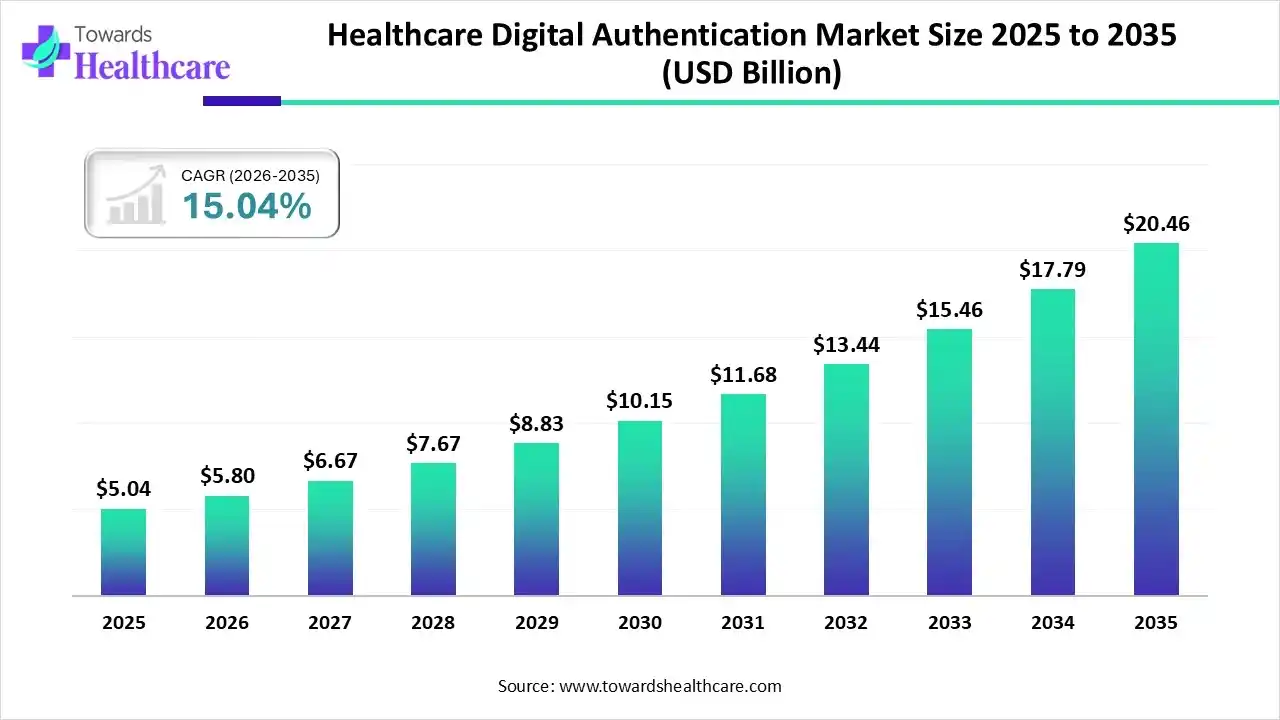
The market is growing due to rising cyber threats, strict privacy regulations, increasing telehealth adoption, and the need to secure patient identities and sensitive medical records across digital healthcare platforms.
Healthcare digital authentication is the process of verifying the identity of patients, providers, and systems using secure digital methods to ensure safe access to healthcare data, applications, and services while preventing unauthorized use. The healthcare digital authentication market is expanding due to increasing cybersecurity on healthcare system, growing adoption of electronic health records and telehealth services, and strict regulatory requirements for data privacy. Rising use of cloud platforms, connected medical devices, and the need to prevent identity fraud while ensuring secure access for patients and providers are further accelerating market growth.
AI enhances the healthcare digital authentication market by enabling advanced biometric verification, real-time fraud detection, and adaptive risk-based access controls. Machine learning analyzes user behavior patterns to identify anomalies, reduce identity theft, and improve authentication accuracy while ensuring seamless, fast, and secure access to healthcare systems and patient data.
Rising Adoption of Biometric Authentication
Healthcare providers are increasingly adopting fingerprint, facial, and iris recognition to replace passwords. Biometric methods enhance security, reduce identity fraud, and improve user convenience for patients and healthcare professionals accessing digital systems.
Expansion of Telehealth and Remote Access
The growing use of telemedicine, mobile health apps, and remote patient monitoring is increasing demand for secure digital authentication. Strong identity verification ensures safe access to virtual consultations, electronic health records, and connected healthcare platforms.
Stricter Data Privacy and Regulatory Requirements
Governments and regulatory bodies are enforcing stricter healthcare data protection laws. Compliance with regulations such as HIPAA and GDPR is driving healthcare organizations to invest in robust digital authentication solutions to safeguard sensitive patient information.
| Key Elements | Scope |
| Market Size in 2026 | USD 5.8 Billion |
| Projected Market Size in 2035 | USD 20.46 Billion |
| CAGR (2026 - 2035) | 15.04% |
| Leading Region | North America by 38.5% |
| Historical Data | 2020 - 2023 |
| Base Year | 2025 |
| Forecast Period | 2026 - 2035 |
| Measurable Values | USD Millions/Units/Volume |
| Market Segmentation | By Type, By Technology, By Deployment Mode, By Application, By Region |
| Top Key Players | NEC Corporation, Thales Group, Fujitsu Limited, HID Global Corporation, IDEMIA, BIO-key International, Inc., Aware, Inc. |
| Segments | Shares % |
| Single-Factor Authentication | 62% |
| Multi-Factor Authentication (MFA) | 38% |
Why Did the Single-factor Authentication Segment Dominate in the Market in 2025?
The single-factor authentication segment dominated the healthcare digital authentication market with a share of approximately 62% in 2025 due to its low implementation cost, ease of deployment, and compatibility with existing healthcare IT systems. Many small and mid-sized healthcare providing preferred if for basic security needs, faster access, and minimal training requirements, especially in resource-constrained settings and developing healthcare markets.
Multi-factor Authentication (MFA)
The multi-factor authentication (MFA) segment is expected to grow at the fastest CAGR due to rising cybersecurity, stricter data protection regulations, and increasing digitization of healthcare services. Healthcare organizations are adopting MFA to strengthen security by combining biometrics, passwords, and one-time codes, ensuring safer access to electronic health records, telehealth platforms, and cloud-based healthcare systems.
| Segments | Shares % |
| Biometric Authentication | 38% |
| PIN/Password-Based | 27% |
| Smart Card Authentication | 20% |
| Multimodal Authentication | 15% |
How the Biometric Authentication Segment Dominated the Healthcare Digital Authentication Market in 2025?
The biometric authentication segment dominated the market with a revenue share of approximately 38% in 2025 due to its high accuracy, convenience, and strong protection against identity fraud. Technologies such as fingerprint, facial, and iris recognition enabled faster, password-free access to healthcare systems, improved patient identification, reduced data breaches, and supported compliance with strict healthcare data security regulations.
Multimodal Authentication
The multimodal authentication segment is expected to grow at the fastest CAGR during the forecast period due to increasing demand for highly secure and reliable access solutions in healthcare. By combining multiple verification methods, such as biometrics, passwords, and smart cards. It minimizes fraud, ensures accurate patient identification, and supports compliance with stringent data protection regulations, making it ideal for advanced digital healthcare systems.
| Segments | Shares % |
| On-Premise | 45% |
| Cloud-Based | 55% |
Why the On-Premise Segment Dominated the Healthcare Digital Authentication Market?
The on-premise segment dominated the market with a share of approximately 45% because it offers organizations full control over their security infrastructure and sensitive patient data. Healthcare providers preferred on-premise solutions for compliance with strict data privacy regulations, reduced dependence on external networks, and the ability to customize systems according to internal protocols, ensuring secure and reliable access to electronic health records and critical healthcare applications.
Cloud-Based
The cloud-based segment is expected to grow at the fastest CAGR during the forecast period due to increasing adoption of cloud healthcare solutions, telemedicine, and mobile health applications. Cloud-based authentication offers scalability, cost-efficiency, remote accessibility, and easier integration with multiple healthcare systems, enabling secure patient and provider access while reducing IT infrastructure burdens and supporting compliance with evolving data privacy regulations.
| Segments | Shares % |
| Patient Identification & Tracking | 34% |
| Medical Record Security & Data Protection | 30% |
| Workforce Management | 20% |
| Pharmacy Dispensing | 16% |
Why Did the Patient Identification & Tracking Segment Dominate in the Market in 2025?
The patient identification & tracking segment dominated the healthcare digital authentication market with a share of approximately 34% in 2025 due to the critical need for accurate patient verification and real-time monitoring. Hospitals and clinics prioritized solutions that reduce medical errors, prevent identity fraud. streamline patient admission, and ensure proper treatment administration, while complying with stringent data privacy regulations, making this application essential in enhancing safety and operational efficiency.
Medical Record Security & Data Protection
The medical record security & data protection segment is expected to grow at the fastest CAGR during the forecast period due to increasing digitization of healthcare data and rising cyber threats. Healthcare organizations are investing in robust digital authentication solutions to safeguard electronic health records, prevent data breaches, ensure regulatory compliance, and maintain patient trust, driving strong demand for secure and reliable medical data protection systems.
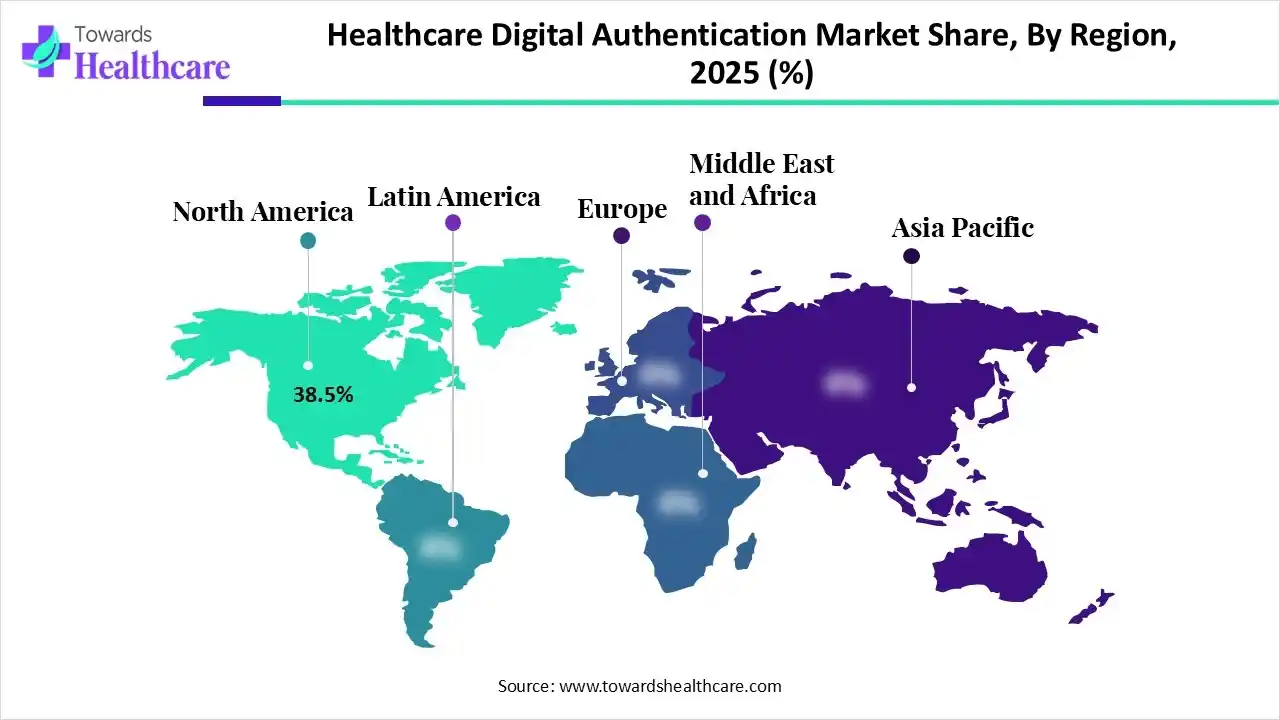
North America dominated the market with share of 38.50% in 2025 due to high adoption of advanced healthcare IT systems, widespread use of electronic health records, and stringent data privacy regulations such as HIPAA. The region’s robust healthcare infrastructure, rising cyber threats, and strong investment in secure digital solutions encouraged healthcare providers to implement advanced authentication technologies, ensuring patient data security and streamlined access across hospitals and telehealth platforms.
U.S. Sets the Standard in Digital Security Leadership 2025
The U.S. led the healthcare digital authentication market in 2025 by capturing the largest revenue share due to advanced healthcare infrastructure, high adoption of electronic health records, and strict data privacy regulations like HIPAA. Growing cyber threats, rising telehealth services, and significant investments in secure authentication technologies further strengthened the country’s market leadership and revenue dominance.
Asia Pacific is anticipated to grow at the fastest CAGR in the healthcare digital authentication market by 22% share in 2025 during the forecast period due to rapid digitization of healthcare systems, increasing telemedicine adoption, and rising awareness of data security. Investments in advanced IT infrastructure, government initiatives for digital healthcare, and growing demand for secure patient identification and record protection are driving this accelerated market growth.
India On Fast-Track to Digital Healthcare Security
India is anticipated to grow at a rapid CAGR in the healthcare digital authentication market during the forecast period due to increasing adoption of digital health platforms, telemedicine, and electronic health records. Government initiatives to strengthen healthcare IT infrastructure, rising awareness of patient data security, and growing investments in advanced authentication solutions are driving strong demand and rapid market expansion across the country.
Europe is expected to grow at a notable CAGR in the healthcare digital authentication market by 27% share in 2025 during the forecast period due to stringent data protection regulations like GDPR, increasing adoption of electronic health records, and rising cybersecurity concerns. Healthcare providers are investing in advanced authentication solutions to ensure secure patient identification, safeguard medical data, and comply with regulatory requirements, driving steady market growth across the region.
UK Accelerates in Digital Healthcare Security Growth
The UK is expected to grow at a rapid CAGR in the healthcare digital authentication market during the forecast period due to increasing digitization of healthcare services, widespread adoption of electronic health records, and strict data privacy regulations. Rising cyber threats, growing telemedicine use, and government initiatives to enhance secure patient identification use, and government initiatives to enhance secure patient identification and medical data protection are driving strong demand for advanced authentication solutions across the country.
| Companies | Headquarters | Offerings |
| NEC Corporation | Tokyo, Japan | Offers advanced biometric authentication solutions, including multimodal facial, fingerprint, and iris recognition systems that provide secure identity verification and access control for healthcare and enterprise applications. |
| Thales Group | France | Provides identity and digital security technologies with integrated biometric authentication (face, fingerprint, iris) and secure access solutions used for verification, data protection, and secure system access across healthcare and other sectors. |
| Fujitsu Limited | Tokyo, Japan | Supplies biometric authentication systems, such as PalmSecure contactless palm-vein recognition, and multimodal biometric platforms to secure identity verification, access control, and data protection in healthcare environments |
| HID Global Corporation | Texas, USA | Delivers secure identity and access management solutions with biometric readers, smart credentials, and multifactor authentication products to manage healthcare user access and protect sensitive data |
| IDEMIA | Courbevoie, France | Provides multimodal biometric and identity verification technologies (fingerprint, facial, iris), secure authentication platforms, and credentialing solutions that support secure patient and provider verification in digital healthcare. |
| BIO-key International, Inc. | New Jersey, USA | Offers identity and access management (IAM) solutions with biometric authentication, passwordless login, multifactor authentication tools like PortalGuard, and biometric scanners to enhance secure access to healthcare systems. |
| Aware, Inc. | Massachusetts, USA | Provides biometric software and services, including fingerprint, face, iris, and voice recognition SDKs and platforms that support secure authentication and identity verification across healthcare and other industries. |
Strengths
Weaknesses
Opportunities
Threats
By Type
By Technology
By Deployment Mode
By Application
By Region





Principal Consultant
Shivani Zoting is a dedicated research analyst specializing in the healthcare industry. With a strong academic foundation, a B.Sc. in Biotechnology and an MBA in Pharmabiotechnology, she brings a unique blend of scientific understanding and strategy.
Learn more about Shivani Zoting
Reviewed By
Aditi Shivarkar is a seasoned professional with over 14 years of experience in healthcare market research. As a content reviewer, Aditi ensures the quality and accuracy of all market insights and data presented by the research team.
Learn more about Aditi Shivarkar










