


The global healthcare information system market size is predicted to increase from USD 662.99 billion in 2026 to approximately USD 1967.99 billion by 2035, expanding at a CAGR of 12.85% from 2026 to 2035.
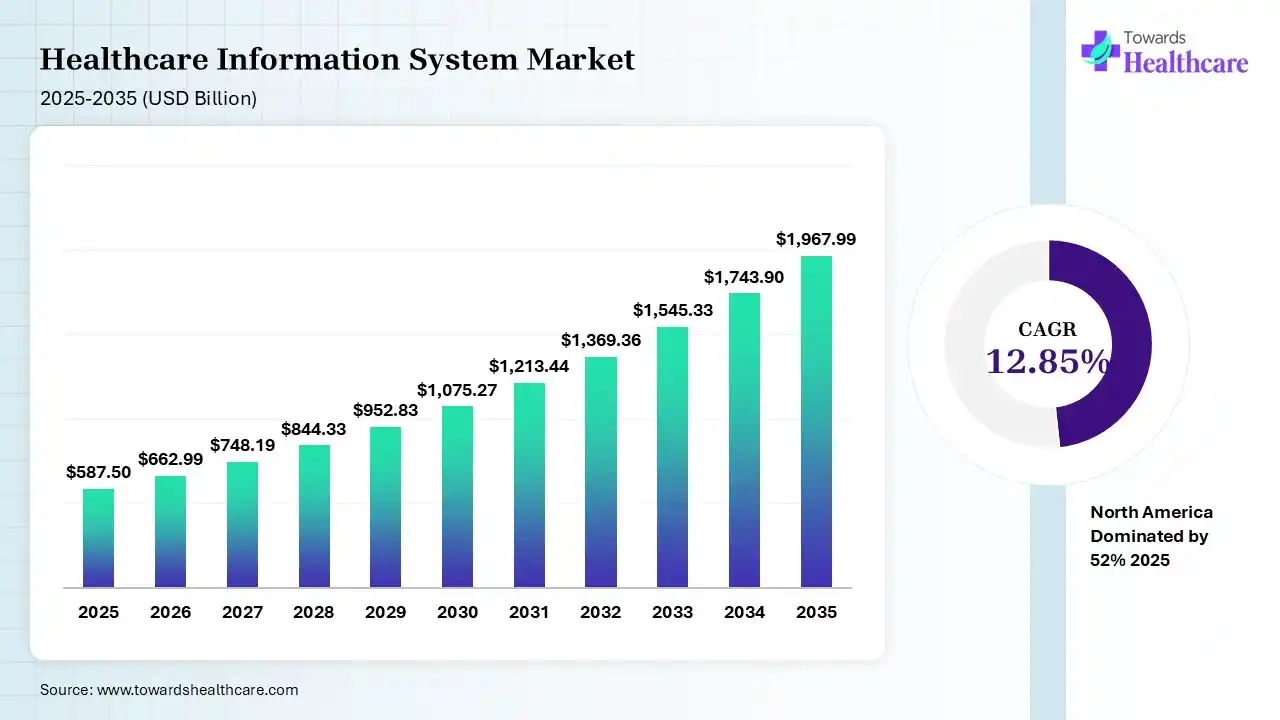
The rapid digital transformation of the healthcare sector is increasing the use of healthcare information systems. Additionally, growth in AI integration, remote patient monitoring, the development of cloud-based platforms, and their launches are also promoting the market growth.
The healthcare information system market is driven by the transition towards digital-first medical environments and value-based care. The healthcare information system encompasses systems, digital platforms, and software used for the management of healthcare data, hospital operations, patient records, and billing practices. These systems reduce administrative burden and medical errors, making healthcare faster, data-driven, more efficient, and safer.
A healthcare information system (HIS) is a digital platform that manages, stores, and exchanges clinical, administrative, and financial healthcare data to improve care delivery and operational efficiency. The market is growing due to expanding AI integration, cloud-based platforms, interoperability, telehealth adoption, and data-driven decision-making, creating opportunities for smarter, connected, and patient-centric healthcare ecosystems.
AI is being integrated into the healthcare information system for the detection of various diseases and for the prediction of disease outbreaks and treatment outcomes. It also offers a personalized treatment plan, patient monitoring, and help in maintaining medical records. It also automates billing, claim processing, and scheduling, where their virtual assistance and chatbots also promote remote healthcare.
Rapid Healthcare Digitalization
Rapid digital transformation of the healthcare sector is increasing the adoption of healthcare information systems for efficient data management, improved communication, and faster healthcare services.
Expanding Telemedicine Platforms
The increasing adoption of telemedicine due to growing internet and smartphone penetration is increasing their use for remote patient monitoring, online doctor consultation, and virtual health services driving the demand for healthcare information systems.
Technological Advancements
Growing technological advancements are driving the development of cloud-based healthcare information systems and mobile health apps with improved data security and patient-centred care.
| Table | Scope |
| Market Size in 2026 | USD 662.99 Billion |
| Projected Market Size in 2035 | USD 1967.99 Billion |
| CAGR (2026 - 2035) | 12.85% |
| Leading Region | North America by 52% |
| Historical Data | 2020 - 2023 |
| Base Year | 2025 |
| Forecast Period | 2026 - 2035 |
| Measurable Values | USD Millions/Units/Volume |
| Market Segmentation | By Application, By Deployment, By Component, By End Use, By Region |
| Top Key Players | Epic Systems Corporation, Oracle Health, GE HealthCare, Philips Healthcare, Siemens Healthineers, McKesson Corporation, athenahealth, Veradigm, MEDITECH (Medical Information Technology, Inc.), CVS Health (Optum/Change Healthcare) |
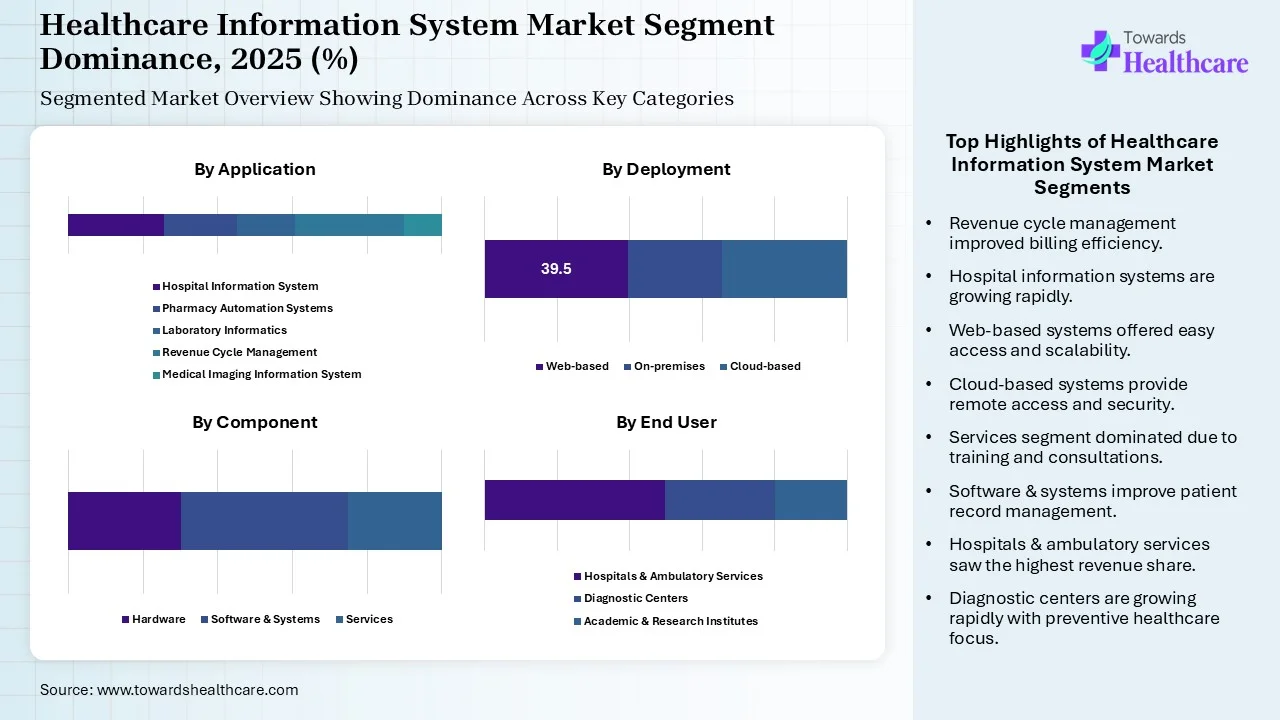
Why Did the Revenue Cycle Management Segment Dominate in the Healthcare Information System Market in 2025?
The revenue cycle management segment held the largest revenue share of the market in 2025, due to its automated and efficient billing process. This helped in improving the financial management and provided faster insurance claims with reduced errors and claims rejections, which increased their acceptance rates.
Hospital Information System
The hospital information system segment is expected to grow with the highest CAGR during the predicted time, due to growing healthcare digitalization, driving its use for enhanced data management and reducing administrative burden. Moreover, growing government support is also increasing its use to reduce medical errors.
How Web-based Segment Dominated the Healthcare Information System Market in 2025?
The web-based segment contributed the biggest revenue share of the market in 2025, due to its easy accessibility. They also offered regular system updates, improved scalability, and remote access, which increased their adoption rates, and their affordable installation also increased their use.
Cloud-based
The cloud-based segment is expected to show the highest growth during the predicted time, driven by its remote accessibility and affordability. Their automatic updates, easy integration, and data backup features are also increasing their use, where their faster deployment and improved security are also increasing their utilization.
Which Component Type Segment Held the Dominating Share of the Healthcare Information System Market in 2025?
The services segment held the dominating share of the market in 2025, due to growth in the training and educational programs. This increased the use of healthcare information systems, which offered best practices and consultations, where their integration with other hospital systems, regular updates, and maintenance also increased their use.
Software & Systems
The software & systems segment is expected to expand rapidly in the market during the upcoming years, due to its efficient management of electronic patient records and seamless scheduling. Their flexibility, remote access, easy integration, and patient-centric care are also increasing their adoption rates.
What Made Hospitals & Ambulatory Services the Dominant Segment in the Healthcare Information System Market in 2025?
The hospitals & ambulatory services segment accounted for the highest revenue share of the market in 2025, due to growth in the patient volume. Similarly, growth in the administrative burden also increased the use of healthcare information systems for comprehensive data management, revenue optimization, and improved patient outcomes.
Diagnostic Centers
The diagnostic centers segment is expected to show the fastest growth rate during the upcoming years, due to growing interest in preventive healthcare, which is increasing the use of healthcare information systems for diagnostic services. Their faster and seamless processing, test scheduling, and reporting are also promoting their use.
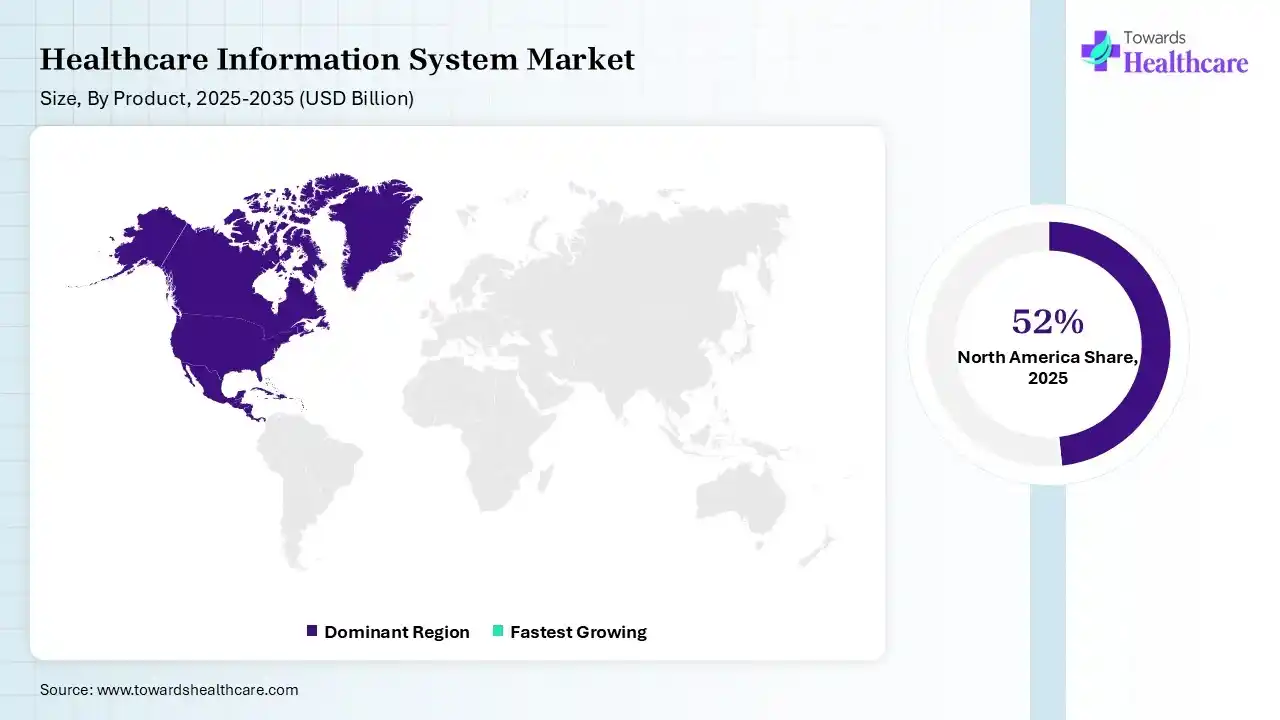
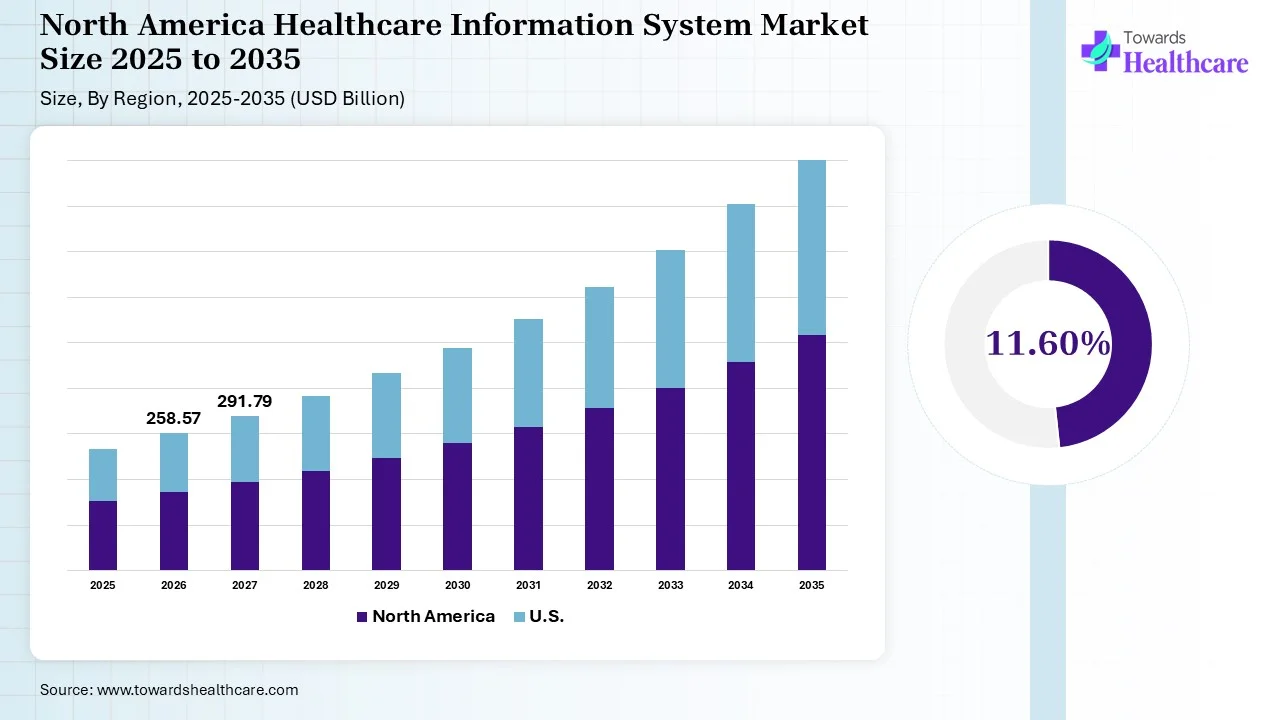
North America dominated the healthcare information system market by 52% in 2025, due to the presence of a well-developed healthcare infrastructure, which increased the use of healthcare information systems across various hospitals, research centres, and clinics. The growth in healthcare investment, skilled personnel, and technological advancements also contributed to the market growth.
U.S. Market Trends
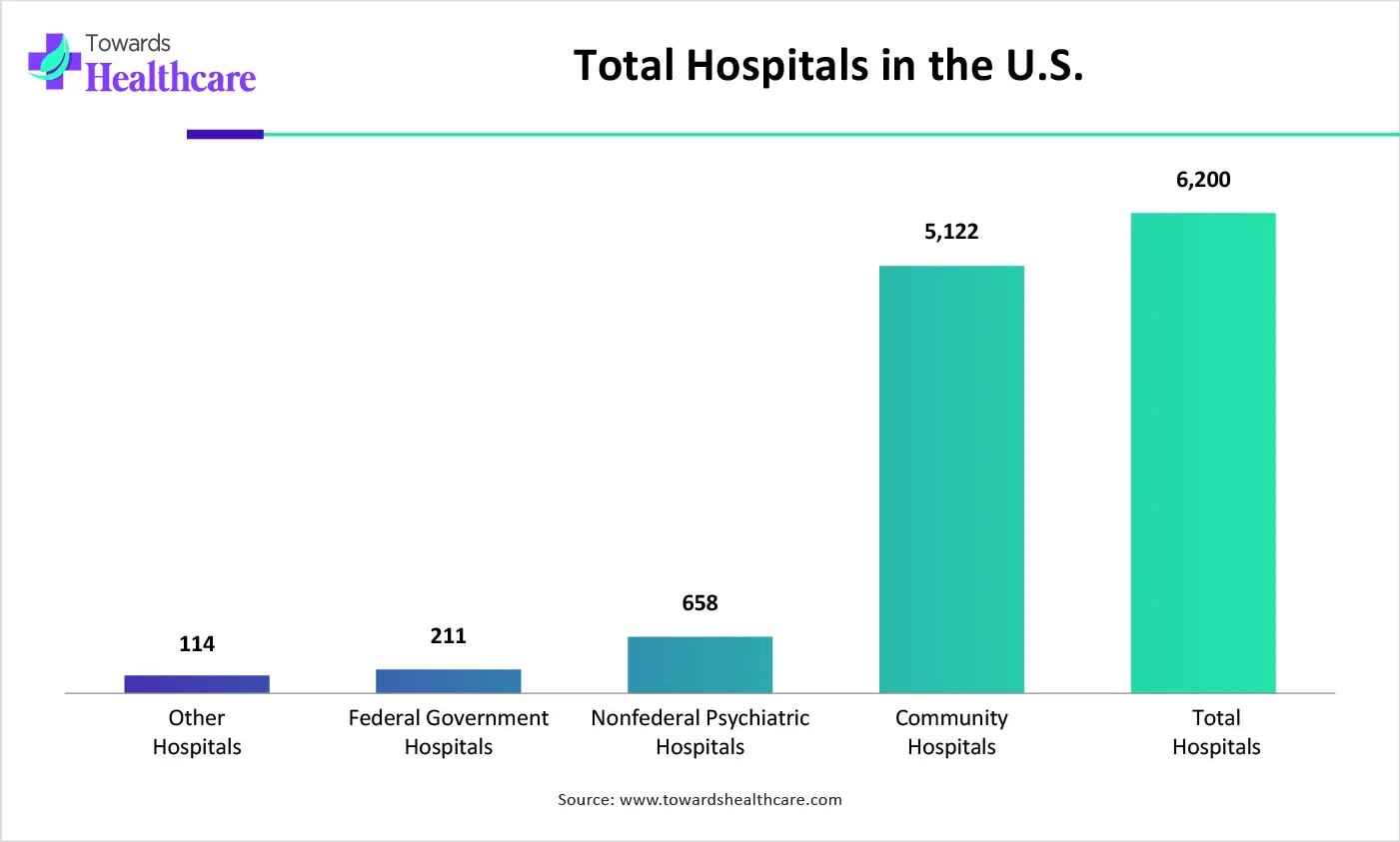
The U.S. consists of well-established healthcare infrastructures, which are driving the early adoption of healthcare information systems for various applications. Moreover, the growing healthcare spending is promoting the development of new platforms with improved features and security, which are also increasing their acceptance rates.
U.S. Healthcare Information Systems Marekt Thrives Through Digital Healthcare Innovation
The U.S. healthcare information systems market is growing due to widespread adoption of electronic health records, expanding telehealth services, and increasing investments in digital healthcare infrastructure. Rising demand for interoperable health data exchange, AI-driven clinical decision support, and value-based care models is accelerating market expansion. Strong government initiatives, healthcare IT modernization, and growing cybersecurity investments are further driving adoption across hospitals, clinics, and integrated healthcare networks.
Asia Pacific is expected to host the fastest-growing healthcare information system market during the forecast period, due to expanding healthcare infrastructure and growing disease burden, which is increasing the adoption of healthcare information systems. The growth of healthcare digitalization, telemedicine platforms, and government initiatives is also enhancing the market growth.
The presence of a large patient population and expanding healthcare are increasing the adoption of advanced systems, such as healthcare information systems for the management of various healthcare operations. The growing government initiatives, digital healthcare, and technological advancements are also increasing their adoption rates.
China Leads the Healthcare Information Systems Market Through Digital Health Expansion
China dominated the healthcare information systems market due to rapid healthcare digitization, large-scale hospital modernization, and strong government support for smart healthcare initiatives. Widespread adoption of electronic medical records. AI-powered healthcare platforms, and cloud-based hospital management systems have accelerated market growth. Increasing investments in healthcare IT infrastructure, expanding telemedicine services, and a large patient population continue to strengthen China’s leadership in the global healthcare information systems market.
India Emerges as the Fastest Growing Healthcare Information Systems Market
India is expected to growing at the fastest CAGR in the healthcare information systems market during the forecast period due to rapid healthcare digitization, expanding hospital infrastructure, and increasing adoption of cloud-based health IT solutions. Government initiatives promoting digital health, rising telemedicine usage, growing investments in healthcare technology, and increasing demand for electronic health records and AI-enabled clinical systems are accelerating market growth across the country.
Europe is expected to grow significantly in the healthcare information system market during the forecast period, due to growth in government initiatives promoting digital health policies and driving the adoption of healthcare information systems. The rising focus on patient safety and data privacy is also increasing their use and innovations, where expanding remote care is also promoting the market growth.
UK Market Trends
The presence of robust healthcare systems and increasing government initiatives is promoting the use of healthcare information systems across the UK. Additionally, increasing use of electronic health records and telemedicine platforms is also promoting their advancements and adoption across various hospitals and pharmacies.
Germany Market Trends
The rapid digital healthcare transformation across Germany increases the adoption of healthcare information systems. An increasing geriatric population and government initiatives are also driving their adoption rates. The growing interoperability requirements are also increasing their adoption.
Latin America is anticipated to show lucrative growth during the forecast period due to expanding digital healthcare. Increasing government initiatives and demand for electronic health records are also increasing the adoption of healthcare information systems, while rising healthcare expenditure is also increasing their use.
Argentina Market Trends
Growing government digital health initiatives and electronic health record adoption are increasing the use of healthcare information systems in Argentina. Expanding healthcare infrastructure is also improving their integration. Rising chronic disease burden is also encouraging their adoption.
Rest of Latin America Market Trends
Improving healthcare infrastructure in the rest of Latin America is increasing the demand for healthcare information systems. Expanding digital health services are also driving demand, where growing electronic health records are also enhancing data management. The growing use of telemedicine is also supporting their integration.
MEA is anticipated to show significant growth during the upcoming year due to rapid healthcare digitalization. Increasing government investments are also driving the adoption of healthcare information systems. At the same time, the growing need to improve operational efficiency is also driving demand.
GCC Countries Market Trends
Advancing healthcare infrastructure in the GCC countries is driving the demand for advanced digital healthcare tools. The growing government digital health initiatives are also increasing the integration of health information systems. The growing cloud computing and AI-based systems are also creating new opportunities.
Saudi Arabia Market Trends
The growing government initiatives in Saudi Arabia are supporting healthcare digitalization, which is driving the demand for healthcare information systems. Increasing chronic disease burden and healthcare investments are also supporting their adoption. Additionally, a rising focus on enhancing healthcare efficiency is also driving their adoption.
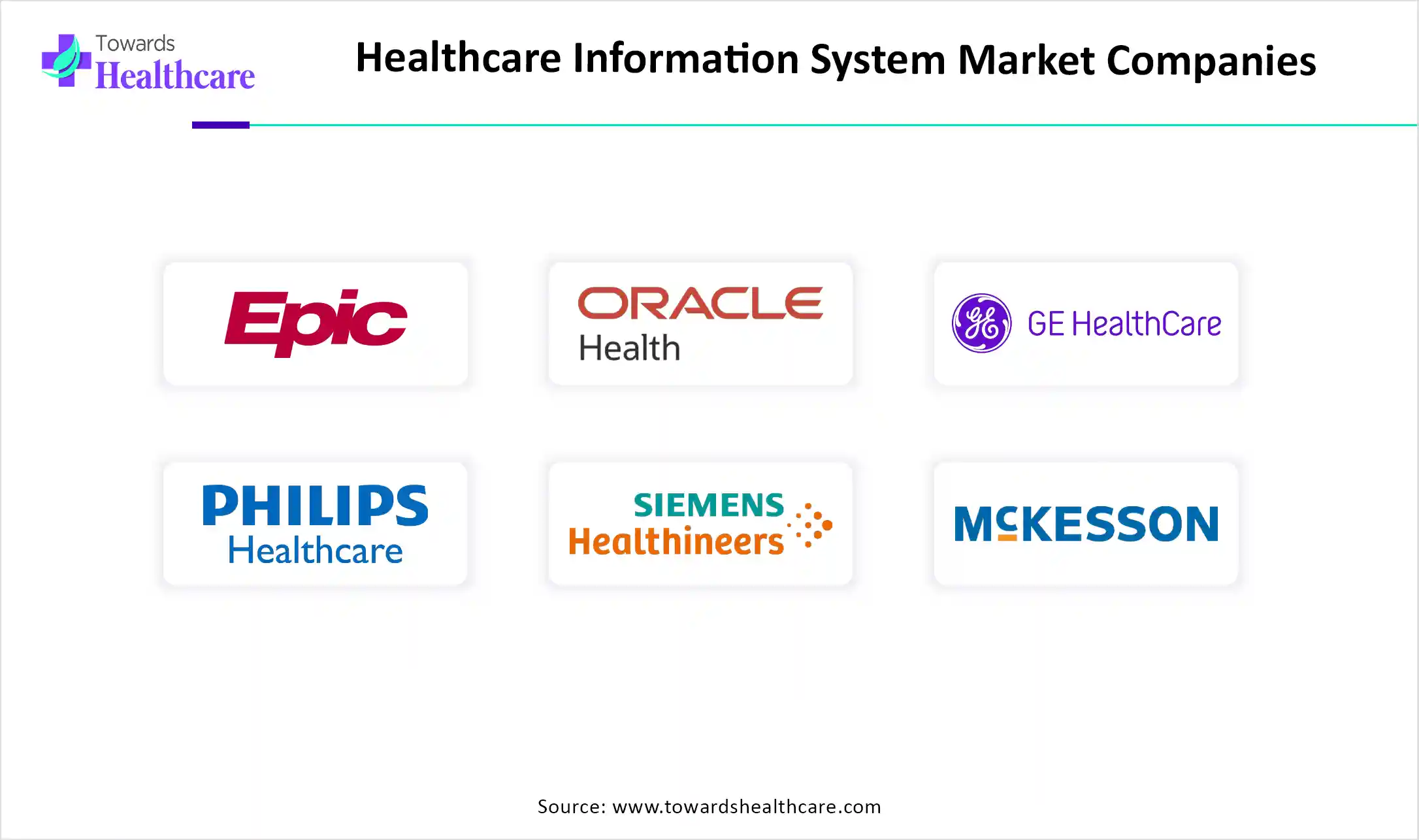
| Companies | Headquarters | Healthcare Information Systems |
| Epic Systems Corporation | Verona, U.S. | EpicCare, Epic Cosmos, and MyChart |
| Oracle Health | Austin, U.S. | Cerner Millennium, Oracle Health Data Intelligence, and HealtheIntent |
| GE HealthCare | Chicago, U.S. | Centricity and Edison Digital Health Platform |
| Philips Healthcare | Amsterdam, Netherlands | HealthSuite, Telenursing, and IntelliSpace |
| Siemens Healthineers | Erlangen, Germany | Syngo, AI-Rad Companion, and teamplay |
| McKesson Corporation | Irving, U.S. | RelayHealth, InterQual, and Paragon |
| athenahealth | Watertown, U.S. | athenaOne |
| Veradigm | Chicago, U.S. | Sunrise, Veradigm EHR, and Acuity |
| MEDITECH (Medical Information Technology, Inc.) | Westwood, U.S. | MEDITECH Expanse |
| CVS Health (Optum/Change Healthcare) | Woonsocket, U.S. | Interoperability solutions, Optum Performance Analytics, and Change Healthcare Clinical Network |
In April 2026, “Emerging technologies like AI can address critical health challenges, and this upcoming policy will provide a roadmap for its comprehensive application in health services”, said National Health Authority (NHA) CEO Dr Sunil Kumar.
By Application
By Deployment
By Component
By End Use
By Region







Principal Consultant
Payal Rabde is a Healthcare Market Research Analyst at Towards Healthcare Research & Consulting with 4+ years of experience in pharmaceuticals, biotechnology, medical devices, and life sciences.
Learn more about Payal Rabde

Reviewed By
Aditi Shivarkar is a seasoned professional with over 14 years of experience in healthcare market research. As a content reviewer, Aditi ensures the quality and accuracy of all market insights and data presented by the research team.
Learn more about Aditi Shivarkar









