

Pipeline Programs

CGT Companies Tracked

Manufacturing Facilities


The global hyaluronic acid market size was estimated at USD 11.54 billion in 2025 and is predicted to increase from USD 12.4 billion in 2026 to approximately USD 23.65 billion by 2035, expanding at a CAGR of 7.44% from 2026 to 2035.
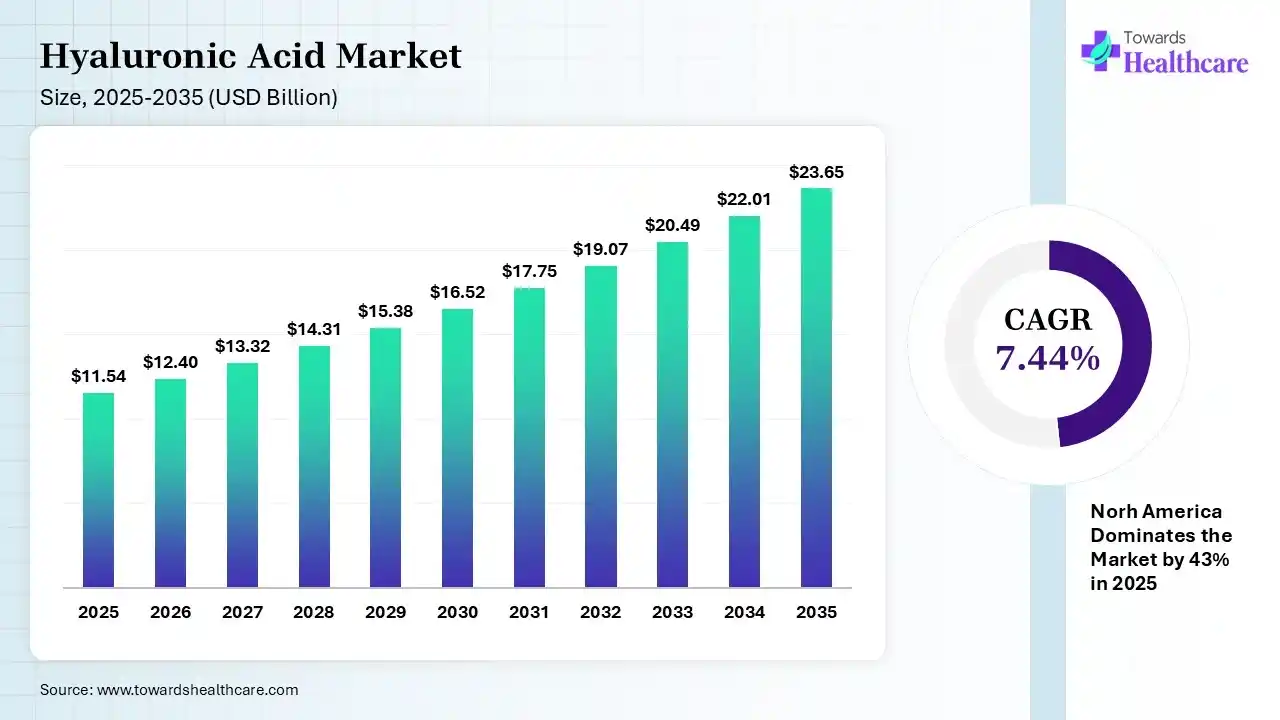
The hyaluronic acid market is growing due to its major applications in dermatology and cosmetics, superior biocompatibility and Safety, Aesthetic Procedures, cosmetics and personal care, osteoarthritis and joint care, and wound healing and regenerative medicine.
The hyaluronic acid market is growing, as hyaluronic acid gel fillers are injected to restore volume lost due to age or disease, provide facial contouring, and help maintain a youthful appearance. Hyaluronic acid filler is becoming popular because of its low allergic response, ease of injection, quick recovery, reproducibility, and immediate outcomes. Intra-articular injections of hyaluronic acid are broadly used, specifically for pain relief in patients with osteoarthritis of the knees. It has become popular as a non-surgical treatment modality, particularly with the concern most physicians have with reiterating intra-articular corticosteroid injections. HA is a significant ingredient in skincare for hydration and lowering wrinkles.
Hyaluronic acid is a naturally occurring polysaccharide found in the human body that retains moisture, lubricates joints, supports tissue repair, and is widely used in pharmaceuticals, medical devices, cosmetics, and aesthetic medicine. The hyaluronic acid market is growing due to rising demand for minimally invasive aesthetic procedures, increasing prevalence of minimally invasive aesthetic procedures, increasing prevalence of osteoarthritis, and expanding use in advanced skincare and orthopaedic treatments. Technological advancements in cross-linked formulation, bioengineered production methods, sustained-release drug delivery systems, and regenerative biomaterials are enhancing product performance and durability. Emereging trends include personalized aesthetic treatments, clean-label skincare products, and tissue-engineered application. Future opportunities lie in regenerative medicine, next-generation wound healing therapies, advanced orthopedic solutions, and precision dermatology, supported by continuous innovation in biotechnology and biomaterial science that broadens clinical and cosmetic application worldwide.
Integration of AI-driven technology in hyaluronic acid drives market growth, as integration of artificial intelligence (AI) allows modified treatment adjustments and early complication identification via real-time data analysis and predictive modeling. More evolving integration of HA-driven diagnostics and treatments with AI-based platforms allows the predictive modeling of HA behavior in tissues and personalized treatment regimens based on molecular profiling. Such novelties could speed up the healthcare translation of HA-based products in precision medicine, which drives the growth of the market.
| Table | Scope |
| Market Size in 2026 | USD 12.4 Billion |
| Projected Market Size in 2035 | USD 23.65 Billion |
| CAGR (2026 - 2035) | 7.44% |
| Leading Region | North America by 43% |
| Historical Data | 2020 - 2023 |
| Base Year | 2025 |
| Forecast Period | 2026 - 2035 |
| Measurable Values | USD Millions/Units/Volume |
| Market Segmentation | By Application, By Region |
| Top Key Players | Allergan, Sanofi, Genzyme Corporation, Salix Pharmaceuticals, F. Hoffmann-La Roche AG, Galderma Laboratories L.P |
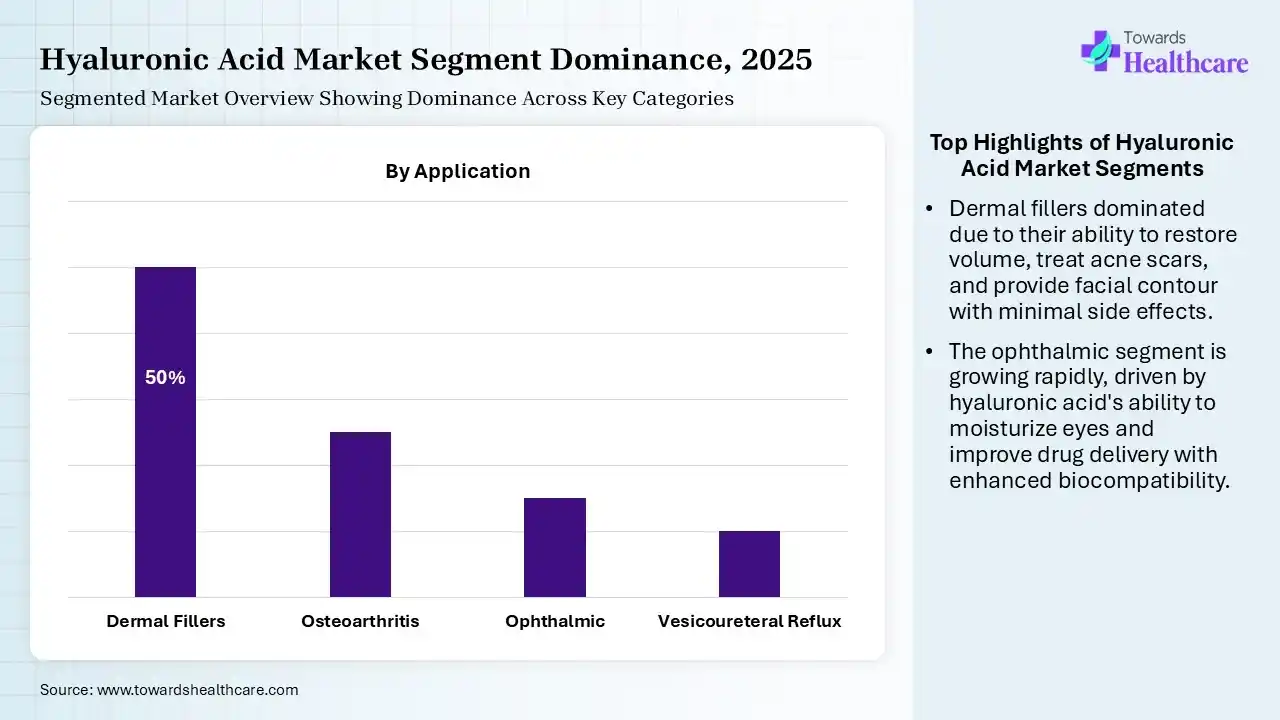
Which Application Segment Led the Hyaluronic Acid Market in 2025?
The dermal fillers segment held the dominant market by 50% in 2025, as hyaluronic acid gel fillers are injected to reinstate volume lost because of age or disease, offers facial contour, and supports maintain a youthful appearance. Filler injection is becoming one of the most commonly performed technologies in a dermatology cosmetic practice. Hyaluronic acid fillers have become popular due to their low allergic response, simple injection, rapid recovery, reproducibility, and immediate outcomes. These fillers support restoring natural shape and appearance, such as treating acne scars or adding shape to the lips.
Ophthalmic
Whereas the ophthalmic segment is the fastest-growing in the market, as hyaluronic acid moisturizes the eye, increases biocompatibility, and extends drug residence time to improve drug delivery. HA has remarkable properties that provide a wide range of therapeutic uses. HA has shown success as an efficient eye drop. HA coating can effectively enhance the intraocular migration of nanomaterials, specifically in the vitreous humour, because of charge-mediated repulsion among the anionic carboxylate anions of HA and the harmfully charged vitreal glycosaminoglycan moieties at physiological pH.
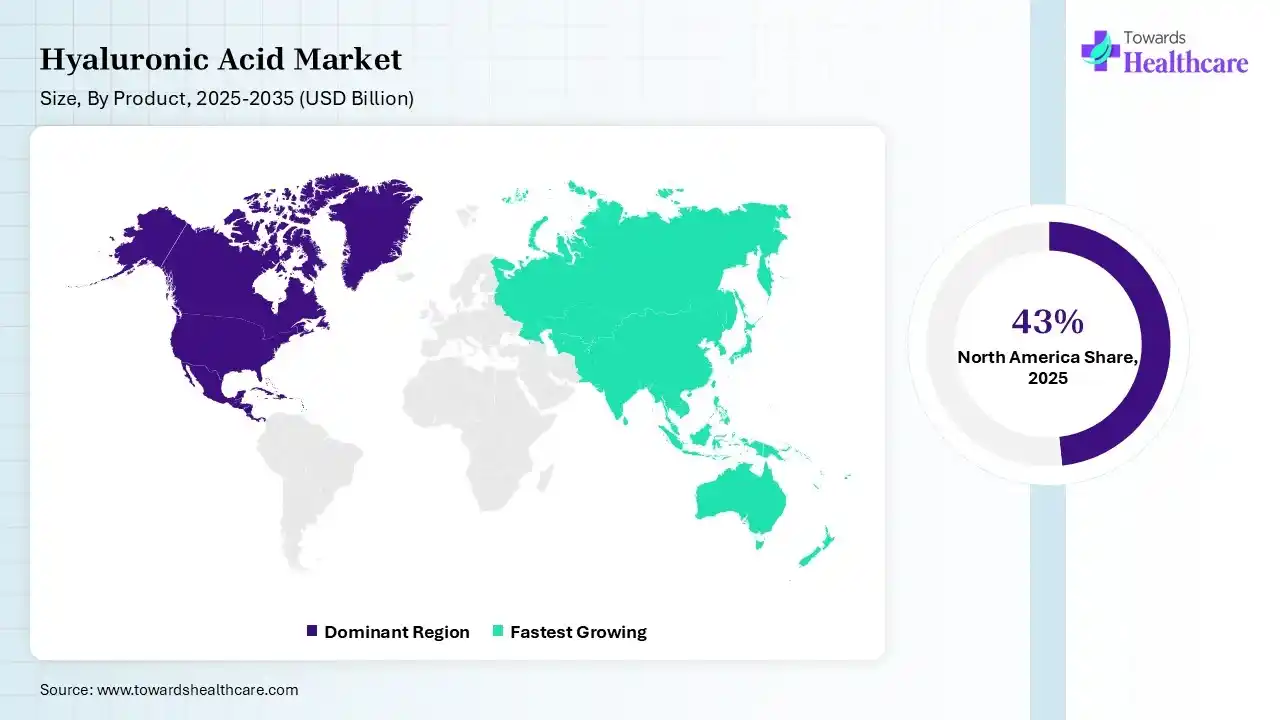
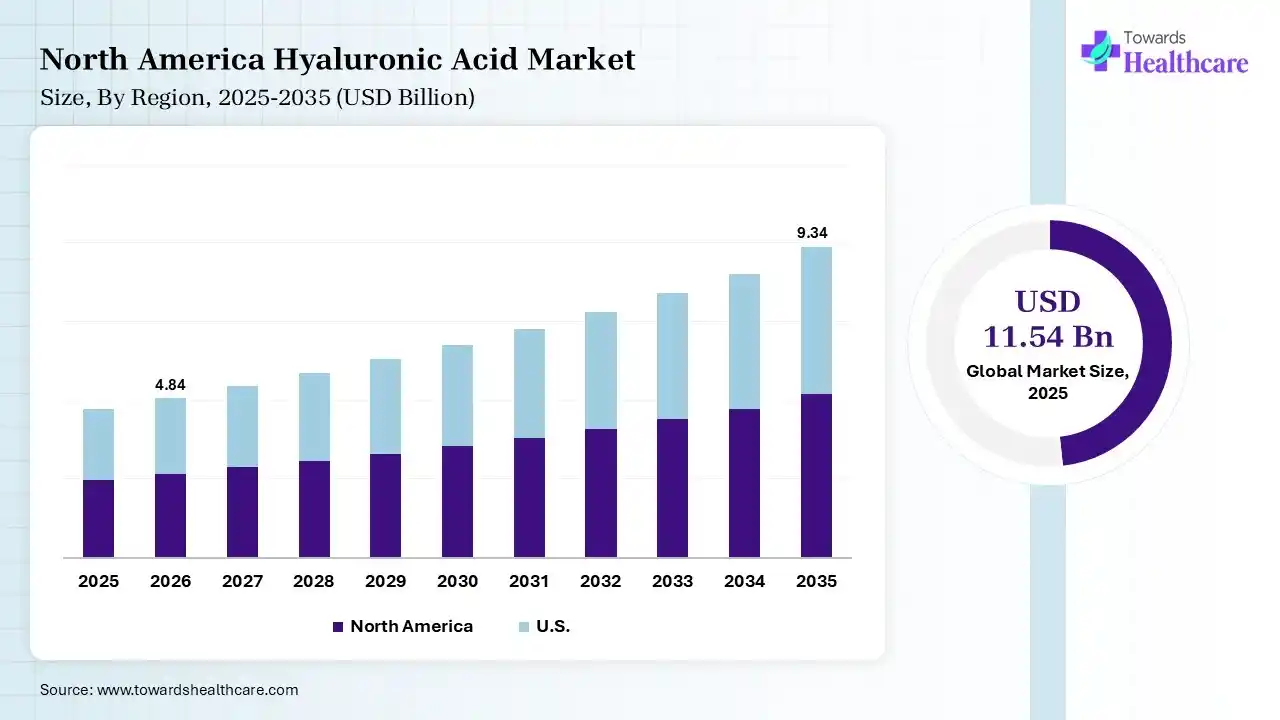
In 2025, North America dominated the hyaluronic acid market by 43% because an aging population and younger demographics are driving a powerful demand for aesthetic solutions, driven by social media influences, remote work trends, and increasing social acceptance. Advancements in technology and product manufacturing, like longer-acting neurotoxin injections and advanced materials for tissue regeneration, are expanding treatment choices and driving greater adoption rates. This region is at the forefront of medical innovation by spending heavily in research, which has led to novel treatments and medical devices that drive the growth of the market.
For Instance,
U.S. Market Trends
U.S. health care provides expedient access to an extremely subspecialized network of physicians who work at the forefront of advancing and utilizing new, advanced procedures and medicines. The increasing awareness of skin health has led to a rising demand for efficient cleansing choices that cater to different skin types, which surges the demand for hyaluronic acid.
Canada Hyaluronic Acid Market Grows Through Aesthetic and Orthopedic Demand
The Canada hyaluronic acid market is growing due to increasing demand for minimally invasive aesthetic procedures, rising prevalence of osteoarthritis, and expanding use of advanced skincare products. Strong healthcare infrastructure, growing consumer awareness of anti-aging treatments, and increasing adoption of hyaluronic acid in ophthalmology and regenerative medicine are driving market growth. Continuous product medicine is driving market growth. Continuous product innovation and biotechnology advancement are further supporting expansion.
Asia Pacific is expected to see rapid growth in the hyaluronic acid market, driven by this region, which leads the global in healthcare tourism as it pairs choice with ability. The region provides multiple high-performing hubs, strong specialization, and a patient experience built for cross-border care. This region is a favorite destination for worldwide medical travelers as it offers healthcare expertise, novel technology, safety, an attractive tourism destination, and cost advantage in the current decade. Technological advancements enabled the advancement of home-based medical tools, improved patient care convenience while lowering hospitalization expenses, encouraging patient independence, and enhancing quality of life.
India Market Trends
India’s diversity in regional characteristics, climate, and culture contributes to diverse facial shapes and skin tones, which influence aesthetic requirements. Aesthetic medicine in India is expected to undergo noteworthy development over the next 5–10 years, driven by technological developments and changing consumer perceptions. Inventions like artificial intelligence and minimally invasive procedures are not only improving treatment results. India has evolved as a leader in the worldwide healthcare industry, and the time has come for it to leverage its talent pool and cost advantages.
China Hyaluronic Acid Market Expands Through Aesthetic and Biotech Innovation
The China hyaluronic acid market is growing due to rising demand for aesthetic procedures, increasing prevalence of joint disorders, and expanding skincare and cosmetic industries. Strong domestic biotechnology manufacturing, government support for healthcare innovation, and the growing use of hyaluronic acid in ophthalmology, regenerative medicine, and drug delivery applications are accelerating in bioengineered formulation are further driving expansion.
Europe is increasing significantly in the hyaluronic acid market, due to the presence of advanced infrastructure, high R&D spending, and extensive adoption in the industries. Strong consumer preference for non-surgical and minimally invasive treatments. Europe has long stood strong as a leader in medical care. It is the hub to great researchers, physicians, and academic institutions. More accessible government approval process compared to the U.S. FDA, enabling a wider range of products.
Germany Market Trends
Germany is the European Union’s leading healthcare production location and is the third largest manufacturer of medical technology globally. It is effective processes, advanced facilities, and ground-breaking technology that make it an advanced location for life science companies to produce their healthcare services. Presence of an advanced healthcare system, particularly with respect to infrastructure, healthcare beds, and trained personnel. Advanced scientific research integrated with a highly skilled workforce has created a boundless environment for innovation.
R&D:
Manufacturing Processes:
Patient Services:
| Company | Headquarters | Latest Update |
| Allergan | Ireland | In September 2025, Allergan Aesthetics, an AbbVie organization, launched the "Naturally You with Injectable Hyaluronic Acid Fillers" campaign, aimed to provide clear, factual education about HA injectable fillers. This initiative mainly focuses on correcting misinformation to raise understanding and celebrate the safe, natural-looking results possible with hyaluronic acid injectable fillers. |
| Sanofi | France | Sanofi to acquire Dynavax, adding a marketed adult hepatitis B vaccine and phase 1/2 shingles candidate to the pipeline. |
| Genzyme Corporation | United States | Genzyme’s single-injection management for knee osteoarthritis remains a foremost product in the worldwide viscosupplementation. |
| Salix Pharmaceuticals | United States | In July 2025, Bausch Health Companies Inc. and its gastroenterology (GI) business, Salix Pharmaceuticals, announced its novel direct-to-consumer (DTC) “I Wish I Knew” campaign for Xifaxan, the first and only medicine FDA-approved for the lower challenges of overt hepatic encephalopathy (OHE) recurrence in adults. |
| F. Hoffmann-La Roche AG | Switzerland | F. Hoffmann-La Roche Ltd. (Roche) continues to focus on its core pharmaceuticals and diagnostics divisions. |
| Galderma Laboratories L.P | United States | In November 2025, Galderma unveiled significant novel data from its range of pioneering Restylane hyaluronic acid (HA) injectables, highlighting its versatility in enhancing the chin profile with Restylane Lyft. |
In August 2025, “This submission represents an important milestone in expanding our Evolysse™ collection of injectable HA gels,” “Sculpt is our most structured product, manufactured using a novel technology and designed to address mid-face volume loss, a high-value segment in facial aesthetics”, said Dr. Rui Avelar, MD, Chief Medical Officer and Head of R&D.
Strengths
Weaknesses
Opportunities
Threats
By Application
By Region






Principal Consultant
Rohan Patil is a seasoned market research professional with over 5+ years of focused experience in the healthcare sector, bringing deep domain expertise, strategic foresight, and analytical precision to every project he undertakes.
Learn more about Rohan Patil

Reviewed By
Aditi Shivarkar is a seasoned professional with over 14 years of experience in healthcare market research. As a content reviewer, Aditi ensures the quality and accuracy of all market insights and data presented by the research team.
Learn more about Aditi Shivarkar










