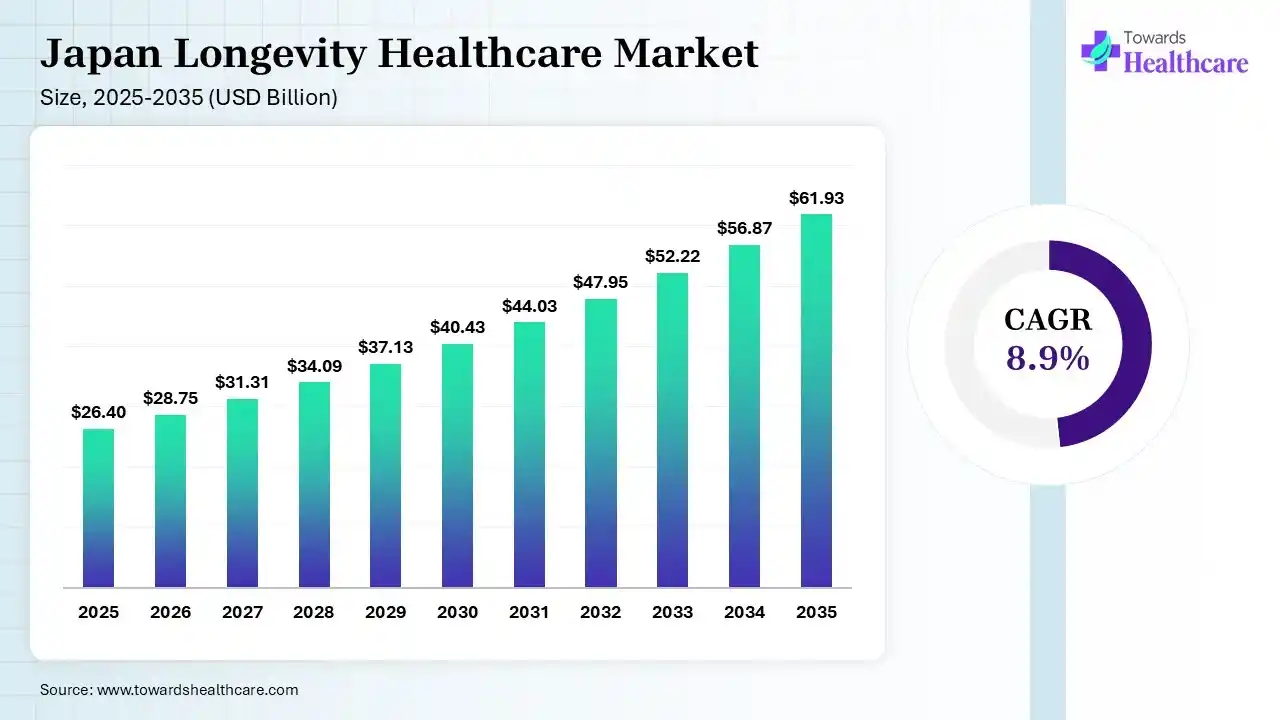
The Japan longevity healthcare market was valued at USD 26.4 billion in 2025 and is anticipated to reach USD 61.93 billion by 2035, expanding at a CAGR of 8.9% from 2026 to 2035. The market is driven by an exceptionally old population, universal health coverage, long-term-care insurance, and growing demand to extend healthy life expectancy, not simply lifespan.
Japan's government explicitly promotes integration of medical care, nursing care, prevention, housing, and daily-life support through its community-based integrated care model. As of September 2026, people aged 65+ accounted for 29.6% of Japan’s population (36.24 million), which represented the highest share among the countries compared by Japan’s Statistics Bureau.
The market covers a broad range of services and technologies. These include preventive medicine, chronic disease management, long-term care, rehabilitation, home healthcare, digital health, nutrition, diagnostics, medical devices, and advanced therapies.
Japan's national medical expenditure reached ¥46.697 trillion in FY2022. The long-term-care market provides another important indicator of future demand. Expenditure is projected to rise from ¥11.2 trillion in FY2022 to ¥16.4 trillion in FY2025, ¥19.9 trillion in FY2030, ¥23.9 trillion in FY2035, and ¥27.6 trillion in FY2040. These projections reflect the growing need for care services as the population ages.
A single market-size figure should not be assigned to the entire longevity healthcare ecosystem without defining its boundaries. Medical care, long-term care, pharmaceuticals, digital health, nutrition, senior living, and preventive diagnostics overlap, and combining their revenues could lead to double counting.
Japan's longevity healthcare market is moving beyond traditional treatment of age-related diseases toward a broader model focused on prevention, functional health, independent living, and continued monitoring.
The government promotes the integration of medical care, nursing care, prevention, housing, and daily-life support through its community-based integrated-care model. This approach reflects the need to coordinate services across hospitals, clinics, care facilities, and patients' homes.
The commercial opportunity extends beyond products marketed directly as anti-aging solutions. In Japan, businesses that help older adults remain healthy, mobile, and independent may address a more substantial and clearly defined need.
The market is segmented across:
How did the Preventive & Healthy-Aging Services Segment Dominate the Market in 2025?
| Longevity Healthcare Solution | 2025 Share | CAGR | 2035 Share |
| Preventive & Healthy-Aging Services | 29% | 8.10% | 26% |
| Nutrition, Nutraceuticals & Functional Foods | 23% | 7.80% | 20% |
| Digital Health, Monitoring & Wearables | 17% | 11.80% | 20% |
| Rehabilitation, Mobility & Functional Health | 14% | 8.90% | 14% |
| Personalized & Precision Longevity Care | 10% | 13.90% | 12% |
| Regenerative & Advanced Longevity Therapies | 7% | 14.60% | 8% |
The preventive and healthy-aging services segment held a 29% market share in 2025, due to health screening, lifestyle management, senior wellness, and disease-risk assessment. The regenerative & advanced longevity therapies segment is anticipated to grow at a 14.6% CAGR, although it starts from a relatively small base. Its expansion is driven by growth in regenerative medicine, cell therapies, and advanced therapeutics. Furthermore, the personalized & precision longevity care segment is also expanding rapidly as diagnostic information, biomarker analysis, digital monitoring and individualized interventions become more integrated.
Thus, the Japanese market is likely to develop from
Prevention → monitoring → personalized intervention → functional restoration → advanced therapies.
Companies capable of integrating diagnostics, longitudinal health data, and intervention programs can capture value earlier in the patient journey, indicating that high-growth longevity businesses do not necessarily need to develop novel anti-aging drugs.
What Factors Enabled the Chronic Disease Prevention & Management Segment to Lead the Japan Longevity Healthcare Market with a 27% market share in 2025?
| Application | 2025 Share | CAGR | 2035 Share |
| Chronic Disease Prevention & Management | 27% | 8.20% | 25% |
| Cognitive & Brain Health | 18% | 10.80% | 20% |
| Mobility, Muscle & Bone Health | 17% | 9.40% | 17% |
| Metabolic & Cardiovascular Health | 16% | 9.10% | 16% |
| Nutrition & Healthy Aging | 13% | 7.60% | 11% |
| Sleep, Stress & Mental Well-being | 9% | 11.30% | 11% |
The chronic disease prevention and management segment contributed to the largest application at 27%, creating sustained demand for the management of hypertension, diabetes, cardiovascular disease, cancer, chronic kidney disease, dyslipidemia, and osteoporosis. The sleep, stress & mental well-being segment is expected to expand rapidly at 11.3% CAGR due to the rise in sleep monitoring, sleep improvement, stress management, mental wellness, digital behavioral interventions, workplace wellness, relaxation and mindfulness programs, and is more heavily weighted toward consumer and employer spending than traditional hospital-based healthcare. The cognitive & brain health segment is also predicted to show the highest growth with a 10.80% CAGR due to rising demand for dementia prevention, Alzheimer's disease management, cognitive assessment, brain-health programs, digital cognitive training, caregiver support, and remote cognitive monitoring.
Therefore, Japan's longevity market is gradually broadening beyond traditional physical health, representing cognition, sleep, mental well-being, and social functioning as important components of healthspan.
Why Did the 60–74 Years Age Group Capture the Largest Share of the Japan Longevity Healthcare Market, Accounting for 43% in 2025?
| Age Group | 2025 Share | CAGR | 2035 Share |
| 60–74 Years | 43% | 8.70% | 40% |
| 75–84 Years | 31% | 9.20% | 32% |
| 85+ Years | 15% | 10.80% | 17% |
| 40–59 Years | 11% | 8.10% | 11% |
The 60–74 years segment led the market with 43% in 2025, as they are generally more capable of independently purchasing preventive health services, nutritional products, digital devices, and fitness-oriented interventions. The 85+ years segment is expected to show the fastest growth with a 10.80% CAGR due to the highest intensity of geriatric and long-term-care needs; dementia, frailty, mobility, home care, and assisted living are becoming increasingly important.
This makes it essential to segment the market customers by functional status rather than chronological age alone.
What Factors Contributed to the Dominance of the Hospitals & Clinics Segment in the Japan Longevity Healthcare Market?
| Individual Consumers |
| Hospitals & Clinics |
| Senior-Care Organizations |
| Pharmaceutical & Biotechnology Companies |
| Employers |
| Insurers/Payers |
| Research Institutions |
The hospitals & clinics segment and individual consumers segment accounted for the dominant end users in 2025. The hospitals & clinics segment was driven by a rise in chronic disease, aging-related conditions, preventive diagnostics, rehabilitation, and precision medicine, which increased clinical adoption, diagnostics, digital health, devices, and advanced therapies use. The individual consumers segment dominated the market due to a large aging population; strong demand for preventive health, functional foods, supplements, wearables, and screening, which led to consumer-paid longevity, nutrition, wellness, and digital-health revenues. The senior-care organizations segment is anticipated to expand rapidly during the forecast period due to rapid growth in the 75+/85+ population, rising care needs, and severe workforce constraints, which accelerates home care, rehabilitation, monitoring, robotics, and care technology.
The Kanto region, particularly Tokyo and the Greater Tokyo metropolitan area, is the dominant regional market for Japan's longevity healthcare ecosystem. A useful distinction is that Kanto is the largest commercial/healthcare-technology market, while some rural regions have higher elderly shares. Therefore, the region with the highest aging rate is not necessarily the region with the largest longevity-healthcare market.
The reasons Kanto dominates are as follows:
For healthcare IT specifically, one current market estimate puts Kanto at 40.1% of Japan's healthcare-IT market in 2025, substantially ahead of Kansai/Kinki at 18.2%. This is a proxy rather than a direct measure of the entire longevity market.
Kansai/Kinki, centered on Osaka and Kyoto, is the second major opportunity.
Its strengths include:
Osaka had approximately 2.40 million people aged 65+ in the 2025 census, representing 27.4% of its population.
| Company | Relevant market/segment | Longevity relevance | Key market position/activity |
| Takeda Pharmaceutical Company | Pharmaceuticals | Chronic disease, oncology, gastroenterology, neuroscience | One of Japan's largest pharmaceutical companies; relevant to age-related disease treatment and advanced therapeutics |
| Astellas Pharma | Pharmaceuticals/advanced therapies | Oncology, immunology, urology, regenerative medicine | Strong focus on innovative therapies and age-related disease areas |
| Daiichi Sankyo | Pharmaceuticals | Oncology, cardiovascular and other chronic conditions | Major Japanese pharmaceutical player with significant innovative-drug portfolio |
| Eisai | Cognitive health/pharmaceuticals | Dementia and Alzheimer's disease | Particularly relevant to the cognitive-health segment |
| Terumo | Medical devices | Cardiovascular, hospital care, diagnostics | Major medical-device company relevant to cardiovascular and aging-related healthcare |
| Olympus | Medical devices | Diagnostics, endoscopy, minimally invasive treatment | Important medical-technology supplier to hospitals |
| Sysmex | Diagnostics | Blood diagnostics, cancer-related testing, laboratory medicine | Important diagnostics company; relevant to preventive screening and disease detection |
| OMRON | Digital health/monitoring | Blood pressure, cardiovascular monitoring, connected health | Strong fit with home monitoring and preventive cardiovascular health |
| Sony | Digital health/life sciences | Medical imaging, healthcare technology, life-science tools | Technology capabilities relevant to healthcare digitization |
| Fujitsu | Digital health/AI | Healthcare IT, AI, health data | Relevant to digital transformation and data-driven healthcare |
| NEC | Digital health/AI | AI, biometrics, healthcare IT | Relevant to digital healthcare infrastructure |
| Kao Corporation | Nutrition/wellness/healthy aging | Consumer health, nutrition, aging-related products | Relevant to consumer-oriented healthy-aging solutions |
| Shiseido | Wellness/healthy aging | Healthy aging, skin aging and consumer wellness | Relevant to the consumer longevity/wellness ecosystem |
| SOMPO Holdings | Senior care/insurance | Elderly care, nursing care, healthcare services | Significant strategic exposure to Japan's aging and long-term-care economy |
| SECOM | Home healthcare/elderly care | Home medical care, monitoring and senior services | Relevant to aging-in-place and home-based care |
| CYBERDYNE | Robotics/rehabilitation | Robotic rehabilitation and mobility support | Important example of Japan's healthcare robotics ecosystem |
| PeptiDream | Biotechnology/drug discovery | Innovative therapeutics | Relevant to advanced drug-discovery ecosystem |
| SanBio | Regenerative medicine | Cell-based regenerative therapy | Direct relevance to advanced longevity/functional-recovery therapies |
The competitive landscape has three broad layers:
First, established healthcare companies operate in pharmaceuticals, medical devices, and diagnostics. Their established products and healthcare relationships give them access to Japan's large healthcare market.
Second, technology-enabled businesses focus on remote monitoring, healthcare IT, AI, robotics, and rehabilitation. Their solutions can support care delivery outside hospitals and help address workforce constraints.
Third, biotechnology and advanced-medicine companies work on regenerative medicine, cell therapies, and innovative therapeutics. These businesses may offer high-value opportunities but face more demanding research, clinical, manufacturing, and regulatory requirements.
Competition is increasingly ecosystem-based. Companies that connect diagnostics, monitoring, prevention, nutrition, rehabilitation, clinical care, and home care may be better positioned to meet Japan's needs than those offering a single product in isolation.
Japan's opportunity is driven by the combination of rapid population aging, increasing chronic-care needs, longer life expectancy, rising long-term-care expenditure, and healthcare workforce shortages. The most attractive opportunities are therefore concentrated around maintaining independence and reducing healthcare/care burden.
| Opportunity | Demand outlook | Key opportunity areas | Market impact |
| Preventive & Healthy Aging | High | Screening, risk assessment, lifestyle programs, health monitoring | Shifts spending from treatment toward prevention |
| Digital Health & Remote Monitoring | Very high | Wearables, RPM, telehealth, AI health platforms | Enables scalable care with fewer healthcare workers |
| Home Healthcare & Aging-in-Place | Very high | Remote monitoring, home diagnostics, medication management, home rehabilitation | Moves care from institutions toward the home. |
| Dementia & Cognitive Health | Very high | Early detection, cognitive monitoring, digital interventions, caregiver support | Major opportunity as the elderly population grows |
| Frailty, Sarcopenia & Mobility | Very high | Rehabilitation, strength training, fall prevention, mobility devices, nutrition | Helps maintain independence and reduce care requirements |
| AI & Healthcare Robotics | Very high | Care robots, rehabilitation robots, AI documentation, monitoring | Addresses Japan's care-worker shortage |
| Functional Foods & Personalized Nutrition | High | Protein, metabolic health, gut health, personalized nutrition | Large consumer-health opportunity |
| Biomarkers & Precision Health | High/emerging | Biological-age testing, genomic testing, disease-risk biomarkers | Enables personalized prevention |
| Longevity Clinics & Preventive Medicine | Emerging | Comprehensive health assessments, personalized programs | Expands self-pay longevity services |
| Regenerative & Cell Therapies | Emerging/high-value | iPSC, cell therapy, tissue regeneration, advanced therapeutics | Creates high-value advanced-medicine opportunities |
1. Home Healthcare and Aging in Place
A major opportunity is helping older Japanese adults remain independent at home for longer. Solutions include remote patient monitoring, home diagnostics, fall detection, medication management, teleconsultation, connected medical devices, home rehabilitation, and AI-assisted elderly monitoring.
These services can support patients after hospital discharge and improve coordination between medical providers, caregivers, and families. They also create opportunities for medical-device companies, insurers, technology providers, and home-care businesses.
2. AI, Robotics and Care Automation
Japan faces a structural shortage of care workers. The supplied report cites an estimated requirement of approximately 2.72 million care workers by FY2040, compared with about 2.15 million in 2022.
This creates opportunities for care robots, rehabilitation robots, mobility assistance, automated monitoring, AI documentation, smart-care facilities, fall detection, and workforce-management software.
The main commercial objective is to increase caregiver capacity and improve productivity, rather than simply replace healthcare professionals.
3. Dementia and Cognitive Health
Dementia and cognitive health are important areas for Japan's longevity market. Opportunities include early cognitive screening, digital assessment, remote monitoring, Alzheimer's diagnostics, caregiver platforms, safety technologies, cognitive training, and pharmaceutical therapies.
This segment creates demand across diagnostics, pharmaceuticals, digital health, senior care, and home monitoring.
4. Frailty, Sarcopenia and Mobility
Maintaining muscle strength, balance, and mobility can help delay dependence on long-term care. Opportunities include muscle-mass assessment, protein nutrition, exercise programs, fall-prevention technologies, rehabilitation devices, mobility aids, and remote physiotherapy.
The segment connects nutrition, healthcare, digital monitoring, and rehabilitation. Providers that combine these services may be able to offer more complete healthy-aging programs.
5. Digital Health and Remote Patient Monitoring
Digital health can connect hospitals, patients, caregivers, and insurers. Its most relevant applications include hypertension, diabetes, cardiovascular disease, dementia, medication adherence, post-discharge monitoring, elderly safety, and rehabilitation.
6. Functional Foods and Personalized Nutrition
Japan's functional-food market offers opportunities in muscle health, protein, bone health, metabolic health, gut health, cognitive-health nutrition, and personalized dietary programs.
Consumer-facing nutrition products can reach customers through retail, e-commerce, wellness providers, and healthcare partnerships. Companies must still ensure that product claims are appropriate for the applicable regulatory category.
7. Biomarkers and Personalized Longevity
Biological-age testing and other biomarker-based assessments offer an emerging opportunity within preventive health. Potential products include biological-aging biomarkers, cardiovascular-risk panels, metabolic biomarkers, genetic testing, inflammatory markers, and multi-omics assessments.
The strongest use case is likely to be testing that leads to an actionable intervention. A biological-age score alone may have limited value if customers do not understand its meaning or cannot use the result to guide health decisions.
8. Regenerative Medicine and Cell Therapy
Japan has a significant research ecosystem in regenerative medicine, including induced pluripotent stem cell research. Opportunities include cell-based therapies, regenerative orthopedics, tissue regeneration, iPSC applications, gene therapy, contract development and manufacturing, and clinical research infrastructure.
The supplied report estimates that Japan's broader regenerative/cellular medicine and gene-therapy market could increase from approximately ¥381.9 billion in 2025 to ¥1.08 trillion in 2035. This estimate relates to the advanced-medicine segment rather than the full longevity healthcare market.
The opportunity is large, but Japan is not an easy market for foreign longevity companies.
Important barriers include:
Japan's universal healthcare and long-term-care systems also mean that a successful product often needs a clear answer to "Who pays?" - government insurance, hospital, employer, care provider, family, or consumer.
Japan's longevity healthcare value chain is highly integrated across prevention, diagnostics, treatment, rehabilitation, long-term care, and home-based services. This is consistent with Japan's policy direction toward integrating medical care, prevention, nursing care, housing, and daily-life support through community-based care.
Research & Innovation → Biomarker/Diagnostic Development → Product & Service Development → Regulatory Approval → Manufacturing → Distribution → Healthcare/Care Delivery → Monitoring & Follow-up → Data & Outcomes
| Value-chain stage | Key activities | Major participants | Longevity relevance |
| 1. Research & Discovery | Aging biology, biomarkers, genomics, iPSC, AI research | Universities, research institutes, pharma, biotech | Creates new longevity technologies |
| 2. Diagnostics & Biomarkers | Blood tests, genomic tests, epigenetic testing, imaging | Diagnostic companies, hospitals, laboratories | Early detection and biological-age assessment |
| 3. Product/Service Development | Digital health, wearables, supplements, rehabilitation, therapies | Medtech, healthtech, food, pharma | Converts research into commercial products |
| 4. Regulatory & Clinical Validation | Clinical trials, safety/effectiveness evaluation, approvals | PMDA, MHLW, hospitals, CROs | Critical for medical/advanced therapies |
| 5. Manufacturing | Pharmaceuticals, devices, diagnostic kits, cell products | Pharma, medtech, CDMOs, biotech | Production and scale-up |
| 6. Distribution | Hospitals, pharmacies, distributors, online channels | Wholesalers, pharmacies, hospitals, platforms | Connects products to users |
| 7. Healthcare Delivery | Screening, diagnosis, treatment, rehabilitation | Hospitals, clinics, physicians | Core clinical interface |
| 8. Long-Term & Home Care | Nursing care, home healthcare, elderly monitoring | Care facilities, home-care providers | Major aging-driven demand center |
| 9. Digital Monitoring | Wearables, RPM, telemedicine, PHR | Healthtech, IT companies, device companies | Enables continuous longevity management |
| 10. Follow-up & Prevention | Lifestyle intervention, nutrition, rehabilitation | Clinics, fitness, nutrition, care providers | Converts testing into healthspan improvement |
| 11. Data & Outcomes | Health data, RWD, AI analytics, longitudinal monitoring | Healthcare/IT companies, pharma, insurers, researchers | Enables personalized and predictive healthcare |
Japan's upstream ecosystem includes aging research, biomarker discovery, genomics, AI, regenerative medicine, iPSC research, drug discovery, and medical-device development.
This creates opportunities for research equipment, sequencing, bioinformatics, biomarker platforms, cell-processing technologies, contract research services, contract development and manufacturing, and AI research platforms.
Diagnostics connect prevention with clinical intervention. The process includes sample collection, laboratory testing, biomarker analysis, risk assessment, physician interpretation, and personalized intervention.
Relevant technologies include blood biomarkers, genetic testing, epigenetic testing, biological-age testing, imaging, metabolic testing, cardiovascular biomarkers, cognitive assessment, and multi-omics.
Biological-age testing may offer greater commercial value when it is linked to actionable health programs rather than sold as a standalone age score.
The consumer pathway can include a test or device, a digital platform, personalized recommendations, and retesting. Relevant products include wearables, functional foods, supplements, biological-age tests, fitness programs, and sleep technologies.
The clinical pathway connects hospitals, diagnostics, physicians, treatment, rehabilitation, and monitoring. It includes medical devices, digital therapeutics, pharmaceuticals, diagnostics, and precision medicine.
The advanced-therapy pathway covers research, preclinical development, clinical trials, regulatory approval, manufacturing, and specialized clinical delivery. Cell therapies, regenerative medicine, and gene therapies fall into this category.
Regulatory and clinical validation are central to market entry. Japan distinguishes between consumer wellness products and regulated medical products.
Digital health includes software as a medical device, digital therapeutics, AI-based drug discovery, online medical care, electronic prescriptions, and personal health records. Regenerative medicine also requires appropriate regulatory oversight.
Companies entering Japan may need local clinical partners, regulatory expertise, Japanese-language documentation, local distribution, and post-market monitoring.
The manufacturing requirements vary by segment. Pharmaceutical products follow a different supply chain from medical devices, diagnostic kits, and regenerative-medicine products. Cell-based therapies can be particularly demanding because sourcing, processing, quality control, manufacturing, and logistics must be coordinated.
Distribution channels include medical distributors, hospitals, clinics, pharmacies, retail, e-commerce, and digital-health platforms. Business-to-business partnerships can be particularly important for foreign companies seeking access to Japanese healthcare institutions.
Hospitals and clinics provide preventive screening, chronic disease management, cancer screening, cardiovascular care, dementia assessment, rehabilitation, precision medicine, and advanced therapies.
Long-term and home healthcare are especially important parts of Japan's longevity value chain. Services may progress from hospital or clinic care to discharge, home rehabilitation, community care, and long-term care.
Key opportunities include remote monitoring, fall detection, rehabilitation, care robotics, mobility technologies, dementia monitoring, medication management, home diagnostics, and AI-assisted care.
Digital health can create a continuous cycle:
Test → Digital record → Monitoring → AI analysis → Intervention → Outcome measurement → Retesting
Japan's Medical DX initiatives aim to improve information sharing across prevention, medical treatment, long-term care, and research. Data can support personalized healthcare, outcome measurement, and longitudinal monitoring.
Highest-value upstream activities
Highest-volume activities
Fastest technology-enabled activities
Strongest recurring-revenue opportunities
Japan's longevity healthcare market is expected to remain closely linked to demographic aging, chronic disease management, long-term care, and the need to preserve independence among older adults.
The long-term-care expenditure projections in the supplied report rise from ¥16.4 trillion in FY2025 to ¥19.9 trillion in FY2030 and ¥23.9 trillion in FY2035, reaching ¥27.6 trillion in FY2040. These figures provide a clear indicator of the scale of future care needs, although they should not be treated as the revenue forecast for the entire longevity healthcare market.
Over the coming years, the market could develop across three broad areas.
Near-term growth: Preventive screening, functional foods, home healthcare, remote monitoring, wearables, rehabilitation, and dementia-care technologies are relevant to existing consumer and healthcare needs.
Technology-led growth: AI healthcare, digital therapeutics, connected medical devices, care robotics, and personalized health platforms may improve care delivery and help address workforce constraints.
Long-term development: Regenerative medicine, cell therapies, gene therapies, iPSC-based applications, and advanced longevity therapeutics could create new opportunities, although these areas involve greater scientific, clinical, and regulatory complexity.
The strongest commercial opportunities are likely to combine multiple services rather than rely on a single product. For example, biological-age testing may become more useful when connected to clinical interpretation, nutrition, physical activity, monitoring, and periodic reassessment. Similarly, remote monitoring can deliver greater value when it is linked to care teams and clear follow-up procedures.
Market development will depend on clinical evidence, regulatory compliance, affordability, reimbursement, consumer trust, and partnerships with healthcare providers.
The long-term opportunity is to help Japan's population maintain health, mobility, and independence for longer while managing the growing demands placed on healthcare and long-term-care systems.
By Longevity Healthcare Solution
By Application
By Age Group
By End User
By Region


Principal Consultant
Payal Rabde is a Healthcare Market Research Analyst at Towards Healthcare Research & Consulting with 4+ years of experience in pharmaceuticals, biotechnology, medical devices, and life sciences.
Learn more about Payal Rabde

Reviewed By
Aditi Shivarkar is a seasoned professional with over 14 years of experience in healthcare market research. As a content reviewer, Aditi ensures the quality and accuracy of all market insights and data presented by the research team.
Learn more about Aditi Shivarkar