
The laboratory plasticware market is projected to grow from USD 7.84 billion in 2025 to USD 13.78 billion by 2035 because research, diagnostic and bioprocessing laboratories consume large volumes of sterile, single-use plastic consumables, and every new assay. Automated workflow and cell culture processes increase the usage of lab plasticware. Laboratory automation, cell and gene therapy, molecular diagnostics and research expansion in Asia drive steady volume growth, lifting the market to USD 10.39 billion by 2030 and sustaining a CAGR of 5.80% from 2026 to 2035.
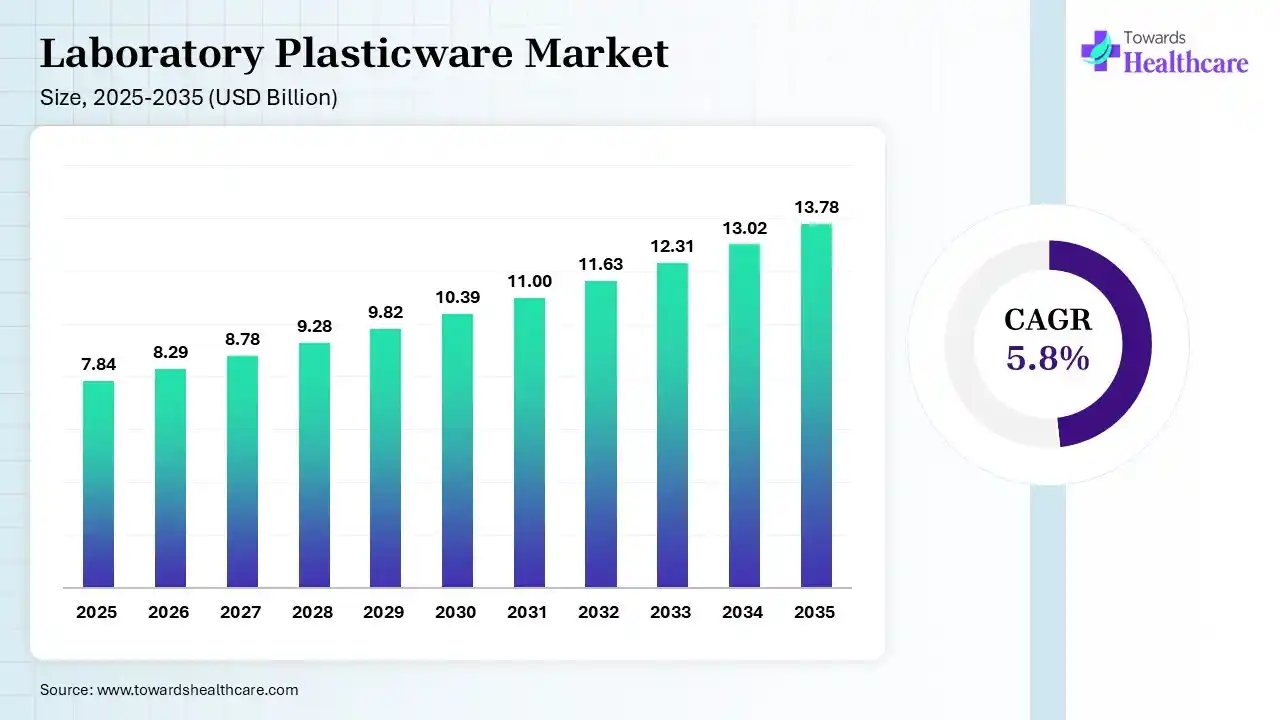
Analyst View: We built the estimate from consumption of laboratory plastic products by product type, material, end user, and region, multiplied by average selling prices, based on the number of research, clinical, and industrial laboratories and their consumable usage. Consumption reflects research funding, diagnostic testing volumes, bioprocessing activity, and automation adoption. The total was cross-checked against the labware and consumables revenue of leading suppliers. Several published estimates are well below the plasticware revenue reported by the major suppliers alone, so we used an evidence-based value. The growth rate reflects steady research and diagnostic demand, moderated by price competition and sustainability pressures on single-use plastics.
Driver: Life science research and drug discovery require large volumes of consumables. Clinical and molecular diagnostics are growing. Cell and gene therapy need high cell culture plastics to use. Automation requires standardized consumables because single-use plastics reduce contamination risk. These growing needs are strengthening the growth of the market.
Restraint: The market growth is restrained by Price competition from low-cost manufacturers, as it pressures margins. Sustainability concerns over single-use plastics are rising. Research funding can fluctuate. Resin price volatility affects costs. Distributor consolidation strengthens buyer power.
Opportunity: Bio-based and recycled labware can command premiums. Automation and high-throughput labs need specialized plates and tips. Emerging research hubs in Asia offers growth. Bioprocessing and cell therapy create demand for specialized vessels. Regional manufacturing improves supply resilience. These factors are anticipated to offer ample growth opportunities to the market.
| Segments | 2025 Share | 2025 Market Value |
| Pipette Tips | 22.40% | USD 1.76 billion |
| Tubes & Vials | 19.60% | USD 1.54 billion |
| Cell Culture Vessels | 18.20% | USD 1.43 billion |
| Microplates | 14.40% | USD 1.13 billion |
| Bottles, Containers & Others | 25.40% | USD 1.99 billion |
Note: 2025 is the base year.
Sources: Expert interviews, secondary sources, Towards Healthcare database and Towards Healthcare analysts.
Pipette tips accounted for 22.40% (USD 1.76 billion) in 2025 because they are widely used in huge volumes in manual pipetting and automated liquid handling. Tubes and vials account for 19.60% (USD 1.54 billion), cell culture vessels for 18.20% (USD 1.43 billion), the fastest-growing product with cell therapy and biologics research, microplates for 14.40% (USD 1.13 billion) and bottles, containers and others for 25.40% (USD 1.99 billion).
| Segments | 2025 Share | 2025 Market Value |
| Polypropylene | 44.60% | USD 3.50 billion |
| Polystyrene | 31.40% | USD 2.46 billion |
| Polyethylene | 12.20% | USD 0.96 billion |
| Others | 11.80% | USD 0.93 billion |
Note: 2025 is the base year.
Sources: Expert interviews, secondary sources, Towards Healthcare database and Towards Healthcare analysts.
Polypropylene accounted for 44.60% (USD 3.50 billion) in 2025 because of its chemical resistance, autoclavability, and low binding to suit tips, tubes, and containers. Polystyrene accounts for 31.40% (USD 2.46 billion), used for optically clear plates, dishes, and culture vessels. Polyethylene accounts for 12.20% (USD 0.96 billion), and others, including polycarbonate, PMP, and bio-based polymers, accounted for 11.80% (USD 0.93 billion).
| Segments | 2025 Share | 2025 Market Value |
| Pharmaceutical & Biotechnology | 38.60% | USD 3.03 billion |
| Clinical & Diagnostic Laboratories | 27.40% | USD 2.15 billion |
| Academic & Research Institutes | 22.20% | USD 1.74 billion |
| Others | 11.80% | USD 0.93 billion |
Note: 2025 is the base year.
Sources: Expert interviews, secondary sources, Towards Healthcare database and Towards Healthcare analysts.
Pharmaceutical and biotechnology companies generated 38.60% (USD 3.03 billion) in 2025 because drug discovery, development, and bioprocessing consume large volumes of plasticware. Clinical and diagnostic laboratories account for 27.40% (USD 2.15 billion), academic and research institutes for 22.20% (USD 1.74 billion), and others, including food, environmental, and industrial labs, for 11.80% (USD 0.93 billion).
Analyst View: Segment values were allocated by matching consumption and prices to products, materials, and end users, using supplier revenue mixes and laboratory data. Pipette tips, polypropylene, and pharma and biotech lead because of high-volume use. We expect cell culture vessels and bio-based materials to gain share.
| Region | 2025 Share | 2025 Market Value |
| North America | 36.80% | USD 2.89 billion |
| Europe | 29.20% | USD 2.29 billion |
| Asia Pacific | 26.40% | USD 2.07 billion |
| Latin America | 4.40% | USD 0.34 billion |
| Middle East & Africa | 3.20% | USD 0.25 billion |
Note: 2025 is the base year.
Sources: Expert interviews, secondary sources, Towards Healthcare database and Towards Healthcare analysts.
North America accounted for 36.80% (USD 2.89 billion) in 2025. Drug discovery, clinical testing, and bioprocessing across the region support high consumption. Research funding changes can affect academic demand.
Europe accounted for 29.20% (USD 2.29 billion) in 2025 because German and Austrian manufacturers are major global suppliers, and sustainability rules encourage bio-based and recycled labware.
Asia Pacific accounted for 26.40% (USD 2.07 billion) in 2025 and is the fastest-growing region. Chinese manufacturers are expanding supply, and research and diagnostics are growing rapidly.
Latin America accounted for 4.40% (USD 0.34 billion) in 2025. Clinical laboratories in Brazil and Mexico drive demand for laboratory plasticware.
The Middle East and Africa accounted for 3.20% (USD 0.25 billion) in 2025. Healthcare and research investment in the Gulf support regional growth.
Analyst View: Regional shares were built from consumption and prices in each region. North America leads because of research and diagnostic scale. We assign Asia Pacific the highest growth premium because research, CRO, and diagnostic activity are expanding fastest there.
| Rank | Company Name | Market-Specific Revenue (USD Billion) | 2025 Share | Key Products / Business | Headquarters |
| 1 | Thermo Fisher Scientific | 1.32 | 16.84% | Nunc and Nalgene plastic labware | United States |
| 2 | Corning | 0.96 | 12.24% | Falcon and Corning plastic labware | United States |
| 3 | Sarstedt | 0.52 | 6.63% | Tubes, tips and cell culture plastics | Germany |
| 4 | Greiner Bio-One | 0.48 | 6.12% | Cell culture and sample plastics | Austria |
| 5 | Eppendorf | 0.42 | 5.36% | Tubes, plates and pipette tips | Germany |
| 6 | Avantor | 0.38 | 4.85% | VWR-branded labware | United States |
| 7 | Mettler-Toledo (Rainin) | 0.30 | 3.83% | Rainin pipette tips | United States |
| 8 | Merck | 0.24 | 3.06% | Millipore labware and filtration plastics | Germany |
| 9 | Sartorius | 0.22 | 2.81% | Pipette tips and lab consumables | Germany |
| 10 | BRAND | 0.12 | 1.53% | Plastic labware and tips | Germany |
Note: Company revenues and shares are 2025 estimates.
Sources: Company press releases, expert interviews, secondary sources, Towards Healthcare database and Towards Healthcare analysts.
Thermo Fisher Scientific led the laboratory plasticware market with an estimated 16.84% (USD 1.32 billion) of 2025 revenue, followed by Corning at 12.24% (USD 0.96 billion) and Sarstedt at 6.63% (USD 0.52 billion). Thermo Fisher Scientific leads through its Nunc and Nalgene brands and broad distribution of tubes, plates, bottles, and cell culture plastics. Corning supplies Falcon and Corning plasticware widely used in cell culture and research, and Sarstedt produces tubes, tips, and cell culture products for research and clinical laboratories. Greiner Bio-One, Eppendorf, Avantor, Mettler-Toledo, Merck, Sartorius and BRAND compete through cell culture and sample plastics, premium tubes and tips, distribution brands, automation tips, filtration plastics and general labware. The top 10 companies accounted for an estimated 63.27% (USD 4.96 billion) of 2025 revenue, while the remaining 36.73% (USD 2.88 billion) was shared among Chinese and Indian plasticware makers, private label suppliers and specialised consumable producers. The laboratory plasticware market is moderately concentrated, and competition centres on quality and purity, sterility and certification, automation compatibility, supply reliability, sustainability credentials and price. Asian manufacturers compete strongly on price in commodity products.
The laboratory plasticware ecosystem links polymer suppliers with moulding and plasticware manufacturers, sterilisation providers, distributors, and laboratory users.
| Ecosystem Stage | Role in the Market | Key Companies |
| Polymer Suppliers | Supply medical-grade and bio-based resins | LyondellBasell, Borealis, INEOS, TotalEnergies, Trinseo |
| Plasticware Manufacturers | Mould tubes, tips, plates and vessels | Thermo Fisher, Corning, Sarstedt, Greiner Bio-One, Eppendorf |
| Sterilisation & Packaging | Sterilise and package products | Gamma and e-beam sterilisation providers |
| Distributors | Sell to laboratories | Fisher Scientific, VWR (Avantor), regional distributors |
| End Users | Use plasticware daily | Pharma and biotech, clinical labs, universities, industrial labs |
Sources: Company press releases, expert interviews, secondary sources, Towards Healthcare database and Towards Healthcare analysts.
The Towards Healthcare Companies Quadrant positions key participants in the laboratory plasticware market by market strength, reflecting revenue scale, market share and geographic reach, and by innovation and growth strategy, reflecting product portfolio breadth, R&D intensity and partnerships. Positions reflect each company's estimated 2025 laboratory plasticware revenue and our assessment of its product innovation, automation compatibility, and distribution.
Sources: Company press releases, expert interviews, secondary sources, Towards Healthcare database and Towards Healthcare analysts.
Leaders: Thermo Fisher Scientific, Corning, Sarstedt, Greiner Bio-One and Eppendorf combine significant plasticware revenue with broad portfolios, cell culture innovation and global distribution.
Innovators: Mettler-Toledo (Rainin) and Sartorius bring premium tips and tubes, automation-compatible consumables and bio-based products.
Niche Players: Avantor, Merck and BRAND serve filtration or general labware segments.
By Product
By Material
By End User
By Region
The laboratory plasticware market was defined as single-use and reusable plastic laboratory products, including tips, tubes, plates, culture vessels, bottles, and containers, worldwide. The 2025 base year was built bottom-up from consumption of laboratory plastic products by product type, material, end user, and region and average selling prices, and checked against the labware and consumables revenue of leading suppliers.
Segment, regional and company values were allocated from product types, materials, end users and regional demand. Key estimates were verified by cross-checking company disclosures, regulatory and industry data and published third-party estimates, and inputs that could not be reconciled were excluded. All segment, regional and company figures were reconciled to the same 2025 base year, and the 2026–2035 forecast, which applies a constant CAGR from the 2025 base, was recalculated and validated.
Analyst View: The laboratory plasticware market grows steadily with research, diagnostic, and bioprocessing activity. Our estimate links demand to consumption and prices, so the forecast follows research funding, testing volumes, and automation. The main upside comes from cell therapy and Asian research growth, while the risks are price competition and sustainability pressures.