
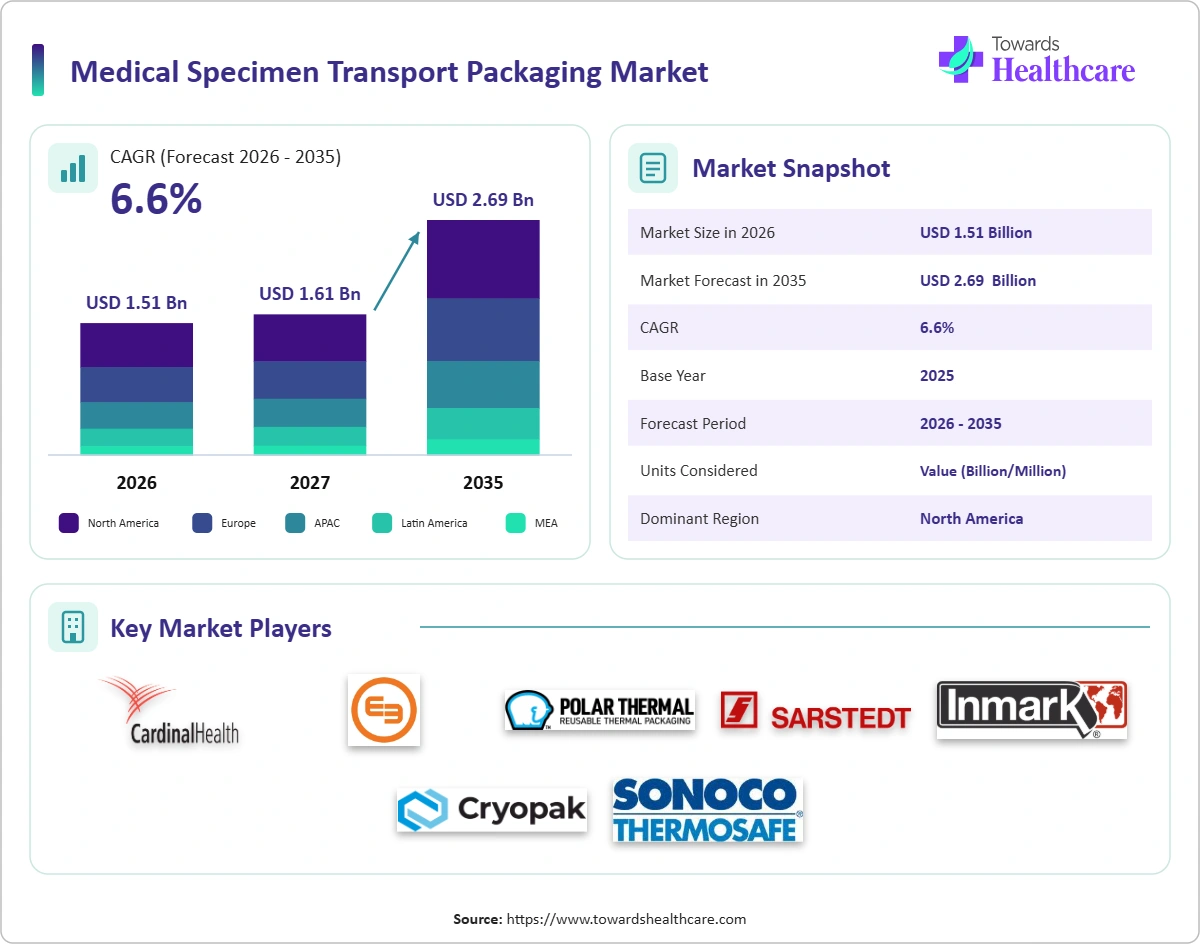
The medical specimen transport packaging market is projected to grow from USD 1.42 billion in 2025 to USD 2.69 billion by 2035 because billions of clinical samples are moved each year from collection points to laboratories, and every shipment must use compliant packaging. Rising diagnostic and molecular testing, laboratory consolidation, home and direct-to-consumer testing, decentralised clinical trials, biobanking, and stricter transport compliance support steady growth, lifting the market to USD 1.95 billion by 2030 and sustaining a CAGR of 6.60% from 2026 to 2035. Specimen transport packaging is a specialised part of medical packaging and overlaps with cold chain packaging when samples need temperature control.
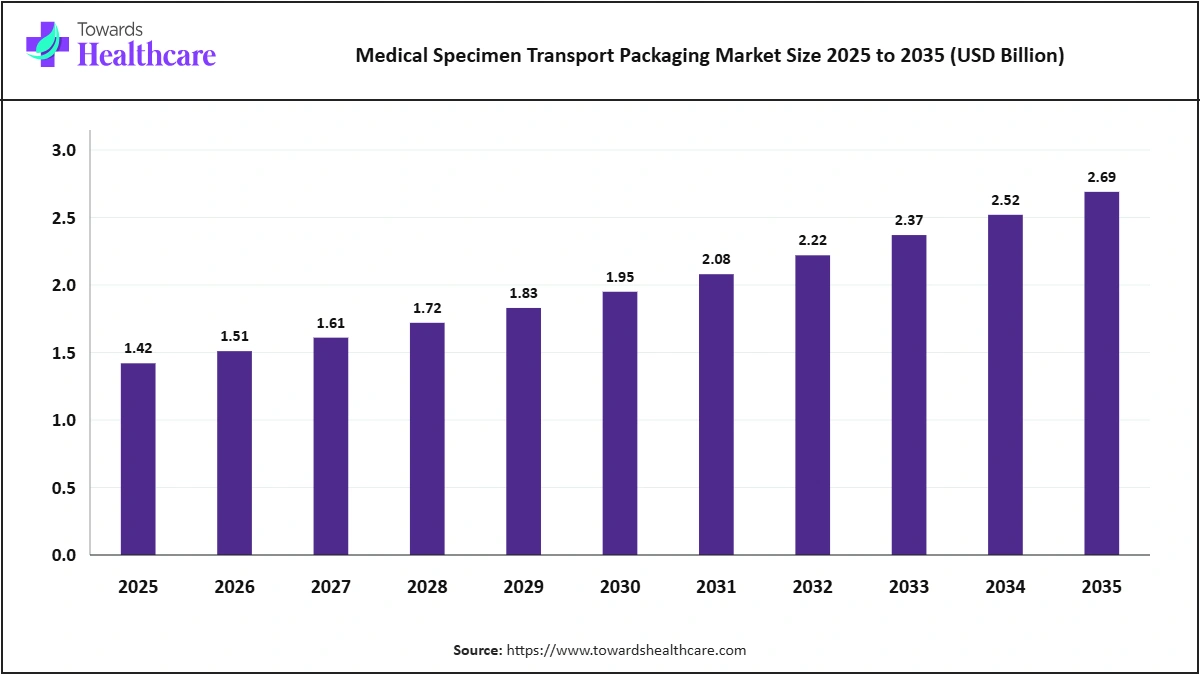
Analyst View: The market estimate was developed using specimen shipment volumes across different sample types, origins, and regions. These volumes were assessed based on diagnostic testing activity and the proportion of samples transported between facilities. The estimate was then calculated using the packaging value per shipment, covering specimen bags, absorbents, secondary containers, outer boxes, and insulation materials.
The total was cross-checked against the specimen and diagnostic packaging revenues of leading suppliers and against published estimates for specimen bags, transport boxes and infectious substance packaging. Published estimates for the full scope are limited, so we base our value on evidence rather than a single comparable figure. The growth rate reflects steady test volume growth and faster growth in home testing and temperature-controlled shipping.
| Driver | Impact | ≈ CAGR Contribution | Time Horizon | Key Regions |
| Diagnostic testing grows | High | +2.58 pp | Short to long term | Global, strongest in North America |
| Laboratories consolidate testing | Medium | +2.17 pp | Medium to long term | Global, fastest uptake in Asia Pacific |
| Home testing expands | Medium | +1.85 pp | Short to medium term | Global |
| Clinical trials ship more samples | Low | +1.45 pp | Long term | Developed and emerging markets |
Note: Contributions are indicative estimates of each factor's effect on annual growth.
Sources: Expert interviews, secondary sources, Towards Healthcare database and Towards Healthcare analysts.
Taken together, these drivers add about 8.05 percentage points to the annual growth of the medical specimen transport packaging market, with diagnostic testing having the largest effect. Their influence is strongest in North America, while uptake grows fastest in Asia Pacific.
| Restraint | Impact | ≈ Negative CAGR Contribution | Time Horizon | Key Regions |
| Price pressure from laboratories | High | -0.65 pp | Short to medium term | Global |
| Single-use plastic concerns | High | -0.48 pp | Medium term | Price-sensitive and emerging markets |
| Rules differ by country | Medium | -0.32 pp | Short term | North America and other mature markets |
Note: Contributions are indicative estimates of each factor's effect on annual growth.
Sources: Expert interviews, secondary sources, Towards Healthcare database and Towards Healthcare analysts.
These restraints are expected to reduce annual growth of the medical specimen transport packaging market by about 1.45 percentage points, led by price pressure from laboratories. Their effect eases over the forecast period as suppliers, buyers, and regulators adapt, leaving a net CAGR of 6.60% from 2026 to 2035.
Growth opportunities are emerging from the rising adoption of home testing and direct-to-consumer collection kits. Demand for recyclable packaging, temperature-controlled solutions for molecular samples, and smart tracking technologies is also creating new avenues for suppliers. In addition, the expansion of laboratory networks in emerging markets is expected to support further market growth.
Note: 2025 is the base year; 2035 values are forecasts.
Sources: Expert interviews, secondary sources, Towards Healthcare database, and Towards Healthcare analysts.
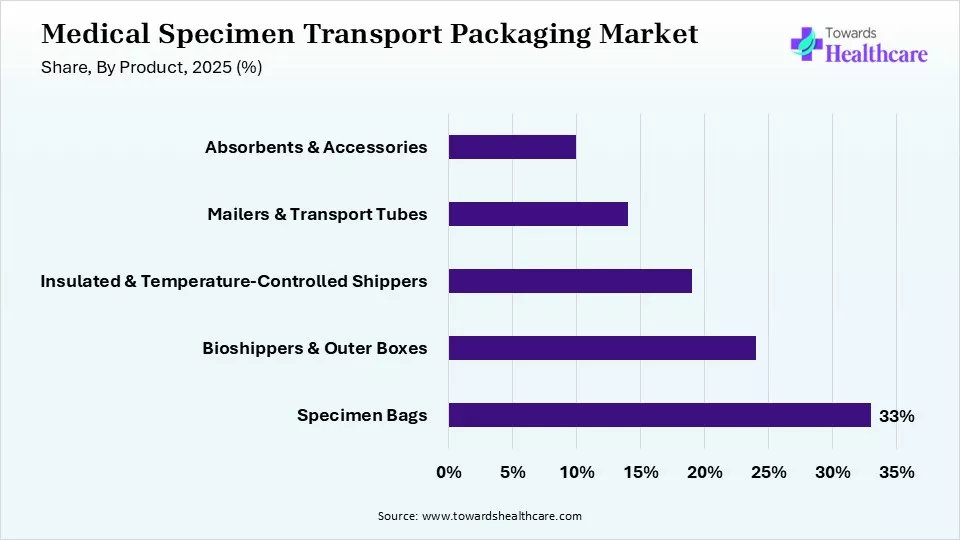
Specimen Bags: The specimen bags segment held the largest product share in 2025, accounting for 33.00% (USD 0.47 billion) of the medical specimen transport packaging market. It is projected to reach USD 0.84 billion by 2035, growing at a CAGR of 6.03% from 2026 to 2035. Its leading position is largely driven by the widespread use of 95 kPa specimen bags with absorbent pads and document pouches. These bags serve as the leak-proof secondary packaging layer in the triple packaging system used to transport most clinical samples. Their high-volume use across diagnostic laboratories further supports demand. However, the specimen bags segment is expected to grow at a slower pace than the overall market during the forecast period.
Bioshippers and rigid outer boxes carry the required UN3373 or UN2814 markings and protect samples during courier, postal, and air transport. The bioshippers & outer boxes segment is expected to grow broadly in line with the overall market over the forecast period.
This segment is growing rapidly as molecular, genetic, and clinical trial samples often require specific temperature conditions during transportation, whether refrigerated, frozen, or maintained within controlled room-temperature ranges. The increasing need to preserve sample quality and integrity during transit is supporting demand for these solutions. The segment is expected to grow faster than the overall market during the forecast period.
Mailers and transport tubes are used for postal kits, home tests, and pneumatic tube systems in hospitals. The mailers & transport tubes segment is expected to grow broadly in line with the overall market over the forecast period.
Products such as absorbent pads, labels, seals, and data loggers play an important role in ensuring packaging compliance and safe specimen transportation. Their use alongside primary and secondary packaging components supports consistent demand across laboratories and diagnostic facilities. The segment is expected to grow broadly in line with the overall market during the forecast period.
Absorbents & Accessories holds the smallest share today and serves more specialised needs within the medical specimen transport packaging market.
Note: 2025 is the base year; 2035 values are forecasts.
Sources: Expert interviews, secondary sources, Towards Healthcare database, and Towards Healthcare analysts.
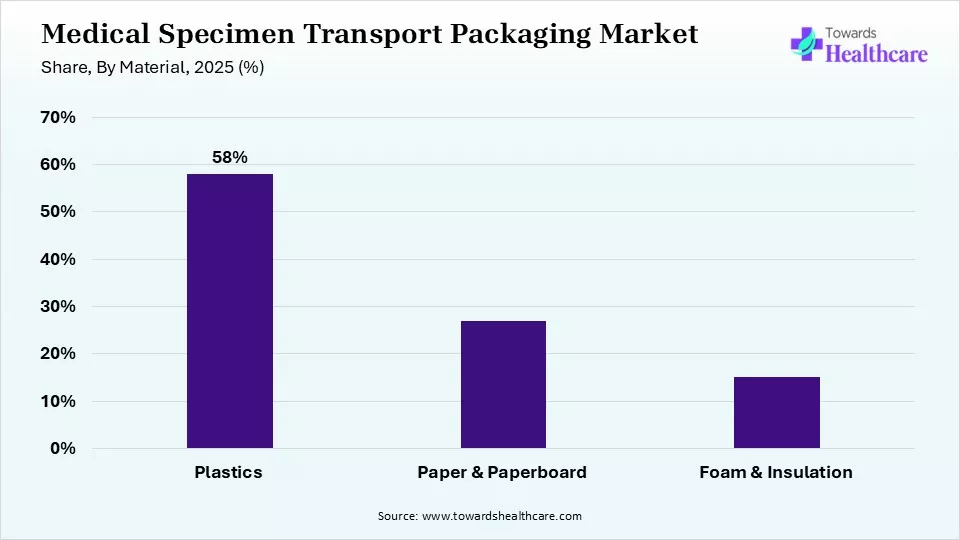
Plastics: The plastics segment held the largest material share in 2025, representing 58.00% (USD 0.82 billion) of the medical specimen transport packaging market. It is projected to reach USD 1.47 billion by 2035, growing at a CAGR of 6.00% from 2026 to 2035. Plastics remain the preferred material because specimen bags, tubes, and secondary containers need to be leak-proof, durable, and resistant to pressure during transportation. Their widespread use across different packaging formats supports their leading position. However, the plastics segment is expected to grow at a slower pace than the overall market during the forecast period.
Paper and paperboard are growing fastest as outer boxes and mailers move to recyclable fibre-based designs. The paper & paperboard segment is expected to grow faster than the overall market over the forecast period.
Materials such as expanded polystyrene (EPS), polyurethane, and recyclable insulation alternatives help maintain the required temperature of specimens during transit. Their role in protecting temperature-sensitive samples supports steady demand across medical transportation applications. The segment is expected to grow broadly in line with the overall market during the forecast period.
Foam & Insulation holds the smallest share today and serves more specialised needs within the medical specimen transport packaging market.
Note: 2025 is the base year; 2035 values are forecasts.
Sources: Expert interviews, secondary sources, Towards Healthcare database, and Towards Healthcare analysts.
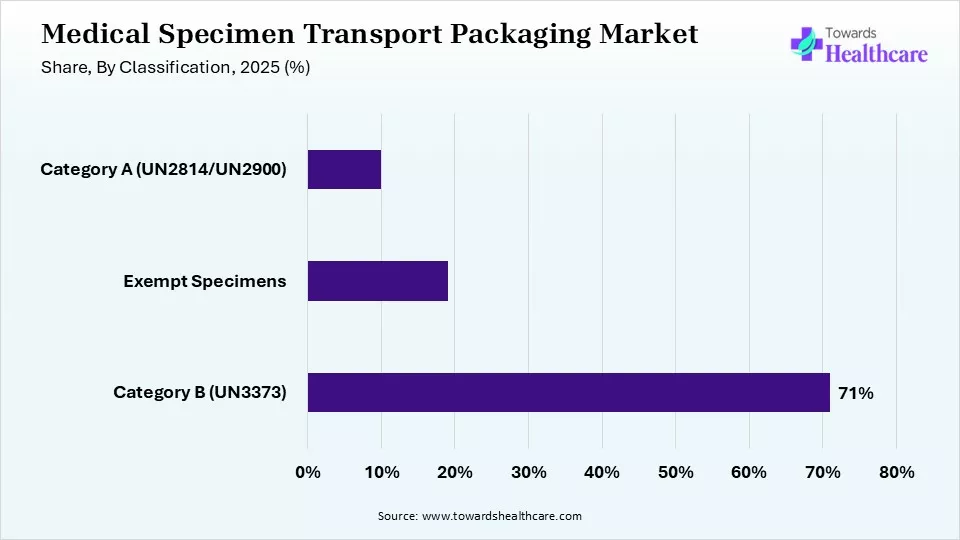
Category B (UN3373): The Category B (UN3373) segment held the largest share in 2025, representing 71.00% (USD 1.01 billion) of the medical specimen transport packaging market. It is projected to reach USD 1.93 billion by 2035, growing at a CAGR of 6.69% from 2026 to 2035. Its leading position is driven by the high volume of routine diagnostic samples classified as Category B biological substances. These shipments must comply with UN3373 and Packing Instruction 650 requirements, supporting consistent demand for compliant transport packaging. The segment is expected to grow broadly in line with the overall market during the forecast period.
Human and animal specimens classified as exempt due to the minimal likelihood of containing pathogens still require triple-layer packaging for safe transportation, although their labeling and marking requirements are less extensive than those for Category B shipments. The continued need for secure specimen handling is expected to support steady demand.
Category A infectious substances need certified packaging to Packing Instruction 620 and are shipped by specialised couriers. The Category A (un2814/un2900) segment is expected to grow broadly in line with the overall market over the forecast period.
Note: 2025 is the base year; 2035 values are forecasts.
Sources: Expert interviews, secondary sources, Towards Healthcare database, and Towards Healthcare analysts.
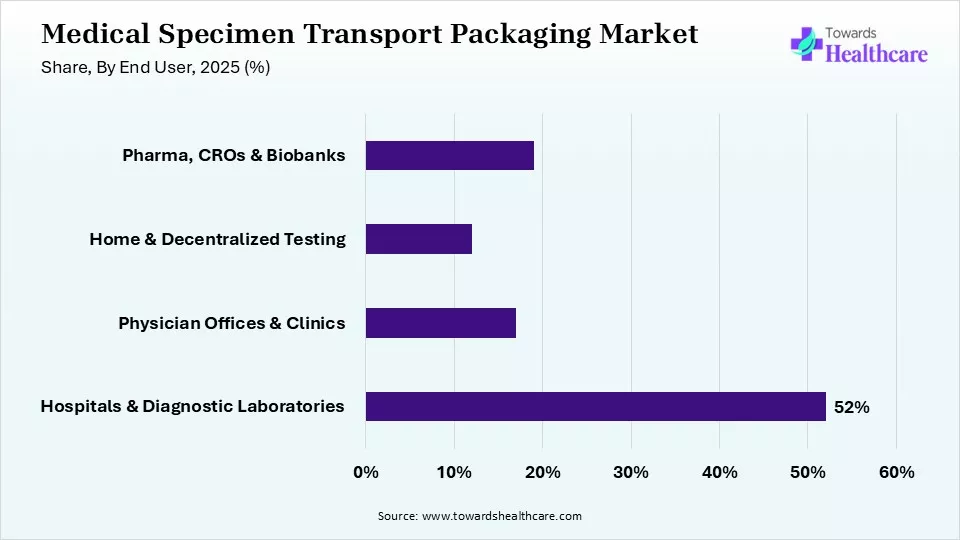
Hospitals & Diagnostic Laboratories: This segment accounted for 52.00% (USD 0.74 billion) of the medical specimen transport packaging market in 2025 and is projected to reach USD 1.31 billion by 2035, expanding at a CAGR of 5.92% from 2026 to 2035. Hospitals and diagnostic laboratories are the largest users because they send and receive most samples between collection points, hospitals, and reference laboratories. The hospitals & diagnostic laboratories segment is expected to grow slower than the overall market over the forecast period.
Physician offices and clinics send samples to outside laboratories every day. The physician offices & clinics segment is expected to grow broadly in line with the overall market over the forecast period.
This segment is expanding rapidly as more patients collect blood, saliva, stool, and swab samples at home and send them to laboratories through postal or courier services. The growing adoption of convenient testing options and decentralized diagnostic services is increasing the need for reliable specimen transport packaging. The segment is expected to grow faster than the overall market during the forecast period.
Pharmaceutical companies, contract research organisations and biobanks ship clinical trial and research samples, often across borders and at controlled temperatures. The pharma, CROs & biobanks segment is expected to grow broadly in line with the overall market over the forecast period.
Although Home & Decentralized Testing starts from the smallest base, its faster growth shows how demand is shifting within the medical specimen transport packaging market.
Analyst View: Segment values were estimated by allocating shipment volumes and packaging costs across different product types, materials, specimen categories, and end users. Specimen bags, plastic-based packaging, Category B samples, and hospitals and laboratories account for the leading shares of the market. However, demand for temperature-controlled shippers, paper-based packaging, and home testing solutions is expected to increase, supporting their gradual growth in market share over the forecast period.
Note: 2025 is the base year; 2035 values are forecasts.
Sources: Expert interviews, secondary sources,Towards Healthcare database, and Towards Healthcare analysts.
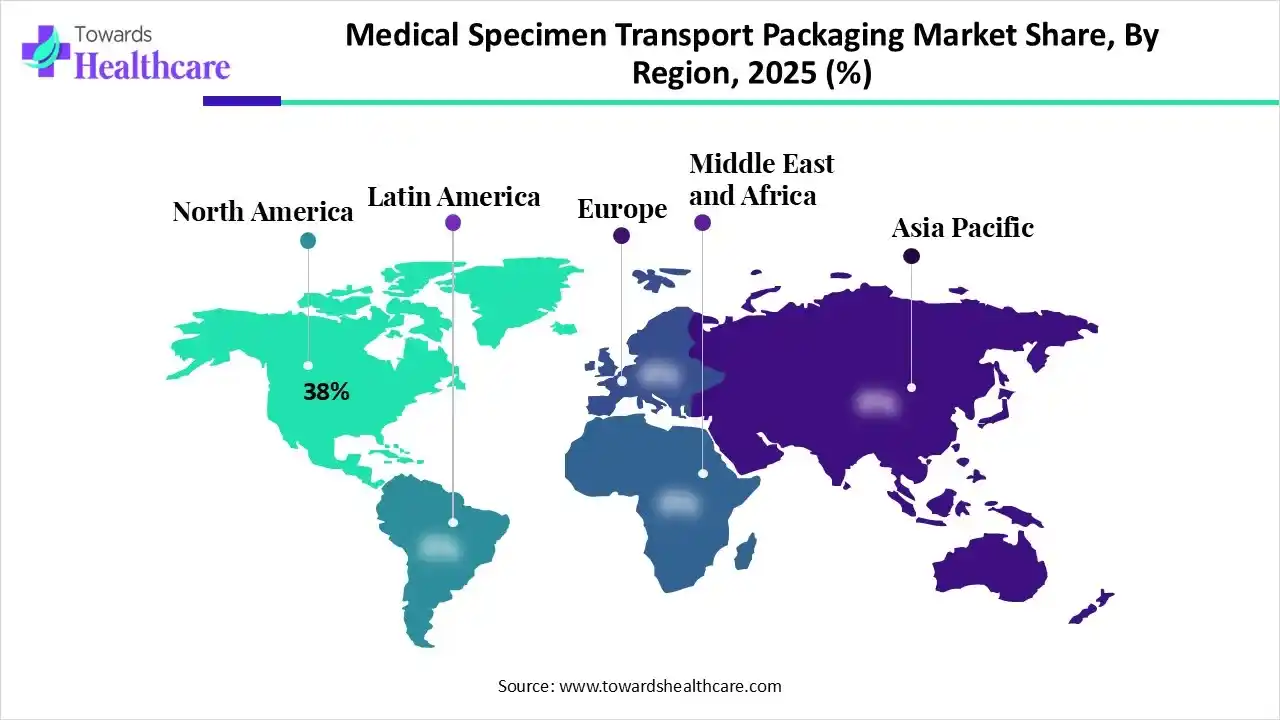
North America: This region accounted for 38.00% (USD 0.54 billion) of the medical specimen transport packaging market in 2025 and is projected to reach USD 0.95 billion by 2035, expanding at a CAGR of 5.81% from 2026 to 2035. North America is the largest region because of very high diagnostic test volumes, large reference laboratories such as Quest Diagnostics and Labcorp, fast growth in home testing, and strict DOT and IATA packaging rules. North America is expected to grow slower than the overall market between 2026 and 2035.
Europe has large laboratory networks, strong public screening programmes, and ADR and IATA compliance rules, with growing demand for recyclable packaging. Europe is expected to grow slower than the overall market between 2026 and 2035.
Asia Pacific is the fastest-growing region because diagnostic laboratory chains are expanding in China and India, hub-and-spoke testing networks are growing, and clinical trial activity is rising. Asia Pacific is expected to grow faster than the overall market between 2026 and 2035.
Latin America is supported by laboratory chains and public health testing in Brazil and Mexico. Latin America is expected to grow slower than the overall market between 2026 and 2035.
Middle East & Africa are supported by new laboratories in Gulf countries and disease surveillance programmes in Africa. Middle East & Africa is expected to grow slower than the overall market between 2026 and 2035.
Analyst View: Regional shares were built from shipment volumes and packaging values in each region. North America leads because of high test volumes and home testing. We assign Asia Pacific the highest growth premium because laboratory networks are expanding fastest there.
| Rank | Company Name | Market-Specific Revenue (USD Billion) | 2025 Share | Key Products / Business | Headquarters |
| 1 | Sonoco ThermoSafe | 0.11 | 7.39% | Diagnostic shippers, kPa bags, insulated shippers | United States |
| 2 | Cryopak | 0.08 | 5.63% | Specimen and temperature-controlled shippers | United States |
| 3 | Inmark | 0.08 | 5.28% | Saf-T-Pak specimen and infectious substance packaging | United States |
| 4 | Air Sea Containers | 0.06 | 4.23% | UN3373 bags, bioshippers, Category A packaging | United Kingdom |
| 5 | Thermo Fisher Scientific | 0.06 | 4.08% | Specimen transport bags and containers | United States |
| 6 | Cardinal Health | 0.05 | 3.52% | Specimen bags and transport supplies | United States |
| 7 | Pelican BioThermal | 0.05 | 3.17% | Temperature-controlled shippers | United States |
| 8 | Sarstedt | 0.05 | 3.17% | Specimen transport bags, tubes and boxes | Germany |
| 9 | Polar Thermal Packaging | 0.02 | 1.41% | Insulated specimen shippers | United Kingdom |
| 10 | Elite Bags | 0.01 | 0.70% | Medical transport bags | Spain |
Note: Company revenues and shares are 2025 estimates.
Sources: Company press releases, expert interviews, secondary sources, Towards Healthcare database and Towards Healthcare analysts.
Sonoco ThermoSafe led the medical specimen transport packaging market with an estimated 7.39% (USD 0.10 billion) of 2025 revenue, followed by Cryopak at 5.63% (USD 0.08 billion) and Inmark at 5.28% (USD 0.07 billion). Sonoco ThermoSafe leads with diagnostic shippers, kPa bags, and insulated shippers, Cryopak supplies specimen and temperature-controlled shippers, and Inmark offers Saf-T-Pak specimen and infectious substance packaging. Air Sea Containers, Thermo Fisher Scientific, Cardinal Health, Pelican BioThermal, Sarstedt, Polar Thermal Packaging and Elite Bags compete through UN3373 and Category A packaging, specimen bags and containers, transport supplies, temperature-controlled shippers, transport tubes and boxes, insulated shippers and transport bags.
The top 10 companies accounted for an estimated 38.73% (USD 0.55 billion) of 2025 revenue, while the remaining 61.27% (USD 0.87 billion) was shared among regional bag makers, laboratory suppliers and courier packaging providers. The medical specimen transport packaging market is fragmented, and competition centres on regulatory compliance and testing, leak and pressure performance, temperature control, ease of use, recyclability, laboratory distribution reach and price. Large laboratories often buy through national distributors and group purchasing contracts.
Sonoco ThermoSafe: Sonoco ThermoSafe is headquartered in the United States. It generated an estimated USD 0.10 billion of market-specific revenue in 2025, about 7.39% of the medical specimen transport packaging market. Its offering centres on Diagnostic shippers, kPa bags, insulated shippers. In the Towards Healthcare Companies Quadrant it is positioned as a Leader.
Cryopak: Cryopak, part of Integreon Global, is headquartered in the United States. It generated an estimated USD 0.08 billion of market-specific revenue in 2025, about 5.63% of the medical specimen transport packaging market. Its offering centres on Specimen and temperature-controlled shippers. In the Towards Healthcare Companies Quadrant it is positioned as a Leader.
Inmark: Inmark is headquartered in the United States. It generated an estimated USD 0.07 billion of market-specific revenue in 2025, about 5.28% of the medical specimen transport packaging market. Its offering centres on Saf-T-Pak specimen and infectious substance packaging. In the Towards Healthcare Companies Quadrant, it is positioned as a Leader.
Air Sea Containers: Air Sea Containers is headquartered in the United Kingdom. It generated an estimated USD 0.06 billion of market-specific revenue in 2025, about 4.23% of the medical specimen transport packaging market. Its offering centres on UN3373 bags, bioshippers, Category A packaging. In the Towards Healthcare Companies Quadrant it is positioned as a Leader.
Thermo Fisher Scientific: Thermo Fisher Scientific is headquartered in the United States. It generated an estimated USD 0.06 billion of market-specific revenue in 2025, about 4.08% of the medical specimen transport packaging market. Its offering centres on Specimen transport bags and containers. In the Towards Healthcare Companies Quadrant, it is positioned as a Leader.
Cardinal Health: Cardinal Health is headquartered in the United States. It generated an estimated USD 0.05 billion of market-specific revenue in 2025, about 3.52% of the medical specimen transport packaging market. Its offering centres on Specimen bags and transport supplies. In the Towards Healthcare Companies Quadrant it is positioned as a Leader.
Pelican BioThermal: Pelican BioThermal is headquartered in the United States. It generated an estimated USD 0.04 billion of market-specific revenue in 2025, about 3.17% of the medical specimen transport packaging market. Its offering centres on Temperature-controlled shippers. In the Towards Healthcare Companies Quadrant it is positioned as a Leader.
Sarstedt: Sarstedt is headquartered in Germany. It generated an estimated USD 0.04 billion of market-specific revenue in 2025, about 3.17% of the medical specimen transport packaging market. Its offering centres on Specimen transport bags, tubes and boxes. In the Towards Healthcare Companies Quadrant, it is positioned as an Innovator.
Polar Thermal Packaging: Polar Thermal Packaging is headquartered in the United Kingdom. It generated an estimated USD 0.02 billion of market-specific revenue in 2025, about 1.41% of the medical specimen transport packaging market. Its offering centres on Insulated specimen shippers. In the Towards Healthcare Companies Quadrant it is positioned as an Innovator.
Elite Bags: Elite Bags is headquartered in Spain. It generated an estimated USD 0.01 billion of market-specific revenue in 2025, about 0.70% of the medical specimen transport packaging market. Its offering centres on Medical transport bags. In the Towards Healthcare Companies Quadrant it is positioned as an Innovator.
The medical specimen transport packaging ecosystem links material suppliers with packaging makers, laboratory distributors, couriers and logistics providers, testing organisations and regulators.
| Ecosystem Stage | Role in the Market | Key Companies |
| Material Suppliers | Supply films, absorbents, board and insulation | Film, paper and foam suppliers |
| Packaging Makers | Make compliant bags, boxes and shippers | Sonoco ThermoSafe, Cryopak, Inmark, Air Sea Containers |
| Distributors | Supply laboratories and clinics | Laboratory and medical distributors |
| Couriers & Logistics | Transport samples | Laboratory couriers, postal services, specialty logistics |
| Users & Regulators | Ship samples and set rules | Laboratories, hospitals, IATA, DOT, WHO |
Sources: Company press releases, expert interviews, secondary sources, Towards Healthcare database and Towards Healthcare analysts.
Material Suppliers: Supply films, absorbents, board and insulation. Key participants include Film, paper and foam suppliers.
Packaging Makers: Make compliant bags, boxes and shippers. Key participants include Sonoco ThermoSafe, Cryopak, Inmark, Air Sea Containers.
Distributors: Supply laboratories and clinics. Key participants include Laboratory and medical distributors.
Couriers & Logistics: Transport samples. Key participants include Laboratory couriers, postal services, specialty logistics.
Users & Regulators: Ship samples and set rules. Key participants include Laboratories, hospitals, IATA, DOT, WHO.
Value in the medical specimen transport packaging market flows from upstream material and technology suppliers to manufacturers and service providers, then through distribution partners to end users. Companies that integrate several stages or build long-term relationships with end users capture a larger share of this value.
The Towards Healthcare Companies Quadrant positions key participants in the medical specimen transport packaging market by market strength, reflecting revenue scale, market share and geographic reach, and by innovation and growth strategy, reflecting product portfolio breadth, R&D intensity and partnerships. Positions reflect each company's estimated 2025 specimen transport packaging revenue and our assessment of its compliance, temperature control and reach.
Sources: Company press releases, expert interviews, secondary sources, Towards Healthcare database and Towards Healthcare analysts.
Leaders: Sonoco ThermoSafe, Cryopak, Inmark, Air Sea Containers, Thermo Fisher Scientific, Cardinal Health and Pelican BioThermal combine large specimen packaging sales with broad compliant and temperature-controlled ranges.
Innovators: Sarstedt, Polar Thermal Packaging and Elite Bags bring specialised thermal and traceable designs.
By Product
By Material
By Specimen Classification
By End User
By Region
The medical specimen transport packaging market was defined as bags, absorbents, secondary containers, outer boxes, insulated shippers, mailers, and tubes used to transport clinical and biological specimens worldwide. The 2025 base year was built bottom-up from specimen shipment volumes by sample type and region and packaging values per shipment, and checked top-down against the specimen and diagnostic packaging revenues of leading suppliers. Segment, regional and company values were allocated from products, materials, specimen classes, users and regional shipments.
Key estimates were verified by cross-checking company disclosures, regulatory and industry data and published third-party estimates, and inputs that could not be reconciled were excluded. All segment, regional and company figures were reconciled to the same 2025 base year, and the 2026-2035 forecast, which applies a constant CAGR from the 2025 base, was recalculated and validated.
Analyst View: The medical specimen transport packaging market grows steadily with diagnostic testing, while home testing, clinical trials, and temperature-sensitive samples add value. Our estimate links demand to specimen shipments and packaging values, so the forecast follows test volumes and laboratory networks. The main upside comes from home testing and temperature-controlled shipping, while the main risks are price pressure and plastic reduction rules.