
Pipeline Programs

CGT Companies Tracked

Manufacturing Facilities


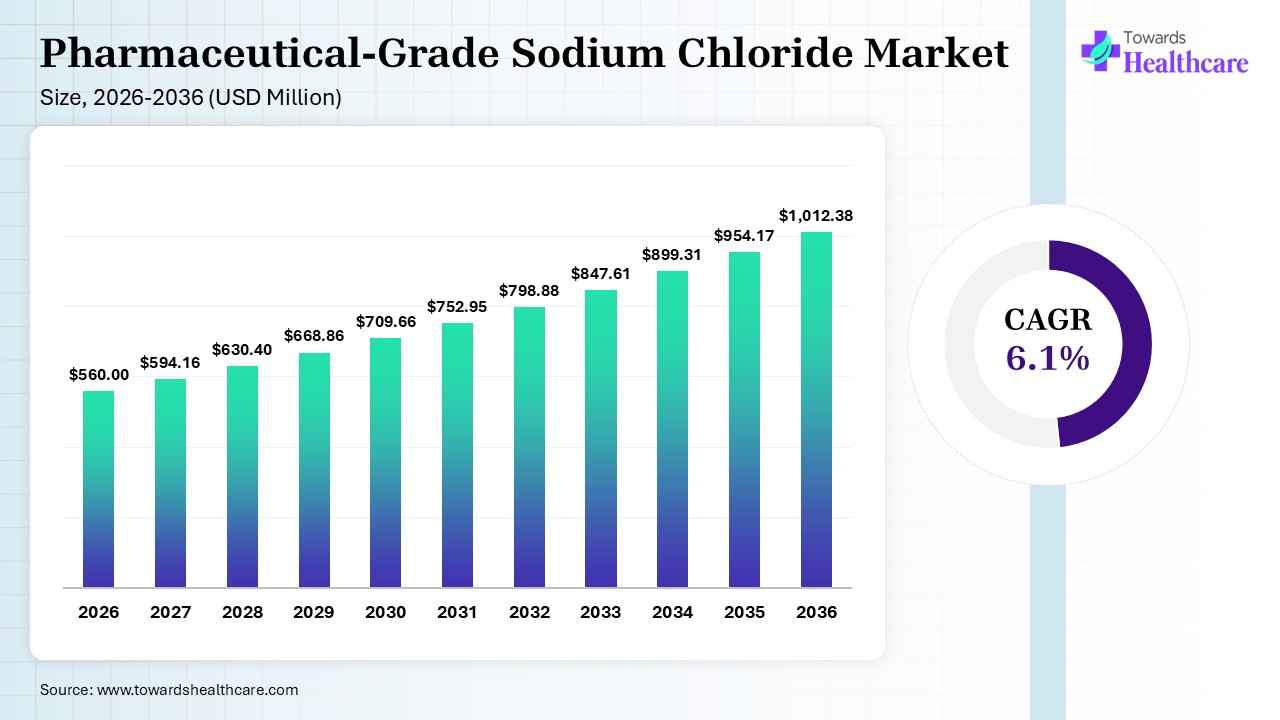
The pharmaceutical-grade sodium chloride market is expected to grow to USD 594.16 million in 2027 and is projected to reach US$ 1012.38 million by 2036, registering a CAGR of 6.1% during 2027-2036. The market size is calculated at US$ 560 million at 2026.
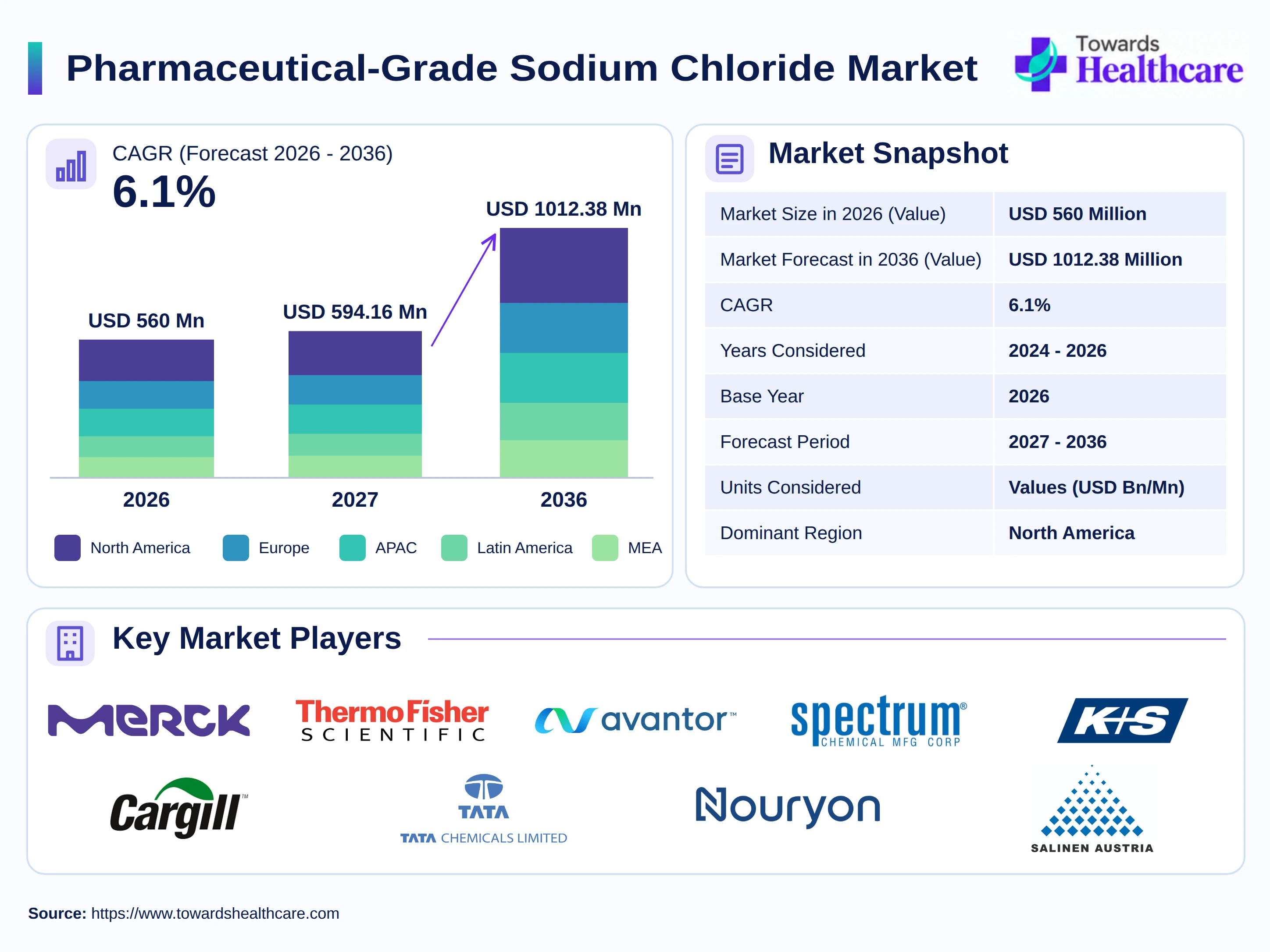
Market growth reflects demand from injectable formulations, infusion solutions, dialysis treatments, and other pharmaceutical applications that require controlled sodium chloride quality. Pharmaceutical manufacturers prioritize reliable sourcing, consistent purity, and documented quality controls. Demand also depends on the expansion of sterile drug manufacturing and the capacity of qualified suppliers to meet pharmaceutical production requirements.
Market Size & Growth Outlook
Regional Market Spotlight
Segmental Spotlight
Pharmaceutical-grade sodium chloride serves as a critical raw material and formulation ingredient across multiple healthcare applications. Its role extends beyond basic salt content. Pharmaceutical manufacturers require controlled chemical purity and consistent product characteristics to meet formulation specifications and applicable quality standards. The requirements vary by application and become particularly stringent in sterile preparations.
The market includes producers that refine sodium chloride to pharmaceutical specifications and suppliers that provide documented product quality, testing, and packaging. Commercial performance depends on the ability to maintain consistent specifications across production batches. Buyers assess product quality, documentation, supply continuity, and manufacturing controls when selecting suppliers.
Pharmaceutical-grade sodium chloride is purchased under strict quality requirements. Purity deviations or contamination can disrupt downstream manufacturing and delay product release. Suppliers with robust quality systems, consistent manufacturing processes, and reliable batch performance hold a competitive advantage in applications with stringent regulatory and operational requirements.
The expansion of injectable drugs, infusion solutions, and other sterile pharmaceutical products supports demand for high-quality sodium chloride. Pharmaceutical manufacturing requires reliable inputs that meet predefined specifications. Changes in sterile production capacity and pharmaceutical output directly influence demand across relevant applications.
Dialysis solutions and related medical fluids also represent important uses. Sodium chloride contributes to electrolyte balance and formulation requirements in these products. Demand depends on treatment volumes, production of dialysis fluids, and the manufacturing needs of healthcare product suppliers.
Quality compliance remains a defining market condition. Pharmaceutical customers require suitable certificates of analysis, traceability, and documented quality controls. Suppliers also face pressure to maintain consistent specifications and avoid disruptions caused by contamination, manufacturing deviations, or inconsistent raw material quality.
| Segments | 2026 Share | 2026 Market Value (USD Million) |
| Pharmaceutical Grade | 60% | $336 |
| High-Purity Pharmaceutical Sodium Chloride | 28% | $156.8 |
| Other Application-Specific Grades | 12% | $67.2 |
The market is segmented by grade and applicable quality requirements. Pharmaceutical-grade products must meet defined purity and impurity specifications suitable for their intended applications. Buyers evaluate the product against relevant pharmacopoeial requirements and internal manufacturing standards.
Sterile applications require additional attention to microbial control and processing conditions. The required grade depends on the final formulation and the customer's manufacturing process. Suppliers that provide consistent quality and reliable documentation remain well positioned to serve regulated pharmaceutical manufacturers.
| Segments | 2026 Share | 2026 Market Value (USD Million) |
| Crystalline Sodium Chloride | 45% | $252 |
| Powdered Sodium Chloride | 25% | $140 |
| Sodium Chloride Solutions | 30% | $168 |
The market includes sodium chloride supplied in forms suited to different manufacturing and formulation needs. Solid forms support pharmaceutical processing and the preparation of solutions. Solution-based products serve applications that require specified concentrations and controlled handling.
Product selection depends on solubility requirements, formulation processes, storage conditions, and downstream processing. Packaging also influences product integrity during transportation and storage. Suppliers align product formats with customer specifications and intended use.
| Segments | 2026 Share | 2026 Market Value (USD Million) |
| Injectable and Infusion Solutions | 38% | $212.8 |
| Dialysis Solutions | 22% | $123.2 |
| Ophthalmic Products | 10% | $56 |
| Oral and Other Pharmaceutical Formulations | 18% | $100.8 |
| Other Pharmaceutical Applications | 12% | $67.2 |
Pharmaceutical-grade sodium chloride serves injectable formulations, infusion solutions, dialysis fluids, ophthalmic products, and other pharmaceutical preparations. Injectable and infusion applications require close control over purity and contamination risks because the products enter the body through routes that demand strict quality management.
Dialysis applications require sodium chloride as part of electrolyte formulations. Ophthalmic and other specialized preparations require product specifications appropriate to their intended use. Demand across these applications depends on production volumes, formulation requirements, and applicable quality standards.
| Segments | 2026 Share | 2026 Market Value (USD Million) |
| Pharmaceutical Manufacturers | 32% | $179.2 |
| Sterile Solution Manufacturers | 25% | $140 |
| Dialysis Solution Manufacturers | 17% | $95.2 |
| Ophthalmic Product Manufacturers | 8% | $44.8 |
| Contract Development and Manufacturing Organizations | 12% | $67.2 |
| Research and Laboratory Institutions | 6% | $33.6 |
Pharmaceutical manufacturers represent a major end-user group because they use sodium chloride in drug formulations and production processes. Manufacturers of sterile solutions and infusion products require consistent quality, reliable documentation, and stable supply arrangements.
Contract development and manufacturing organizations also purchase pharmaceutical-grade raw materials for client production programs. Medical solution manufacturers and other healthcare product producers contribute additional demand. Research and laboratory applications represent a separate customer group with requirements determined by their specific use cases.
| Segments | 2026 Share | 2026 Market Value (USD Million) |
| North America | 29% | $162.4 |
| Europe | 27% | $151.2 |
| Asia Pacific | 30% | $168 |
| Latin America | 7% | $39.2 |
| Middle East and Africa | 7% | $39.2 |
Asia Pacific is estimated to account for the largest regional share, supported by pharmaceutical manufacturing capacity and demand for sterile formulations. North America and Europe remain important markets due to established pharmaceutical industries and stringent quality requirements, while Latin America and the Middle East and Africa contribute through regional manufacturing and healthcare demand.
The United States is estimated to account for most North American market revenue, supported by its pharmaceutical manufacturing base and demand for high-quality ingredients used in sterile products. Canada and Mexico contribute through pharmaceutical production, formulation activities, and regional supply chains.
Germany, the United Kingdom, and France are estimated to be important markets because of their established pharmaceutical industries and demand for quality-controlled ingredients. Other European markets contribute through sterile solution production, pharmaceutical formulation, and ingredient distribution.
China is estimated to represent the largest separately identified market in Asia Pacific, supported by pharmaceutical production and demand for pharmaceutical raw materials. India and Japan also contribute significantly through drug manufacturing and formulation, while South Korea and Australia support regional demand for quality-controlled pharmaceutical ingredients.
Brazil is estimated to be the largest separately identified market in Latin America, reflecting its pharmaceutical manufacturing base and domestic demand for medicines and sterile solutions. Argentina and other markets contribute through local production, imports, and pharmaceutical distribution networks.
GCC countries are estimated to contribute through healthcare investment and pharmaceutical supply-chain development, while South Africa represents an important market for pharmaceutical products and ingredients in the region. Demand elsewhere depends on medicine manufacturing capacity, imports, and investment in healthcare infrastructure.
Saudi Arabia and the United Arab Emirates are estimated to account for the largest shares of the GCC allocation, supported by healthcare investment and pharmaceutical supply-chain development. The remaining GCC markets contribute smaller shares based on their pharmaceutical demand and distribution capacity.
Expansion of Sterile Pharmaceutical Manufacturing
Growth in injectable drugs, infusion solutions, and sterile pharmaceutical production increases demand for sodium chloride that meets stringent quality specifications. Manufacturers require dependable raw materials to maintain production schedules and meet product-release requirements.
Demand from Dialysis and Medical Solutions
Dialysis fluids and other medical solutions rely on controlled electrolyte formulations. Production volumes in these categories support recurring demand for pharmaceutical-grade sodium chloride with consistent specifications.
Emphasis on Quality and Traceability
Pharmaceutical manufacturers require documented product quality, batch traceability, and reliable testing. These requirements favor suppliers with established quality management systems and disciplined manufacturing controls.
Strict Quality and Compliance Requirements
Suppliers must maintain consistent purity and control relevant impurities throughout production. Quality deviations create risks for customer qualification, batch release, and continued supply relationships. Compliance adds testing, documentation, and process-control requirements.
Raw Material and Production Variability
Raw material quality and processing conditions affect the consistency of the finished product. Manufacturers must control purification and processing stages to maintain required specifications across batches.
Supply Continuity and Qualification Barriers
Pharmaceutical customers depend on qualified suppliers and consistent product specifications. A supplier change requires technical review and quality approval. Production interruptions and logistics disruptions therefore create operational risks for customers.
Specialized Products for Sterile Applications
Suppliers with strong quality systems and manufacturing controls can expand into applications with demanding purity and contamination requirements. Consistent performance and suitable documentation strengthen customer relationships.
Long-Term Supply Partnerships
Pharmaceutical manufacturers value dependable supply and consistent specifications. Suppliers that demonstrate reliable production and responsive technical support can strengthen long-term commercial relationships.
Manufacturing Process Improvements
Investment in purification, analytical testing, process monitoring, and packaging controls improves quality consistency and production efficiency. These capabilities support qualification by regulated customers and reduce the risk of quality-related disruptions.
Pharmaceutical-grade sodium chloride pricing depends on purity specifications, product form, processing requirements, packaging, order volume, and supply agreements. Products intended for demanding pharmaceutical applications require quality controls and documentation that influence the overall cost structure.
Bulk purchasing arrangements influence commercial terms, while specialized formats and customer-specific requirements affect processing and packaging costs. Buyers also evaluate supplier reliability, quality consistency, and qualification requirements when comparing offers. Pricing analysis therefore considers both unit cost and the operational value of dependable supply.
Demand originates from pharmaceutical formulation, sterile solution production, dialysis fluids, and other healthcare manufacturing applications. Consumption patterns depend on downstream production volumes and the quantity of sodium chloride required in each formulation. Pharmaceutical customers also maintain quality and supplier qualification requirements that influence purchasing decisions.
Supply depends on raw material availability, purification capacity, manufacturing controls, analytical testing, and packaging operations. Producers must maintain consistent product quality across batches and provide documentation that supports customer review. Distribution partners contribute through storage, handling, and shipment management.
Supply disruptions create challenges when customers depend on qualified products with specific specifications. Manufacturers with reliable production processes, appropriate quality controls, and stable distribution networks hold an advantage in maintaining supply continuity.
The pharmaceutical-grade sodium chloride value chain begins with raw salt sourcing and continues through purification, processing, quality testing, packaging, and distribution. Each stage affects the final product's suitability for pharmaceutical use.
Pharmaceutical Manufacturing: End users incorporate sodium chloride into formulations or production processes according to defined specifications.
Quality management connects all stages of the value chain. Supplier qualification, traceability, and documented controls support product consistency and reduce the risk of downstream manufacturing disruptions.
Technology development in this market focuses on purification efficiency, process consistency, analytical testing, and contamination control. Manufacturers invest in process monitoring and quality systems to reduce variation between production batches and maintain compliance with pharmaceutical specifications.
Advances in analytical methods strengthen impurity detection and support more consistent product release. Improvements in packaging and handling also help preserve product quality throughout distribution. Innovation centers on operational reliability and quality assurance because customers prioritize consistent performance across qualified supply arrangements.
| Customer Group | Key Applications | Primary Purchasing Priorities |
| Pharmaceutical manufacturers | Drug formulations and pharmaceutical processing | Purity, consistency, documentation and supply reliability |
| Sterile solution manufacturers | Injectable and infusion solutions | Strict quality control, contamination prevention and batch traceability |
| Dialysis solution manufacturers | Dialysis fluids and electrolyte solutions | Consistent specifications and dependable supply |
| Ophthalmic product manufacturers | Ophthalmic formulations | Application-specific purity and quality requirements |
| Contract manufacturing organizations | Client-specific pharmaceutical production | Supplier qualification, documentation and production continuity |
| Research and laboratory users | Pharmaceutical research and testing | Appropriate grade, reliable specifications and packaging |
The competitive landscape includes pharmaceutical ingredient suppliers, specialty chemical manufacturers, and life-science companies with relevant high-purity sodium chloride offerings. Competition centers on product quality, compliance, production capability, supply continuity, and customer qualification.
Companies serving regulated pharmaceutical customers compete through documented quality systems and the ability to meet application-specific requirements. Distribution coverage and customer service also influence supplier selection, particularly for manufacturers managing multiple production sites or demanding delivery schedules.
| Company | Headquarters | Market position | Relevant capabilities |
| Merck KGaA | Darmstadt, Germany | Life-science and pharma-ingredient supplier | High-purity chemicals and excipients for regulated and research applications |
| Thermo Fisher Scientific | Waltham, Massachusetts, U.S. | Life-science supplier and distributor | Laboratory and pharmaceutical-related chemicals, including the Fisher Chemical portfolio, with quality documentation and global distribution |
| Avantor | Radnor, Pennsylvania, U.S. | High-purity materials supplier | High-purity materials and supply solutions for pharmaceutical and life-science manufacturing |
| Spectrum Chemical | Gardena, California, U.S. | Specialty chemical supplier | Specialty and high-purity chemicals for pharmaceutical and laboratory use |
| K+S | Kassel, Germany | Salt producer | Salt production and refined salt products across industrial and specialized applications |
| Cargill | Minnetonka, Minnesota, U.S. | Salt producer | Salt production and processing across multiple end-use markets |
| Tata Chemicals | Mumbai, India | Salt and chemical producer | Salt manufacturing and chemical processing |
| Nouryon | Amsterdam, Netherlands | Specialty chemical manufacturer | Specialty chemicals and chemical processing; its salt business may have moved to Nobian, so confirm or remove |
| Salinen Austria | Bad Ischl, Austria | Regional salt producer | Salt production and refined salt products |
Strategic activity in the broader pharmaceutical ingredients and specialty chemicals sector focuses on production efficiency, quality systems, geographic reach and portfolio development. Relevant developments include capacity expansion, process improvements, distribution partnerships, and investments in analytical capabilities.
For pharmaceutical-grade sodium chloride suppliers, strategic priorities include strengthening purification capacity, improving batch consistency, expanding access to pharmaceutical customers, and maintaining reliable supply networks. Company-level assessments should distinguish general salt production from verified pharmaceutical-grade manufacturing and supply.
High-Purity Products for Regulated Manufacturing
Manufacturers with strong process controls and reliable testing capabilities have opportunities to serve customers with demanding specifications. The commercial advantage comes from consistent product quality and dependable documentation.
Supply Security and Qualified Supplier Networks
Pharmaceutical producers prioritize stable access to qualified ingredients. Suppliers that demonstrate consistent production and reliable delivery strengthen their position in long-term supply arrangements.
Customer-Specific Packaging and Service
Packaging formats, batch documentation, and delivery schedules influence purchasing decisions. Suppliers that align these services with customer manufacturing requirements strengthen retention and improve service differentiation.
Emerging Pharmaceutical Manufacturing Capacity
Expansion of pharmaceutical production in developing manufacturing hubs creates opportunities for qualified ingredient suppliers. Local distribution, dependable logistics, and compliance with customer requirements remain essential to market access.
| Force | Market Impact |
| Competitive Rivalry | Competition centers on quality consistency, customer qualification, price and supply reliability. |
| Supplier Power | Raw material availability and the number of qualified input suppliers influence production continuity and cost. |
| Buyer Power | Large pharmaceutical manufacturers negotiate commercial terms and impose stringent quality requirements. |
| Threat of New Entrants | Quality systems, process controls, customer qualification and regulatory expectations create entry barriers. |
| Threat of Substitutes | Substitution remains limited in applications that require sodium chloride as a specified formulation ingredient. |
The pharmaceutical-grade sodium chloride market remains closely linked to pharmaceutical production, sterile solution manufacturing, and healthcare applications that require controlled raw material quality. Demand depends on downstream manufacturing volumes and the continued need for consistent ingredients across regulated applications.
Competitive advantage rests on reliable purity, quality documentation, manufacturing consistency, and supply continuity. Suppliers that strengthen purification processes, analytical testing, and customer service are positioned to serve demanding pharmaceutical customers. Market expansion also depends on the ability to qualify products for specific applications and maintain consistent quality across shipments.
By Grade
By Form
By Application
By End User
By Distribution Channel
By Region



Principal Consultant
Payal Rabde is a Healthcare Market Research Analyst at Towards Healthcare Research & Consulting with 4+ years of experience in pharmaceuticals, biotechnology, medical devices, and life sciences.
Learn more about Payal Rabde

Reviewed By
Aditi Shivarkar is a seasoned professional with over 14 years of experience in healthcare market research. As a content reviewer, Aditi ensures the quality and accuracy of all market insights and data presented by the research team.
Learn more about Aditi Shivarkar