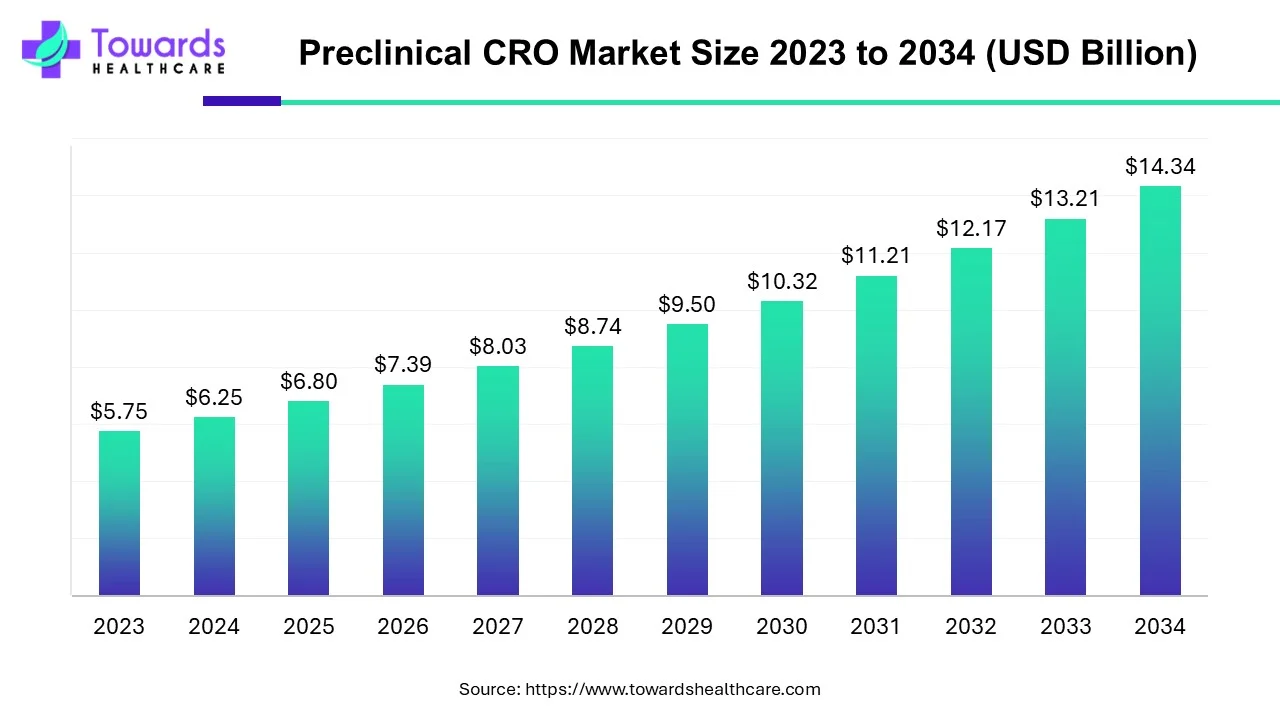
The global preclinical CRO market size was calculated at USD 6.8 billion in 2025 and is predicted to reach around USD 14.34 billion by 2034, expanding at a CAGR of 8.73% from 2025 to 2034. The need for high-quality preclinical CRO is increasing due to the rise in large-molecule preclinical trials and the rising desire to reduce R&D costs.
Surging R&D budgets, growing outsourcing demand, especially in bioanalysis, drug metabolism and pharmacokinetics (DMPK), and toxicology, with a rise in emphasis on personalized medicine, drive the overall market growth. Nowadays, CROs are aiming at strategic alliances to execute artificial intelligence & automation across their activities, while the latest patient-derived organoids (PDOs) are broadly advancing because of increased predictive accuracy and expedited decision-making turnarounds. In addition, the market is experiencing substantial consolidation across key companies to explore innovative approaches.
A specialized company that offers services to help pharmaceutical and biotechnology companies in the early phases of drug development is known as a preclinical CRO. Any novel medication or treatment must go through rigorous in vitro and in vivo testing to assess its pharmacological profile, safety, and efficacy before it can start human clinical trials. This stage is essential to guarantee that the drug is safe for future growth in addition to being effective.
The increasing occurrence of different chronic illnesses and gene-related disorders must be addressed. This demand led to a rise in investments in research activities from various biopharmaceutical and medical device firms aimed at creating new and innovative drugs and devices for diagnosing, preventing, and treating chronic diseases. Thus, it is anticipated that the biopharmaceutical industry's explosive growth and development will significantly contribute to the expansion of the worldwide preclinical CRO market.
Artificial intelligence (AI) and machine learning (ML) algorithms have become an indispensable part of the healthcare sector, driving the latest innovations. AI and ML have the potential to transform the preclinical CRO market by accelerating drug discovery, enhancing research productivity, and lowering costs. It improves target discovery, chemical screening, and toxicity forecasting while simplifying data management and optimizing animal model usage. AI assists in patient modeling, discovering biomarkers, and designing clinical trials, accelerating drug development and personalizing it further. Through the simulation of biological systems and the anticipation of market success, AI has the potential to change preclinical testing, enhancing innovation and success rates in the development of drugs.
Specifying Advanced Modalities & Seamless Solutions:
To fulfil the increasing demand for advanced & intricate biologics, cell and gene therapies, RNA-based medicines, & antibody-drug conjugates (ADCs), CROs are stepping into novelty, including offering integrated, Investigational New Drug (IND)-enabling pathways by combining disease biology, animal model selection, toxicology strategy, biomarker development, and regulatory documentation under a one contract.
Novelty in Technology Across CRO:
In this era, a trend includes huge adoption of organ-on-a-chip and 3D bioprinting technologies, as these provide human-specific organ interactions better than standard rodent alternatives.
Prospective Transitions Towards AI-Driven Solutions:
In the upcoming era, eminent CROs will move from sequential wet-lab testing to AI-powered virtual molecule screening, which shrinks upfront candidate turnover and lowers early experimental expenses.
Driver
Increased Prevalence of Chronic Diseases
The growing demand for new life-saving medications is driving up investment in preclinical research. Preclinical CROs play an important role in the development of novel pharmaceuticals and staging concepts for their commercialization. The increasing prevalence of chronic diseases, including cancer, cardiovascular diseases, and neurological disorders, is greatly pushing up the need for innovative treatments and preclinical trial initiatives. As these illnesses spread, the demand for novel therapies and measures escalates, resulting in heightened attention to preclinical studies. Because of this, it is anticipated that the need for preclinical CRO services will keep rising, mirroring the larger need for creative healthcare solutions to address the rising incidence of chronic illnesses.
The American Cancer Society (ACS) today released Global Cancer Statistics, 2024, the organization’s report on global cancer facts and trends. According to the findings, an estimated 20 million cancer cases are newly diagnosed globally each year, and 9.7 million people die from the disease worldwide. By 2050, the number of cancer cases is predicted to reach 35 million.
Restraint
High Costs of Advanced Models
Adopting advanced preclinical models provides considerable benefits for drug development, but it also entails significant financial costs that may exceed the limits of numerous research budgets. The costs linked to these advanced models can be significant, possibly restricting their wider use in preclinical research. In particular, the expenses associated with the preclinical stages, including laboratory research and animal experimentation, may vary from USD 15 million to USD 100 million. This steep cost presents a considerable obstacle for smaller firms and research organizations, which might find it difficult to set such substantial amounts for their R&D efforts. As a result, the high costs of advanced preclinical models can hinder preclinical CRO market growth.
Opportunity
Increased R&D Investments
Increasing R&D investments signify a major opportunity for the global market. With pharmaceutical companies encountering fierce competition and the necessity for innovation, numerous firms are increasing their resources for research and development. This increased investment leads to a rising need for preclinical CROs capable of offering vital services, including toxicology assessments, pharmacology research, and bioanalytical assistance. Through partnerships with preclinical CROs, these firms can accelerate their drug development schedules and improve their chance of obtaining regulatory approval. Furthermore, CROs that provide specialized knowledge in niche fields such as gene therapy or rare diseases will be especially poised to benefit from this trend, assisting clients in traversing the complicated preclinical landscape while optimizing their R&D profits.
By service, the toxicology testing segment held a dominant presence in the preclinical CRO market in 2025. Toxicology is an important service that is increasingly being outsourced to Contract Research Organizations (CROs) because of their advanced capabilities in conducting toxicology assessments. As more companies move noncore preclinical studies to CROs, the demand for these services is expected to grow, especially since CROs offer additional value-added services. According to research from the Sevier Research Institute, around 50% of preclinical trials fail because of toxicology-related issues. This high failure rate highlights the growing importance of toxicology testing, which is likely to drive further demand for preclinical CRO services.
By service, the bioanalysis and DMPK studies segment is anticipated to grow with the highest CAGR in the preclinical CRO market during the studied year. This growth is driven by the rising demand for pharmacokinetic services, which are essential for supporting toxicology tests in IND-enabling studies. Additionally, bioanalysis and DMPK research are vital throughout the entire formulation procedure, not just in the preclinical phase. This widespread need across various stages of drug formulation is contributing to the growth of this segment.
By model type, the (PDO) patient-derived organoid model segment will dominate the global market in 2024 and hold the largest revenue share. (PDO) Patient-derived organoid models are increasingly being used because of their capacity to correctly mimic tissues and anticipate how particular patients will respond to medications. This is a significant benefit for personalized therapy, and the fact that the samples may be cryopreserved increases its value. Because of these benefits, PDOs are becoming increasingly important in preclinical research, particularly for accelerating cancer detection and prognosis.
By model type, the patient-derived xenografts (PDXs) Model segment is expected to expand at a significant rate throughout the forecast period. Increasingly, CROs have an internal supply of mice with immune deficiencies with (PDXs) patient-derived xenografts. These studies are important because they preserve the original genetic composition of tumor cells, allowing researchers to connect laboratory findings to actual responses. It has also been shown that the way patients respond in clinical trials frequently replicates their responses in PDX models, which contributes to a better safety profile and speeds up the approval process for (NDAs) New Drug Applications.
By end use, the biopharmaceutical companies segment held the largest shares of the preclinical CRO market in 2024. The proliferation of small and medium-sized biopharmaceutical firms throughout the world is driving growth in this industry and is predicted to increase the need for preclinical CRO services, particularly among smaller organizations with less experience in the early phases of drug formulation. Furthermore, the rapid expansion of the biopharmaceutical sector is expected to increase the need for preclinical CRO services shortly. The biopharmaceutical industry presently makes up approximately 20% of the global pharmaceutical market and is constantly developing.
By end use, the government and academic institutes segment is expected to grow with the highest CAGR in the market during the studied year. This expansion might be ascribed to increased spending from government agencies and academic institutions in the preliminary stage of drug and medical device research and development. Furthermore, as more academic and government organizations outsource preclinical activities to CROs, the industry is anticipated to expand even further.
North America dominated the global preclinical CRO market share of 48% in 2025. This is mostly owing to the presence of many major biopharmaceutical businesses in the region. The increasing tendency of major companies to outsource preclinical activities has fuelled market expansion even more. According to the (PhRMA) Pharmaceutical Research and Manufacturers Association, the U.S. performs over fifty percent of the pharmaceutical industry's research and development efforts and owns the intellectual property for many new products. As a result, North America's rapidly expanding biopharmaceutical industry is expected to play a significant role in the continuing growth of the worldwide preclinical CRO market.
U.S. Market Trends:
As a major contributor to the preclinical CRO market in North America & is primarily propelled by accelerating acquisitions, expanding pipelines across cell & gene therapies, multi-specific antibodies, & ADCs. Alongside, the U.S. biopharma sponsors are outsourcing early-stage research to secure working capital and overcome the vast fixed costs to maintain internal animal housing and specialized testing spaces.
For instance,
In September 2025, Crown Bioscience opened a state-of-the-art model development center in Kannapolis, North Carolina, to reinforce the company’s operations and boost its ability to facilitate advanced preclinical oncology models.
Canada Market Trends
The significant growth of the market in Canada is drastically driven by consistent federal funding via the Biomanufacturing and Life Sciences Strategy, which enhances local R&D capacity. According to our analysis, Canada can initiate First-in-Human (FIH) clinical trials before formal FDA IND approval. Meanwhile, Health Canada’s simplified Clinical Trial Application (CTA) process dictates a strict 30-day default review timeline. This highly assists global sponsors in employing Canadian CROs for fast, unified preclinical-to-early-phase clinical solutions.
Asia Pacific is expected to grow at the fastest rate during the forecast anticipated duration. Due to the cost-effectiveness provided by CROs in nations like China and India, preclinical outsourcing is anticipated to grow in the Asia Pacific region as a result of the evolving business model of MNC outsourcing and the growing expense of R&D. To lower the cost of research, well-established firms in the U.S. and Western Europe seek analytical services, site research development, and clinical operations in the Asia Pacific area.
China Market Trends:
Across the Asia-Pacific, China is predicted to expand rapidly in the preclinical CRO market during 2026-2035. Along with a sophisticated domestic therapeutic pipeline, China’s local biotechs are widely out-licensing early innovations to global pharma, which raises demand for data packages that favour both the NMPA & international regulators. Also, China is adjusting to international compliance frameworks by emphasizing technology challenges, regional partitioning, & specialized niche mastery.
India Market Trends:
In the future, India is anticipated to grow fastest, as they provide affordability across labor & facility operational spending & highlights as a key hub for IND-enabling studies. Additionally, large public funding injections, like dedicated multi-million-dollar allocations to the Department of Biotechnology (DBT), are persistently empowering the nation’s baseline research infrastructure. India’s latest New Drugs and Clinical Trials Rules have greatly streamlined bureaucratic barriers & expedited regulatory approval timelines.
September 2024: By acquiring BTS Research, a well-known preclinical CRO, PharmaLegacy expands its preclinical offerings. This calculated action increases PharmaLegacy's capacity for medication research and discovery by extending its laboratory operations into North America. By addressing the increasing need for preclinical research, the acquisition seeks to provide clients with integrated solutions. It displays PharmaLegacy's dedication to growing its worldwide presence and advancing life sciences innovation.
By Service
By Model Type
By End-use
By Region



Principal Consultant
Payal Rabde is a Healthcare Market Research Analyst at Towards Healthcare Research & Consulting with 4+ years of experience in pharmaceuticals, biotechnology, medical devices, and life sciences.
Learn more about Payal Rabde

Reviewed By
Aditi Shivarkar is a seasoned professional with over 14 years of experience in healthcare market research. As a content reviewer, Aditi ensures the quality and accuracy of all market insights and data presented by the research team.
Learn more about Aditi Shivarkar