
Pipeline Programs

CGT Companies Tracked

Manufacturing Facilities


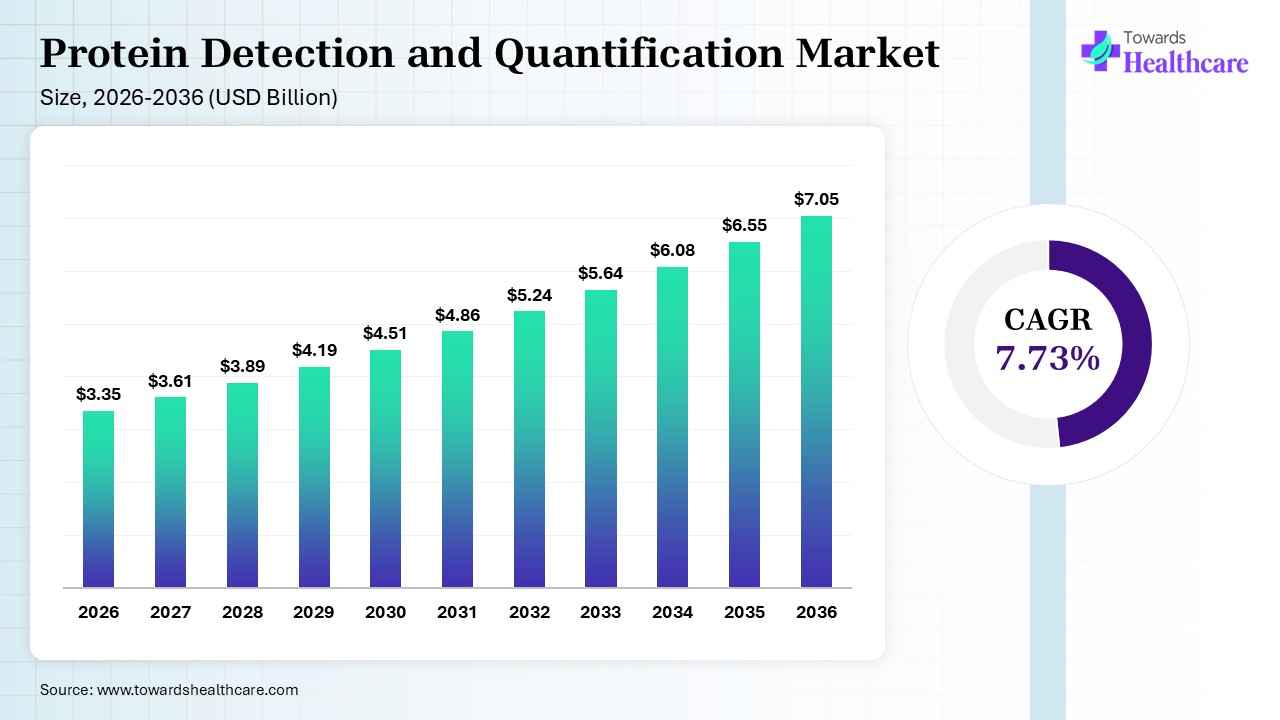
The protein detection and quantification market is expected to reach US$ 3.35 billion in 2026 and is projected to reach US$ 7.05 billion by 2036, registering a CAGR of 7.73% during 2027-2036. Market demand reflects the growing use of protein analysis in drug discovery, proteomics research, biomarker validation, clinical research, and biopharmaceutical development. Repeated consumption of assay kits and reagents supports recurring revenue, while demand for advanced analytical instruments and specialized services expands the market's technology base.
Protein detection and quantification technologies support routine protein concentration measurement and advanced protein characterization. Colorimetric assays serve established laboratory workflows, while fluorescence-based methods and immunological assays support sensitive and target-specific detection. Chromatography and mass spectrometry address protein separation, identification, and complex proteomics applications. Technology selection depends on analytical sensitivity, specificity, sample compatibility, throughput, reproducibility, and operating costs.
The market is segmented by product, technology, application, end user, and region. Product segmentation distinguishes recurring consumable purchases from instrument sales and analytical services. Technology segmentation reflects differences in detection principles, sensitivity, throughput, and application suitability.
| Segment | Categories |
| By Product | Kits and reagents/consumables; instruments; services; other products |
| By Technology | Colorimetric assays; fluorescence-based assays; immunological methods; chromatography; mass spectrometry; spectroscopy and other detection technologies |
| By Application | Drug discovery and development; proteomics and molecular biology research; biomarker discovery and validation; clinical diagnostics and disease research; biopharmaceutical quality control; other applications |
| By End User | Pharmaceutical companies; biotechnology companies; academic and research institutes; contract research organizations (CROs); clinical and diagnostic laboratories; other end users |
| By Region | North America; Europe; Asia Pacific; Latin America; Middle East and Africa |
Reagents and consumables form a core product category because protein measurement requires assay kits, buffers, standards, antibodies, substrates, and sample-preparation materials. Laboratories purchase these products repeatedly to support experiments, analytical testing, and ongoing research programs. Product selection depends on assay format, sample type, sensitivity, reagent stability, and compatibility with existing laboratory workflows.
Instruments support protein measurement through plate readers, spectrophotometers, fluorescence detection systems, imaging platforms, and advanced analytical platforms. Demand reflects laboratory throughput, automation requirements, instrument replacement cycles, and the complexity of the intended application. Services support specialized protein analysis, method development, protein characterization, and workflows requiring advanced technical expertise.
Colorimetric assays support routine protein concentration measurement through accessible laboratory procedures. Fluorescence-based assays address applications requiring sensitive detection, while immunological methods use target-specific recognition to measure selected proteins. Chromatography separates proteins based on physicochemical properties, and mass spectrometry supports protein identification, characterization, and complex proteomics workflows.
Technology selection depends on the analytical objective. Routine concentration measurement requires dependable quantification and practical workflow integration. Proteomics research requires methods suited to complex samples and detailed protein analysis. Laboratories evaluate sensitivity, specificity, dynamic range, reproducibility, sample requirements, analytical time, and total operating costs when selecting a method.
Drug discovery and development use protein analysis for target validation, assay development, candidate characterization, and biological response assessment. Proteomics research examines protein abundance, function, interactions, and modifications across biological systems. These applications require analytical methods that produce reliable and reproducible results.
Biomarker discovery and validation support research into cancer, inflammatory diseases, cardiovascular conditions, and other disorders. Clinical and diagnostic applications require methods suited to the intended diagnostic purpose and applicable quality requirements. Biopharmaceutical quality control uses protein measurement and characterization to support product development and manufacturing workflows.
Pharmaceutical and biotechnology companies prioritize analytical reliability, throughput, workflow integration, and technical support. Academic and research institutions emphasize affordability, assay flexibility, and access to a broad range of methods. CROs require repeatable workflows, dependable turnaround times, and access to specialized analytical capabilities.
Clinical and diagnostic laboratories place greater emphasis on method validation, quality control, and consistency. Biopharmaceutical manufacturers require reliable analytical performance and appropriate documentation to support development and manufacturing activities.
Advanced analytical instruments involve significant acquisition, maintenance, and operating costs. Specialized proteomics workflows also require trained personnel, appropriate sample preparation, validated methods, and data-analysis expertise. These requirements create barriers for laboratories with limited budgets or technical resources.
Assay variability remains a key challenge. Sample preparation, matrix effects, protein stability, antibody specificity, calibration, and differences between analytical methods affect results. Laboratories rely on appropriate controls, standardized procedures, and method-specific validation to maintain reproducibility.
Multiplex protein analysis, high-sensitivity detection, automated workflows, and integrated data processing provide opportunities for technology providers. Platforms that measure multiple targets within limited sample volumes address research requirements involving complex biological samples.
Analytical service providers also serve laboratories that lack specialized instruments or experienced proteomics teams. Additional opportunities arise from translational research, biomarker validation, biopharmaceutical development, and advanced protein characterization.
Pricing varies by assay format, reagent composition, analytical sensitivity, sample throughput, instrument specifications, and intended application. Routine protein assay kits follow a kit-based pricing model, while specialized immunoassays and high-sensitivity products involve different reagent and validation requirements.
Instrument pricing depends on detection technology, throughput, automation, software, and service coverage. Advanced analytical platforms require greater capital investment and technical support. Service pricing reflects sample volume, analytical complexity, turnaround time, data processing, and reporting requirements.
Customers evaluate cost per sample, reagent consumption, repeat-test rates, maintenance, instrument utilization, and total cost of ownership. A practical pricing assessment compares the full analytical workflow and its operating requirements.
Demand comes from research laboratories, pharmaceutical and biotechnology companies, clinical and diagnostic laboratories, CROs, and biopharmaceutical manufacturers. Consumable demand follows experiment frequency, sample volumes, and assay usage. Instrument demand follows laboratory expansion, capital expenditure, replacement cycles, and adoption of automated analytical workflows.
The supply chain includes raw-material suppliers, reagent and antibody producers, assay developers, instrument manufacturers, component suppliers, distributors, and analytical service providers. Reagent supply depends on the availability and quality of biological materials, chemicals, antibodies, and assay components. Instrument production relies on precision components, optical systems, detectors, electronics, and software integration.
Supply-chain performance depends on product consistency, inventory management, manufacturing quality, instrument availability, and technical support. Specialized reagents and advanced platforms require application-specific qualification and customer training. Suppliers that maintain reliable product availability and effective service coverage strengthen their position with research and commercial customers.
The value chain begins with raw materials and biological reagents, followed by assay development, reagent formulation, instrument engineering, software integration, quality testing, distribution, and customer application. Analytical service providers add value through sample preparation, method development, protein characterization, and data interpretation.
Reagent suppliers compete through consistency, specificity, sensitivity, stability, and workflow compatibility. Instrument manufacturers compete through analytical performance, automation, throughput, software, and service coverage. Distributors support product access and technical assistance across regional markets.
Operational bottlenecks include specialized reagent quality, instrument component availability, skilled technical labor, method validation, and customer training. Reliable technical support reduces workflow disruption and strengthens customer retention.
Technology development focuses on detecting low-abundance proteins, measuring multiple targets in parallel, reducing sample requirements, and improving reproducibility. Colorimetric assays and fluorescence-based methods support established workflows, while immunological methods provide target-specific detection. Chromatography and mass spectrometry serve advanced separation and protein-characterization needs.
Multiplex technologies increase the number of proteins measured within a single workflow. Automated liquid handling and plate-based systems reduce manual intervention and support higher sample throughput. Software tools support data processing and comparisons across experiments.
Technology benchmarking assesses sensitivity, specificity, dynamic range, sample requirements, throughput, analytical time, reproducibility, and workflow complexity. Instrument comparisons also consider automation, data integration, operating costs, and service availability.
| Customer group | Key requirements |
| Pharmaceutical companies | Reproducibility, analytical performance, throughput, documentation, and workflow integration |
| Biotechnology companies | Assay flexibility, target-specific analysis, scalability, and technical support |
| Academic and research institutes | Affordability, protocol flexibility, reagent availability, and ease of use |
| Contract research organizations | Repeatability, turnaround time, broad assay access, and dependable service |
| Clinical and diagnostic laboratories | Method validation, quality control, consistency, and intended-use compliance |
| Biopharmaceutical manufacturers | Product characterization, batch consistency, analytical reliability, and process integration |
| Segments | 2026 Share | 2026 Market Value (USD Million) |
| Kits and Reagents/Consumables | 55% | 1,842.50 |
| Instruments | 25% | 837.5 |
| Services | 15% | 502.5 |
| Other Products | 5% | 167.5 |
Kits and reagents/consumables are estimated to dominate the product segment because routine protein assays require recurring supplies across research and analytical workflows. Instruments support specialized and high-throughput analysis, while services address outsourced testing, analytical support, and other laboratory requirements.
| Segments | 2026 Share | 2026 Market Value (USD Million) |
| Colorimetric Assays | 25% | 837.5 |
| Fluorescence-Based Assays | 20% | 670 |
| Immunological Methods | 18% | 603 |
| Chromatography | 12% | 402 |
| Mass Spectrometry | 15% | 502.5 |
| Spectroscopy and Other Detection Technologies | 10% | 335 |
Colorimetric assays are estimated to represent a major share because they are widely used for routine protein concentration measurement and are accessible to many laboratories. Fluorescence-based and immunological methods serve applications requiring greater sensitivity or target specificity, while chromatography and mass spectrometry support advanced protein characterization and proteomics.
| Segments | 2026 Share | 2026 Market Value (USD Million) |
| Drug Discovery and Development | 25% | 837.5 |
| Proteomics and Molecular Biology Research | 23% | 770.5 |
| Biomarker Discovery and Validation | 18% | 603 |
| Clinical Diagnostics and Disease Research | 14% | 469 |
| Biopharmaceutical Quality Control | 13% | 435.5 |
| Other Applications | 7% | 234.5 |
Drug discovery and development is estimated to represent the largest application segment as pharmaceutical researchers use protein analysis to study targets, evaluate candidate compounds, and characterize biological responses. Proteomics and biomarker research also drive demand for sensitive, reproducible measurements across complex biological samples.
| Segments | 2026 Share | 2026 Market Value (USD Million) |
| Pharmaceutical Companies | 27% | 904.5 |
| Biotechnology Companies | 22% | 737 |
| Academic and Research Institutes | 24% | 804 |
| Contract Research Organizations (CROs) | 12% | 402 |
| Clinical and Diagnostic Laboratories | 10% | 335 |
| Other End Users | 5% | 167.5 |
Pharmaceutical companies are estimated to be the largest end-user group because protein analysis supports drug development, characterization, and quality-related workflows. Biotechnology companies and academic research institutes also represent substantial demand, while CROs and diagnostic laboratories contribute through outsourced research and testing services.
| Segments | 2026 Share | 2026 Market Value (USD Million) |
| North America | 39% | 1,306.50 |
| Europe | 27% | 904.5 |
| Asia Pacific | 23% | 770.5 |
| Latin America | 6% | 201 |
| Middle East and Africa | 5% | 167.5 |
North America is estimated to lead the market because of its established biotechnology and pharmaceutical industries, research infrastructure, and adoption of advanced analytical technologies. Europe represents another significant market, while Asia Pacific offers growth potential through expanding life sciences research, biopharmaceutical manufacturing, and laboratory capacity.
The United States is estimated to account for most North American revenue due to its large pharmaceutical and biotechnology sectors, extensive research activity, and adoption of advanced protein-analysis technologies. Canada and Mexico contribute through academic research, biopharmaceutical development, and laboratory testing.
Germany, the United Kingdom, and France are estimated to be important European markets because of their life sciences research, pharmaceutical development, and laboratory infrastructure. The rest-of-Europe category captures other countries contributing to regional demand.
China and Japan are estimated to be major contributors to the Asia Pacific market, while India and South Korea support regional demand through growing biotechnology, pharmaceutical, and research activities. Expansion of laboratory capacity and biopharmaceutical development may support further adoption of protein detection and quantification technologies.
Brazil is estimated to be the largest separately identified market in Latin America, supported by its research institutions, pharmaceutical sector, and laboratory testing needs. Argentina and other regional markets contribute through academic research and life sciences activities, although investment and access to advanced equipment vary.
GCC countries and South Africa are estimated to represent important markets within the region, supported by healthcare research, diagnostic laboratories, and developing life sciences capabilities. Broader regional adoption will depend on research funding, laboratory infrastructure, and access to advanced analytical instruments and consumables.
Saudi Arabia and the United Arab Emirates are estimated to account for the largest shares of the GCC allocation, reflecting their research investment and healthcare infrastructure development. Qatar, Kuwait, Oman, and Bahrain contribute smaller shares through academic, clinical, and laboratory research.
The competitive landscape includes life-science reagent suppliers, analytical instrument manufacturers, protein assay developers, specialist proteomics companies, and laboratory service providers. Companies compete through assay performance, portfolio breadth, instrument capabilities, automation, pricing, technical support, and distribution reach.
Competitive positioning differs by product category. Reagent suppliers benefit from recurring consumable demand and established laboratory protocols. Instrument manufacturers focus on analytical performance, installed-base retention, upgrades, service contracts, and compatibility with associated consumables. Specialized providers differentiate through advanced protein analysis, high-sensitivity detection, multiplex platforms, and complex proteomics workflows.
| Company | Headquarters | Relevant capabilities |
| Thermo Fisher Scientific | Waltham, Massachusetts, U.S. | Protein assay reagents, laboratory instruments, and analytical workflows |
| Danaher Corporation | Washington, D.C., U.S. | Life-science technologies and analytical platforms through operating businesses |
| Merck KGaA | Darmstadt, Germany | Laboratory reagents, antibodies, and life-science research products |
| Bio-Rad Laboratories | Hercules, California, U.S. | Protein analysis reagents, immunoassays, and laboratory instruments |
| Agilent Technologies | Santa Clara, California, U.S. | Analytical instrumentation and technologies supporting protein characterization |
| Bruker Corporation | Billerica, Massachusetts, U.S. | Mass spectrometry and advanced analytical platforms |
| Waters Corporation | Milford, Massachusetts, U.S. | Chromatography and mass spectrometry technologies |
| Bio-Techne Corporation | Minneapolis, Minnesota, U.S. | Protein analysis reagents, immunoassays, and life-science research tools |
| Promega Corporation | Madison, Wisconsin, U.S. | Assay technologies, reagents, and protein-related research products |
| QIAGEN N.V. | Venlo, Netherlands | Sample preparation and molecular and protein research workflows |
| Shimadzu Corporation | Kyoto, Japan | Analytical instrumentation and chromatography systems |
| Revvity, Inc. | Waltham, Massachusetts, U.S. | Detection technologies and analytical tools for life-science research |
Strategic activity across the wider proteomics sector includes portfolio expansion, technology licensing, platform integration, and acquisitions that strengthen access to protein-analysis capabilities. Thermo Fisher Scientific completed its acquisition of Olink in 2024, expanding its access to proteomics technologies. The transaction highlights the strategic importance of high-throughput protein analysis.
Strategic assessment covers portfolio breadth, technology differentiation, customer access, application coverage, and opportunities for integrated analytical workflows. Company profiles examine relevant products, target customers, competitive strengths, and market positioning.
High-sensitivity detection, multiplex protein analysis, automated workflows, and integrated data processing represent key opportunity areas. Platforms that reduce sample requirements or simplify complex analytical procedures address practical laboratory needs. Analytical services also provide an opportunity to serve customers without access to specialized instruments or experienced proteomics teams.
White-space analysis focuses on unmet requirements in sensitivity, throughput, reproducibility, cost per sample, and accessibility. Research institutions prioritize flexibility and affordability, while pharmaceutical and biotechnology customers emphasize reliable performance, documentation, and integration into development workflows.
| Force | Assessment | Market implications |
| Competitive rivalry | High | Suppliers compete through assay performance, portfolio breadth, price, automation, and technical support. |
| Threat of new entrants | Moderate | Specialized assay development, quality requirements, distribution access, and customer qualification create entry barriers. |
| Supplier bargaining power | Variable | Dependence on specialized biological materials, antibodies, detectors, and precision components influences supply conditions. |
| Buyer bargaining power | Moderate to high | Large pharmaceutical companies and CROs negotiate pricing, while validated workflows and switching costs influence supplier selection. |
| Threat of substitutes | Application-dependent | Alternative assay formats replace selected methods, subject to performance requirements and established protocols. |
The protein detection and quantification market is projected to expand through 2035 as proteomics research, drug discovery, biomarker validation, and biopharmaceutical development sustain demand for reliable analytical tools. Reagents and consumables support recurring revenue, while advanced instruments and multiplex technologies expand analytical capabilities.
Automation and integrated data analysis address throughput and reproducibility requirements. Commercial success depends on matching technology to application needs and demonstrating reliable performance, consistent product quality, workflow compatibility, and dependable technical support.
By Product
By Technology
By Application
By End User
By Region


Principal Consultant
Payal Rabde is a Healthcare Market Research Analyst at Towards Healthcare Research & Consulting with 4+ years of experience in pharmaceuticals, biotechnology, medical devices, and life sciences.
Learn more about Payal Rabde

Reviewed By
Aditi Shivarkar is a seasoned professional with over 14 years of experience in healthcare market research. As a content reviewer, Aditi ensures the quality and accuracy of all market insights and data presented by the research team.
Learn more about Aditi Shivarkar