The rat model market is expected to increase from USD 0.78 billion in 2025 to USD 1.32 billion by 2035, driven by continued regulatory demand for rodent-based safety studies and the expanding use of specialized disease models in biomedical research. Consistent demand for toxicology testing is expected to support steady market growth, taking the market to approximately USD 1.01 billion by 2030. The market is projected to register a CAGR of 5.40% during 2026-2035.
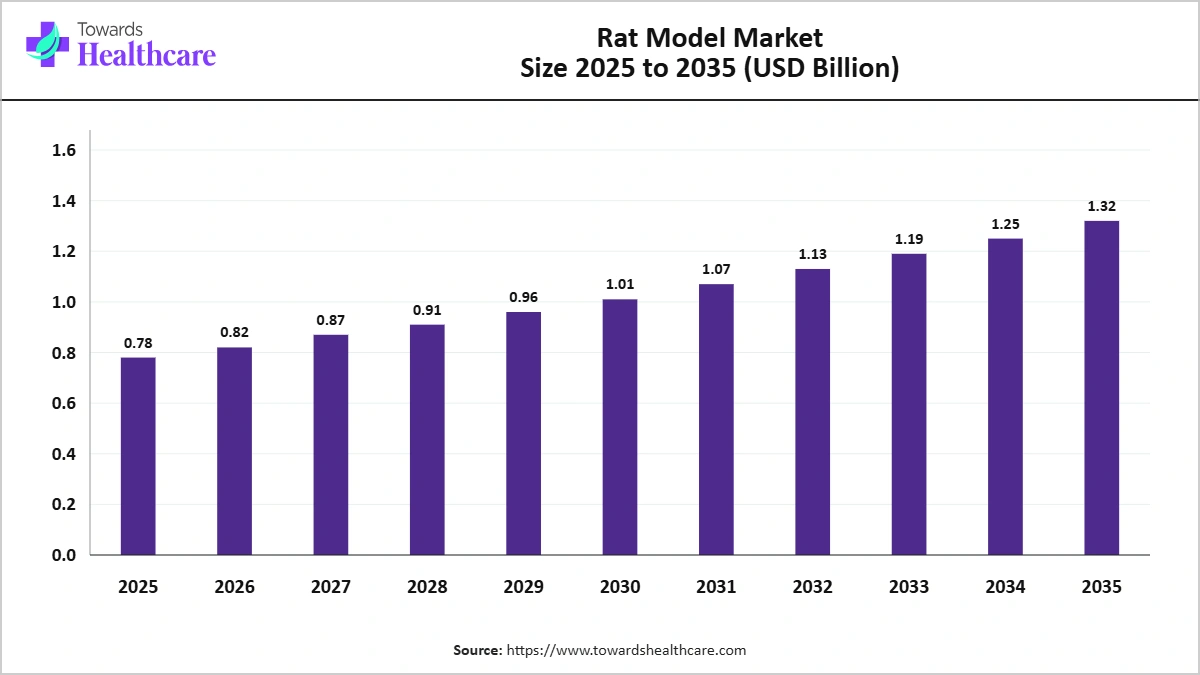
Analyst View: The market estimates are based on laboratory rat sales volumes and average prices across different model types, breeding and supply revenues, and company-level revenues from research models and related services. These inputs provide a basis for evaluating market size and forecasting future growth.
The rat model market is steady. Regulators want fewer animal studies, but rats stay central to toxicology and benefit where non-rodent work is reduced.
| Driver | Impact | ≈ CAGR Contribution | Time Horizon | Key Regions |
| Regulatory toxicology | High | +2.11 pp | Short to long term | Global, strongest in North America |
| Disease research | Medium | +1.78 pp | Medium to long term | Global, fastest uptake in Asia Pacific |
| CRISPR models | Medium | +1.52 pp | Short to medium term | Global |
| Outsourcing | Low | +1.19 pp | Long term | Developed and emerging markets |
Note: Contributions are indicative estimates of each factor's effect on annual growth.
Sources: Expert interviews, secondary sources, Towards Healthcare database and Towards Healthcare analysts.
Regulatory toxicology, disease research and CRISPR models drive most growth in the rat model market.
| Restraint | Impact | ≈ Negative CAGR Contribution | Time Horizon | Key Regions |
| Animal testing phase-out | High | -0.53 pp | Short to medium term | Global |
| Biotech funding | High | -0.39 pp | Medium term | Price-sensitive and emerging markets |
| Ethics | Medium | -0.26 pp | Short term | North America and other mature markets |
Note: Contributions are indicative estimates of each factor's effect on annual growth.
Sources: Expert interviews, secondary sources, Towards Healthcare database and Towards Healthcare analysts.
The animal testing phase-out is the main restraint, followed by biotech funding swings and ethics pressure.
Humanised Rats
The development of humanised rat models containing human genes, cells, or tissues creates new opportunities in preclinical research. These models help researchers study human-specific diseases, immune responses, and drug interactions, supporting the development of more targeted therapies.
Model Services
Growing demand for specialized research models is creating opportunities for colony management, animal surgery, breeding support, and model customization services. These services help pharmaceutical companies and research institutions maintain laboratory colonies and access specialized models without investing heavily in in-house facilities.
Asia Supply
Expanding laboratory animal breeding capabilities in China is creating opportunities to strengthen the regional supply of research rat models. Investments in breeding facilities, research infrastructure, and biotechnology are supporting local production and improving access to laboratory animals across Asia.
Note: 2025 is the base year; 2035 shares and CAGRs are forecasts.
Sources: Expert interviews, secondary sources, Towards Healthcare database, and Towards Healthcare analysts.
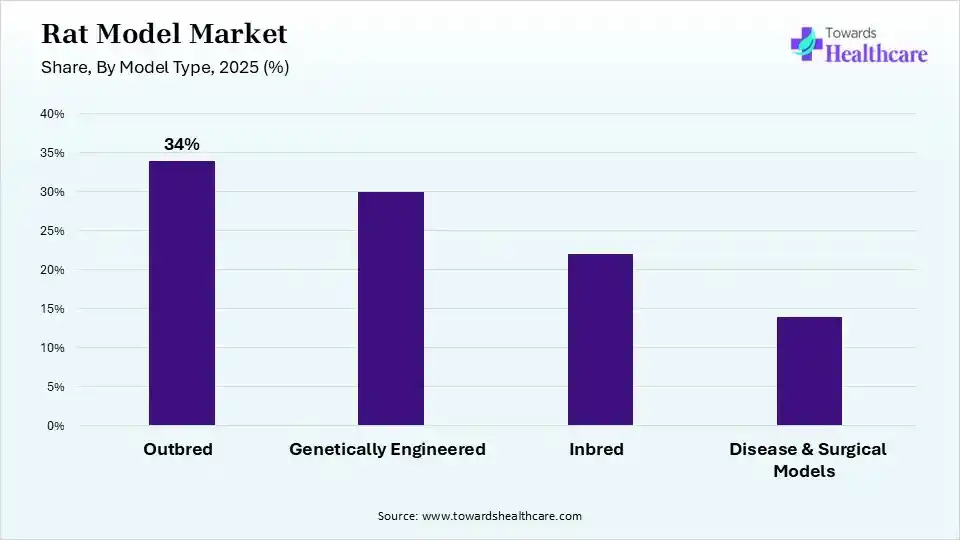
Outbred rats account for 34.00% of the rat model market, making them the largest model type segment. Their widespread use in regulatory toxicology and preclinical safety studies supports demand, particularly as FDA guidance issued in May 2026 allows the use of a single rodent species for certain general toxicology studies.
Genetically Engineered models are widely used in neuroscience, metabolic research, and genetic disease studies, helping researchers investigate specific biological mechanisms and evaluate targeted therapies.
Inbred are valued for their genetic uniformity and predictable research outcomes. They help researchers minimize genetic variations across experiments, making them suitable for controlled studies involving disease progression, drug responses, and laboratory testing.
Disease & Surgical Models support research involving specific medical conditions and surgical procedures. These models help researchers investigate disease mechanisms, evaluate treatment effectiveness, and study physiological changes associated with different interventions.
Breeding & Supply account for 62.00% of the rat model market, making them the largest service segment. Consistent demand for laboratory rats across pharmaceutical research, toxicology testing, and academic studies supports this segment, as research institutions require a reliable supply of standardized animals.
Model Services increasing demand for customized disease models, genetic modifications, surgical procedures, and colony management services is supporting segment growth as pharmaceutical and biotechnology companies seek specialized research solutions.
Toxicology and safety applications account for 34.00% of the rat model market, making them the largest application segment. Continued regulatory requirements for preclinical drug safety assessments support demand for laboratory rats to evaluate toxicity, organ damage, and potential adverse effects of new drug candidates.
Oncology driven by increasing research into cancer development, tumor progression, and treatment effectiveness. Rat models help researchers investigate cancer biology and evaluate the safety and efficacy of emerging cancer therapies.
Cardiovascular and metabolic is projected to grow at a CAGR of 6.51%. Rising research into obesity, diabetes, heart disease, and metabolic disorders is increasing the use of rat models to understand disease mechanisms and assess potential treatments.
Neuroscience supported by growing research into neurological and psychiatric disorders. Rat models are widely used to study brain function, neurodegenerative diseases, and nervous system disorders, as well as to evaluate potential neurological treatments.
Others market share includes applications in immunology, infectious diseases, reproductive research, and other biomedical studies. Laboratory rat models support these research activities by helping scientists investigate disease mechanisms, test experimental treatments, and advance scientific understanding.
Pharma & Biotech companies account for 46.00% of the rat model market, making them the largest end-user segment. Increasing investments in drug discovery, preclinical safety testing, and therapeutic development drive demand for laboratory rats to evaluate drug effectiveness and potential toxicity.
Contract research organizations (CROs) are projected to grow at a CAGR of 6.25%. Rising outsourcing of preclinical research, toxicology testing, and disease studies is increasing CRO demand for laboratory rats and specialized research models.
Academic & Researchgrowing investments in biomedical research, disease investigation, and experimental studies support the use of laboratory rats to understand biological processes and explore new treatment approaches.
Analyst View: Genetically engineered rat models, specialized model services, and cardiovascular and metabolic research are expected to gain market share at a faster pace. Meanwhile, outbred rats and toxicology and safety applications continue to dominate the market, supported by their established role in preclinical research and regulatory safety assessments.
Note: 2025 is the base year; 2035 shares and CAGRs are forecasts.
Sources: Expert interviews, secondary sources, Towards Healthcare database and Towards Healthcare analysts.
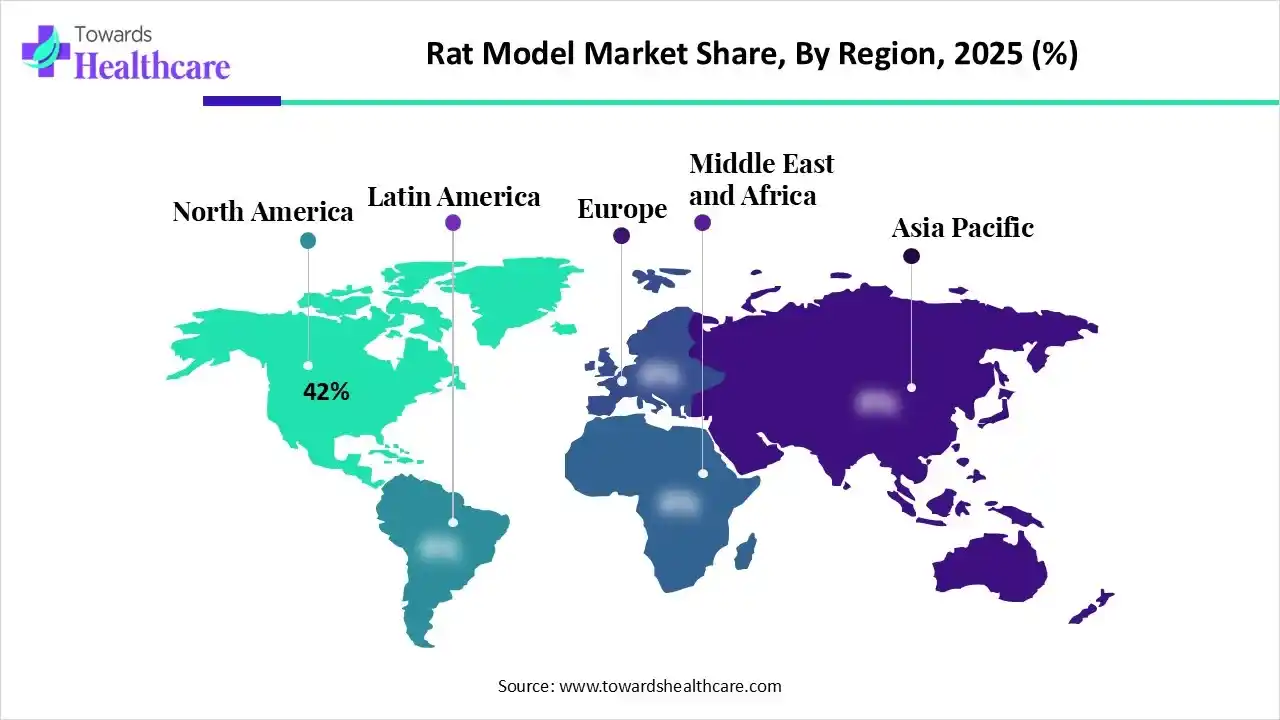
North America: North America dominated the rat model market in 2025, accounting for 42.00% of global revenue. Its leading position is supported by established pharmaceutical and biotechnology industries, advanced preclinical research facilities, and strong demand for laboratory animal models. Although Charles River reported a decline in small research model revenue in the region in mid-2026, North America remains the largest regional market.
Europe strong pharmaceutical industries, established academic institutions, and advanced biomedical research facilities support regional demand. The use of laboratory rats in toxicology, drug development, disease research, and preclinical safety testing continues to drive the market.
Asia Pacific growth is supported by expanding pharmaceutical manufacturing, increasing CRO activities, and rising investment in biomedical research. China is an important contributor, with Charles River reporting higher small research model revenue in the country. Growing research capabilities and demand for preclinical testing are expected to strengthen the region's market position.
Latin America demand is supported by pharmaceutical research, academic institutions, and the gradual development of biotechnology capabilities. Laboratory rats are used in toxicology, disease modelling, and drug development studies across the region. However, its overall contribution remains relatively limited compared with North America, Europe, and Asia Pacific.
The Middle East and Africa growing pharmaceutical research, academic activities, and investments in healthcare and life sciences are supporting demand. While the market remains relatively small, expanding research infrastructure and scientific capabilities offer opportunities for future growth.
Analyst View: North America is expected to maintain its leading position, supported by its established pharmaceutical industry, research infrastructure, and consistent demand for preclinical testing. Europe will continue to hold a significant share due to its strong biomedical research base and regulatory testing requirements. Meanwhile, Asia Pacific is projected to record the fastest growth, driven by expanding pharmaceutical and CRO activities, rising research investments, and increasing demand for laboratory models.
| Rank | Company Name | 2025 Share (%) | Key Products / Business | Headquarters |
| 1 | Charles River | 34.00% | Sprague Dawley, Wistar and model rats | United States |
| 2 | Inotiv | 14.00% | research model rats | United States |
| 3 | Janvier Labs | 6.00% | research rats | France |
| 4 | Taconic | 4.00% | genetically engineered models | United States |
| 5 | The Jackson Laboratory | 3.00% | research models | United States |
| 6 | Cyagen | 3.00% | knockout and transgenic rats | China |
| 7 | GemPharmatech | 3.00% | genetically engineered models | China |
| 8 | Japan SLC | 2.00% | research rats | Japan |
| 9 | Hilltop Lab Animals | 1.00% | research rats | United States |
Note: Company shares are 2025 estimates.
Sources: Company press releases, expert interviews, secondary sources, Towards Healthcare database and Towards Healthcare analysts.
Charles River led the rat model market in 2025, accounting for an estimated 34.00% of total revenue. Inotiv followed with a 14.00% share, while Janvier Labs held 6.00%. Charles River maintains its strong position through its range of Sprague Dawley, Wistar, and other research model rats. Inotiv competes through its research rat portfolio, while Janvier Labs supplies rats for laboratory research.
Other key players include Taconic, The Jackson Laboratory, Cyagen, GemPharmatech, Japan SLC, and Hilltop Lab Animals. These companies compete through specialized research models, genetically engineered rats, knockout and transgenic models, and standard laboratory rat supplies. Their offerings support a wide range of preclinical studies and biomedical research requirements.
The top companies accounted for an estimated 70.51% of total market revenue in 2025, while the remaining 29.49% was distributed among regional breeders and academic colonies. This indicates a relatively concentrated market, with a few established suppliers holding significant positions. Competition primarily revolves around animal health status, genetic quality, consistent supply, customized model development, and pricing.
Charles River, headquartered in the United States, held an estimated 34.00% share of the rat model market in 2025, making it the leading market participant. Its strong position is supported by its extensive portfolio of Sprague Dawley, Wistar, and other laboratory rats used in preclinical research. The company is classified as a Leader.
Inotiv, based in the United States, accounted for approximately 14.00% of the rat model market revenue in 2025. The company competes primarily through its research model rat offerings, serving pharmaceutical, biotechnology, and preclinical research requirements.
Janvier Labs, headquartered in France, held an estimated 6.00% share of the rat model market in 2025. The company supplies laboratory rats for pharmaceutical research, toxicology studies, and biomedical applications. Its established research animal portfolio and presence in the laboratory animal supply market support its position as a Leader.
Taconic, headquartered in the United States, accounted for an estimated 4.00% share of the rat model market in 2025. The company focuses on genetically engineered and specialized research models that support studies involving disease mechanisms and drug development.
The Jackson Laboratory held an estimated 3.00% share of the rat model market in 2025. Based in the United States, the organization is known for its research model portfolio and contributions to biomedical research.
Cyagen, headquartered in China, accounted for an estimated 3.00% share of the rat model market in 2025. The company specializes in knockout and transgenic rat models that help researchers investigate gene functions and develop disease-specific research models.
GemPharmatech, based in China, held approximately 3.00% of the rat model market revenue in 2025. Its market presence is largely supported by genetically engineered animal models developed for specialized biomedical and preclinical research. The company's focus on advanced model development places it in the Innovator.
Japan SLC, headquartered in Japan, held an estimated 2.00% share of the rat model market in 2025. The company supplies research rats for pharmaceutical development, toxicology testing, and academic studies.
Hilltop Lab Animals, based in the United States, accounted for approximately 1.00% of the rat model market revenue in 2025. The company supplies research rats for laboratory studies and preclinical research applications.
The rat model ecosystem links breeders, model developers, CROs, pharma & academia, and regulators, with each stage adding value before products reach end users. Rat studies support animal parasiticides, probiotics, and cell therapy research, and some studies examine the human microbiome in humanized rats.
| Ecosystem Stage | Role in the Market | Key Companies |
| Breeders | Breed rats | Charles River, Inotiv, Janvier |
| Model Developers | Create engineered rats | Cyagen, GemPharmatech, Taconic |
| CROs | Run studies | toxicology CROs |
| Pharma & Academia | Use models | Drug developers, universities |
| Regulators | Set rules | FDA, EMA |
Sources: Company press releases, expert interviews, secondary sources, Towards Healthcare database, and Towards Healthcare analysts.
Breeders supply laboratory rats with controlled genetic backgrounds and defined health status. They maintain pathogen-free colonies and follow strict breeding and monitoring practices to ensure consistent animal quality for research and preclinical studies.
Model developers create specialized rat models using genetic engineering techniques such as CRISPR. These technologies enable faster development of knockout, transgenic, and disease-specific models, helping researchers study complex conditions and evaluate potential treatments.
Contract research organizations (CROs) purchase laboratory rats to conduct preclinical studies on behalf of pharmaceutical and biotechnology companies. Their demand is driven by outsourced toxicology, safety assessment, disease modelling, and drug development activities.
Pharmaceutical companies and academic institutions use laboratory rats for drug discovery, toxicity testing, and disease research. These models remain important for understanding biological processes, evaluating treatment responses, and generating preclinical data.
Regulatory authorities establish guidelines to improve animal welfare and reduce the use of laboratory animals wherever possible. These requirements encourage researchers to adopt alternative testing methods while ensuring that necessary preclinical safety assessments remain scientifically reliable.
Value in the rat model market flows from upstream material and technology suppliers to manufacturers and service providers, then through distribution partners to end users. Companies that integrate several stages or build long-term relationships with end users capture a larger share of this value.
The Towards Healthcare Companies Quadrant positions key participants in the rat model market by market strength, reflecting revenue scale, market share, and geographic reach, and by innovation and growth strategy, reflecting product portfolio breadth, R&D intensity, and partnerships. Positions reflect each company's estimated 2025 share of the rat model market and our assessment of its product innovation, portfolio breadth, and partnerships.
Sources: Company press releases, expert interviews, secondary sources, Towards Healthcare database and Towards Healthcare analysts.
Leaders: Charles River, Inotiv, Janvier Labs, Taconic, The Jackson Laboratory and Cyagen combine high market share with broad portfolios and strong innovation.
Innovators: GemPharmatech, Japan SLC and Hilltop Lab Animals bring newer technologies and specialised products.
By Model Type
By Service
By Application
By End User
By Region
The rat model market was defined as laboratory rats and related services worldwide, including outbred, inbred, genetically engineered, and disease and surgical model rats, supplied through breeding and supply and model services, for toxicology and safety, oncology, neuroscience, cardiovascular and metabolic, and other research, used by pharmaceutical and biotech companies, CROs, and academic institutes. The 2025 base year was built bottom-up from demand volumes and average prices by model type, service, application, end user, and region, and checked top-down against the market-specific revenues of leading companies and public industry data. Segment, regional and company values were allocated from model type, service, application and end user and region demand.
Key estimates were verified by cross-checking company disclosures, regulatory and industry data, and published third-party estimates, and inputs that could not be reconciled were excluded. All segment, regional, and company figures were reconciled to the same 2025 base year, and the 2026-2035 forecast, which applies a constant CAGR from the 2025 base, was recalculated and validated.
Analyst View: We expect the rat model market to grow moderately. The FDA's push to reduce animal testing caps volume growth, but rats gain where non-rodent studies are cut.