Pipeline Programs

CGT Companies Tracked

Manufacturing Facilities


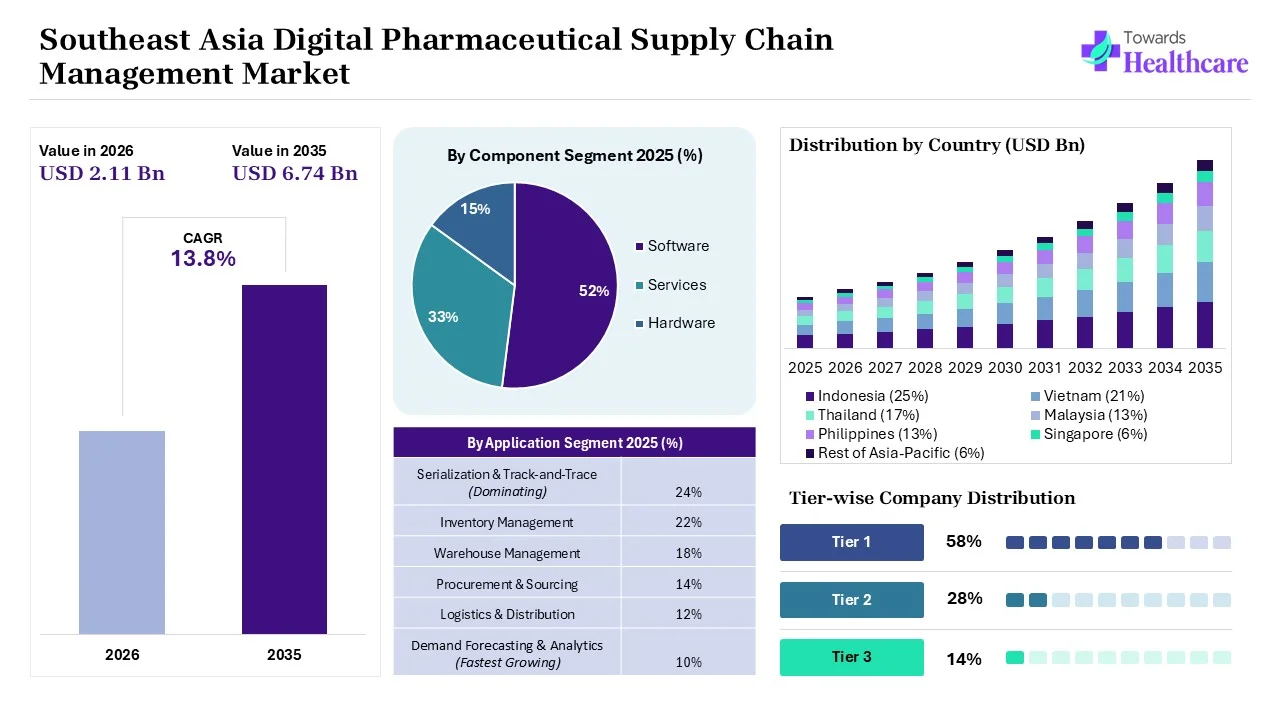
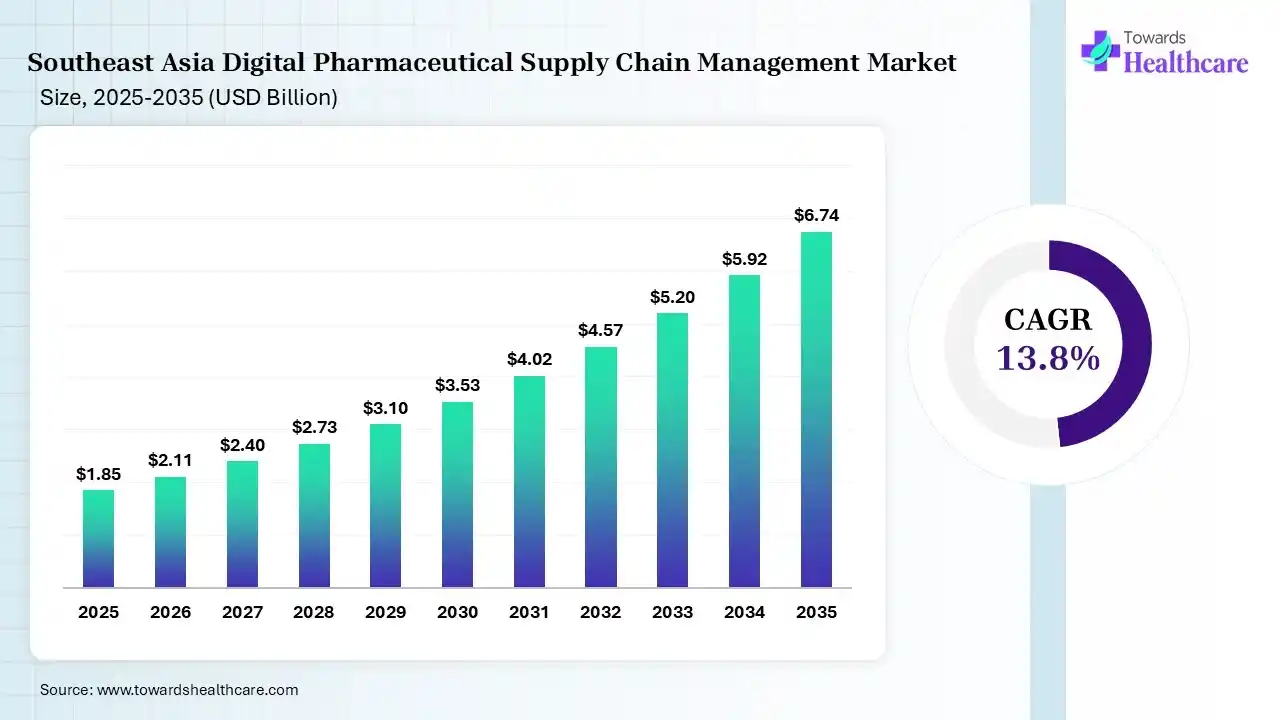
The Southeast Asia digital pharmaceutical supply chain market currently in 2026 records USD 2.11 billion and is anticipated to grow to USD 6.74 billion by 2035, advancing at a CAGR of 13.8% from 2026 to 2035.
Digital pharmaceutical supply chain management refers to the use of digital technologies such as AI, IoT, blockchain, cloud computing, and data analytics to manage and optimize the flow of pharmaceutical products from manufacturers to end users. It improves visibility, efficiency, traceability, and regulatory compliance while ensuring safe and timely delivery of medicine. The Southeast Asia digital pharmaceutical supply chain management market is driven by rising demand for transparency, increasing concern about counterfeiting, and the need for efficient logistics systems. Key trends include real-time tracking, predictive analytics, and blockchain adoption, while opportunities are growing in digital transformation across emerging markets. Technological advancements such as AI-based forecasting, IoT-enabled monitoring, and automated inventory systems are reshaping the industry.
The Southeast Asia digital pharmaceutical supply chain management market is growing due to rising healthcare demand, expanding pharmaceutical manufacturing, and increasing focus on reducing drug counterfeiting. Government initiatives supporting healthcare digitization, along with rapid adoption of IoT, AI, and cloud-based logistics systems, are boosting efficiency. Additionally, growing e-pharmacy platforms and improving cold chain infrastructure are strengthening end-to-end visibility and accelerating market expansion across the region.
AI is transforming the Southeast Asia digital pharmaceutical supply chain management market by improving demand forecasting, inventory optimization, and real-time decision-making. It enhances drug traceability, reduces counterfeiting risks, and strengthens cold chain monitoring through predictive analytics. AI-powered automation streamlines procurement and logistics operations, lowering costs and delays. Additionally, it supports better regulatory compliance and improves supply chain transparency, enabling faster and more efficient delivery of medicines across the region.
Rising Digital Transformation
The Southeast Asia digital pharmaceutical supply chain management market is witnessing strong digital transformation with the adoption of AI, IoT, and cloud platforms. These technologies improve real-time tracking, inventory control, and operational efficiency. Growing investments in smart logistics systems are enhancing transparency and reducing supply chain disruptions across the region.
Expansion of Cold Chain Infrastructure
The region is rapidly expanding cold chain logistics to support vaccines, biologics, and temperature-sensitive drugs. Governments and private players are investing in advanced refrigeration, monitoring systems, and last-mile delivery networks. This trend ensures product quality, reduces wastage, and strengthens overall pharmaceutical distribution efficiency.
Increased Focus on Supply Chain Security
There is a growing emphasis on securing pharmaceutical supply chains through serialization, blockchain, and anti-counterfeit technologies. These innovations help improve traceability and prevent fake medicines. Stronger regulatory frameworks and cross-border compliance standards are further shaping a safer and more transparent future market outlook.
| Table | Scope |
| Market Size in 2026 | USD 2.11 Billion |
| Projected Market Size in 2035 | USD 6.74 Billion |
| CAGR (2026 - 2035) | 13.8% |
| Historical Data | 2020 - 2023 |
| Base Year | 2025 |
| Forecast Period | 2026 - 2035 |
| Measurable Values | USD Millions/Units/Volume |
| Market Segmentation | By Component, By Deployment Mode, By Application, By End User, By Technology, By Region |
| Top Key Players | SGX Pharmatics, DKSH, Zuellig Pharma, YCH Group, Tiong Nam Logistics, Bolloré Logistics Asia Pacific |
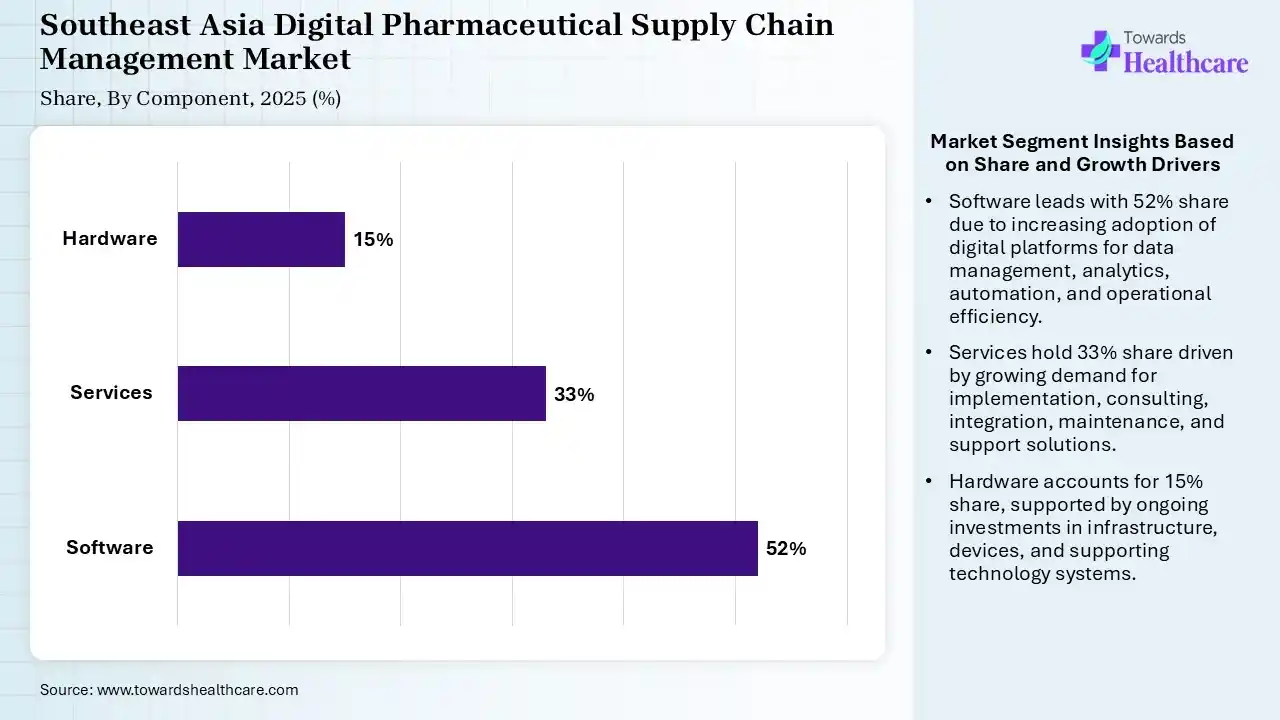
| Segment | Share 2025 (%) |
| Software | 52% |
| Services | 33% |
| Hardware | 15% |
The Software Segment Dominated the Southeast Asia Digital Pharmaceutical Supply Chain Management Market in 2025
The software segment held a dominant share of 52% in 2025 due to increasing adoption of cloud-based platforms, inventory management systems, real-time tracking solutions, and analytics tools across pharmaceutical operations. Software enables end-to-end supply chain visibility, improves demand forecasting, enhances regulatory compliance, and reduces operational inefficiencies. Growing digitization initiatives and the need for data-driven decision-making further strengthened the segment’s leading market position.
The services segment held the second-largest share of 33% in 2025 and is expected to grow at the fastest CAGR in the market during the forecast period due to the growing need for implementation, integration, consulting, maintenance, and support services. As pharmaceutical companies increasingly adopt digital supply chain solutions, demand for specialized expertise to ensure seamless deployment and system optimization continues to rise. Ongoing digital transformation initiatives and evolving regulatory requirements further supported the segment’s strong market position.
The hardware segment held a 15% of Southeast Asia digital pharmaceutical supply chain management market share due to increasing deployment of IoT sensors, RFID tags, barcode scanners, GPS tracking devices, and cloud chain monitoring equipment. These technologies enable real-time visibility, product traceability, and temperature control throughout the supply chain. Growing investments in smart logistics infrastructure and stricter regulatory requirements for pharmaceutical safety are further driving demand for advanced hardware solutions.
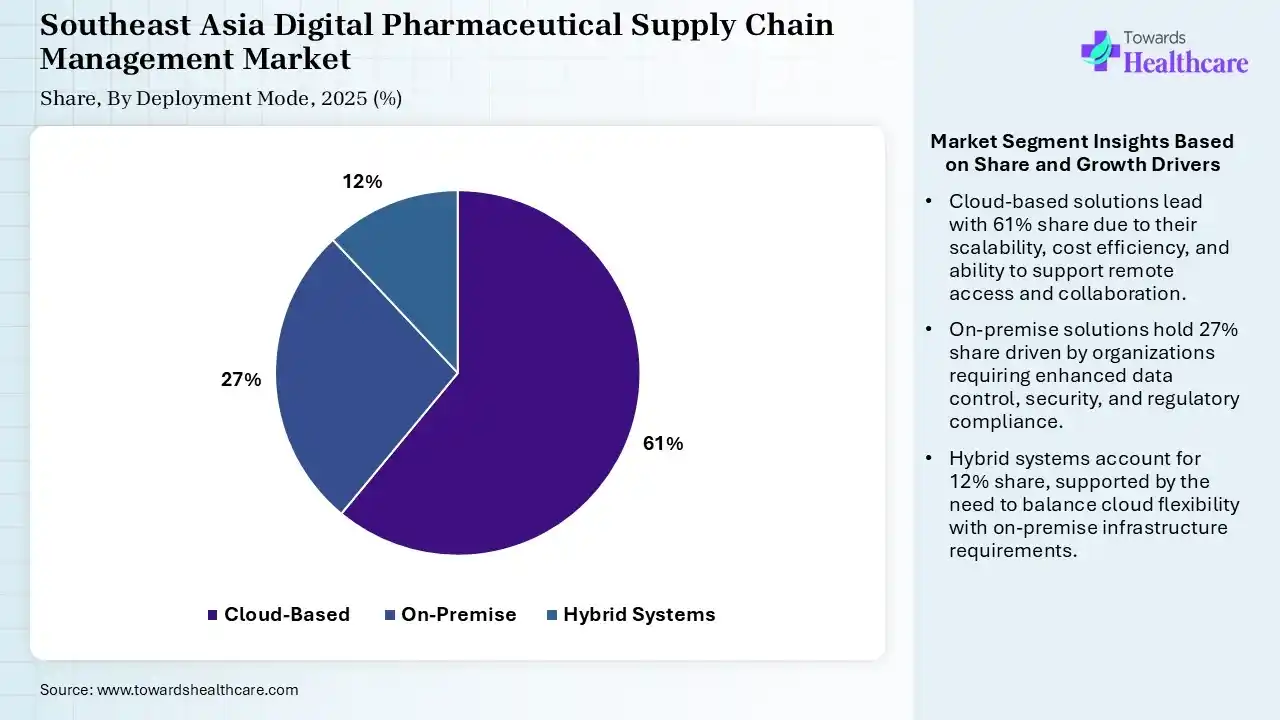
| Segment | Share 2025 (%) |
| Cloud-Based | 61% |
| On-Premise | 27% |
| Hybrid Systems | 12% |
The Cloud-based Segment Led the Southeast Asia Digital Pharmaceutical Supply Chain Management Market in 2025 with the Largest Share
The cloud-based segment led the market with a share of 61% in 2025 and is expected to witness the highest CAGR during the forecast period due to its scalability, cost-effectiveness, and ability to provide real-time data access from multiple locations. Cloud platforms enable seamless integration of supply chain operations, enhance collaboration among stakeholders, and support advanced analytics for better decision-making. Growing digital transformation initiatives and increasing demand for flexible, remotely accessible solutions further strengthened the segment’s market leadership.
The on-premise segment held the second-largest share of 27% in 2025 due to the strong demand from large pharmaceutical companies seeking greater control over sensitive data, systems customization, and regulatory compliance. On-premise solutions offer enhanced security and reliability for mission-critical operations. Additionally, organizations with established IT infrastructure continue to prefer on-premise deployments to maintain data sovereignty and operational control.
The hybrid systems segment held 12% of the Southeast Asia digital pharmaceutical supply chain management market due to its ability to combine the scalability and flexibility of cloud solutions with the security and control of on-premise systems. Pharmaceutical companies are increasingly adopting hybrid deployment to manage sensitive data while enabling real-time initiatives, and evolving regulatory requirements are further accelerating demand for hybrid solutions.
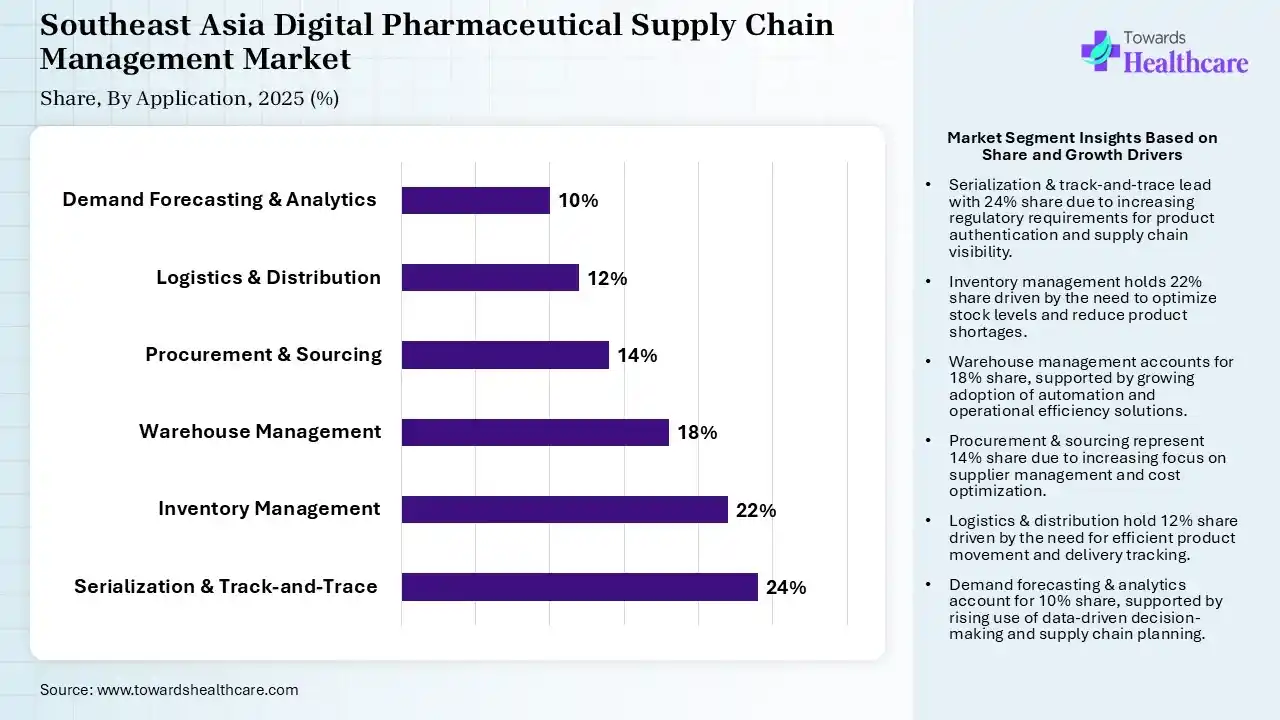
| Segment | Share 2025 (%) |
| Serialization & Track-and-Trace | 24% |
| Inventory Management | 22% |
| Warehouse Management | 18% |
| Procurement & Sourcing | 14% |
| Logistics & Distribution | 12% |
| Demand Forecasting & Analytics | 10% |
The Sterilization & Track-and-trace Segment Led the Southeast Asia Digital Pharmaceutical Supply Chain Management Market in 2025 with the Largest Share
The sterilization & track-and-trace segment dominated the market with a share of 24% in 2025 and is expected to grow at the fastest CAGR during the forecast period due to increasing concerns over counterfeit drugs, stricter regulatory requirements, and the growing need for end-to-end products across the supply chains, ensuring authenticity, safety, and compliance. Rising adoption of digital technologies and enhanced focus on patient safety further strengthened the segment’s market leadership.
The inventory management segment held the second-largest share of 22% in 2025 due to the growing need to optimize stock levels, reduce wastage, and prevent drug shortages. Digital inventory solutions enable real-time monitoring, accurate demand forecasting, and efficient warehouse operations. Increasing pharmaceutical production, expanding distribution networks, and the need for cost-effective supply chain management further supported the segment’s strong market position.
The warehouse management segment held an 18% market share due to the increasing need for efficient storage, inventory tracking, and order fulfillment operations. Digital warehouse solutions help optimize space utilization, reduce manual errors, and improve real-time visibility of pharmaceutical products. Growing pharmaceutical production, rising e-pharmacy activities, and investments in smart warehousing technologies are further driving demand for advanced warehouse management systems.
The demand forecasting & analytics segment held a 10% share in 2025 due to increasing demand for data-driven decision-making and supply chain optimization. Advanced analytics and AI-powered forecasting tools help pharmaceutical companies accurately predict demand, reduce inventory costs, minimize stockouts, and improve operational efficiency. Growing digitization and the need for resilient supply chains are further accelerating segment growth.
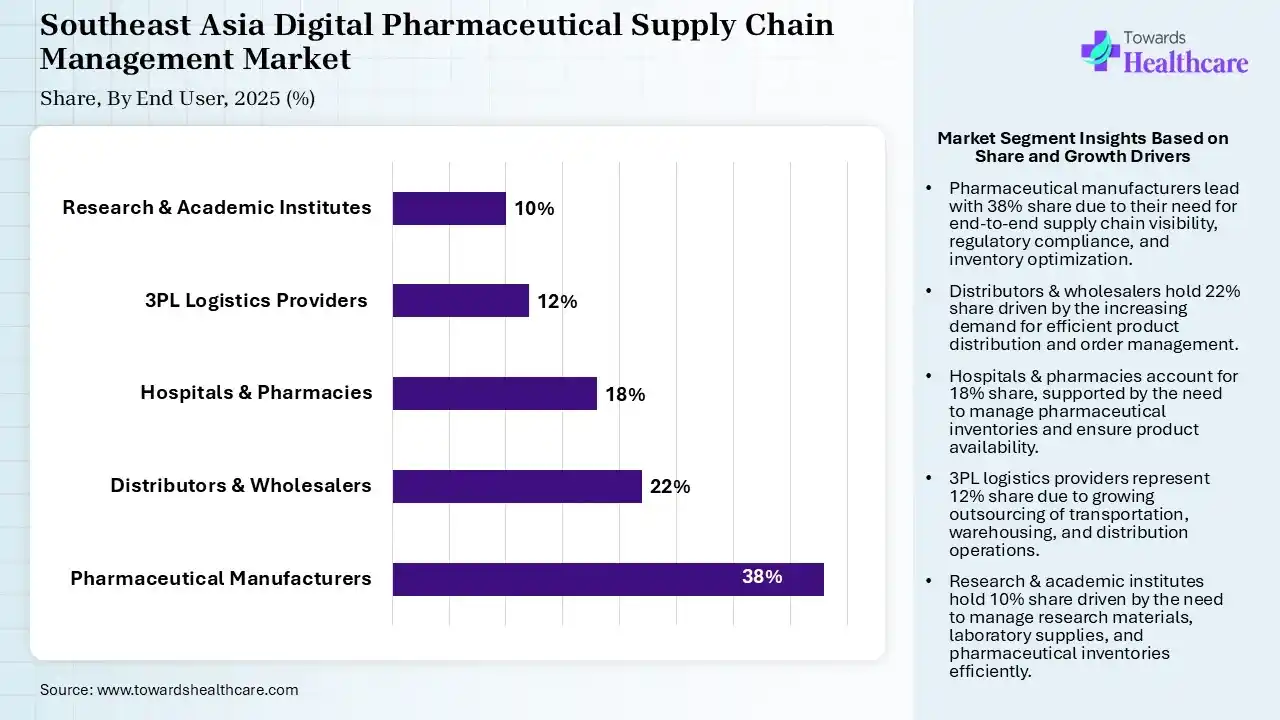
| Segment | Share 2025 (%) |
| Pharmaceutical Manufacturers | 38% |
| Distributors & Wholesalers | 22% |
| Hospitals & Pharmacies | 18% |
| 3PL Logistics Providers | 12% |
| Research & Academic Institutes | 10% |
The Pharmaceutical Manufacturers Segment Led the Southeast Asia Digital Pharmaceutical Supply Chain Management Market in 2025 with the Largest Share
The pharmaceutical manufacturers segment held a dominant share of 38% in 2025 due to its extensive involvement in production, inventory management, regulatory compliance, and distribution activities. Manufacturers increasingly adopted digital supply chain solutions to improve operational efficiency, ensure product traceability, and reduce supply disruptions. Growing pharmaceutical production volumes, rising exports, and investments in advanced technologies such as AI and IoT further strengthened the segment’s leading position.
The distributors & wholesalers segment held the second-largest share of 22% in 2025 due to their critical role in ensuring efficient movement of medicines between manufacturers and healthcare providers. Growing demand for real-time inventory visibility, route optimization, and regulatory compliance encouraged the adoption of digital supply chain solutions. Expanding pharmaceutical trade, increasing product volumes, and the need for timely deliveries further supported the segment’s significant market share.
The hospitals & pharmacies segment held an 18% market share due to increasing demand for efficient medicine inventory management, real-time stock monitoring, and timely drug availability. Digital supply chain solutions help healthcare providers reduce shortages, minimize wastage, and improve operational efficiency. The expansion of healthcare infrastructure, rising patient volumes, and growing adoption of digital technologies are further driving growth in this segment.
The 3PL logistics providers segment held a 12% share in 2025 and is expected to grow at the fastest CAGR in the Southeast Asia digital pharmaceutical supply chain management market during the forecast period due to increasing outsourcing of logistics operations by pharmaceutical companies. 3L providers offer advanced digital tracking, cold chain management, warehousing, and transportation solutions that improve efficiency and reduce costs. Rising demand for specialized pharmaceutical logistics services and expanding regional distribution networks are further accelerating segment growth.
| Segment | Share 2025 (%) |
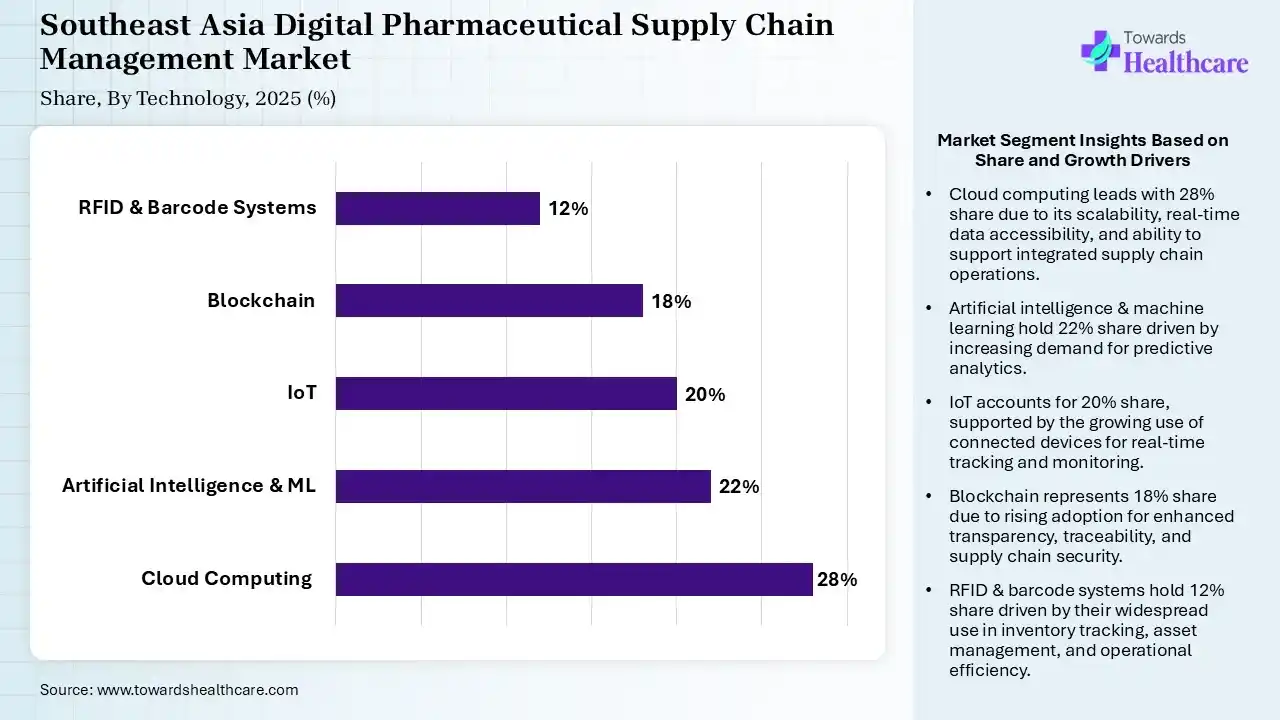
| Cloud Computing | 28% |
| Artificial Intelligence & ML | 22% |
| IoT | 20% |
| Blockchain | 18% |
| RFID & Barcode Systems | 12% |
The Cloud Computing Segment Led the Southeast Asia Digital Pharmaceutical Supply Chain Management Market in 2025 with the Largest Share
The cloud computing segment held a dominant share of 28% in 2025 due to its ability to provide scalable, cost-effective, and real-time access to supply chain data across multiple locations. Cloud-based platforms enhance collaboration, streamline inventory and logistics management, and support advanced analytics for informed decision-making. Growing digital transformation initiatives, increasing data volumes, and the need for flexible and secure supply chain operations further strengthened the segment’s leadership.
The artificial intelligence & ML segment held a 22% share in 2025 and is expected to grow at the fastest CAGR in the market during the forecast period due to its ability to enhance demand forecasting, inventory optimization, and predictive analytics. AI and ML help reduce operational costs, improve supply chain visibility, and enable data-driven decision-making. Increasing digitization, growing data volumes, and the need for resilient pharmaceutical supply chains are further driving rapid adoption.
The IoT segment held a 20% of Southeast Asia digital pharmaceutical supply chain management market due to increasing demand for real-time monitoring, asset tracking, and cold chain management. IoT-enabled sensors connected devices provide continuous visibility into the location and condition of pharmaceutical products, helping reduce losses and ensure regulatory compliance. Rising investments in smart logistics infrastructure and the need for improved supply chain efficiency are further driving segment growth.
The blockchain segment held a 18% of market share due to increasing demand for secure, transparent, and tamper-proof supply chain records. Blockchain technology enhances product traceability, helps combat counterfeit drugs, and improves regulatory compliance by enabling end-to-end visibility. Growing concerns regarding drug authenticity, supply chain security, and data integrity, along with rising digital transformation initiatives, are further accelerating adoption across the pharmaceutical industry.
The Southeast Asia digital pharmaceutical supply chain management market is leading due to rapid healthcare digitization, expanding pharmaceutical industry manufacturing activities m and growing investments in advanced technologies such as AI, IoT, and growing investments in advanced technologies such as AI, IoT, and cloud computing. Rising demand for supply chain transparency, increasing focus on drug traceability, and supportive government initiatives are accelerating adoption. Additionally, the region’s expanding healthcare infrastructure and growing pharmaceutical trade continue to strengthen market growth.
Indonesia dominated the Southeast Asia digital pharmaceutical supply chain management market with a share of 25% in 2025 due to its large population, expanding pharmaceutical industry, and increasing healthcare expenditure. Rising adoption of digital technologies for inventory management. Logistics optimization and drug traceability have accelerated market growth. Government initiatives supporting healthcare digitization, coupled with growing investments in supply chain infrastructure and e-pharmacy platforms, further strengthened Indonesia’s leading market position.
Vietnam held a 20.83% share in 2025 and is expected to grow at the fastest CAGR in the market during the forecast period due to rapid healthcare modernization, increasing pharmaceutical production, and rising investments in digital infrastructure. Growing adoption of cloud-based platforms, AI-driven analytics, and supply chain automation is enhancing operational efficiency. Supportive government initiatives, expanding healthcare access, and increasing demand for pharmaceutical traceability are further accelerating market growth.
| Company | Headquarters | Offerings |
| SGX Pharmatics | Singapore | Digital pharmaceutical supply chain platforms, inventory management, traceability solutions, and logistics optimization |
| DKSH | Bangkok, Thailand | Healthcare distribution, supply chain management, warehousing, and pharmaceutical logistics services |
| Zuellig Pharma | Singapore | Pharmaceutical distribution, digital supply chain solutions, cold chain logistics, and inventory management |
| YCH Group | Singapore | Smart warehousing, pharmaceutical logistics, digital supply chain visibility, and transportation management |
| Tiong Nam Logistics | Johor, Malaysia | Warehousing, pharmaceutical transportation, inventory management, and cold chain services |
| Bolloré Logistics Asia Pacific | Singapore | End-to-end pharmaceutical logistics, supply chain analytics, cold chain management, and freight solutions |
In November 2025, "This expansion is aligned with our mission to democratise access to advanced critical care therapies across emerging markets. Southeast Asia remains a strategic geography for Venus, and we are committed to deepening our presence here through sustained portfolio diversification and long-term partnerships" said, Saransh Chaudhary, President, Global Critical Care, Venus Remedies Limited.
By Component
By Deployment Mode
By Application
By End User
By Technology
By Region









Principal Consultant
Rohan Patil is a seasoned market research professional with over 5+ years of focused experience in the healthcare sector, bringing deep domain expertise, strategic foresight, and analytical precision to every project he undertakes.
Learn more about Rohan Patil

Reviewed By
Aditi Shivarkar is a seasoned professional with over 14 years of experience in healthcare market research. As a content reviewer, Aditi ensures the quality and accuracy of all market insights and data presented by the research team.
Learn more about Aditi Shivarkar