The global stereo microscopes market size was estimated at USD 932.12 million in 2025 and is predicted to increase from USD 976.77 million in 2026 to approximately USD 1488.23 million by 2035, expanding at a CAGR of 4.79% from 2026 to 2035.
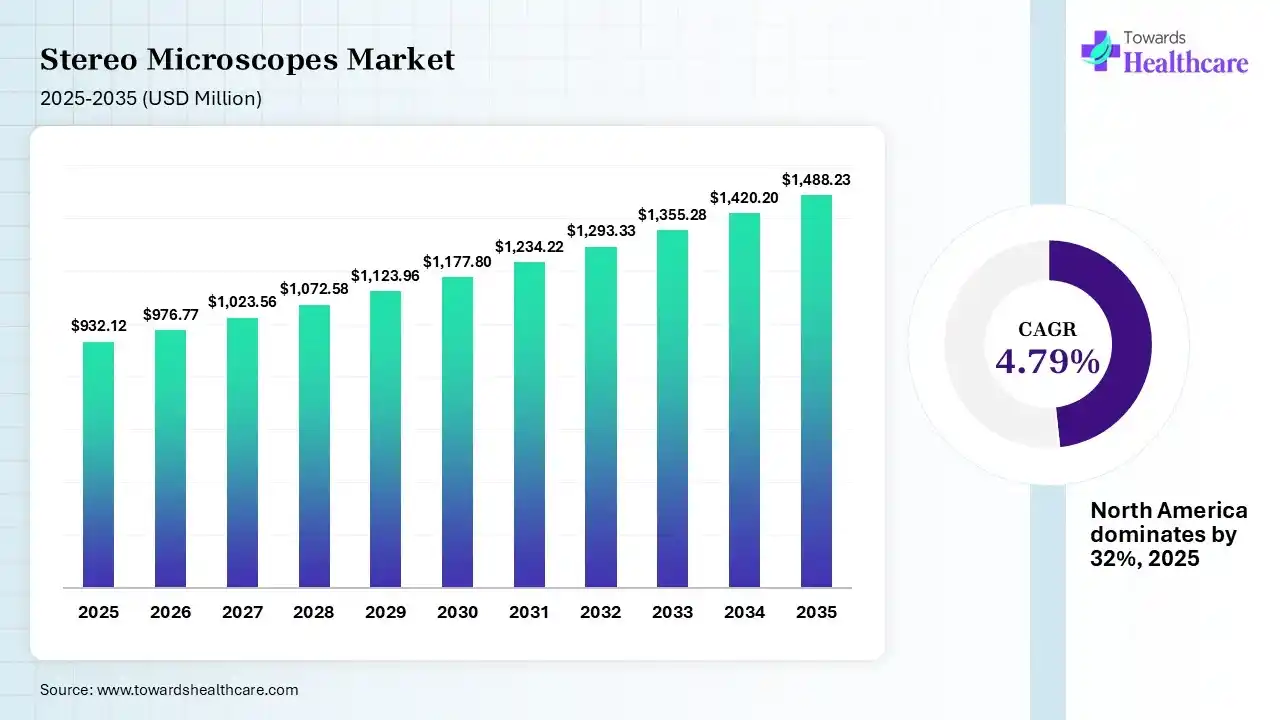
Significant applications in life sciences, forensic research, & medical procedures, and ongoing advances in digital imaging are driving the demand for advanced stereo microscopes.
The global stereo microscopes market is propelled by the growing demand for 3D visualization, breakthroughs in digital imaging, & widening applications in life sciences, forensic research, & medical procedures. Whereas the leading firms are increasingly fostering 3D visualization via digital integration and sophisticated LED imaging. Extensive innovation includes AI-powered automated focusing, 4K digital imaging, and high-resolution, with high-depth-of-field optics, like Leica FusionOptics, and Vision Engineering’s eyepiece-less Mantis 3rd Gen.
Sharper Vision, Smarter Research: The Rising Demand for Stereo Microscopes
Stereo microscopes are optical instruments that provide a three-dimensional, low-magnification view of specimens, enabling detailed observation, inspection, and manipulation of samples in research, industrial, clinical, and educational applications. The stereo microscope market is growing due to increasing demand for precision inspection in electronics, life sciences, and semiconductor manufacturing, along with expanding biomedical research activities. Technological advancements such as digital imaging, high-resolution optics, LED illumination, ergonomic design, and AI-assisted image analysis are enhancing performance and user experience. Emerging trends include integration with automated inspection systems, 3D visualization, and connected digital microscopy platforms for remote collaboration. Future opportunities lie in quality control, advanced material science, forensic analysis, and regenerative medicine research, where accurate visualization and efficient workflow optimization continue.
The widespread adoption of AI algorithms, especially convolutional neural networks (CNNs), is allowing real-time segmentation & categorization of structures in complex, 3D samples, like the detection of cells or defects. Moreover, AI is playing as a GPS for cells, which automatically detects sites of interest (ROIs) and navigates to them, & finally enables efficient 3D imaging of rare events, including specific cell mitosis or rare cancer cells.
Boosted Ergonomics & Illumination
The players are emphasizing high-eyepoint eyepieces & enhanced ergonomic stands that enable users to work comfortably for longer periods, and also LED lighting is becoming standard for superior, adjustable, & energy-efficient illumination, with several models offering independent top/bottom controls.
Pushing Augmented Reality (AR) in Surgery
In the future, systems will integrate 3D, high-definition (HD), & 4K imaging with AR, overlaying, such as pre-operative CT/MRI data directly into the surgeon's field of view to raise navigational accuracy.
Spurring Fluorescence & Multi-Modal Imaging
Prospective microscopes will highly unite fluorescence with standard 3D imaging, which will enable real-time visualization of molecular and cellular markers, & this is crucial for oncology & tumor boundary finding.
| Table | Scope |
| Market Size in 2026 | USD 976.77 Million |
| Projected Market Size in 2035 | USD 1488.23 Million |
| CAGR (2026 - 2035) | 4.79% |
| Leading Region | North America by 32% |
| Key Applications | Life sciences research, semiconductor inspection, electronics manufacturing, medical device inspection, forensic analysis, educational laboratories, industrial quality control |
| Primary End Users | Research institutes, universities, hospitals, biotechnology companies, pharmaceutical companies, electronics manufacturers, semiconductor companies, industrial inspection facilities |
| Key Growth Drivers | Digital microscopy adoption, semiconductor manufacturing expansion, biotechnology research growth, automation in quality control, increasing R&D investments |
| Measurable Values | USD Millions/Units/Volume |
| Market Segmentation | By Test Type, By Design Type, By Zooming Type, By End User, By Region |
| Top Key Players | Nikon Corporation, Cole-Parmer Instrument Company, LLC., Unitron, Vision Engineering Ltd., KEYENCE CORPORATION, ZEISS International, Meiji Techno, Scienscope International Inc., Thermo Fisher Scientific Inc., Seiwa Optical America Inc. |
Which Test Type Dominated the Stereo Microscopes Market in 2025?
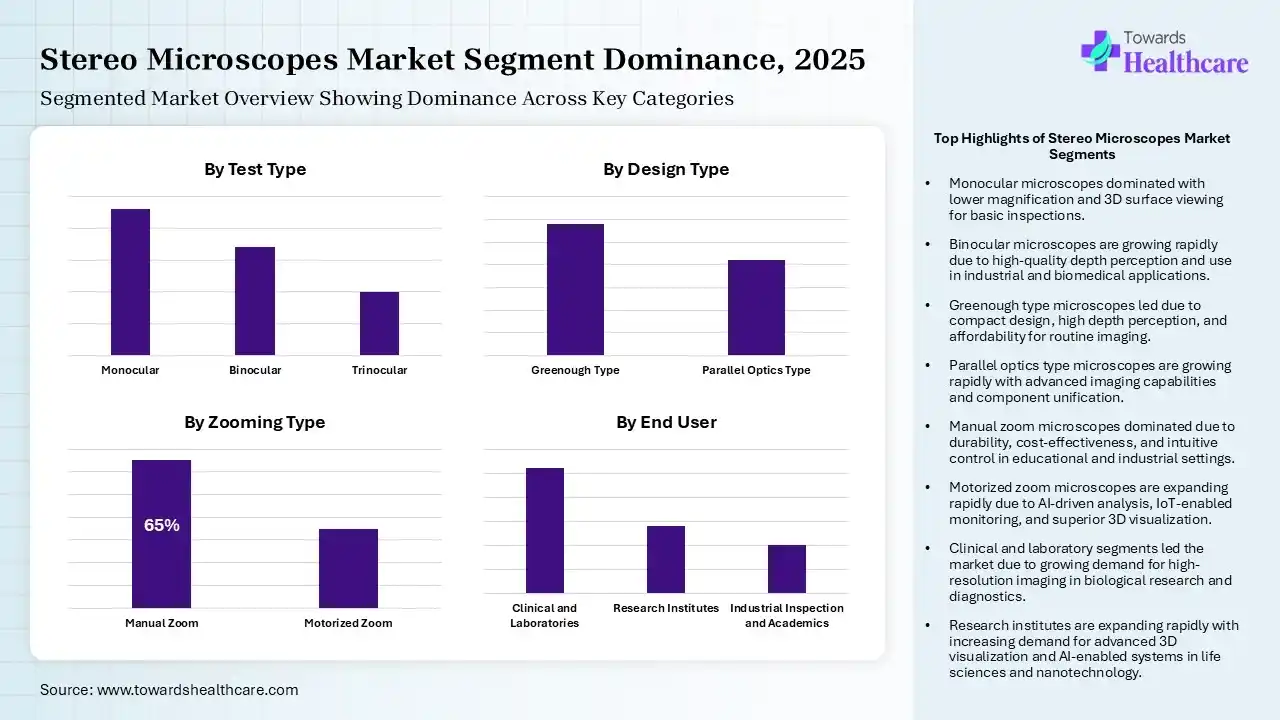
In 2025, the monocular segment held the largest revenue share of the market. This is mainly characterized by a single eyepiece for, typically, lower-magnification 3D surface viewing, and often employed for basic inspection, education, & simple assembly procedures. Its dominance is fueled by its adoption for 3D viewing with a single eyepiece, utilized in medical diagnostics, dentistry, and forensics for inspecting solid, opaque specimens.
Binocular
During the prospective period, the binocular segment is predicted to witness the fastest growth. This mainly facilitates three-dimensional, upright images with high-quality depth perception, which is significant for industrial quality control, electronics inspection, & biomedical research. Its common types are Greenough & Common Main Objective (CMO) designs, which offer simulated natural eye movement for expanded 3D viewing & rigorous image flatness & easy integration with accessories, respectively.
How did the Greenough Type Segment Lead the Stereo Microscopes Market in 2025?
The Greenough type segment captured the biggest share of the market in 2025. This is primarily fueled by the emergence of two independent, inclined optical paths, which are increasingly leveraged for inspection & routine imaging due to their compact design, high depth perception, and affordability. The trend has been stepping towards FusionOptics Technology, which uses an asymmetrical optical path, which is useful in the human brain, combining these into a single image, i.e., both sharp & deep.
Parallel Optics Type
In the coming era, the parallel optics type segment is anticipated to show a lucrative growth. Its adoption is featured by the use of two separate, parallel optical paths that pass through a single large objective lens, and also allows easy unification of components, like camera ports, fluorescence modules, & beam splitters. An emerging trend comprises the Nikon SMZ25, which provides a 25:1 zoom ratio (0.63x – 15.75x) with ‘Perfect Zoom Optics,’ which enables perfect, high-resolution imaging from macro-level organism viewing to microscopic cellular details.
Which Zooming Type Dominated the Stereo Microscopes Market in 2025?
The manual zoom segment registered dominance in the market in 2025. Prominent catalysts are their durability, cost-effectiveness, and intuitive, tactile control, specifically in educational & industrial settings. Advanced, manual systems widely use user-defined, click-stops at significant magnification levels, which makes it easy to return to a specific zoom factor, for persistent documentation and measurement. Researchers are focusing on raising zoom ratios, enhancing optical resolution, & combining digital technology for optimized, ergonomic, & high-precision imaging in diagnostics & research.
Motorized Zoom
In the coming era, the motorized zoom segment is estimated to expand at the fastest CAGR. This type has been increasingly adopted due to the increased need for workflow effectiveness, AI-driven image analysis, IoT-enabled remote monitoring, & superior 3D visualization capabilities. The latest motorized, encoded zoom systems are enabling real-time, automated measurement & calibration, like in the ZEISS Axio Zoom.V16, which utilizes electronic zoom curves to confirm accurate measurements without manual calibration.
Why did the Clinical and Laboratories Segment Lead the Market in 2025?
In 2025, the clinical and laboratories segment held a dominant share of the stereo microscopes market. Globally surging demand in biological research, cellular biology, and pharmacology for high-resolution imaging, with greater use in microsurgery, pathology, and diagnostic laboratories, is propelling the segmental expansion. Furthermore, specialized surgical microscopes, which are more sophisticated, boom-mounted stereo systems, are employed for delicate procedures in the brain or ear.
Research Institutes
The research institutes segment is predicted to register rapid expansion in the upcoming years. This is primarily driven by increasing investments in R&D of life sciences, nanotechnology, and material studies, demand for digital/AI-enabled systems, & STEM education progression. These institutes are highly utilizing advanced stereo microscopes for 3D visualization of opaque, thick, or large specimens, particularly model organisms, embryos, and tissue samples, with typical magnifications between 7.5x and 75x.
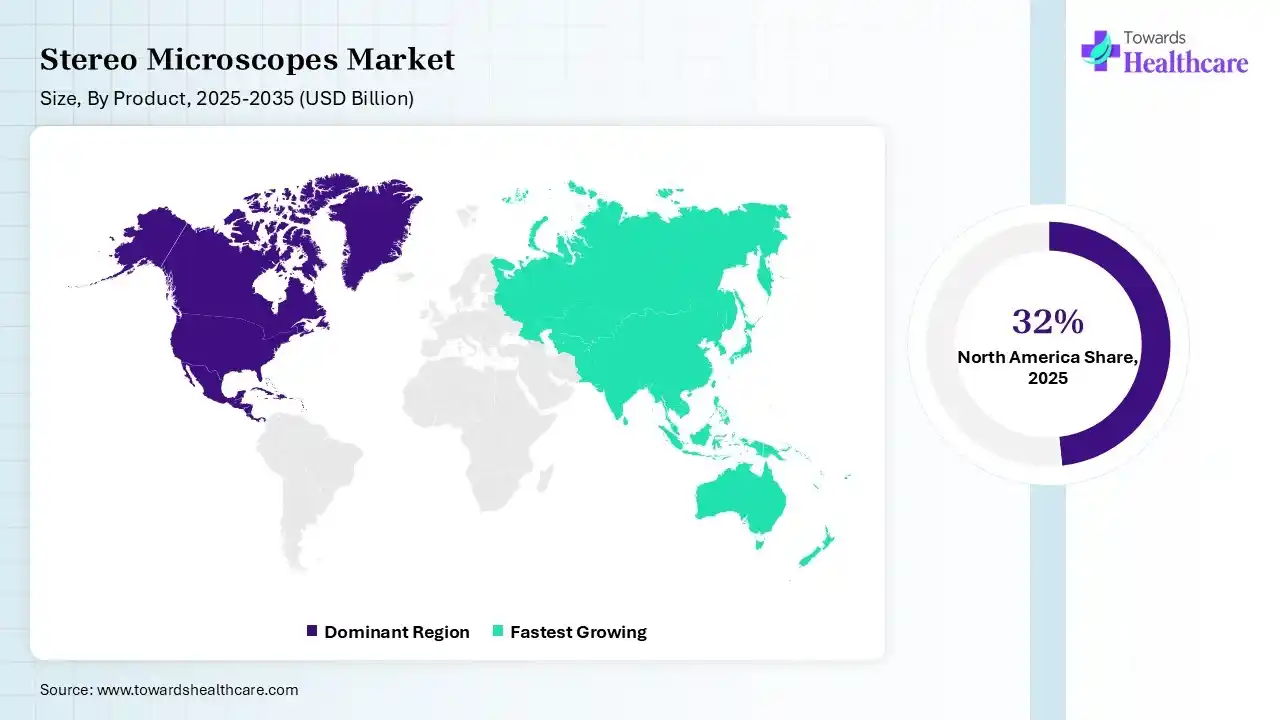
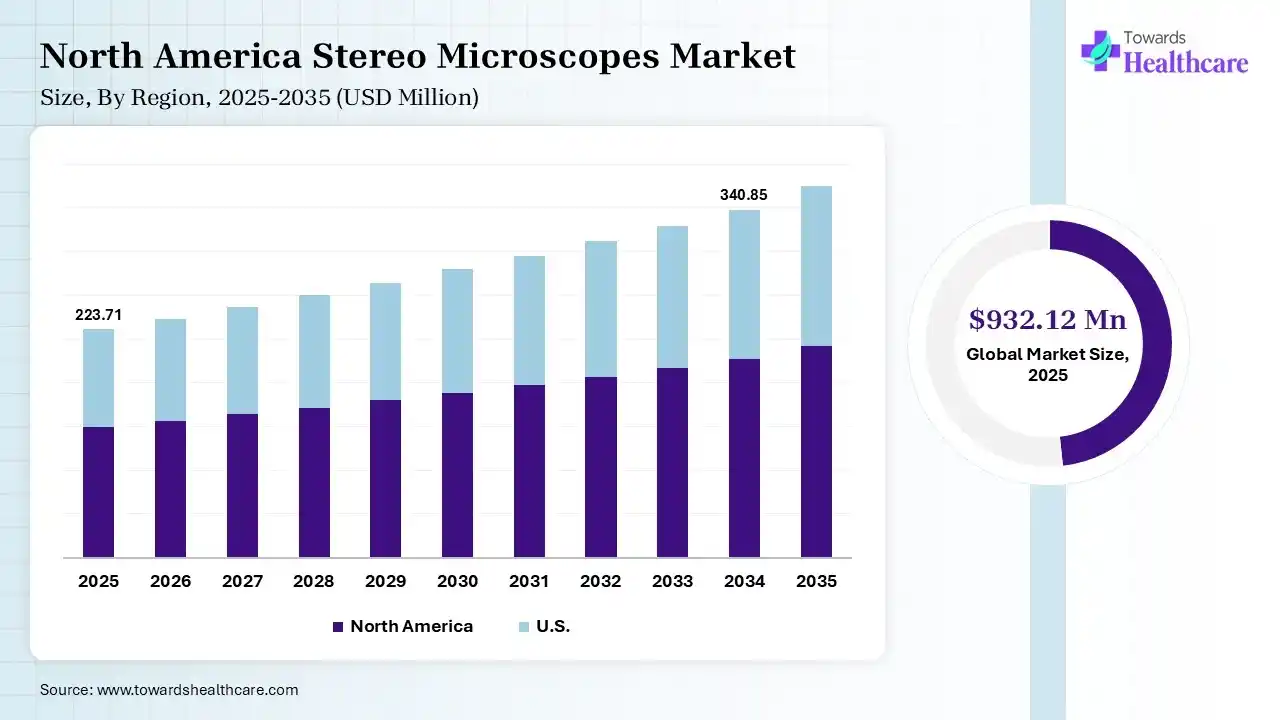
North America led the stereo microscopes market by 32% share due to the higher demand in life sciences, electronics/semiconductor inspection, & medical device production. The region broadly pushes several robust research activities in cellular biology, forensic science, and pharmaceuticals. It has implemented high-end models, which are featured by fully integrated 4K CMOS cameras capable of 60fps live streaming & direct capture to USB, & enable real-time alliance on UHD monitors.
U.S. Market Trends
However, the U.S. market held the largest revenue share in 2025, as its leaders fostered integrated stereo microscopy with OCT (Optical Coherence Tomography), fluorescence imaging, & hyperspectral imaging, enabling real-time molecular characterization & extensive finding of lesion margins in pathology.
Canada Stereo Microscope market Expands Through Research and Precision Manufacturing
The Canada stereo microscope market is expanding due to increasing investment in life sciences research, biotechnology, and advanced manufacturing. Rising demand for precision inspection in electronics, medical devices, and academic laboratories is driving adoption. Technological advancements in digital microscopy, high-resolution imaging, and automated inspection systems, along with growing government support for scientific research and innovation, are further accelerating market growth.
The prospective growth of the Asia Pacific stereo microscopes market is driven by its robust hub for semiconductor manufacturing, mainly in Taiwan, South Korea, and China. Also, the region is executing major funding for research in the pharmaceutical and biotechnology areas. Alongside, South Korean researchers and firms are bolstering 3D stereo-imaging for surgical robots & endoscopes, which raises depth perception for delicate procedures, including microvascular, dental, & neurosurgery.
China Market Trends
Whereas many prominent Chinese manufacturers are using AI for automatic image analysis, which allows for real-time identification, classification, & quantification of microscopic structures in biological samples. Alongside, researchers at Tsinghua University have established a 3D light field microscope capable of capturing real-time 3D images of neurons firing in live mice.
India Stereo Microscopes Market Expands with Research and Industrial Growth
The India stereo microscopes market is expanding due to growing investments in life science research, pharmaceutical manufacturing, electronics production, and academic laboratories. Increasing demand for precision inspection, quality control, and biomedical research is accelerating adoption. Government initiatives supporting scientific innovation, expanding healthcare infrastructure, and advancements in digital microscopy, high-resolution imaging, and automated inspection technologies are further driving market growth across the country.
| Ecosystem Segment | Key Participants | Role in Market |
| Technology Providers | ZEISS, Leica Microsystems, Nikon, Evident, Keyence | Develop optical technologies, lenses, imaging systems, and visualization platforms |
| Product Manufacturers | Leica Microsystems, ZEISS, Nikon, Evident, Motic, Meiji Techno, Vision Engineering | Manufacture stereo microscopes and accessories |
| Service Providers | Thermo Fisher Scientific, Fisher Scientific, VWR, Avantor | Distribution, calibration, maintenance, and support services |
| Platform Providers | ZEISS, Leica Microsystems, Nikon, Keyence | Integrated digital microscopy and imaging ecosystems |
| CROs/CDMOs (Limited Relevance) | Charles River Laboratories, Labcorp Drug Development | Utilize stereo microscopes in research and testing workflows |
| Software Vendors | ZEISS, Leica Microsystems, Nikon, Keyence | Imaging software, measurement tools, AI-assisted analysis |
| Research Institutions | EMBL, Max Planck Institutes, NIH-funded laboratories, major universities | Drive technology adoption and application development |
| End-User Industries | Life Sciences, Healthcare, Electronics, Semiconductors, Manufacturing, Education | Primary consumers of stereo microscope systems |
Regulatory Approvals
Distribution to Hospitals and Clinics
Post Distribution Maintenance
| Tier 1 | Tier 2 | Tier 3 | |
| Typical Market Influence | 68% | 23% | 9% |
| Tier 1 | ||||
| Company Name | Headquarters | Country | Why Relevant to This Market | Key Products/Services |
| Carl Zeiss AG | Oberkochen, Baden-Württemberg | Germany | Global microscopy leader with extensive stereo microscope portfolio and industrial inspection presence | Stemi Series, SteREO Discovery Series |
| Leica Microsystems | Wetzlar, Hesse | Germany | One of the most recognized stereo microscope manufacturers globally | Leica M Series Stereo Microscopes |
| Nikon Corporation | Tokyo | Japan | Strong presence in life sciences and industrial microscopy | SMZ Series Stereo Microscopes |
| Tier 2 | ||||
| Company Name | Headquarters | Country | Why Relevant to This Market | Key Products/Services |
| Vision Engineering Ltd. | Woking, Surrey | United Kingdom | Pioneer in ergonomic stereo microscopy solutions | Lynx EVO, OPTA, Mantis |
| Motic Microscopes | Xiamen, Fujian | China | Major global microscopy manufacturer with broad stereo portfolio | SMZ Series Stereo Microscopes |
| Meiji Techno Co., Ltd. | Saitama | Japan | Specialized microscopy manufacturer with strong educational and industrial presence | EMZ Series Stereo Microscopes |
| Tier 3 | ||||
| Company Name | Headquarters | Country | Why Relevant to This Market | Key Products/Services |
| Hirox Co., Ltd. | Tokyo | Japan | Specialized digital stereo microscopy solutions | RH Series Digital Microscopes |
| UNITRON Ltd. | Commack, New York | United States | Industrial and educational stereo microscope supplier | Z Series Stereo Microscopes |
| Inspectis AB | Kista, Stockholm County | Sweden | Specialized inspection microscopes for electronics manufacturing | Digital Stereo Inspection Systems |
In February 2025, "Together, we're not just offering a product; we're transforming the future of microscopy by making advanced imaging accessible and intuitive for researchers everywhere”, said Nick Beavers, CEO of Media Cybernetics.
Strengths
Weaknesses
Opportunities
Threats
By Test Type
By Design Type
By Zooming Type
By End User
By Region







Principal Consultant
Shivani Zoting is a dedicated research analyst specializing in the healthcare industry. With a strong academic foundation, a B.Sc. in Biotechnology and an MBA in Pharmabiotechnology, she brings a unique blend of scientific understanding and strategy.
Learn more about Shivani Zoting
Reviewed By
Aditi Shivarkar is a seasoned professional with over 14 years of experience in healthcare market research. As a content reviewer, Aditi ensures the quality and accuracy of all market insights and data presented by the research team.
Learn more about Aditi Shivarkar