


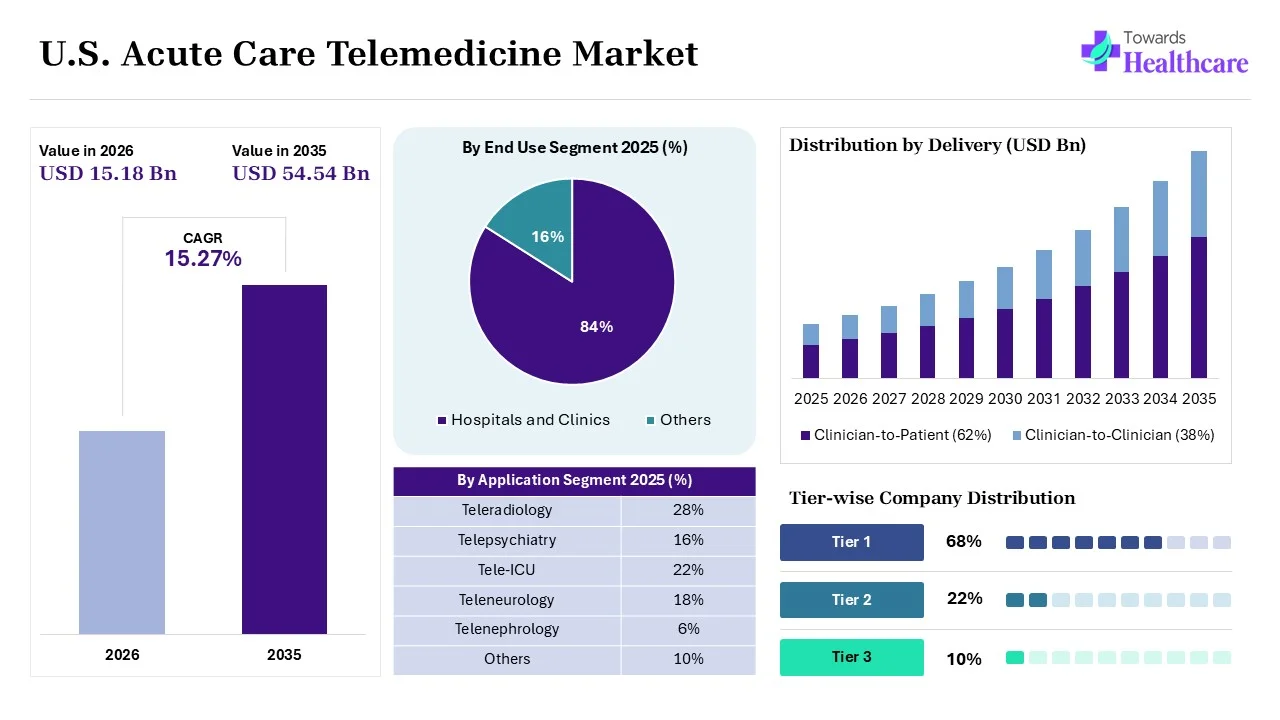
The U.S. acute care telemedicine market size touched US$ 13.17 billion in 2025, with expectations of climbing to US$ 15.18 billion in 2026 and hitting US$ 54.54 billion by 2035, driven by a CAGR of 15.27% over the forecast period. The growing critical healthcare clinician shortages across the U.S. are driving the demand for acute care telemedicine. Expanding healthcare digitalization, growing chronic disease burden, increasing AI integration, growing funding, and increasing new platform launches are also enhancing the market growth.
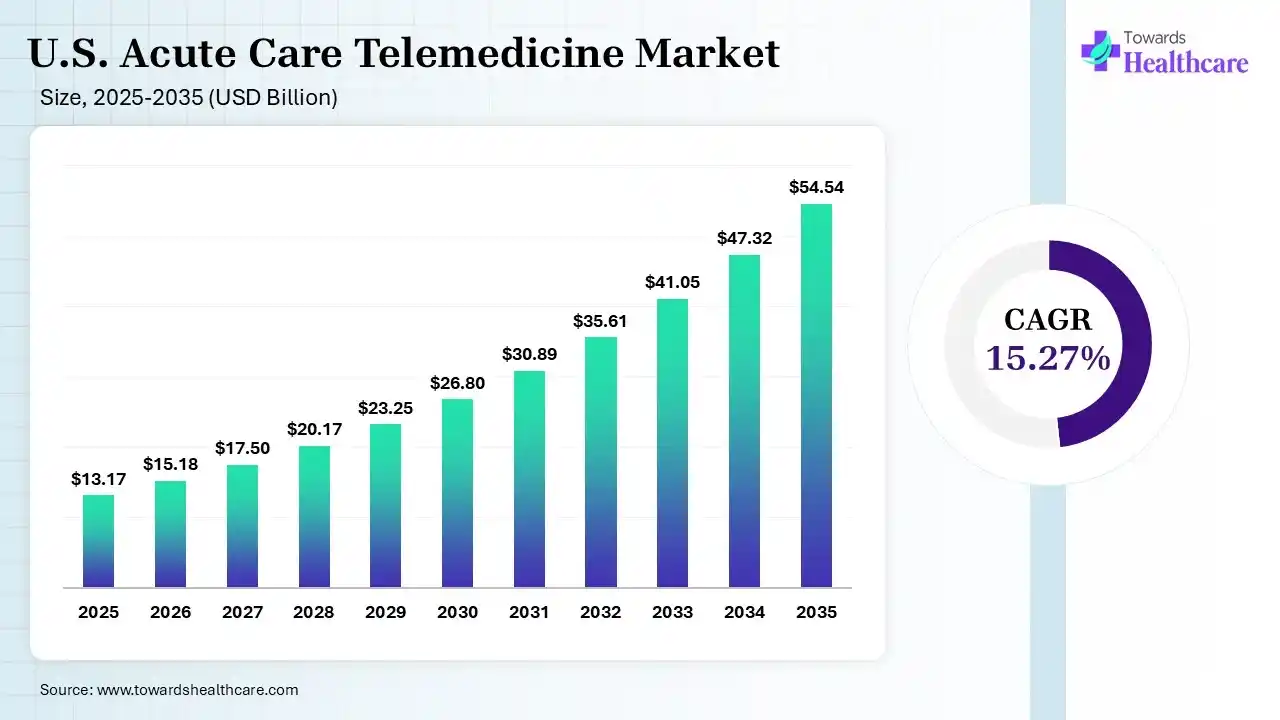
The U.S. acute care telemedicine market is driven by the urgent need to reduce operational hospital costs and increasing adoption of advanced electronic health record (EHR) integrations. The U.S. acute care telemedicine encompasses digital health and telecommunication technologies across the U.S., which are utilized to offer immediate and short-term medical services to patients with serious health conditions. Acute care refers to the immediate and short-term medical treatment provided to patients with urgent, sudden, or severe health conditions, with an aim to prevent complications and enhance outcomes. The common types of acute care conditions in the U.S. include heart attacks, severe infections, respiratory distress, stroke, accidents, acute psychiatric emergencies, and surgical emergencies.
Therefore, the growing incidence of chronic disease across the U.S. is driving the demand for their acute care telemedicine platforms. Additionally, expanding healthcare digitalization is also propelling the adoption of various acute care telemedicine platforms such as teleradiology, telecardiology, tele-stroke services, tele-ICU services, telepsychiatry, and emergency telemedicine consultations. These platforms help in image interpretation, remote patient monitoring, remote disease management, and real-time consultation services, enabling healthcare professionals to assess, monitor, diagnose, and treat patients in remote settings. At the same time, increasing healthcare professional shortages, rising demand for rapid access to healthcare services, increasing investments, technological advancements, and increasing high-speed connectivity are also fueling the market expansion.
The growing applications of AI in the U.S. acute care telemedicine market are increasing their integration with various acute care telemedicine platforms, where they help in the identification of high-risk patient populations across the U.S. At the same time, it also offers predictive analytics, patient triaging, and clinical decision support, which increases their adoption rates. AI also offers early warning systems, facilitates personalized treatment recommendations, and improved operation efficiency in emergency departments, as well as drives automated routine administrative tasks, reducing physician workload.
Expanding Critical Care Services
The growing shortage of healthcare specialists and intensivists is increasing the demand for tele-ICU platforms to enhance the management of patients with critical health conditions. They also help in remote patient monitoring, AI-assisted clinical decision making, and real-time consultation, which help in enhancing patient outcomes as well as ICU efficiency. These platforms also help in reducing unnecessary patient transfer and offer 24/7 specialist support, which in turn is increasing their adoption across the community as well as rural hospitals.
Growing Physician Shortage
The growing patient volume and the rising physician shortage across the U.S. are increasing the burden on healthcare professionals and limiting their access. This, in turn, is increasing the demand for acute care telemedicine platforms to bridge this gap and achieve better patient outcomes by promoting remote disease diagnosis and management, where they are also offering emergency services and 24/7 availability. Furthermore, remote consultations also enhance treatment recommendations, shorten response time, and improve the quality of care, which is encouraging their adoption.
Rise of Remote Patient Monitoring
Increasing health awareness and expanding home healthcare are driving a shift towards remote patient monitoring services, which is increasing the adoption of acute care telemedicine platforms. They help in continuous patient monitoring, promoting early interventions, post-discharge care management, and reducing hospital readmissions. At the same time, their growing adoption is also driving the development of advanced wearable devices and connected health technologies, which in turn is expanding their access.
| Table | Scope |
| Market Size in 2026 | USD 15.18 Billion |
| Projected Market Size in 2035 | USD 54.54 Billion |
| CAGR (2026 - 2035) | 15.27% |
| Historical Data | 2020 - 2023 |
| Base Year | 2025 |
| Forecast Period | 2026 - 2035 |
| Measurable Values | USD Millions/Units/Volume |
| Market Segmentation | By Delivery, By Application, By End Use |
| Top Key Players | Amwell, Doxy.me, Teladoc Health, Eagle Telemedicine, Access Telecare, Doctor On Demand, MDLIVE, GlobalMed, eVisit, VSee Health |
| Segment | Share 2025 (%) |
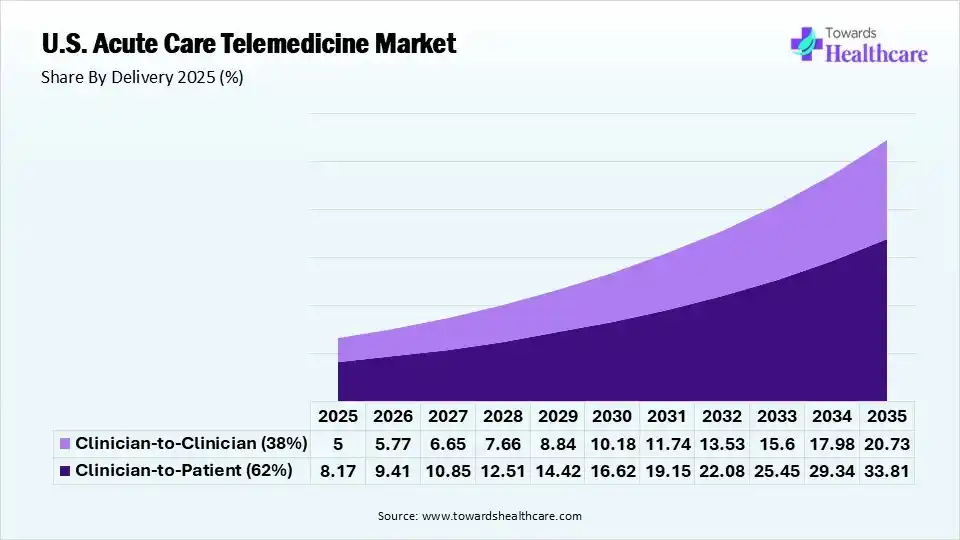
| Clinician-to-Patient | 62% |
| Clinician-to-Clinician | 38% |
The Clinician-to-Patient Segment Dominated the Market With 62% in 2025
The clinician-to-patient segment held a major revenue share of 62% of the U.S. acute care telemedicine market in 2025, driven by expanded acute care access directly to patients. Hospitals deploy virtual triage programs, which have increased the adoption of this delivery platform. At the same time, reimbursement support also accelerated their adoption.
The clinician-to-clinician segment held the second-largest share of 38% of the market in 2025 and is expected to witness the fastest growth with a CAGR during the forecast period, as it addresses specialist shortages across facilities. Supports real-time expert collaboration and improves emergency decision-making speed. They also expand expert care access and drive real-time data sharing.
| Segment | Share 2025 (%) |
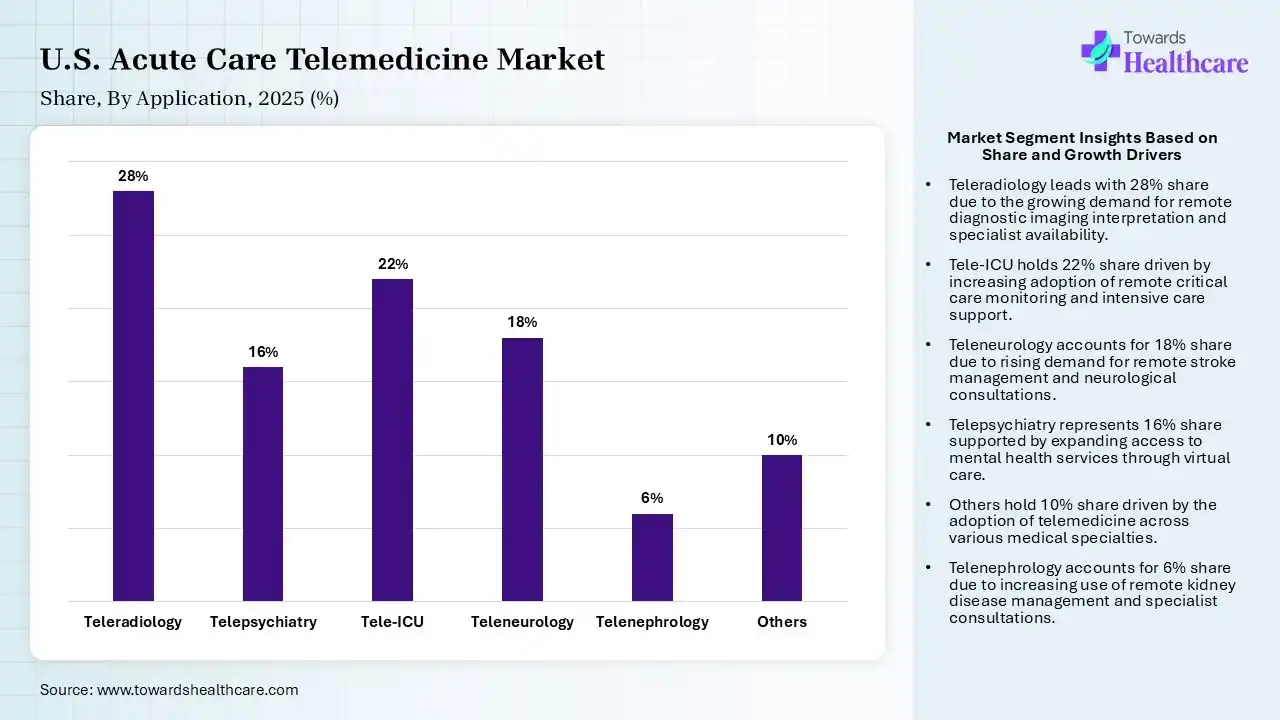
| Teleradiology | 28% |
| Telepsychiatry | 16% |
| Tele-ICU | 22% |
| Teleneurology | 18% |
| Telenephrology | 6% |
| Others | 10% |
The Teleradiology Segment Dominated the Market With 28% in 2025
The teleradiology segment accounted for the highest revenue share of 28% of the U.S. acute care telemedicine market in 2025, as high imaging volumes required rapid interpretation. It enabled 24/7 radiology coverage and reduced reporting turnaround time, which increased their use. Additionally, their faster diagnosis and treatment decisions also increased their adoption across emergency departments.
The tele-ICU segment held the second-largest share of 22% of the market in 2025, driven by expanding centralized critical care oversight across hospitals. These platforms also help improve ICU outcomes and optimize intensivist utilization. Their real-time decision-making, 24/7 remote monitoring, is also increasing their adoption to manage a high number of critical cases.
The teleneurology segment held 18% of the U.S. acute care telemedicine market share in 2025 and is expected to show the highest growth with a CAGR during the forecast period, driven by the growing stroke burden, which drives its adoption. Enables rapid neurological assessments, which increase their demand. Supports time-sensitive interventions, promoting their adoption.
The telepsychiatry segment held 16% of the market share in 2025, due to rising mental health emergencies, which increases its demand. Improving specialist availability, rapid access, 24/7 psychiatric support, and reduced wait times also increased their use. They also support crisis intervention services, which increases their acceptance rates.
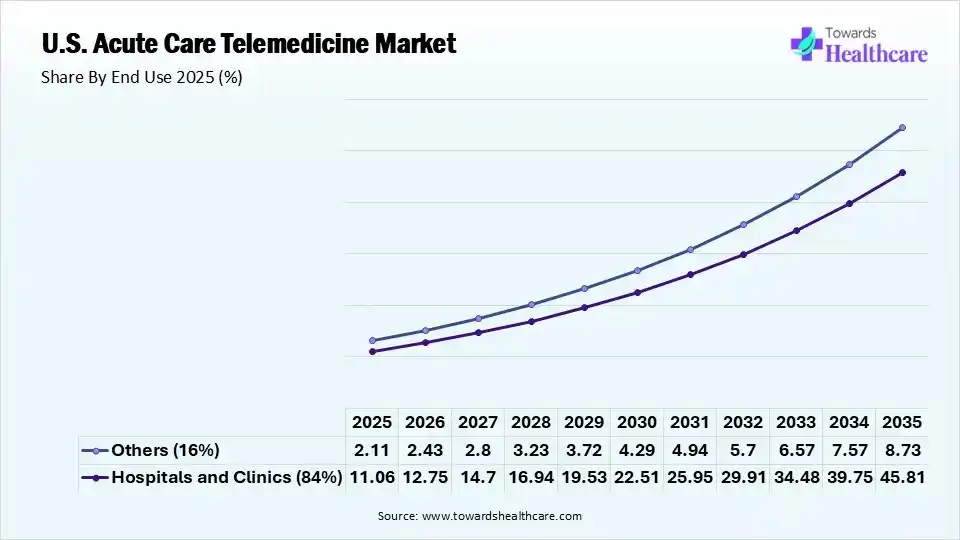
| Segment | Share 2025 (%) |
| Hospitals and Clinics | 84% |
| Others | 16% |
The Hospitals and Clinics Segment Dominated the Market With 84% in 2025
The hospitals and clinics segment contributed the biggest revenue share of 84% of the U.S. acute care telemedicine market in 2025, driven by large healthcare systems, which invest heavily in telemedicine. Acute care workflows integrate virtual platforms, which have increased the adoption of acute care telemedicine models. They also supported inpatient and emergency services, which increased their use.
The others segment held the second-largest share of 16% of the market in 2025 and is expected to gain the highest share with a CAGR during the forecast period, due to the expansion of alternative care settings, which increases virtual care adoption. Furthermore, they improve specialist access in underserved areas, which drives their demand. They also support decentralized healthcare delivery, promoting their expansion.
The U.S. acute care telemedicine market held a considerable share in 2025 and is expected to show significant growth during the forecast period, due to extensive hospital networks utilizing telemedicine platforms. Favorable reimbursement support and a strong technology ecosystem are also accelerating their innovations. Growing disease burden and rising demand for immediate access to acute services are also increasing the adoption of various acute care telemedicine platforms. Expanding healthcare digitalization, increasing investments, and growing healthcare IT companies are also driving the development and adoption of new telemedicine platforms. At the same time, increasing healthcare professional shortage and a shift towards remote healthcare consultations are also contributing to the market growth.
| Companies | Headquarters | U.S. Acute Care Telemedicine Platforms |
| Amwell | Boston, U.S. | Amwell Converge |
| Doxy.me | South Carolina, U.S. | Doxy.me Clinic |
| Teladoc Health | New York, U.S. | Solo |
| Eagle Telemedicine | Atlanta, U.S. | Eagle Telemedicine Program |
| Access Telecare | Dallas, U.S. | Telemed IQ |
| Doctor On Demand | San Francisco, U.S. | Doctor On Demand Enterprise Platform |
| MDLIVE | Florida, U.S. | ADLIVE Virtual Care Platform |
| GlobalMed | Arizona, U.S. | eNcounter |
| eVisit | Phoenix, U.S. | eVisit Enterprise |
| VSee Health | California, U.S. | VSee Clinic or VSee Telehealth Platform |
In February 2026, after the series D financing round of Talkiatry, which is a Telepsychiatry provider, its co-founder and CEO, Robert Krayn, highlighted that "Talkiatry is setting the standard for how psychiatry is delivered and measured, with a proven national operating model centered on employed psychiatrists built upon a proprietary technology platform." "Health systems, payers, and employers continue to choose Talkiatry as their psychiatry partner of record to deliver consistent, superior outcomes across their patient populations."
By Delivery
By Application
By End Use







Principal Consultant
Rohan Patil is a seasoned market research professional with over 5+ years of focused experience in the healthcare sector, bringing deep domain expertise, strategic foresight, and analytical precision to every project he undertakes.
Learn more about Rohan Patil

Reviewed By
Aditi Shivarkar is a seasoned professional with over 14 years of experience in healthcare market research. As a content reviewer, Aditi ensures the quality and accuracy of all market insights and data presented by the research team.
Learn more about Aditi Shivarkar









