

Pipeline Programs

CGT Companies Tracked

Manufacturing Facilities


The U.S. complementary and alternative medicine market size was estimated at USD 52.84 billion in 2025 and is Complementary and Alternative Medicine predicted to increase from USD 67.55 billion in 2026 to approximately USD 616.07 billion by 2035, expanding at a CAGR of 27.84% from 2026 to 2035.
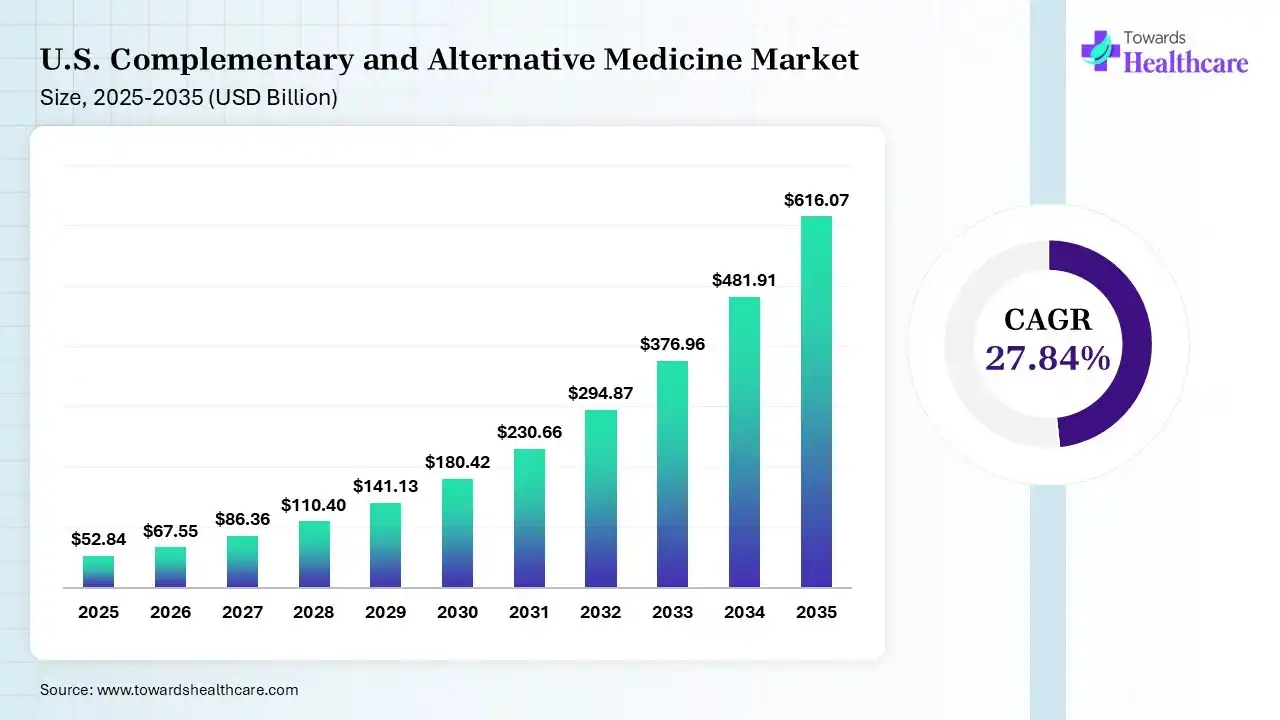
The U.S. complementary and alternative medicine market is growing due to CAM therapies providing major advantages, including an extensive variety of botanicals and nutritional products, like herbal and dietary supplements, and vitamins.
The U.S. complementary and alternative medicine market is growing, as this type of medicine offers many advantages, such as patients' increased control over their medical care. A growing number of patients in the United States have shifted towards complementary and alternative medicine (CAM) to address their healthcare limitations. Many patients have verified a growing interest in understanding their healthcare and actively engaging with their physicians. There is an increasing emphasis on the doctor-patient bonding, wherein patients seek a more cooperative role in their healthcare. The broad availability of medical care data on the internet has contributed to this shift, as patients frequently bring printed materials or online research to healthcare appointments.
The U.S. complementary and alternative medicine (CAM) market companies' products, therapies, and practices used alongside or in place of conventional medicine to promote overall health and well-being. These include herbal medicine, dietary supplements, acupuncture, chiropractic care, yoga, meditation, and rising consumer preference for chronic diseases, and growing turopathy. The market is expanding due to rising consumer preference for preventive healthcare, increasing prevalence of chronic diseases, and growing awareness of holistics wellness. Technological advancements such as AI-powered wellness platforms, telehealth consultations, wearable health devices, and personalized nutrition solutions are enhancing accessibility and user engagement. A key trend is the integration of complementary therapies into mainstream healthcare and employer wellness programs. Future opportunities lie in evidence-based integrative medicines, digital therapeutics, personalized wellness plans, and expanding research in natural therapies, supported by increasing consumer spending on self-care and long-term health management.
Integration of AI-driven technology in U.S. complementary and alternative medicine drives market growth, as AI-based models are introduced in complementary and alternative medicine (CAM), they accelerate the patients' outcomes. AI-based technology also presents the possibility of a healthcare decision support system for various chronic diseases with training in functional magnetic resonance imaging (fMRI). AI-driven incorporation is fast-tracking in the conventional medical sector. AI is currently applied for pattern diagnostics, symptom classifications, and identifying drug candidate substances in the complementary and alternative medicine sector.
Mental Health:
Integrating the CIM service is advantageous for enhancing mental health in patients. It offers holistic, patient-driven strategies that enhance traditional care, improving mood, lowering anxiety, and relieving stress.
Integration with Conventional Care:
Integrating complementary therapies in conventional healthcare provides a more comprehensive, patient-centered, and holistic approach to management, with the strength to enhance overall health results and patient satisfaction. It creates opportunities for partnering between various healthcare professionals.
Rising Preventive Care Demand:
Increasing CAM services in preventive care, some dietary supplements show relatively strong positive evidence for being efficient in the prevention of some common diseases. CAM is progressively used as a tool for disease prevention rather than treatment only.
| Table | Scope |
| Market Size in 2026 | USD 67.55 Billion |
| Projected Market Size in 2035 | USD 616.07 Billion |
| CAGR (2026 - 2035) | 27.84% |
| Key Applications | Pain management, stress reduction, mental wellness, chronic disease support, preventive healthcare, immune support, rehabilitation, women’s health, digestive health, sleep management |
| Primary End Users | Consumers/patients, wellness centers, integrative healthcare clinics, hospitals, physicians, pharmacies, retail health providers, insurance providers |
| Key Challenges | Limited insurance coverage, regulatory complexity, inconsistent clinical evidence for some therapies, quality control issues in supplements, physician acceptance barriers |
| Measurable Values | USD Millions/Units/Volume |
| Market Segmentation | By Intervention, By Distribution Method |
| Top Key Players | Columbia Nutritional, Nordic Nutraceuticals, Ramamani Iyengar Memorial Yoga Institute, The Healing Company, SCHUMACHER YOGA, Pure Encapsulations, LLC |
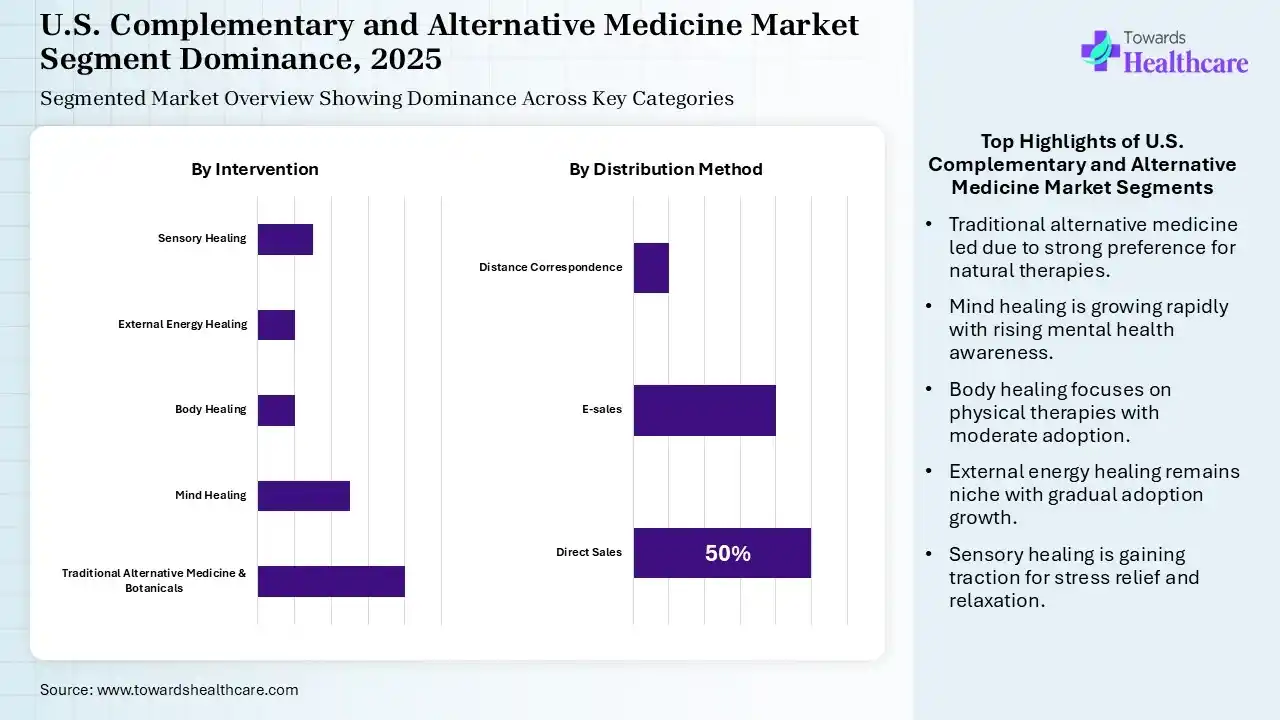
Which Intervention Segment Led the Market in 2025?
| Segment | Share 2025 (%) |
| Traditional Alternative Medicine & Botanicals | 40% |
| Mind Healing | 25% |
| Body Healing | 10% |
| External Energy Healing | 10% |
| Sensory Healing | 15% |
Explanation
The traditional alternative medicine/botanicals segment was dominant in the U.S. complementary and alternative medicine market by 40% in 2025, as traditional medicine is seen as pre-scientific, and its practices and treatments are to be replaced with up-to-date, advanced, more effective science-driven medicine. Alternative medicine is more advantageous than conventional medicine as it often focuses on natural substances, which some believe to be safer, gentler, or more appropriate for the human body than industrial medicines. These therapies' goal is to support patients by manipulating the invisible energy sector. According to some healthcare systems and practices, the energy around the body can impact health.
For instance,
Mind Healing
Whereas the mind healing segment is the fastest-growing in the market during 2026-2035, as meditation and associated tools improve empathy and mindful presence in the health care professionals, thereby increasing the quality of care. Mind-body-based therapies significant adjunct in managing chronic pain and other stress-related noncommunicable diseases by increasing resilience via self-care. Mind-body techniques support alleviating symptoms of chronic illnesses, enhancing recovery post-surgery, and improving inclusive quality of life, creating a strong connection between mental states and physical health results.
Why Direct Sales Segment Led the Market in 2025?
| Segment | Share 2025 (%) |
| Direct Sales | 50% |
| E-sales | 40% |
| Distance Correspondence | 10% |
Explanation
The direct sales segment was dominant in the U.S. complementary and alternative medicine market by 50% in 2025, as this type of sales allows sellers to build strong, personal relationships with consumers, increasing trust, which is significant for health-associated products. Direct sales rely on individual networks and word-of-mouth recommendations, which are significantly helpful in the health and wellness sectors where consumers value peer testimony. Direct selling allows for immediate feedback and individual support, confirming that clients feel supported on their health care journey.
E-sales
Whereas the e-sales segment is estimated to be the fastest-growing in the market during the forecast period, as healthcare e-commerce platforms are removing those gaps in direct sales. They modernize sales, mechanize workflows, ensure compliance, and make connected, patient approachable digital storefronts. It applies digital platforms and electronic transactions to deliver medical care solutions, products, and information. This comprises the online sale of pharmaceuticals, telemedicine solutions, electronic health records management, and the use of digital tools for patient interaction, like appointment booking, virtual discussions, and health monitoring claims.
The U.S. complementary and alternative medicine market is experiencing robust growth, projected to rise from USD 36.65 billion in 2025 to USD 293.57 billion by 2035. Regional growth is driven by rising chronic disease prevalence, demand for holistic health, and increased insurance coverage. The market is growing fastest in the West, Southwest, and urban Northeast, driven by progressive wellness cultures and the integration of integrative medicine in major medical centers.
Growth is further accelerated by the rise of telemedicine, enabling rural areas to access specialized practitioners, and the rapid expansion of e-commerce for herbal supplements and natural products. Corporate wellness programs in metropolitan areas are also increasingly integrating CAM, contributing to sustained regional demand. Traditional Alternative Medicine and Botanicals remain the largest segment, but Mind & Body practices are growing rapidly across all regions. While the U.S. complementary and alternative medicine market is fragmented with many providers, metropolitan areas represent the highest revenue concentration. The increasing insurance coverage for select therapies like acupuncture in certain states is aiding regional penetration and reducing the cost barrier for consumers.
R&D:
Manufacturing Processes:
Patient Services:
|
Category
|
Market Participants & Explanation |
| Technology Providers | Digital health platforms, telehealth providers, wellness tracking companies enabling access to alternative medicine consultations and personalized health programs |
| Product Manufacturers | Companies producing herbal supplements, vitamins, minerals, natural remedies, essential oils, and traditional health products |
| Service Providers | Acupuncture clinics, chiropractic centers, naturopathic practitioners, massage therapy providers, integrative medicine clinics |
| Platform Providers | Online wellness marketplaces and healthcare platforms connecting consumers with CAM professionals |
| CROs/CDMOs | Limited role; mainly involved in clinical studies, supplement testing, and natural product development |
| Software Vendors | Electronic health record systems and healthcare platforms supporting integrative medicine providers |
| Research Institutions | Universities and medical centers researching integrative medicine effectiveness and clinical applications |
| End-User Industries | Healthcare systems, hospitals, wellness industry, pharmaceutical companies, consumer health sector |
| Tier 1 | Tier 2 | Tier 3 | |
| Typical Market Influence | 55% | 30% | 15% |
| Tier 1 | ||||
| Company Name | Headquarters | Country | Why Relevant to This Market | Key Products/Services |
| Nature's Sunshine Products | Lehi, Utah, USA | United States | Major U.S. natural health and herbal supplement company with global distribution | Herbal supplements, nutritional products, wellness formulations |
| The Vitamin Shoppe | Secaucus, New Jersey, USA | United States | One of the largest U.S. specialty retailers for natural health products | Vitamins, supplements, herbal products, wellness solutions |
| GNC Holdings | Pittsburgh, Pennsylvania, USA | United States | Recognized consumer health brand with extensive supplement retail presence | Herbal supplements, sports nutrition, vitamins |
| Tier 2 | ||||
| Company Name | Headquarters | Country | Why Relevant to This Market | Key Products/Services |
| Gaia Herbs | Brevard, North Carolina, USA | United States | Specialized herbal medicine company focused on botanical products | Herbal extracts, supplements, plant-based remedies |
| Himalaya Wellness | Bengaluru, India / U.S. operations | India / United States market | Strong herbal medicine presence in U.S. natural health segment | Herbal supplements, botanical healthcare products |
| NOW Foods | Bloomingdale, Illinois, USA | United States | Established supplement manufacturer with broad natural health portfolio | Nutritional supplements, herbal extracts, natural products |
| Tier 3 | ||||
| Company Name | Headquarters | Country | Why Relevant to This Market | Key Products/Services |
| MaryRuth's Organics | Los Angeles, California, USA | United States | Fast-growing wellness brand focused on clean-label supplements | Liquid vitamins, herbal supplements, wellness products |
| HerbalGram | Austin, Texas, USA | United States | Supports herbal medicine research and industry education | Herbal research publications, industry data |
| Pure Encapsulations | Sudbury, Massachusetts, USA | United States | Professional supplement brand used in integrative healthcare | Clinical nutrition supplements |
In April 2026, "Sam has scaled influential health-data platforms, and Ravi has led major clinical organizations while guiding innovative diagnostics through FDA pathways. Their combined expertise will be invaluable as whole-genome and multiomic intelligence becomes foundational to modern medicine”, Matt Rabinowitz, PhD, Co-Founder and Executive Chairman of MyOme, emphasized the importance of the newly appointed board members
Strengths
Weaknesses
Opportunities
Threats
By Intervention
By Distribution Method





Principal Consultant
Shivani Zoting is a dedicated research analyst specializing in the healthcare industry. With a strong academic foundation, a B.Sc. in Biotechnology and an MBA in Pharmabiotechnology, she brings a unique blend of scientific understanding and strategy.
Learn more about Shivani Zoting
Reviewed By
Aditi Shivarkar is a seasoned professional with over 14 years of experience in healthcare market research. As a content reviewer, Aditi ensures the quality and accuracy of all market insights and data presented by the research team.
Learn more about Aditi Shivarkar










