


Research indicates strong growth opportunities in the U.S. healthcare technology market. The U.S. healthcare technology market size was estimated at USD 225.08 billion in 2025 and is predicted to increase from USD 266.76 billion in 2026 to approximately USD 1230.99 billion by 2035, expanding at a CAGR of 18.52% from 2026 to 2035. Analysis also highlights that the U.S. healthcare technology market is rapidly expanding due to swift healthcare digitalization, EHR modernization, increasing investments in AI applications, and rising demand for remote monitoring devices.
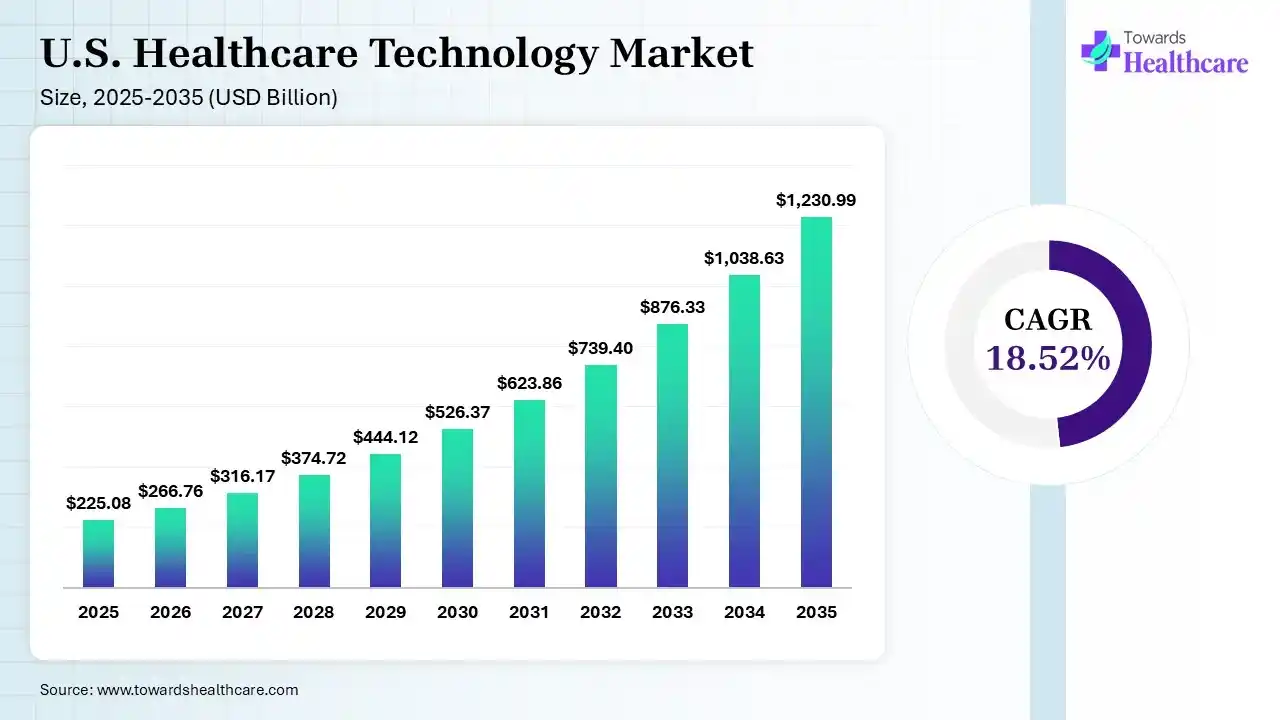
The U.S. healthcare technologies refers to the innovations used to improve medical care services and enhance patient outcomes across the U.S. They include electronic health records, wearable devices, AI, telemedicine, etc. Furthermore, cloud migration, artificial intelligence, connected medical devices, interoperability, cybersecurity, remote care, healthcare analytics, and automation are driving the U.S. healthcare technology market, promoting its entry into a high-investment modernization cycle. Additionally, more than 99% of U.S. non-federal acute-care hospitals had adopted certified EHRs by 2024, while 91% of office-based physicians had adopted certified EHRs, indicating that the market's technology base is already highly digitized.
Analyst View - Market Size
The U.S. healthcare technology market is in a transition from digitization to intelligent infrastructure, representing the most important structural feature, where EHR penetration is already near saturation among hospitals, shifting incremental technology spending towards AI, cloud infrastructure, interoperability, cybersecurity, connected devices, analytics, and workflow automation.
Moreover, it was reported that U.S. healthcare spending reached US$5.3 trillion in 2024, while hospital expenditure and physician and clinical services accounted for US$1.63 trillion and US$1.11 trillion, respectively, providing a very large economic base for technology modernization.
Thus, the replacement, integration, and intelligence layer around existing healthcare infrastructure is the principal opportunity and not the EHR adoption, where they are also associated with risks such as enterprise sales cycles, interoperability complexity, cybersecurity exposure, regulatory requirements for AI-enabled products, and budget constraints among smaller providers.
| Indicator | Latest Available Data | Market Relevance |
| U.S. healthcare spending | US$5.3T, 2024 | Large underlying healthcare expenditure base |
| Healthcare spending as % of GDP | 18.0%, 2024 | Significant economic importance of healthcare |
| U.S. hospitals | 6,100, FY2024 | Large institutional technology customer base |
| Community hospitals | 5,121, FY2024 | Core provider technology market |
| Certified EHR adoption | >99% of non-federal acute-care hospitals, 2024 | EHR market has reached mature penetration |
| Certified EHR adoption among physicians | 91%, 2024 | Ambulatory digital infrastructure remains extensive |
| Hospitals participating across four interoperability domains | 76%, 2025 | Interoperability remains a major investment area |
| Hospitals enabling patient API access | ~90%, 2024 | Supports patient-facing digital applications |
| Hospitals enabling patient-generated data submission | ~67%, 2024 | Supports wearables/RPM/connected-care technologies |
| AI-enabled medical devices | FDA-maintained authorization list | Growing regulated AI-device ecosystem |
| 500+ record healthcare breaches | 435 in 2024 | Cybersecurity remains a major technology requirement |
Based on our research, the table outlines market indicators, their latest trends, and relevance. Nearly 6,100 U.S. hospitals in FY2024, including 5,121 community hospitals, were reported by AHA, where approximately 70% of community hospitals were recorded to be system-affiliated, which brought together the importance of enterprise-scale procurement and health-system technology strategies.
Hardware Segment Dominates the Market with 42% share in 2025
| Segment/Sub-segment Name | Market Share | CAGR | Growth Driver |
| Hardware | 42.00% | 16.40% | Hospitals continue upgrading connected clinical infrastructure. Connected monitoring and diagnostic equipment increase technology spending. Smart-device adoption expands the installed healthcare technology base. |
| Software | 38.00% | 20.10% | Providers accelerate EHR, AI, and interoperability investments. Cloud software expands access to scalable clinical and administrative tools. Automation increases demand for intelligent healthcare applications. |
| Services | 20.00% | 18.00% | Healthcare organizations require implementation and integration expertise. Managed services reduce internal technology-management requirements. Cybersecurity and data-management needs increase recurring service demand. |
Based on our research, the table highlights different types of components, market share, and CAGR. The hardware segment held the dominant share of 42% in 2025 because healthcare organizations continue purchasing connected medical, diagnostic, monitoring, and networking equipment. The software segment is expected to expand rapidly with a 20.10% CAGR during the forecast period, as healthcare organizations move from basic digitization toward AI-enabled workflows, interoperability, analytics, and cloud applications.
Analyst View - Component
As connected devices create the data foundation required by analytics and AI, the hardware segment remains strategically important, while installed EHR and device infrastructure creates an addressable base for AI, interoperability, patient engagement, and automation applications software segment represents the stronger expansion opportunity, highlighting a shift in spending power from physical infrastructure toward the software and intelligence layer. Moreover, services should benefit from the complexity of modernization, which drives the importance of implementation, cybersecurity, integration, and managed services to operate multiple legacy systems.
Cloud-Based Segment Leads the Market with 51%
| Segment/Sub-segment Name | Market Share | CAGR | Growth Driver |
| Cloud-Based | 51.00% | 22.40% | Cloud platforms enable scalable healthcare data infrastructure. Providers increasingly adopt SaaS-based clinical and financial applications. Cloud architectures support interoperability and distributed care delivery. |
| On-Premise | 29.00% | 11.80% | Large health systems retain infrastructure for sensitive workloads. Legacy applications continue supporting critical clinical operations. Security and control requirements sustain selected on-premises deployments. |
| Hybrid | 20.00% | 19.60% | Organizations combine legacy infrastructure with cloud applications. Hybrid architecture supports gradual modernization of healthcare IT. Data sovereignty and workload flexibility encourage mixed environments. |
The given table illustrates that the cloud-based segment held the largest share of 51% of the market in 2025 and is anticipated to show the highest growth of 22.40% CAGR during the predicted period, due to its enhanced interoperability and adoption of SaaS-based clinical applications.
Analyst View – Deployment
The demand for scalable computing, distributed data access, and SaaS applications reflects cloud-based segments' strong structural advantage, where the 29% on-premises segment share highlights that modernization is not equivalent to immediate infrastructure replacement. Moreover, the ability to modernize application layers while retaining selected legacy systems of the hospitals makes the hybrid segment commercially important, which creates opportunities for integration platforms, APIs, cybersecurity, cloud migration and managed infrastructure providers.
Artificial Intelligence Segment Held a Dominant Share of 21% of the Market
| Segment/Sub-segment Name | Market Share | CAGR | Growth Driver |
| Artificial Intelligence | 21.00% | 32.80% | Healthcare organizations deploy AI across clinical and administrative workflows. Generative AI accelerates documentation, research, and decision-support applications. AI-enabled diagnostics and predictive analytics expand commercial adoption. |
| Internet of Things | 20.00% | 20.70% | Connected devices continuously generate clinical and operational data. Remote monitoring expands connected-care applications. Smart hospitals increase demand for connected infrastructure and asset tracking. |
| Big Data & Analytics | 19.00% | 19.20% | Providers use analytics to improve population and financial management. Growing healthcare datasets create demand for advanced analytics platforms. Predictive models support earlier intervention and resource planning. |
| Cloud Computing | 18.00% | 23.50% | Cloud infrastructure supports healthcare application modernization. SaaS models lower deployment complexity for healthcare organizations. Cloud data platforms improve accessibility and scalability. |
| Robotics & Automation | 14.00% | 18.90% | Hospitals automate repetitive clinical and administrative processes. Surgical robotics expands technology-intensive procedural capabilities. Pharmacy and logistics automation improves operational throughput. |
| Blockchain | 8.00% | 17.40% | Healthcare organizations explore trusted data-exchange architectures. Blockchain supports selected claims and identity-management applications. Traceability requirements create opportunities in pharmaceutical workflows. |
As per the analysis, the table highlights different technologies along with their market share and CAGR. The artificial intelligence segment held the major share of 21% in 2025 and is predicted to show the fastest growth with 32.80% CAGR during the upcoming years, due to improved workflow efficiency and increasing adoption rates.
Analyst View - Technology
With the strongest technology-growth opportunity and developing regulatory infrastructure, the AI segment is expanding rapidly, where it is increasingly being embedded into imaging, EHR workflows, clinical decision support, documentation, drug development, and administrative automation. A dedicated AI-enabled medical device list covering authorized products is maintained by the FDA, and AI-enabled device development across the product lifecycle, including transparency, bias, design, development, and documentation, was covered in the 2025 draft guidance. Furthermore, transparency requirements for AI and predictive algorithms incorporated into certified health IT, were introduced by ONC's HTI-1 rule.
Clinical Applications Segment Contributed to 28% of Market Share
| Segment/Sub-segment Name | Market Share | CAGR | Growth Driver |
| Clinical Applications | 28.00% | 17.60% | Providers continue investing in electronic clinical workflows. EHR modernization supports connected clinical operations. Decision-support tools increasingly integrate analytics and AI. |
| Patient Care & Monitoring | 26.00% | 24.80% | Chronic disease management expands remote monitoring demand. Virtual care extends healthcare delivery beyond traditional facilities. Connected devices enable continuous patient data collection. |
| Administrative & Financial | 22.00% | 18.10% | Healthcare organizations prioritize revenue-cycle automation. Claims and billing systems increasingly use intelligent automation. Workforce and supply-chain platforms improve operational efficiency. |
| Patient Engagement | 14.00% | 21.60% | Consumers increasingly use digital channels to manage healthcare. Patient portals and mobile applications improve access and communication. Digital scheduling and medication tools increase technology utilization. |
| Research & Life Sciences | 10.00% | 22.70% | Pharmaceutical companies increase digital clinical-development investment. Real-world data supports evidence generation and commercialization. AI and genomics accelerate data-intensive research workflows. |
The above-mentioned table confirms that the clinical applications segment led the market with a 28% share in 2025 due to growth in investments and EHR modernization. The patient care & monitoring segment held 26% market share in 2025 and is expected to expand rapidly with a 24.80% CAGR during the forecast period, due to growing home healthcare and advancements in connected devices.
Analyst View - Application
The EHRs, clinical documentation, order entry, and diagnostic workflows are embedded in routine care, which contributed to clinical application segment dominance, and the expansion of hospitals, outpatient facilities, and home care is driving fast growth of the patient care and monitoring segment. Additionally, nearly nine in ten hospitals enabled patients to access health information through APIs, whereas two-thirds enabled some form of patient-generated health-data submission to the EHR in 2024.
Hospitals & Health Systems Segment Held Major Revenue Share of 39%
| Segment/Sub-segment Name | Market Share | CAGR | Growth Driver |
| Hospitals & Health Systems | 39.00% | 17.80% | Large providers continue modernizing enterprise healthcare infrastructure. AI, cloud, EHR, and connected-device investments remain concentrated in health systems. Interoperability initiatives require integrated technology platforms. |
| Ambulatory Care | 18.00% | 20.40% | Outpatient care continues shifting toward technology-enabled delivery. Ambulatory providers adopt cloud-based clinical and revenue platforms. Virtual care and remote monitoring expand outpatient capabilities. |
| Healthcare Payers | 14.00% | 19.60% | Insurers increase automation across claims and member engagement. Predictive analytics supports utilization and population management. Digital platforms improve payer-provider and member connectivity. |
| Diagnostic & Imaging Centers | 10.00% | 18.90% | Imaging centers adopt AI-assisted diagnostic workflows. Digital imaging increases demand for advanced data infrastructure. Cloud-based image management improves collaboration and accessibility. |
| Home Healthcare | 8.00% | 26.30% | Aging populations increase demand for home-based healthcare. Remote monitoring enables continuous care outside facilities. Virtual care platforms support decentralized patient management. |
| Pharmaceutical & Biotechnology Companies | 7.00% | 21.80% | Drug developers expand use of real-world and clinical data. AI accelerates drug discovery and clinical development workflows. Digital platforms support precision medicine and evidence generation. |
| Government & Public Health | 4.00% | 16.90% | Public agencies modernize health information infrastructure. Digital surveillance improves population-health monitoring. Interoperable systems support cross-agency data exchange. |
Based on the information gathered, the table covers various end users, market share, and CAGR. The hospitals & health systems segment registered dominance over the market with a 39% share in 2025 due to rapid healthcare digitalization and rise in investment. The home healthcare segment is expected to show the highest growth with a CAGR of 26.30% during the upcoming years, due to growth in the geriatric population and virtual care platforms.
Analyst View - End User
As the most complex combination of clinical, administrative, infrastructure, and data systems is operated by hospitals and health systems, it remained the largest buyer group, while around 6,100 hospitals providing a substantial institutional customer base were recorded across the U.S. Similarly, remote monitoring, virtual care, connected devices, and the migration of selected services from institutional settings into the home fuel home healthcare segment expansion. Furthermore, more than 90% of hospitals were recorded to use EHR developers across inpatient and outpatient settings in 2024 as per ONC data, which highlights a shift towards enterprise platforms rather than isolated applications.
Clinical Data Segment Led the Market with 32%
| Segment/Sub-segment Name | Market Share | CAGR | Growth Driver |
| Clinical Data | 32.00% | 17.90% | EHR systems generate expanding volumes of clinical information. Providers require integrated data for coordinated care. AI applications increase demand for structured clinical datasets. |
| Financial & Claims Data | 23.00% | 16.80% | Payers and providers automate claims-intensive workflows. Revenue-cycle platforms increasingly rely on integrated financial datasets. Analytics improves reimbursement and utilization management. |
| Patient-Generated Data | 18.00% | 27.40% | Wearables generate continuous patient health information. Remote monitoring expands collection of home-based clinical data. Consumer health platforms increasingly integrate patient-generated datasets. |
| Genomic & Molecular Data | 12.00% | 24.60% | Precision medicine increases genomic-data utilization. Sequencing technologies generate increasingly complex datasets. Biomarker analytics supports targeted therapeutic development. |
| Real-World Data | 15.00% | 23.10% | Pharmaceutical companies expand evidence-generation programs. Registries and observational data support clinical decision-making. Regulatory and commercial needs increase demand for real-world evidence. |
As per the survey conducted, the table suggests that the clinical data segment held the dominant share of 32% in 2025, due to the expansion of clinical datasets. The patient-generated data segment held 18% market share in 2025 and is anticipated to grow at the fastest CAGR of 27.40% during the predicted period, due to rising use of wearable and remote monitoring devices.
Analyst View - Data Type
With EHRs now nearly universal across U.S. acute-care hospitals, the clinical data segment remains the foundational data category, while wearables, remote monitoring, and digital health platforms extend data generation outside traditional clinical settings, making the patient-generated data segment the highest growth category. Thus, clinical, claims, patient-generated, genomic, and real-world datasets support AI models, population health, precision medicine, clinical research, and payer analytics.
| Region | Representative States | Technology Demand Characteristics |
| Northeast | NY, PA, NJ, MA, CT | Dense academic medical centers, specialty care, payer infrastructure and health-tech innovation |
| Midwest | IL, OH, MI, MN, WI | Large integrated health systems, manufacturing/medical-device base and hospital networks |
| South | TX, FL, GA, NC, VA | Large and growing patient populations, extensive hospital infrastructure and expanding outpatient/home care |
| West | CA, WA, OR, AZ, CO | Strong digital-health, AI, biotechnology, and technology-company ecosystem |
The given table covers regions across the U.S., along with their states and technology demand. Moreover, the facility and service data by U.S. Census division and state were provided by the AHA’s 2026 hospital-statistics dataset, which supports state-level market mapping and competitive analysis.
| State | 2025 Population |
| Florida | 23.46M |
| New York | 20.00M |
| Pennsylvania | 13.06M |
| New Jersey | 9.55M |
| Massachusetts | 7.15M |
| Maryland | 6.27M |
Based on the information gathered, the table highlights that Florida had the largest population while Maryland contributed to the lowest population. Additionally, these population figures should be treated as healthcare-demand context, rather than healthcare-technology market revenue.
Analyst View - Geographic Market
The health-system, hospital-network, and state level should be assessed for commercial targeting in the U.S. market. A substantial demand pool is developed by large population centers, while disproportionately strong demand for AI, genomics, analytics, and advanced clinical technologies is developed by states with dense academic, research, and technology ecosystems. Thus, the combination of hospital counts, health-system affiliation, healthcare expenditure, payer concentration, technology adoption, digital-health investment, and local regulatory/procurement conditions should be included in the state-level market mapping.
The EHR infrastructure has reached maturity, as more than 99% of non-federal acute-care hospitals and 91% of office-based physicians had adopted certified EHRs, with 90% of hospitals using the same EHR developer across inpatient and outpatient settings. Thus, according to ONC's analysis, the share of the top three hospital EHR developers increased from 35% in 2010 to more than 80% in 2024.
Analyst View
The data suggest that it is essential for vendors entering the U.S. healthcare technology market to integrate with established EHR environments, where FHIR APIs, interoperability middleware, AI applications, data platforms, clinical decision support, and patient-generated data integration are becoming the adjacent opportunities.
In 2025, a total of 76% of hospitals engaged in all four measured interoperability domains, where electronically sending, receiving, and finding information by hospitals recorded a significant rise. In 2024, around 90% of hospitals enabled patient access through APIs, and 70% of them utilized standards-based APIs. Moreover, for the U.S. interoperability environment, TEFCA, USCDI, and FHIR-based standards are becoming important components.
AI accounts for the highest-growth technology category with 32.8% CAGR. An updated list of AI-enabled medical devices is maintained by the FDA, where its January 2025 draft guidance recommends lifecycle-oriented approaches for AI-enabled medical devices covering design, development, maintenance, documentation, and transparency.
Analyst View
AI adoption should be measured by workflow penetration. It offers high-value applications such as clinical documentation, medical imaging, decision support, patient risk prediction, drug discovery, revenue-cycle automation, coding, scheduling, and operational optimization. However, its commercial constraints are shifting towards validated workflow integration, which encourages healthcare organizations to focus on interoperability, cybersecurity, explainability, clinical validation, and measurable economic outcomes.
The expansion of healthcare technology is promoting cybersecurity requirements, with the record of 500 or more healthcare breaches reaching 744 in 2023, as per HHS reports, while 435 such breaches were recorded in 2024 by HHS/HIPAA Journal data, and financial consequences of inadequate security controls were also recorded. In April 2026, HHS OCR announced four ransomware settlements involving breaches affecting more than 427,000 individuals.
Analyst View
In order to support recurring demand for managed security, identity management, encryption, monitoring, compliance and incident-response services, cybersecurity should be embedded across cloud, EHR, IoT, remote monitoring, patient portals and data platforms.
| Company | Relevant Market Exposure | Latest Public Data/Intelligence |
| Microsoft | Cloud, AI, healthcare cloud, analytics, IoT, infrastructure | FY2025 revenue US$281.724B; Azure and other cloud services revenue grew 34%; more than 400 data centers across 70 regions |
| GE HealthCare | Imaging, monitoring, AI-enabled diagnostics, ultrasound, healthcare equipment | 2025 revenue US$20.625B; Imaging US$9.245B; AVS US$5.354B; PCS US$3.086B; PDx US$2.900B |
| Tempus AI | AI, genomic data, clinical data, RWE, precision medicine | 2025 Diagnostics revenue US$955.381M; Data & Applications revenue US$316.408M |
| Epic | EHR, clinical workflow, interoperability | KLAS reported Epic added 176 hospitals in 2024, its largest net hospital gain on record |
| Oracle Health | EHR, cloud healthcare infrastructure, clinical AI | Major enterprise EHR platform following Cerner acquisition; increasingly focused on cloud and clinical AI |
Based on the information gathered, it was also highlighted that Microsoft's Intelligent Cloud portfolio included Nuance Healthcare cloud services, and GE HealthCare recorded US$9.531 billion in Canada revenue. While focus on business, combining laboratory testing with multimodal datasets to support physicians, researchers, payers, and pharmaceutical companies is driving Tempus growth, where Epic's addition to KLAS is promoting a rise in acute-care EHR market share, reflecting concentration of enterprise EHR purchasing. Moreover, these company revenues are company/segment revenues and should not be interpreted as revenue generated from the U.S. healthcare technology market unless it is disclosed by the company.
| Buyer Group | Primary Technology Needs | Key Procurement Criteria |
| Hospitals & Health Systems | EHR, AI, cloud, interoperability, cybersecurity, devices | Integration, clinical workflow, security, ROI, scalability |
| Physician Practices | EHR, telehealth, RCM, patient engagement | Ease of use, cost, interoperability, implementation time |
| Ambulatory Surgery Centers | Monitoring, workflow, scheduling, RCM | Reliability, procedural efficiency, integration |
| Payers | Claims, analytics, member engagement, AI | Data quality, automation, security, compliance |
| Diagnostic/Imaging Centers | Imaging, AI diagnostics, cloud PACS/data | Accuracy, workflow, interoperability, uptime |
| Home Healthcare | RPM, virtual care, connected devices | Ease of deployment, connectivity, patient adherence |
| Pharma/Biotech | RWE, clinical data, genomics, AI | Data quality, regulatory usability, scale, analytical capability |
| Government/Public Health | Data exchange, surveillance, analytics | Security, interoperability, compliance, procurement requirements |
Analyst View - Buyer Intelligence
As EHR adoption is already near universal, U.S. buyers are preferring solutions that can operate within existing technology ecosystems where they can generate measurable operational, financial, or clinical value. On the other hand, large health systems offer enterprise agreements that can cover multiple hospitals and outpatient facilities, while smaller providers provide cloud deployment, implementation speed, and predictable subscription costs. Furthermore, for AI vendors, buyer qualification is expanding beyond model accuracy into workflow integration, data provenance, cybersecurity, explainability, regulatory status, and measurable ROI.
| Opportunity Area | Commercial Rationale |
| AI-enabled clinical workflows | High supplied CAGR and expanding regulatory ecosystem |
| Generative AI | Documentation, administrative automation and knowledge workflows |
| Cloud migration | 51% supplied market share and 22.4% CAGR |
| Healthcare interoperability | 76% hospital participation across four interoperability domains in 2025 |
| Remote patient monitoring | Supports fastest-growing patient-care applications |
| Patient-generated data | 27.4% supplied CAGR |
| Cybersecurity | Increasing digital attack surface and regulatory enforcement |
| Healthcare analytics | Large clinical, claims and operational datasets |
| Home healthcare technology | 26.3% supplied CAGR among end users |
| Genomic/molecular platforms | 24.6% supplied CAGR |
| Healthcare automation | Administrative, pharmacy, logistics and clinical applications |
The major market risks and constraints include;
Based on the assessment, the market is expanding rapidly due to modernizing healthcare infrastructure. The growth in the adoption of EHR systems and cloud platforms are also driving market expansion. The new collaboration among the major companies are expanding their portfolio and services. The strong growth in investments and home health care can also create new market opportunities.
Payal Rabde, Senior Research Analyst, led the primary market research, developed the methodology, analysed trends, segmentation, competition, forecasts, and strategic opportunities, forming the report's analytical foundation.
Aman Singh, a multidisciplinary strategist, was responsible for collecting and validating clinical trial data, research publications, company information, partnerships, and other quantitative datasets, strengthening evidence-based analysis and market estimations.
Aditi Shivarkar, an expert business strategist, reviewed the complete research document, performed quality checks, validated findings, refined content, corrected inconsistencies, and finalized the report, ensuring accuracy, clarity, credibility, and publication-ready quality.
By Component
By Deployment
By Technology
By Application
By End User
By Data Type


Principal Consultant
Payal Rabde is a Healthcare Market Research Analyst at Towards Healthcare Research & Consulting with 4+ years of experience in pharmaceuticals, biotechnology, medical devices, and life sciences.
Learn more about Payal Rabde

Reviewed By
Aditi Shivarkar is a seasoned professional with over 14 years of experience in healthcare market research. As a content reviewer, Aditi ensures the quality and accuracy of all market insights and data presented by the research team.
Learn more about Aditi Shivarkar









