


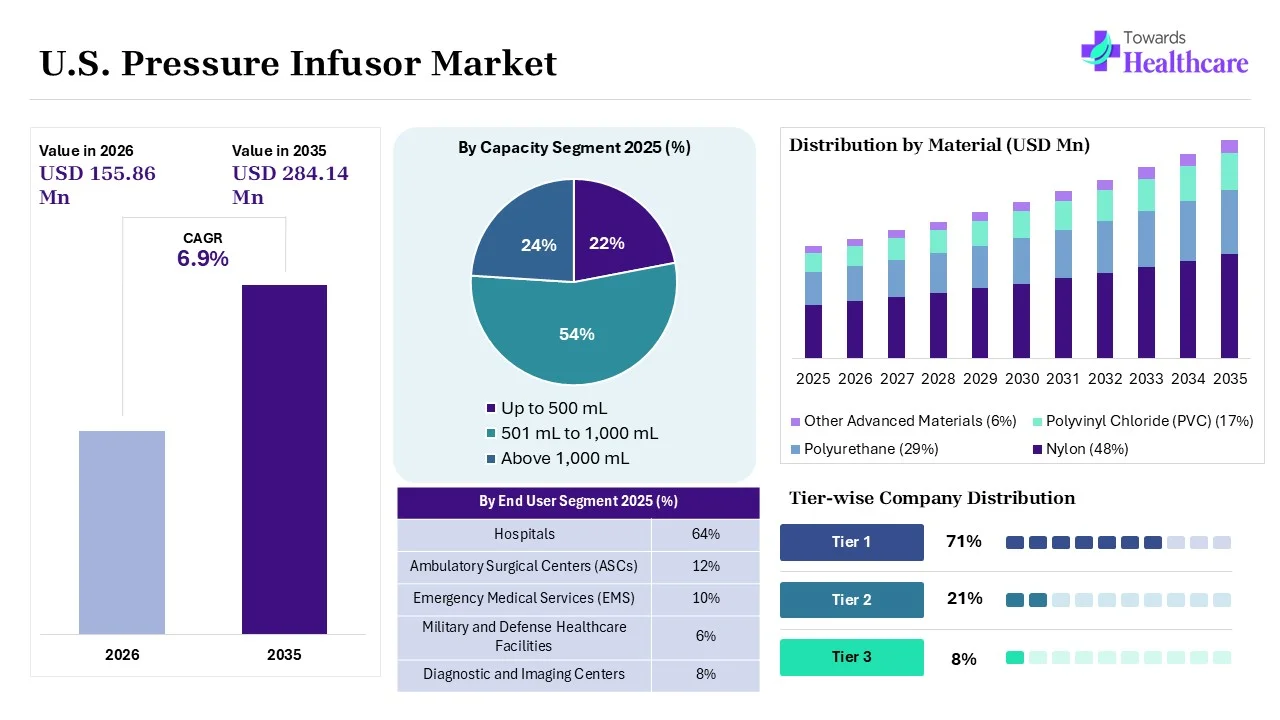
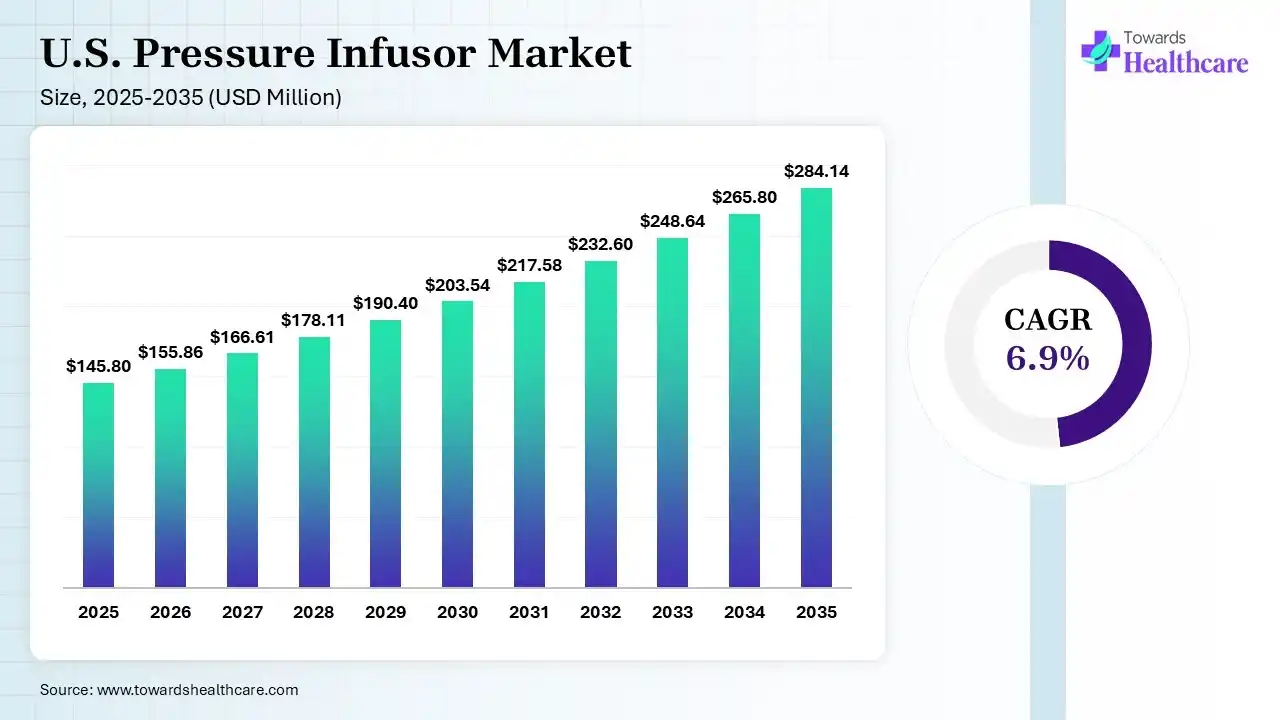
The U.S. pressure infusor market size was estimated at USD 145.8 million in 2025 and is predicted to increase from USD 155.86 million in 2026 to approximately USD 284.14 million by 2035, expanding at a CAGR of 6.9% from 2026 to 2035.
The pressure infusion bag is usually a product that is rapidly pressurized, while blood transfusion, therefore, allows blood, plasma, cardioplegia, and different fluids to enter the human body as soon as possible. This pressure infusor bag has a dual-pressure safety valve that switches between normal and over-pressure mode with a click of a button. These particularly intended cuff and bladder tools are used to pressurize sterile parenteral fluids such as blood and IV solutions to offer quick infusion into patients suffering from hypovolemia and its complications. The pressure infusion bag was originally intended to lessen the infusion time needed to deliver blood.
Pressure infusion bag is a tool which speed-up the rate of infusion and controls the volume of infused fluid through adjusting air pressure, therefore allowing rapid fluid administration for patients with hypovolemia and its related complications. These devices are life-saving in emergency care, significantly used for patients with hemorrhagic shock, serious dehydration, acute trauma, and various conditions. The significant applications are quick fluid infusion and pressure monitoring in pre-op, post-op, ICU, emergency rooms, surgery, and cardiac catheterization.
Macro Factors
Micro Factors
The market is highly consolidated and dominated by a few massive, established medical device corporations like Smiths Medical, Baxter, and Zimmer Biomet. These industry giants maintain complete control by securing exclusive, long-term supply contracts with major hospital networks and Group Purchasing Organizations. Because basic mechanical infusor technology is standard, these top brands do not compete on breakthrough features. Instead, they battle fiercely on pricing, volume discounts, and reliable supply chains. Smaller manufacturers and new companies find it nearly impossible to break in, as they cannot match the low production costs or distribution power of these dominant leaders.
AI-based technology in a pressure infusor offers many advantages, such as huge automation, targeted care, and enhanced operational effectiveness. AI-based innovations, like smart infusion pumps with real-time intensive care, prognostic analytics for maintenance, and remote management via telehealth, are renovating traditional infusion practices and setting novel standards for patient safety and accuracy. ​ AI-based smart pumps increasingly take over tasks like automated dose adjustments based on patients’ real-time physiological data, lowering human mistakes and allowing consistent drug delivery. This system helps streamline day-of operations in infusion centers by improving patient assignment, drug premixing, and other logistics. Prophetic analytics manage resource allocation more effectively, anticipating equipment requirements and potential staff limitations, which is especially relevant as demand for AI-based pressure infusors increases.
Shift to Polyurethane and Latex-Free Materials:
Pressure Infusor is a disposable, non-sterile device made from latex-free materials and DEHP-free. It removes the challenges of type IV hypersensitivity reactions or anaphylaxis in patients with severe latex sensitivities.
Smart Monitoring:
Smart infusion tools industrialized with a massive-precision liquid level monitoring module, the tools track fluid levels in real-time, lessening the requirement for constant supervision and enabling patients to rest comfortably. These novel technologies and continuing optimization create easy-to-operate devices for healthcare organizations, significantly reducing medical staff workloads
Decentralized Care:
Patient facilities in a decentralized system decrease facility expenses in a huge number of treatments and efficiently exploit resources at high demand levels, enabling an overall more comparable cost per treatment.
| Table | Scope |
| Market Size in 2026 | USD 155.86 Million |
| Projected Market Size in 2035 | USD 284.14 Million |
| CAGR (2026 - 2035) | 6.9% |
| Historical Data | 2020 - 2023 |
| Base Year | 2025 |
| Forecast Period | 2026 - 2035 |
| Measurable Values | USD Millions/Units/Volume |
| Market Segmentation | By Product Type, By Capacity, By Application, By Pressure Range, By End User, By Distribution Channel, By Material |
| Top Key Players | Merit Medical Systems, ICU Medical, SunMed, B. Braun SE, VBM Medizintechnik GmbH |
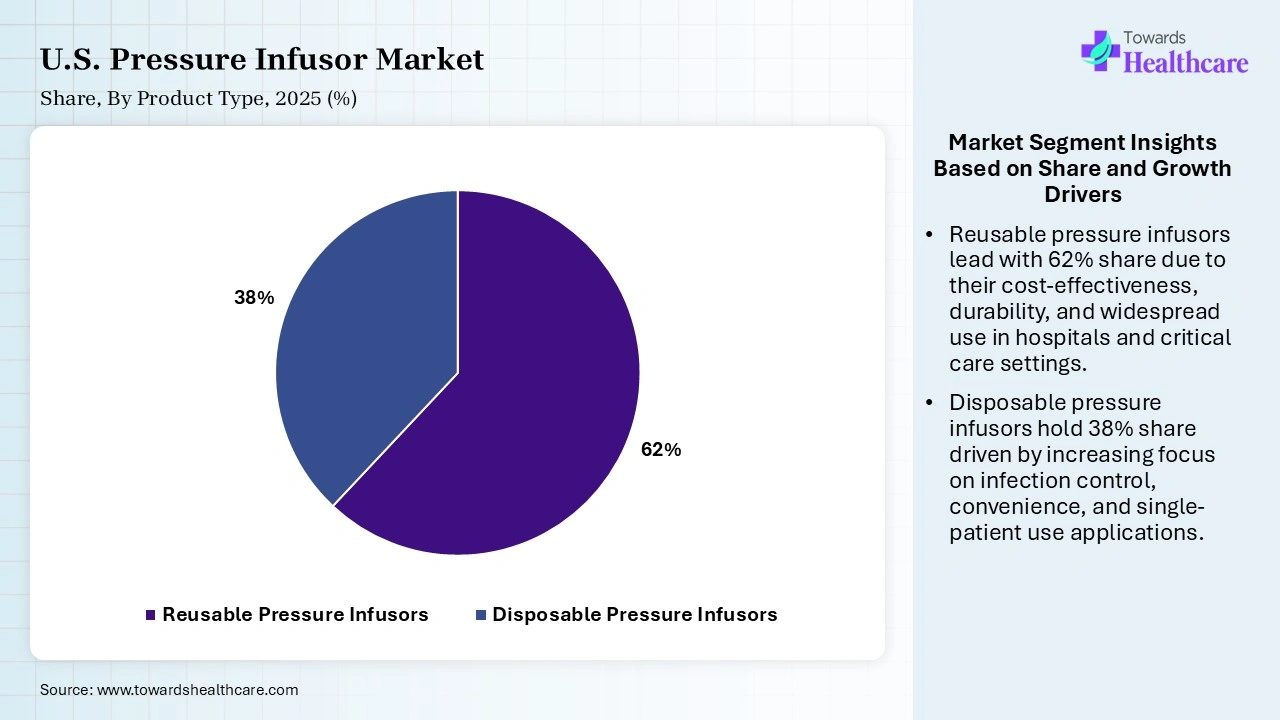
| Segment | Share 2025 (%) |
| Reusable Pressure Infusors | 62% |
| Disposable Pressure Infusors | 38% |
The Led the U.S. Pressure Infusor Market in 2025
The reusable pressure infusors segment contributed the largest market share of 62% in 2025, as reusable pressure infusor for usage in rapid infusion of liquids. Intended with reliable pressure control and durable construction to reduce the challenges of tearing. The application of a disposable pressure infusor increases patient safety during healthcare emergencies.
The disposable pressure infusors segment held a significant share of 38%, and is expected to grow at the fastest CAGR of 8.10 % during the forecast period in the market, as disposable infusion pumps involve their lightweight, minor size, ease of use, independence from an outside power supply, removal of programming mistakes, and disposability. Disposable pressure infusor amplifies patient safety throughout healthcare emergencies.
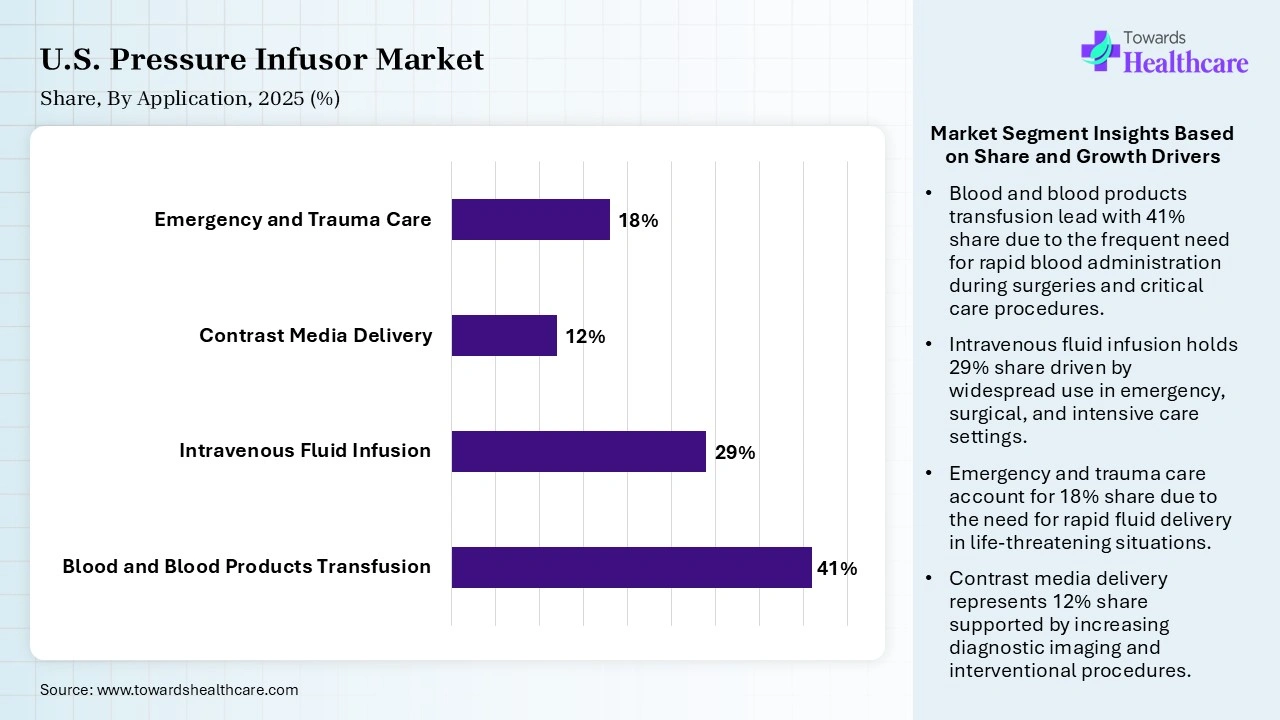
| Segment | Share 2025 (%) |
| Blood and Blood Products Transfusion | 41% |
| Intravenous Fluid Infusion | 29% |
| Contrast Media Delivery | 12% |
| Emergency and Trauma Care | 18% |
Silver Blood and Blood Products Transfusion Segment Led the U.S. Pressure Infusor Market in 2025
The blood and blood products transfusion segment contributed the largest market share of 41%. Blood transfusions save a patient's life and reduce the problems of severe blood loss. A lot of hemorrhage leads to a seriously low haemoglobin level and causes damage to body organs because of a lack of oxygen. Blood transfusion with pressure bags safely bridges to central access in the initial phases of trauma resuscitation.
The intravenous fluid infusion segment held a significant share of 29% of the U.S. pressure infusor market, as they prevent or manage dehydration and electrolyte imbalances. IV fluids make you feel better quickly. Polyelectrolytic solutions is their lack of calcium, which makes them well-matched with blood and blood components.
The emergency and trauma care segment held a significant share of 18% of the market and is expected to grow at the fastest CAGR of 8.50 % during the forecast period. The transportable sealed positive-pressure infusion tools achieved potentially higher infusion rates and a shorter time to reach resuscitation targets as compared with the conventional pressure infuser bag under identical pressure conditions.
The contrast media delivery segment held a significant share of 12% of the market, as pressure infusors offer rapid, non-electric fluid administration. These pressure-infusor bags contain no metallic parts, making them a significant choice for MRI surroundings where gas-powered injectors are restricted or require complex installations.
| Segment | Share 2025 (%) |
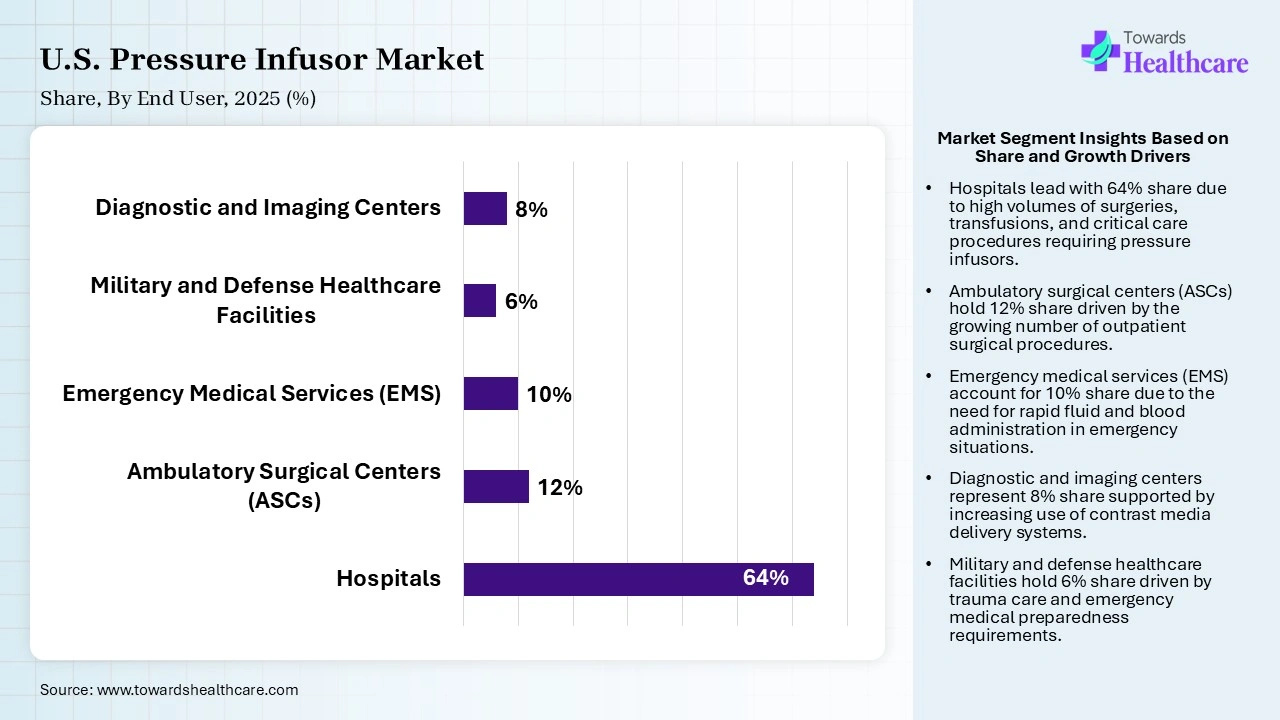
| Hospitals | 64% |
| Ambulatory Surgical Centers (ASCs) | 12% |
| Emergency Medical Services (EMS) | 10% |
| Military and Defense Healthcare Facilities | 6% |
| Diagnostic and Imaging Centers | 8% |
The Hospitals Segment led the U.S. Pressure Infusor Market in 2025
The hospitals segment held a major share of 64% in the market, as the pressure-infusor processes are more effective than the piston-pump processes, as the latter is less efficient in infusing fluids quickly and is related to excessive positive and negative pressure in the infusion circuit. Used for emergency rapid fluid infusion and blood transfusion in alternative settings, involving field operations, hospitals, and combat zones.
The ambulatory surgical centers (ASCs) segment held a significant 12% share of the market, as ambulatory infusion includes their capability to bring medications with exceptional accuracy. These tools provide programmable infusion rates that are precisely adjusted to meet particular patient requirements, ensuring optimal therapeutic results. Modern ambulatory infusors are prepared with multiple safety mechanisms to protect patients during therapy.
The emergency medical services (EMS) segment contributed a U.S. pressure infusor market share of 10%, and is expected to grow at the fastest CAGR of 8.80% during the forecast period, as the advantages of infusion therapy are the capability to transport therapeutics directly into the bloodstream, evading the digestive system. These processes confirm that the medication spreads to the target site rapidly, resulting in a faster response as compared to oral medications.
The military and defense healthcare facilities segment held a significant 6% share of the market, as pressure infusors are crucial in military and defense healthcare, as they offer quick, gravity-independent fluid and blood recovery for trauma patients. In combat zones or during transport, it is often incredible to suspend an IV bag from an outdated IV pole.
| Segment | Share 2025 (%) |
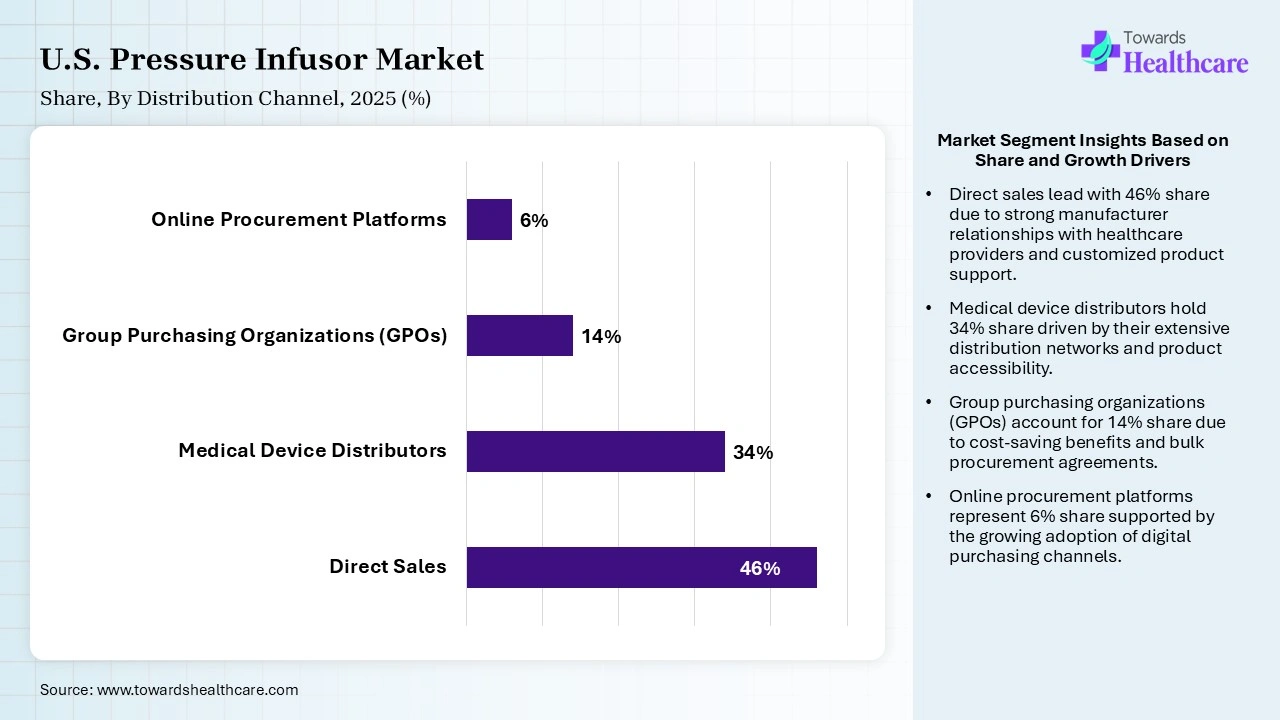
| Direct Sales | 46% |
| Medical Device Distributors | 34% |
| Group Purchasing Organizations (GPOs) | 14% |
| Online Procurement Platforms | 6% |
The Direct Sales Segment led the U.S. Pressure Infusor Market in 2025
The direct sales segment contributed the largest market share of 46%, as consumers benefit from direct selling due to their convenience and the service it offers, involving personal demonstration and description of products, home delivery, and substantial satisfaction guarantees. Direct selling provides an alternative to traditional employment for those needs a flexible opportunity to supplement household income.
The medical device distributors segment held a significant share of 34% in the market. They confirm with healthcare suppliers that all the needed healthcare products are in stock. It supports minimizing delays and confirms that patients receive timely and suitable care. A healthcare tools distributorship is a business that fills the gap between the manufacturer and the healthcare professional.
The group purchasing organizations (GPOs) segment held a significant share of 14% in the U.S. pressure infusor market, as GPOs regulate and streamline buying, radically lowering the internal resources needed to manage procurement, specifically for nonstrategic and tail-devoted categories, which drain time, starved of proportionate strategic value.
The online procurement platforms segment held a significant share of 6% in the market and is expected to grow at the fastest CAGR of 9.10% during the forecast period, as online procurement involves cost savings, increasing efficiency, lowering processing times, enhanced compliance and government adherence, and improved supplier relations. This type of procurement system often involves features for the management of supplier information, performance, and relationships.
| Segment | Share 2025 (%) |
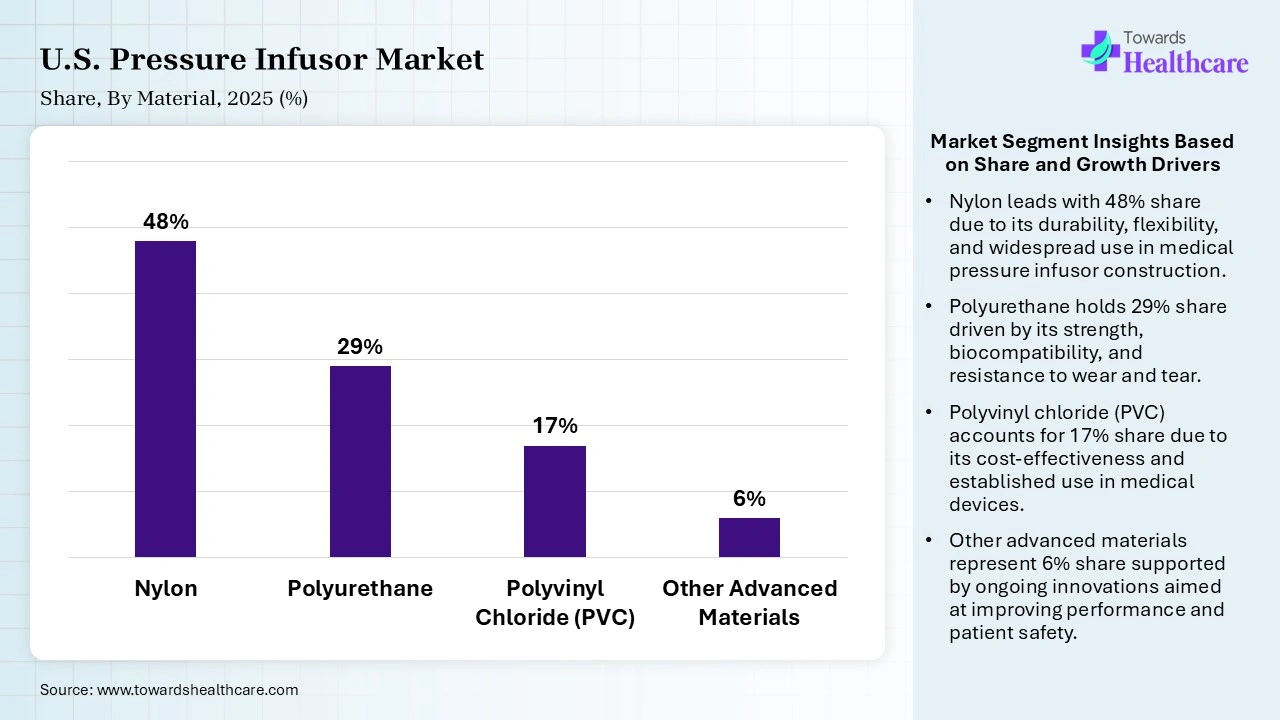
| Nylon | 48% |
| Polyurethane | 29% |
| Polyvinyl Chloride (PVC) | 17% |
| Other Advanced Materials | 6% |
The Nylon Segment led the U.S. Pressure Infusor Market in 2025
The nylon segment contributed the largest market share of 48%, as nylon pressure infusors are extremely durable, tear-resistant healthcare tools used to quickly administer IV fluids and blood. Their reinforced nylon construction offers supreme longevity and reliable pressure maintenance.
The polyurethane segment held a significant share of 29% in the market and is expected to grow at the fastest CAGR of 7.90 % during the forecast period. Polyurethane pressure infusors are widely used in serious care and trauma centers to quickly manage intravenous fluids or blood. PU is integrally latex-free and hypoallergenic, creating it entirely safe for patients and healthcare staff.
The polyvinyl chloride (PVC) segment held a significant share of 17% in the market, as PVC is resilient to weathering, biochemical rotting, erosion, abrasion, and shock. It is the ideal choice for many long-life and outdoor products.
R&D:
Manufacturing Processes:
Patient Services:
| Company | Headquarters | Latest Update |
| Merit Medical Systems | United States | In December 2025, Merit Medical System invested in capital expenditures for property and equipment of $81.7 million, $35.1 million, and $34.3 million for the years. |
| ICU Medical | United States | In September 2025, ICU Medical Inc., a worldwide medical technology company specializing in IV therapy and critical care, announced new 510(k) regulatory clearance from the U.S. Food and Drug Administration (FDA) for the Clave portfolio of needle-free connectors. |
| SunMed | United States | SunMed's pressure infuser bags ensure high visibility and user-friendliness, identification, and continued investment in R&D. |
| B. Braun SE | United States | In March 2025, the B. Braun Group expanded its business operations in a demanding environment, and sales increased by 4.4 percent to 9.1 billion. |
| VBM Medizintechnik GmbH | United States | VBM Medizintechnik GmbH introduced a line of environmentally friendly disposable pressure infusion cuffs constructed from recyclable materials |
In November 2025, “At TriSalus, our goal is to empower physicians with tools that deliver therapy more effectively and consistently,” said Mary Szela, CEO and President of TriSalus Life Sciences. “The TriNav XP Infusion System extends the reach of our Pressure-Enabled Drug Delivery™ approach with our SmartValve Technology, giving clinicians greater flexibility to treat patients in a range of embolization procedures."
By Product Type
By Capacity
By Application
By Pressure Range
By End User
By Distribution Channel
By Material










Principal Consultant
Shivani Zoting is a dedicated research analyst specializing in the healthcare industry. With a strong academic foundation, a B.Sc. in Biotechnology and an MBA in Pharmabiotechnology, she brings a unique blend of scientific understanding and strategy.
Learn more about Shivani Zoting
Reviewed By
Aditi Shivarkar is a seasoned professional with over 14 years of experience in healthcare market research. As a content reviewer, Aditi ensures the quality and accuracy of all market insights and data presented by the research team.
Learn more about Aditi Shivarkar










